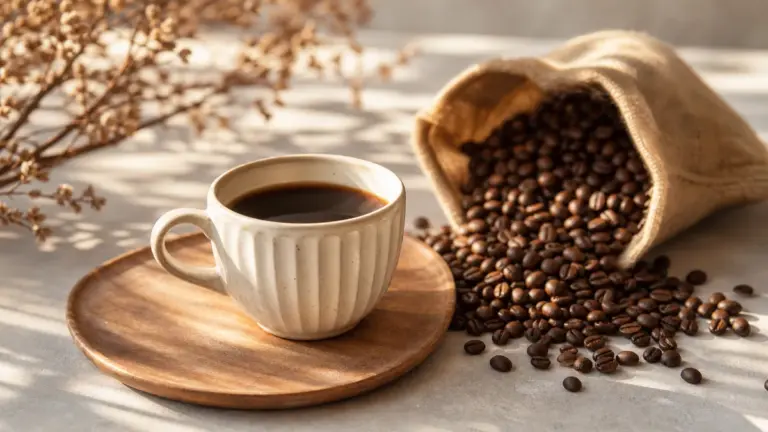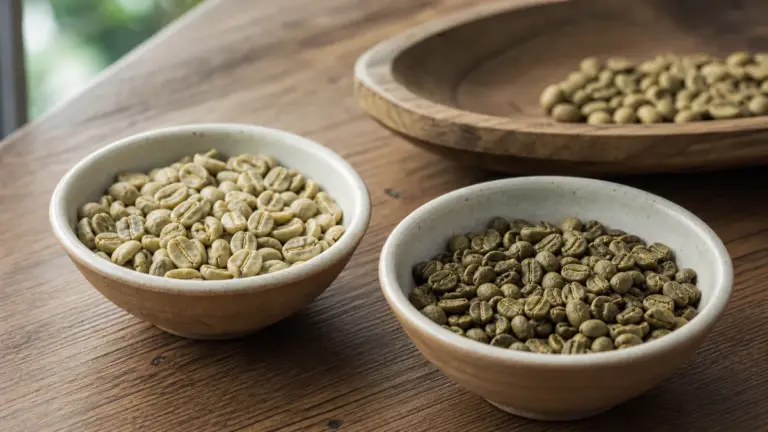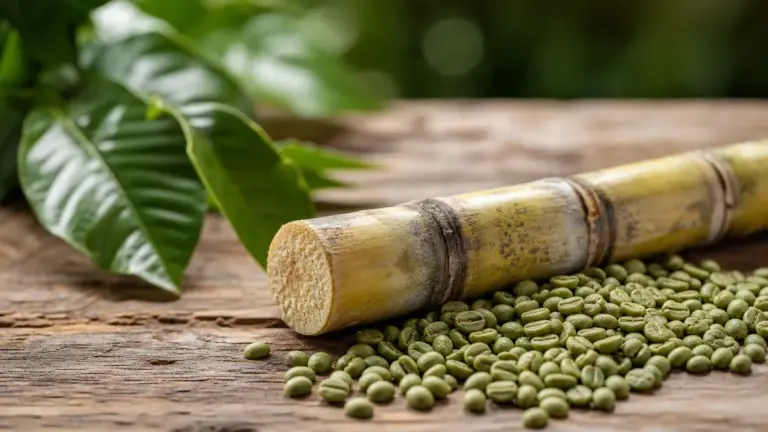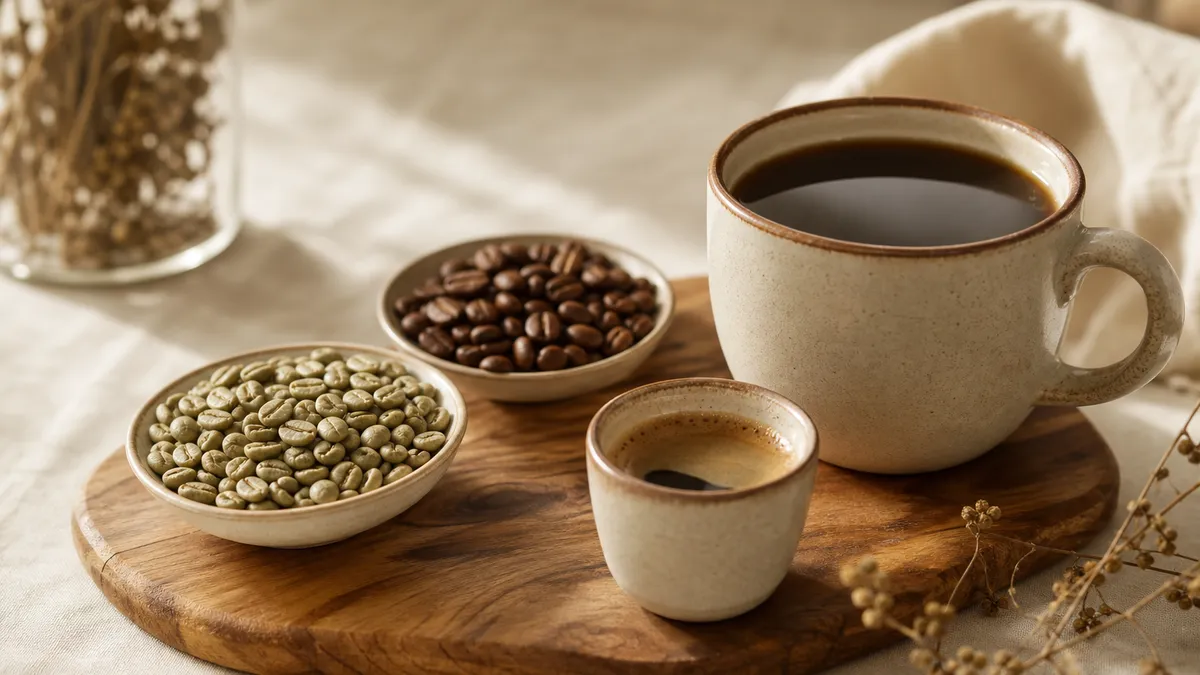
Half-caf coffee usually combines equal amounts of regular and decaffeinated coffee, while naturally low-caffeine coffees get their lower caffeine content from the plant itself. Neither means caffeine-free: the useful distinction is how much caffeine remains in the particular coffee and the serving you actually drink.
In short
- A 50:50 blend describes the ingredients, not a guaranteed caffeine amount per cup.
- Laurina, also called Bourbon Pointu, is a naturally low-caffeine arabica variety, not a decaffeination process.
- Some Aramosa selections are low in caffeine, but the hybrid name alone does not guarantee this.
- Robusta generally contains more caffeine than arabica, so the regular component of a half-caf blend matters.
- Black and green tea still contain caffeine. Pure rooibos and honeybush offer caffeine-free alternatives.
What half-caf actually means
Half-caf is a blending approach rather than a coffee variety. A common formulation is equal proportions of regular coffee and decaf, as illustrated by producers explicitly describing their products as 50:50 blends.
The intention is to keep a familiar coffee drink while reducing its caffeine. However, “half” needs a comparison: half the caffeine of which coffee, brewed with what dose, and served in what quantity?
Decaf retains some caffeine. Consequently, replacing half a regular coffee dose with decaf does not produce precisely half the original caffeine, even if everything else stays constant.
For a simple mathematical illustration, assume that the regular component contributes R milligrams per gram and the decaf contributes D, measured on the same basis. An equal-weight blend contains:
Caffeine per gram of blend = (R + D) ÷ 2
This is a blend calculation, not a prediction of what brewing extracts. Without measured ingredient values, it cannot give a reliable milligram figure for your drink.
For the wider distinctions between reduced caffeine, decaf and caffeine-free drinks, start with our caffeine and decaf guide.
Half-caf is not the same as diluted coffee
Adding water to brewed coffee lowers its caffeine concentration, but does not remove caffeine from the drink. If you finish the whole diluted serving, you still consume the caffeine originally present.
Replacing part of the caffeinated grounds with decaf changes the ingredients instead. That is why a half-caf blend can preserve your usual brewing dose without relying on a smaller portion of regular coffee.
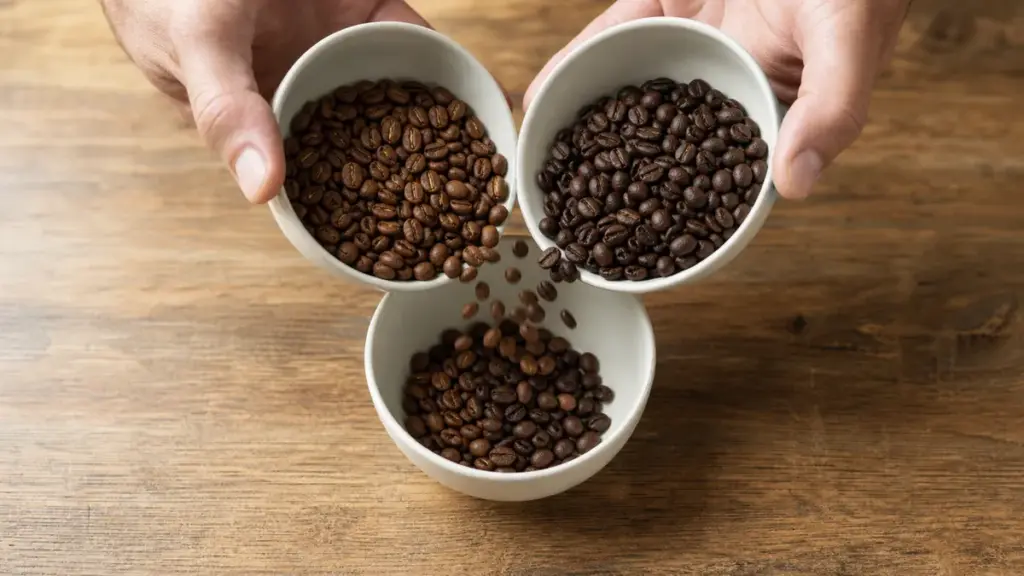
Naturally low-caffeine varieties: Laurina and Aramosa
Naturally low-caffeine coffee has less caffeine before any decaffeination treatment. This is a property of the plant material, although a variety name is not a laboratory result for every harvest.
It also helps to separate botanical categories. A species is a distinct botanical group; a variety or cultivar is a named form within a species; an interspecific hybrid combines parentage from different species.
Laurina, also called Bourbon Pointu
Laurina is a variety of Coffea arabica, also encountered as Coffea arabica var. laurina or C. arabica cv. Laurina. Bourbon Pointu is another established name for it.
Brazil’s Instituto Agronômico, or IAC, describes its seed caffeine content as around 0.6%, approximately half that of other commercial arabica cultivars. That makes Laurina a genuine lower-caffeine option, but not a naturally caffeine-free coffee.
Individual results vary. A peer-reviewed laboratory study published in 1998 found 0.36 to 1.08% caffeine across the Laurina material examined, including tissue-culture-derived plants. Those experimental results demonstrate variation; they are not a specification for every retail bag.
The practical buying question is therefore not simply “Is this Laurina?” Ask whether the particular lot has been tested, and what the reported percentage measures.
Aramosa needs a more careful explanation
Aramosa refers to hybrids involving Coffea arabica and Coffea racemosa. It should not be treated as one uniform variety with one fixed caffeine content.
Producer Daterra explicitly distinguishes its low-caffeine Aramosa selections from other lineages within this hybrid category. Its research notes warn that Aramosa coffees can have different genetics and are not necessarily low in caffeine.
This is why a universal caffeine range covering both Laurina and Aramosa would be misleading. Some descriptions group them together, but the stronger practical rule is to request evidence for the actual selection and lot.
For an interested coffee drinker, either can be worth exploring. For someone who needs a tightly controlled caffeine intake, the name on the bag is not enough.
How arabica and robusta compare
Arabica is Coffea arabica; robusta is coffee traded from Coffea canephora. Robusta generally contains about twice as much caffeine as arabica, although individual coffees vary.
Switching from a robusta-containing blend to arabica may therefore reduce caffeine when the dose and preparation remain comparable. Ordinary arabica is not, however, equivalent to a specifically low-caffeine variety.
The same distinction matters in half-caf. A blend containing regular robusta and decaf cannot automatically be assigned the same caffeine content as one containing regular arabica and decaf.
The table compares the evidence behind the options, rather than pretending that every bean percentage can be converted into a standard cup.
| Coffee option | What it is | What the caffeine evidence tells you | Who it suits |
|---|---|---|---|
| Half-caf | Usually regular coffee blended with decaf | Reduction depends on both ingredients and the blend proportions | Someone wanting to adjust a familiar coffee |
| Laurina or Bourbon Pointu | An arabica variety | IAC gives around 0.6%; research shows variation | Someone interested in naturally lower-caffeine arabica |
| Selected Aramosa | Arabica and racemosa hybrid material | Some selections are low-caffeine; others are not | Someone willing to check selection-specific evidence |
| Coffea eugenioides | A separate coffee species | A botanical study reported 0.44 to 0.60% of dry matter | A specialist-coffee enthusiast |
| Regular robusta | Coffea canephora | Generally higher in caffeine than arabica | Not the obvious starting point for reducing caffeine |
Percentages here describe beans, not brewed drinks. The figures come from different sources and plant material, so they are not a controlled head-to-head comparison.
Rare species: interesting, but not straightforward substitutes
Coffea eugenioides
Coffea eugenioides is a separate species, not an arabica variety. A 2005 study reported caffeine concentrations of 0.44 to 0.60% of dry matter in the material examined.
It is more than a botanical curiosity: specialist producer Inmaculada documents growing it and supplying coffee used in competitions. Nevertheless, treat it as a specialist lot to investigate, rather than assuming it will be a dependable everyday replacement.
Its species name also does not establish the caffeine content of a particular brewed serving.
Coffea charrieriana
Coffea charrieriana was formally described from Cameroon in 2008 as a caffeine-free species. That date refers to its scientific description, not its first collection: the original paper records material collected in 1983.
It belongs in the botanical story, not on a routine shopping shortlist. The description establishes an unusual species; it does not establish a widely available retail drink with verified serving-level caffeine information.
Neither species should be confused with conventional decaf, which has undergone a process to remove caffeine.
How to choose and blend lower-caffeine coffee
Use this short method to make comparisons meaningful. It is an approach to controlling ingredients, not a validated caffeine-dosing protocol.
- Choose your priority. For an adjustable blend, consider half-caf. For interest in the plant itself, investigate tested Laurina or a verified low-caffeine Aramosa selection. If you need to avoid caffeine, do not assume either is suitable.
- Check what the claim means. Ask whether “half-caf” describes equal ingredient weights or a measured reduction against a named reference coffee.
- Request useful test information. Look for the lot identity, test date, whether beans were green or roasted, and whether the result is expressed on a dry-matter basis.
- Weigh a trial blend. As an author-proposed starting point, combine 10 g regular coffee with 10 g decaf. This establishes equal ingredient weights, not a known caffeine dose.
- Keep your usual preparation consistent. When comparing blends, avoid changing the total coffee dose and serving size at the same time. Record the proportions so you can repeat the mixture you prefer.
“Dry matter” means the result excludes moisture from the calculation. A percentage measured in green beans cannot simply be applied to the weight of roasted grounds to calculate a drink.
Brewing introduces another variable: not all caffeine present in the grounds necessarily reaches the cup. Serving size and preparation also matter, so favour a measured drink result with a stated recipe when precision is necessary.
There is no need to choose the decaf component by process name alone. Our guides to water-process decaf and CO2 and sugarcane decaf explain those choices separately.
Tea alternatives and sensible caffeine limits
Black and green tea are not caffeine-free substitutes. The NHS currently gives 75 mg in a cup of tea, including black or green tea, as an approximate pregnancy-guidance figure, not a guarantee for every brew.
Pure rooibos and honeybush are useful alternatives when you want a hot drink without caffeine. A 2019 laboratory study using sensitive analytical methods detected no caffeine in the samples tested. Check blends for added caffeinated ingredients rather than relying on the word “herbal”.
During pregnancy, caffeine-free does not automatically mean unrestricted: NHS guidance also advises limiting herbal teas and avoiding teas containing liquorice root. Speak to a midwife or pharmacist if unsure about a particular blend.
For healthy non-pregnant adults, EFSA’s 2015 scientific risk assessment found no safety concerns with habitual caffeine intakes up to 400 mg a day, spread across the day, or single doses up to 200 mg. It also found that 100 mg close to bedtime can affect sleep in some adults.
These are population benchmarks, not targets or personal guarantees. The NHS advises no more than 200 mg daily during pregnancy, counting all sources. Discuss personal restrictions, medicines or troublesome symptoms with a GP, pharmacist or midwife.
For half-caf and low-caffeine varieties, the most useful rule is simple: choose by verified caffeine information and the serving you drink, not by a reassuring name alone.
FAQ
Can I make half-caf with instant coffee?
Yes, you can combine regular and decaffeinated instant coffee by weight. Equal weights establish a 50:50 ingredient blend, but not a guaranteed caffeine amount: the two products can have different caffeine concentrations, and decaf retains some caffeine. Keep your total instant-coffee dose consistent when comparing mixtures, and use product-specific information if you need to estimate intake.
Does naturally low-caffeine coffee taste weaker?
Lower caffeine does not automatically mean weaker flavour. Caffeine content and brewing strength are different measurements: strength concerns how concentrated the brewed drink is. Laurina or another lower-caffeine coffee can still be brewed at your preferred coffee-to-water ratio. Choose a coffee for its stated flavour profile, rather than assuming that less caffeine means a thin drink.
Is dark-roasted coffee a reliable low-caffeine choice?
No, roast colour is not a reliable substitute for choosing a verified lower-caffeine coffee. In a controlled roasting experiment, researchers found caffeine remained stable while other coffee compounds changed. That does not make every roast identical, but it does undermine the idea that dark roasting reliably removes enough caffeine to create a low-caffeine product.
Where to go next
Read Caffeine and Decaf to place half-caf and naturally low-caffeine varieties within the wider set of options. For help choosing the decaf portion of a blend, Swiss Water and Mountain Water Process and CO2 and Sugarcane Decaf explain the main process distinctions.
Sources
- Half Caff Coffee Roasters, Half Caff Colombia product description, undated, accessed November 2026. Used only as a producer example of a stated 50:50 formulation. URL: https://halfcaff.com/.
- US Food and Drug Administration, Spilling the Beans: How Much Caffeine is Too Much?, 2024. Used for residual caffeine in decaf. URL: https://www.fda.gov/consumers/consumer-updates/spilling-beans-how-much-caffeine-too-much.
- Instituto Agronômico, Cafés Especiais IAC, Curiosidades sobre a variedade Laurina: uma abordagem técnico-científica, 2018. URL: https://cafesespeciaisiac.wordpress.com/2018/11/21/curiosidades-sobre-a-variedade-laurina-uma-abordagem-tecnico-cientifica/.
- University of Zurich researchers, Baumann and colleagues, Non-destructive analysis of natural variability in bean caffeine content of Laurina coffee, Phytochemistry, 1998. Abstract retrieved through PubMed. URL: https://pubmed.ncbi.nlm.nih.gov/11711066/.
- Daterra, Meet the Researchers, producer research notes, undated edition hosted by DRWakefield in 2024, sections “Aramosa” and “Guarani”. URL: https://drwakefield.com/wp-content/uploads/2024/10/Meet_the_researchers.pdf.
- Institut de recherche pour le développement, Campa and colleagues, Qualitative relationship between caffeine and chlorogenic acid contents among wild Coffea species, Food Chemistry, 2005, Table 2. Retrieved paper copy. URL: https://library.sweetmarias.com/wp-content/uploads/2020/08/caffeine-and-chlorogenic-acid-contents-among-wild-Coffea.pdf.
- Stoffelen, Noirot, Couturon and Anthony, A new caffeine-free coffee from Cameroon, Botanical Journal of the Linnean Society, 2008. Original paper text retrieved through Paperity. URL: https://paperity.org/p/86858825/a-new-caffeine-free-coffee-from-cameroon.
- Inmaculada Coffee Farms, About Us, undated, accessed November 2026. Used for the producer’s cultivation and competition-use account. URL: https://www.inmaculadacoffeefarms.com/about-us.
- Ludwig and colleagues, Royal Society of Chemistry, Variations in caffeine and chlorogenic acid contents of coffees: what are we drinking?, Food & Function, 2014. URL: https://pubs.rsc.org/en/content/articlepdf/2014/fo/c4fo00290c.
- Stander, Joubert and De Beer, Revisiting the caffeine-free status of rooibos and honeybush herbal teas using specific MRM and high resolution LC-MS methods, Journal of Food Composition and Analysis, 2019. Publisher abstract retrieved. URL: https://www.sciencedirect.com/science/article/pii/S0889157518308500.
- NHS, Foods to avoid in pregnancy, reviewed 15 June 2026. URL: https://www.nhs.uk/pregnancy/keeping-well/foods-to-avoid/.
- European Food Safety Authority, Caffeine, current topic page summarising the Scientific Opinion on the safety of caffeine, 2015. URL: https://www.efsa.europa.eu/en/topics/topic/caffeine.
This article was researched using original botanical and analytical studies, agricultural research guidance, current NHS and EFSA guidance, and clearly identified producer documentation; no first-hand testing was undertaken.
Last checked: November 2026