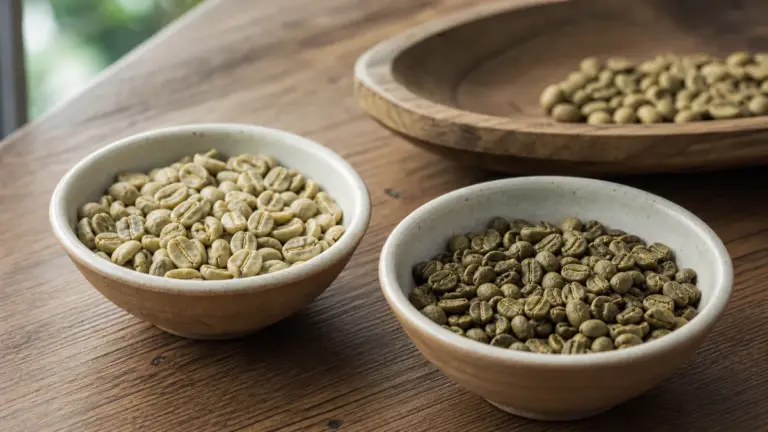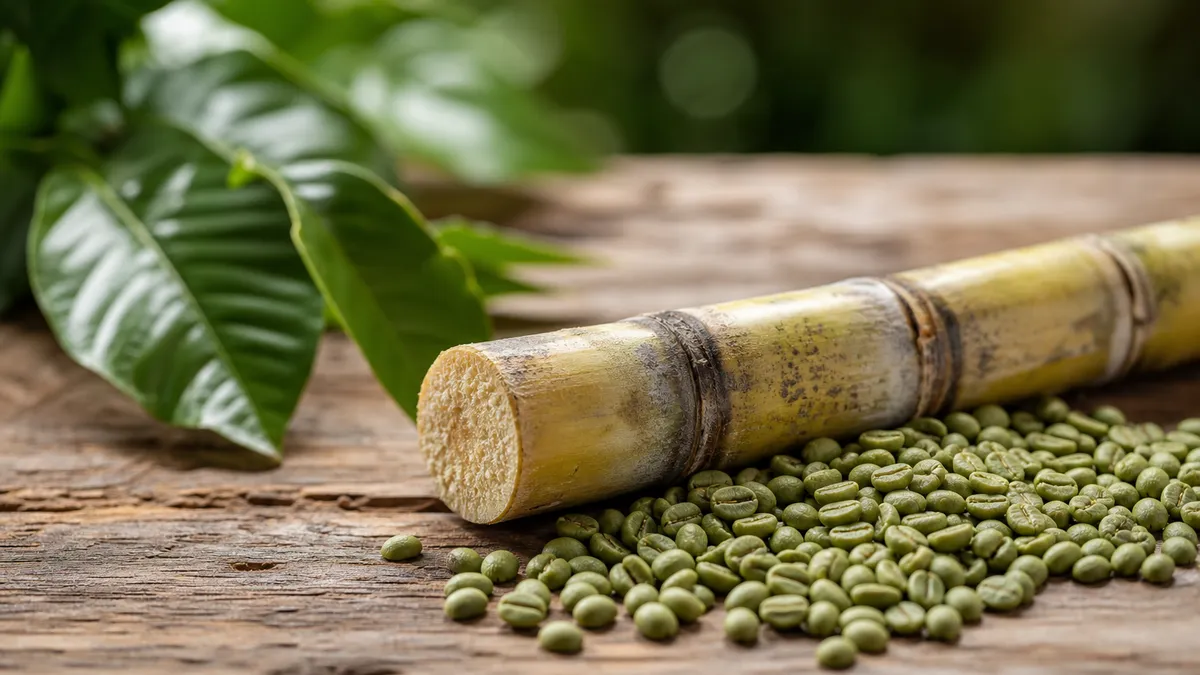
CO2 and sugarcane decaf are methods of removing caffeine from unroasted coffee beans: one uses pressurised carbon dioxide, while the other uses ethyl acetate, a solvent that can be made from sugarcane-derived alcohol. Both aim to remove caffeine while preserving the coffee’s character, but neither the process name nor the word “natural” guarantees a particular flavour or a completely caffeine-free drink.
In short
- Supercritical CO2 extraction requires temperatures above approximately 31°C and pressures above approximately 74 bar. These are physical thresholds, not a complete processing recipe.
- Not all CO2 decaf is supercritical: CR3 in Bremen, Germany, uses a subcritical liquid-CO2 process.
- Sugarcane decaf uses ethyl acetate, often shortened to EA. Naturally sourced EA is still an organic solvent.
- “Sugarcane” describes the solvent’s source, not an instruction to sweeten the beans.
- Look for the named process, traceable coffee origin and, where caffeine restriction matters, product-specific caffeine information.
What distinguishes CO2 and sugarcane decaf?
The main difference is the substance that carries caffeine out of the bean. A solvent is simply something that dissolves another substance. Carbon dioxide performs that role under carefully controlled pressure and temperature; ethyl acetate does it as a liquid during EA processing.
Both methods normally treat green coffee before roasting. Water or steam first moistens the beans, helping caffeine move out of their structure. Afterwards, the processor separates the caffeine-bearing solvent and dries the coffee ready for roasting.
This article concentrates on those two routes. For the wider family of methods, including water processing, see how decaffeination works.
| Criterion | CO2 decaf | Sugarcane EA decaf |
|---|---|---|
| Caffeine-extracting substance | Pressurised carbon dioxide | Ethyl acetate |
| Defining distinction | Can use supercritical CO2 or subcritical liquid CO2 | “Sugarcane” identifies the claimed feedstock for the EA |
| Useful supplier question | Which CO2 process and processor were used? | Is the EA sugarcane-derived, and where was processing done? |
| Who it suits | Readers who specifically want CO2 processing | Readers comfortable with EA processing who want documented sugarcane sourcing |
| What the name cannot establish | Final flavour or caffeine per serving | Final flavour or caffeine per serving |
Choose between them on verified processing information and the coffee you enjoy, rather than treating either name as a quality grade.
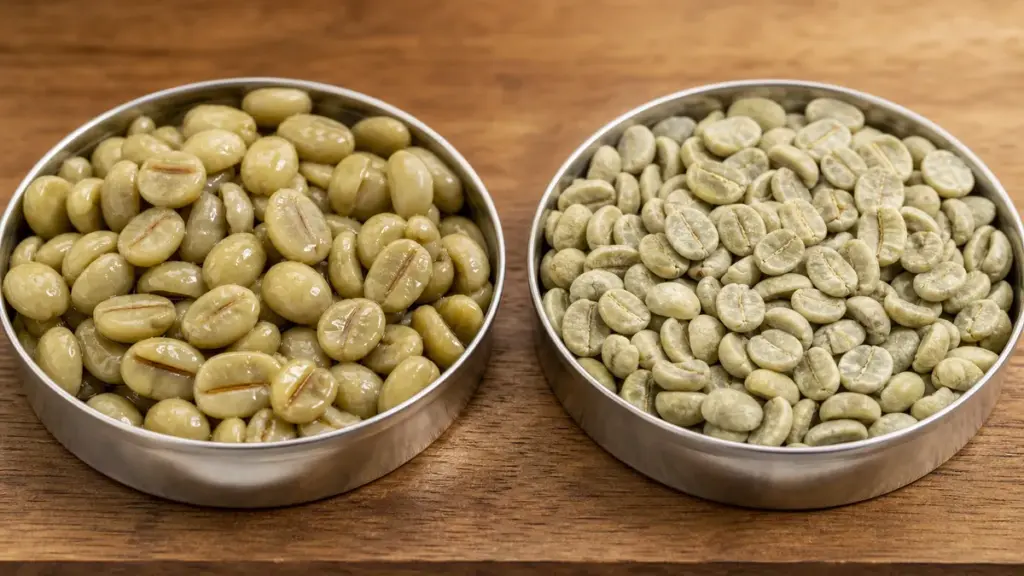
How supercritical CO2 decaffeination works
Carbon dioxide becomes a supercritical fluid when both its temperature and pressure exceed its critical point. For CO2, the rounded thresholds are approximately 31°C and 74 bar. Above this point, it is no longer divided into separate liquid and gas phases.
Those figures explain the word “supercritical”, but they are not sufficient instructions for decaffeinating coffee. Extraction also depends on bean moisture, temperature, pressure, circulation and time.
The process, step by step
- Moisten the green beans. Water helps caffeine become mobile within the bean. Experimental research has shown that pre-soaking improves its extraction rate.
- Circulate pressurised CO2. In the extraction vessel, caffeine passes from the moistened beans into the circulating fluid.
- Separate the caffeine. Depending on the system, separation can involve water washing, pressure changes or activated carbon, a porous material that holds substances on its surface.
- Recover the CO2 and dry the beans. The extraction medium can circulate through the system again, while the treated coffee is prepared for subsequent roasting.
CO2 is a non-polar solvent, meaning its electrical charge is distributed without a permanent positive and negative end. However, “non-polar” alone does not explain caffeine removal. Water within the bean, caffeine’s distribution between water and CO2, and movement through the bean all matter.
A laboratory extraction study by Peker and colleagues found that soaking beans and using water-saturated CO2 increased extraction rates. That is experimental evidence about the mechanism, not proof that every commercial CO2 coffee tastes unchanged.
An important distinction: CR3 uses liquid CO2
CR3 in Bremen is sometimes presented as an example of supercritical decaffeination. Its own description of Carbonic Natural identifies a different process: subcritical liquid CO2, operating at around 20°C and 70 bar.
Both belong to the CO2 family, but their operating conditions differ. If a bag simply says “CO2 decaf”, do not automatically describe it as supercritical. Ask the roaster for the processor or process name if that distinction matters to you.
How sugarcane ethyl acetate decaffeination works
Sugarcane decaf is an ethyl acetate process. Ethyl acetate, also called ethyl ethanoate, belongs to the ester family of organic compounds. Here, “organic” is a chemistry term, not a claim of certified organic farming.
EA can be produced by reacting ethanol with acetic acid. In the sugarcane route, fermentation of sugarcane-derived material supplies the alcohol; molasses, a by-product of sugar production, can provide the starting material.
That is why “naturally decaffeinated with sugarcane” appears on packaging. It describes a sourcing route for the extraction solvent. It does not mean that sugarcane juice, rather than a solvent, removes the caffeine.
The Colombian connection
Descafecol’s decaffeination plant is in Manizales, Caldas, Colombia. The company describes its process as using water and naturally sourced ethyl acetate obtained through a sugarcane-based process.
In a typical EA sequence:
- The beans are moistened. Water or steam prepares them for extraction.
- EA circulates through the coffee. Caffeine dissolves into the extraction liquid and is carried away.
- The extraction liquid is separated. Processing continues until the required caffeine specification is reached.
- The beans are steamed and dried. Steaming removes residual EA before the coffee is prepared for roasting.
The crucial distinction is naturally sourced solvent, not solvent-free. EA remains the same named chemical compound regardless of the marketing language around its feedstock.
Nor does “EA decaf” by itself prove sugarcane sourcing. If a seller makes that more specific claim, ask for the processor’s documentation rather than assuming all ethyl acetate has the same origin.
Are these methods safe?
The useful safety question is whether the processor uses a permitted substance under appropriate manufacturing controls, not whether its name sounds familiar.
For example, England’s extraction-solvent rules list both ethyl acetate and carbon dioxide for use in compliance with good manufacturing practice. The relevant provisions define this as leaving only technically unavoidable residues or derivatives in quantities presenting no danger to human health. Other UK nations have their own applicable legislation.
This is a regulatory basis for controlled food processing, not a promise that every sample contains absolutely no residue. Equally, the presence of a solvent during manufacture does not mean the finished coffee is unsafe.
Do not confuse ethyl acetate with other solvents
Ethyl acetate, methyl acetate and dichloromethane are different substances. A numerical residue limit for one must not be transferred to another.
In particular, England’s table places EA under good manufacturing practice rather than assigning it the coffee-specific numerical limit used for methyl acetate. Claims about a universal “UK solvent limit” can therefore be misleading unless they identify the substance and applicable jurisdiction.
For coffee drinkers, residual caffeine is a separate consideration. Decaffeinated coffee still contains some caffeine, and neither CO2 nor sugarcane wording supplies a reliable amount per serving.
The NHS advises no more than 200 mg of caffeine a day from all sources during pregnancy. If you need strict restriction because of sensitivity, a condition or medication, ask the supplier for relevant caffeine information and speak to a GP, pharmacist or midwife. A process name is not personal medical guidance.
Which method preserves flavour better?
There is no sound basis here for declaring that every CO2 coffee tastes better than every sugarcane EA coffee, or the reverse. Claims of flavour preservation need to be distinguished from evidence comparing finished coffees.
CR3 and Descafecol both describe their methods as preserving coffee character. Those are processors’ claims, not independent proof of an overall winner.
Selectivity does not mean nothing else changes
A selective extraction preferentially removes the intended substance. It does not necessarily leave every other component untouched.
This matters because the treatment includes moistening, extraction and drying, not just the choice of solvent. An experimental study published in 2026 examined supercritical CO2 processing alongside subsequent drying and found that processing conditions affected both extraction and sugar retention.
Its sensory results also showed why chemical measurements need careful interpretation: changes in sugar content did not translate into a simple prediction of poorer sensory scores. That study investigated one set of processing conditions, not a universal ranking of commercial methods.
Compare the coffee, not just the process
For a useful tasting comparison, ask for coffees with clear origin and roast information. Brew them using the same method and assess specific qualities: sweetness, acidity, aroma, body and aftertaste.
Treat “sweet” or “caramel” as tasting descriptions, not evidence that sugarcane processing has added sugar. The process described above uses sugarcane-derived EA to extract caffeine, not to sweeten the drink.
If you want to compare these methods with a water-based alternative, water-process decaf is the useful next distinction.
How to read CO2 and sugarcane decaf labels
Start with the precise words rather than the most reassuring adjective.
“CO2 decaf” identifies the extraction medium, but may leave the supercritical or subcritical distinction unstated. “EA decaf” identifies ethyl acetate. “Sugarcane EA” adds a feedstock claim that should be supported by the supply chain.
“Natural” is not equivalent to “chemical-free”, “solvent-free” or “certified organic”. For EA, it can explain the solvent’s source, but does not change its function.
Food information must be accurate and not misleading. The applicable food-information framework differs between Great Britain and Northern Ireland, so sellers should substantiate their wording under the rules applying where they sell.
For your own purchase, ask:
- Which company decaffeinated this lot?
- What exact process was used?
- If sugarcane sourcing is claimed, what documentation supports it?
- Is there caffeine testing relevant to this product, and does it describe beans or the prepared drink?
Keep the last distinction clear. A percentage measured in dry coffee is not automatically the caffeine concentration in your cup. For the broader caffeine-reduction choices, visit caffeine and decaf.
FAQ
Does sugarcane decaf contain added sugar?
Sugarcane decaffeination is not a sugar-sweetening process. The name refers to the material used to produce the ethyl acetate that extracts caffeine. A plain coffee sold this way should not be confused with a flavoured or sweetened product. Check the product description separately if the seller also mentions added flavours or other ingredients.
Is CO2 decaf environmentally better?
The process name alone does not establish a lower environmental impact. A meaningful comparison would need defined boundaries and evidence covering the relevant processing, energy, water, transport and recovery systems. CO2 circulation is a useful process detail, but it is not enough on its own to rank one finished coffee against another.
Can I decaffeinate coffee at home using either method?
These are industrial processing methods, not suitable home techniques. CO2 extraction requires controlled pressure equipment, while EA processing requires appropriate solvent handling, recovery and finished-product controls. Buy coffee already decaffeinated by a traceable processor rather than attempting either method. Home brewing adjustments are not a substitute for a verified decaffeination process.
Where to go next
Read How Coffee Is Decaffeinated for the wider process comparison, then Swiss Water and Mountain Water Process for the water-based alternatives. Half-Caf and Low-Caffeine Varieties explains other caffeine-reduction approaches, while Caffeine and Decaf brings the subject together. When choosing CO2 and sugarcane decaf, use those distinctions to ask more precise questions of the roaster.
Sources
-
NIST, An Equation of State for the Thermodynamic Properties of Carbon Dioxide, NIST IR 8608, February 2026. Critical-point data.
https://nvlpubs.nist.gov/nistpubs/ir/2026/NIST.IR.8608.pdf -
Peker, H. and colleagues, AIChE Journal, Caffeine extraction rates from coffee beans with supercritical carbon dioxide, 1992, volume 38, pages 761 to 770. Experimental extraction study; abstract retrieved.
https://aiche.onlinelibrary.wiley.com/doi/abs/10.1002/aic.690380513 -
NIST, A review of supercritical fluid extraction, 1986. Technical explanation of caffeine separation routes.
https://www.govinfo.gov/content/pkg/GOVPUB-C13-a32a9a92c5b3bbad766268b2b1e322c9/pdf/GOVPUB-C13-a32a9a92c5b3bbad766268b2b1e322c9.pdf -
CR3, Carbonic Natural, undated, retrieved November 2026. Processor’s description of subcritical liquid-CO2 decaffeination.
https://carbonic-natural.com/en/ -
Descafecol, Servicio de descafeinación, undated, retrieved November 2026. Processor location and sugarcane-derived EA description.
https://descafecol.com/productos/servicio-de-descafeinacion/ -
American Chemical Society, Ethyl acetate, 2019. Chemistry and solvent use.
https://www.acs.org/molecule-of-the-week/archive/e/ethyl-acetate.html -
Ally Coffee, Cauca: Sugar Cane Process: Decaf, undated, retrieved November 2026. Supplier’s explanation of sugarcane fermentation and esterification.
https://www.allycoffee.com/coffees/cauca-sugar-cane-process-decaf/ -
Sucafina, Sugarcane EA Decaf, undated, retrieved November 2026. Molasses feedstock, extraction and steaming.
https://sucafina.com/apac/offerings/sugarcane-ea-decaf -
UK legislation, The Food and Feed (Miscellaneous Amendments) Regulations 2022, Schedule 2, inserting Schedule 6 into England’s 2013 extraction-solvent regulations.
https://www.legislation.gov.uk/uksi/2022/1351/pdfs/uksi_20221351_en.pdf -
NHS, Foods to avoid in pregnancy, current page retrieved November 2026.
https://www.nhs.uk/pregnancy/keeping-well/foods-to-avoid/ -
US Food and Drug Administration, Spilling the Beans: How Much Caffeine is Too Much?, current page retrieved November 2026. Residual caffeine and individual sensitivity.
https://www.fda.gov/consumers/consumer-updates/spilling-beans-how-much-caffeine-too-much -
Hiraga, Y. and colleagues, The Society of Chemical Engineers, Japan, Development of Process for Suppressing Elution of Sugars in Supercritical CO2 Extraction for Decaffeination from Green Coffee Beans, 2026. Experimental study; abstract retrieved.
https://www.jstage.jst.go.jp/article/kakoronbunshu/52/1/52_25wh015/_article/-char/en -
Food Standards Agency, Packaging and labelling, updated September 2026. Accuracy requirements and GB/NI distinction.
https://www.gov.uk/government/publications/packaging-and-labelling/packaging-and-labelling
Research combined retrieved processor descriptions, chemistry references, experimental research and official safety and labelling sources; commercial flavour claims were distinguished from independent evidence.
Last checked: November 2026