Coffee farmers earn what remains after producing and selling their crop, not the headline price quoted on a commodities exchange. Farmgate prices matter, but farmer income also depends on harvest size, production costs, farm area and other household earnings, so there is no single meaningful worldwide figure for what a coffee farmer earns.
In short
- A farmgate payment goes to the grower; an export payment may go to a cooperative or exporter.
- Revenue is not take-home income: production expenses must be deducted.
- Any farmer’s share of retail value needs a named product, market, year and calculation method.
- Living income concerns the whole household; living wage concerns a worker’s remuneration.
- Premiums need checking against additional work, eligible sales volumes and what actually reaches farmers.
What does “farmer income” actually mean?
The first question is what an earnings figure measures. A payment for coffee, the farm’s annual turnover and the household’s income after expenses describe different things.
Use the following distinctions when reading a supplier’s transparency report or a sustainability claim.
| Measure | What it means here | What it does not establish |
|---|---|---|
| Farmgate coffee revenue | Receipts from the grower’s coffee sales, before production expenses | The amount available for household needs |
| Gross farm income | Revenue from coffee, other farm products and farm services, before expenses | Profitability |
| Net farm income | Farm revenue minus the production costs included in the calculation | Total household income |
| Net household income | Net farm earnings plus other household income, with relevant expenses deducted | Whether the household can afford a decent living |
“Gross farm income” is not used identically in every study. Here it means farm revenue before expenses; always read the source’s definition rather than assuming agreement.
Net income also needs an accounting boundary. Does the calculation include equipment depreciation, the gradual allocation of equipment expenditure over its working life? Has unpaid family labour been valued? A positive balance after cash expenses does not necessarily mean the farmer has received adequate compensation for their work.
This distinction is central to understanding the coffee industry: buying and selling coffee generates revenue, but revenue alone cannot demonstrate a decent livelihood.
Farmgate prices versus futures and FOB prices
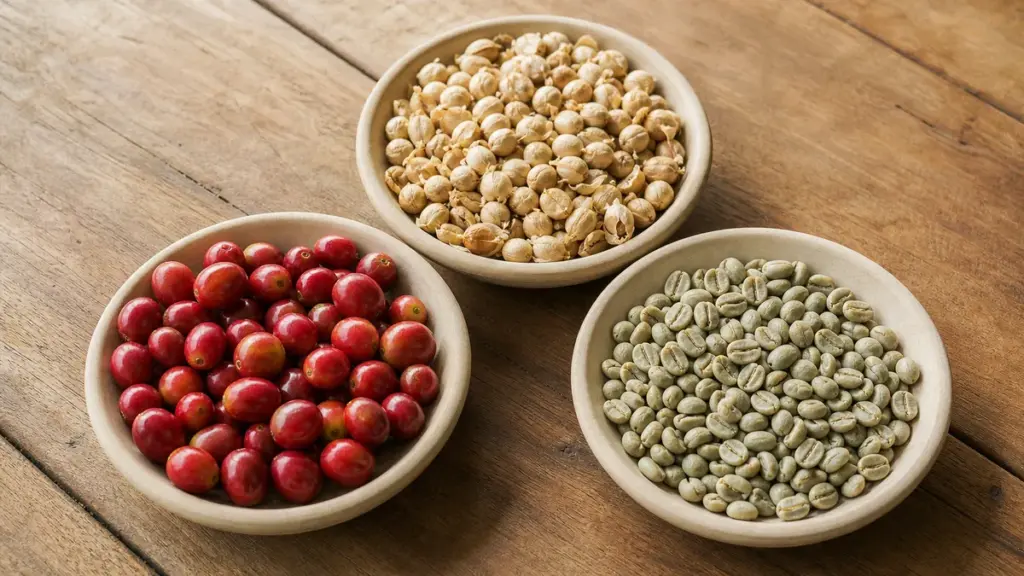
A farmgate price is the payment received by the grower for the product sold. That product might be fresh cherries, dried cherries, parchment coffee, meaning beans still enclosed in their papery covering, or processed green beans.
Those are not interchangeable quantities. A kilogram of cherries is not a kilogram of exportable green coffee. Comparisons need a stated product form, moisture basis and conversion method.
ICE describes its Coffee C futures contract as an arabica benchmark for exchange-grade green coffee delivered under specified warehouse and quality conditions. It is not a quotation for every farmer’s crop. Commercial differentials, negotiated additions or deductions reflecting quality and market conditions, help connect benchmark prices with physical coffee transactions.
The mechanics belong in coffee futures and differentials. For farmer income, the essential point is that a futures quotation is not evidence of what a grower received.
FOB, or Free on Board, is another distinct boundary. An FOB export price includes activities between the farm and export shipment, potentially including processing, transport and cooperative operations. Fairtrade explicitly distinguishes its farmgate living-income reference prices from its FOB minimum prices.
A roaster publishing an FOB payment has therefore disclosed something useful, but not necessarily the farmer’s payment. For the intervening roles, see green coffee trading.
What share of the retail price reaches farmers?
There is no universal percentage that applies equally to a supermarket bag, a capsule and a café drink.
A useful example comes from BASIC’s The Grounds for Sharing, published in 2024. Its model followed coffee from Brazil, Colombia, Ethiopia and Vietnam into German retail products, using 2021 sales data. Across 41 modelled products, the weighted aggregate assigned approximately 21% of final consumer value to coffee cultivation.
That denominator included VAT and Germany’s coffee tax. The cultivation share represented farmgate value before farm production expenses, not farmers’ disposable income. It also combined several retail formats rather than describing one typical bag.
This is a modelled value-chain estimate, not a worldwide farmer survey or a current UK percentage. It should not be repackaged as either.
A café-cup calculation needs its own evidence: the coffee dose, the farmgate value attributable to that dose, processing and roasting conversions, and the complete drink’s selling value. A bag-share estimate cannot simply be transferred to a prepared drink.
A percentage is informative only when its numerator and denominator are explicit. It is not, by itself, a measure of whether the farmer earns enough.
What production costs remove from revenue
Coffee production expenses extend beyond picking. The International Coffee Organization’s indicator framework includes hired labour, fertilisers, pest and disease management, planting material, energy, irrigation, transport, credit and certification-related expenses.
Farm renewal and equipment also matter. Leaving these out can make a farm appear more profitable while postponing the expenditure needed to keep it productive.
The Global Coffee Data Standard distinguishes a simplified calculation using major expenses from fuller accounting that can include land, capital assets and unpaid family labour. Neither should be presented without identifying what was counted.
For household living-income assessment, another distinction matters: family labour generally earns its return through the household’s net farm income. If a study separately deducts an assumed wage for that labour, its remaining “profit” is not directly comparable with a household-income figure that leaves that remuneration within net earnings. Ask which approach was used.
Harvest volume changes the result too. As an arithmetic relationship, a higher payment per kilogram cannot guarantee higher annual revenue if the saleable harvest falls sufficiently.
Living income: the household test
A living income is the net annual income a household needs to afford a decent standard of living in a particular place. The Living Income Community of Practice includes food, water, housing, education, healthcare, transport, clothing and provision for unexpected events.
It is a locally grounded benchmark, not a single global earnings target. Comparing a household with it requires compatible assumptions about location, household composition, the assessment period and income sources.
Living income is not living wage
The Global Living Wage Coalition’s living-wage approach concerns remuneration for a standard working week sufficient to support a worker and their family. Its methodology considers household needs and the typical number of workers supporting that household.
Living income instead assesses the household’s combined net earnings. A coffee-growing household may need a living income while employing seasonal workers who need a living wage. Improving one should not depend on underpaying the other.
What a Living Income Reference Price does
Fairtrade’s Living Income Reference Price, or LIRP, models the farmgate payment needed under specified conditions. Its inputs include:
- The household’s cost of decent living.
- A realistically attainable, sustainable yield.
- Sustainable production expenses, including appropriate remuneration for hired workers.
- A viable farm area.
A LIRP is therefore conditional, not a guarantee for every household. A smaller holding or lower harvest can leave a family below the benchmark despite receiving the reference payment.
Fairtrade’s Honduras explanatory note illustrates why averages need care. In its baseline sample, average net income exceeded the living-income benchmark, but larger farms pulled that average upwards. Half the sampled farmers had no more than 2.8 hectares of coffee, and that group’s average income remained below the benchmark.
Premiums: useful, but not the same as income
A premium is an additional payment, but its purpose and recipient need identifying.
A quality premium rewards particular coffee characteristics. Its contribution to net earnings should be assessed after any additional harvesting, sorting or processing work, not treated as pure profit.
The Fairtrade Premium is paid to producer organisations above the selling price. Members decide democratically how to use it. Benefits may include production improvements, organisational services, direct financial benefits or community investment, rather than an identical cash addition for every farmer.
Under the Rainforest Alliance’s current Premium Annex, version 1.4, coffee premiums are negotiated between first buyers and farm certificate holders and recorded in agreements. A negotiated premium is not a universal living-income guarantee.
Volumes matter as well. Fairtrade’s 2025 coffee impact summary reports that cooperatives sold, on average, 35% of their coffee on Fairtrade terms in 2023. Certification status should therefore not be mistaken for proof that the entire harvest attracted those trading benefits.
What can improve farmer income?
The strongest approach combines purchasing practices with farm and household support.
Make sourcing commitments dependable. Fairtrade identifies long-term purchasing relationships alongside reference-price payments as important for enabling farm investment. Ask about committed volumes and payment timing, not just a particularly attractive transaction.
Assess productivity through net income. Training, suitable planting material and crop management should be evaluated against additional expenses and actual household outcomes. The Columbia Center on Sustainable Investment also cautions that sector-wide production increases can affect market prices: greater output is not an unlimited solution.
Support producer capability and bargaining. Cooperatives can provide services, access to finance and collective marketing. Their governance, deductions and distribution of benefits should remain visible to members and buyers.
Recognise limits beyond the farm. Very small landholdings and unsuitable growing conditions can constrain coffee earnings. Diversification, other employment and public services belong in livelihood discussions rather than leaving every problem for the coffee harvest to solve.
For UK workplace buyers, these are useful tests of sourcing claims, not grounds for assuming that an expensive product necessarily delivers better farmer outcomes.
How to assess a supplier’s income claim
Use this short checklist before accepting “farmers are paid fairly” as a complete answer.
- Identify the recipient. Was the payment made to an individual grower, cooperative, processor or exporter?
- Identify the product and period. Request the harvest year, product form, weight basis and any conversion assumptions.
- Separate payments. Ask which elements are the base payment, quality differential, certification premium and later bonus.
- Check the income calculation. Look for production expenses, treatment of family labour and relevant household income sources.
- Check the benchmark and coverage. Ask which living-income assessment was used, how many households were assessed and what proportion of their harvest the purchasing commitment covered.
Request itemised written quotations and supporting sourcing documentation for workplace procurement. Keep the commercial quotation separate from the evidence about farmgate prices and farmer income: one does not establish the other.
FAQ
Does a higher supermarket selling price mean the farmer receives more?
No, a higher selling price does not establish a higher farmgate payment. BASIC’s value-chain research separates cultivation from exporting, manufacturing, retailing and taxes because these are different components. Look for evidence of the grower’s payment and trading terms rather than treating the finished product’s positioning as proof.
Should food grown and eaten by the household count as income?
Yes, its value can be included in a clearly defined household-income assessment. The German Retailers Working Group’s coffee baseline methodology includes self-consumed farm production alongside cash earnings and other income sources. The valuation method must be stated, and the same production should not be counted again as a cash sale.
Is paying a Living Income Reference Price compulsory for Fairtrade coffee?
No, Fairtrade describes LIRP payments as voluntary commitments by buyers. They are distinct from the Fairtrade Minimum Price, which is mandatory for sales on Fairtrade terms. A supplier should therefore identify any separate LIRP commitment and its coverage rather than relying on certification alone.
Where to go next
Read Coffee Prices: The C-Market and Futures for benchmark pricing, and Green Coffee Trading, Importers and Exporters for the businesses between farm and roaster. Direct Trade and Coffee Auctions explains alternative purchasing relationships and the questions to ask about their benefits.
Sources
- International Coffee Organization, Indicators: Economic Suite, undated, current online framework. Source.
- Global Coffee Platform, Global Coffee Data Standard, version 1.0.0, sections 3.3.1 to 3.3.4, undated online documentation. Source.
- ICE, Coffee C Futures, current online contract specifications, checked November 2026. Source.
- Fairtrade International, Living Income Reference Prices: FAQ, undated, current online guidance. Source.
- BASIC, commissioned by Global Coffee Platform, IDH and Solidaridad, The Grounds for Sharing: A Study of Value Distribution in the Coffee Industry, final report, 6 August 2024, particularly sections 5.1 and 5.2.1. Source.
- Living Income Community of Practice, The Concept, undated, current online definition. Source.
- Global Living Wage Coalition, Frequently Asked Questions, undated, current methodology explanation. Source.
- Fairtrade International, Living Income Reference Prices, undated, methodology explanation. Source.
- Fairtrade International, Fairtrade Living Income Reference Prices for Coffee from Honduras: Explanatory Note, 2022 reference-price exercise, using 2021 to 2022 baseline data. Source.
- Fairtrade International, Fairtrade Coffee: Impact at a Glance, 2025. Source.
- Rainforest Alliance, Premium Annex, version 1.4, binding from 1 March 2026, online page updated 28 October 2026. Source.
- Columbia Center on Sustainable Investment, Ensuring Economic Viability and Sustainability of Coffee Production, 2019. Source.
- German Retailers Working Group on Living Income in the Coffee Sector, Household Income Assessment: Baseline Assessment Results, 5 March 2026. Source.
This article was researched through retrieved primary frameworks, certification documents and original value-chain research, keeping modelled estimates separate from observed household results.
Last checked: November 2026