How much do you know about coffee beyond your usual order? These coffee trivia and quizzes offer 12 scored questions, verified answers and a playful coffee personality round, with no specialist brewing knowledge required.
In short
- The main quiz has three rounds of four questions, with one point for each correct answer.
- For a fair test, skip the trivia section until you have finished answering.
- Answers include explanations, so an incorrect guess still teaches you something.
- The factual rounds draw on botanical references, UNESCO records and official historical accounts.
- The coffee personality round is entertainment, not a scientific assessment.
Test Your Coffee Knowledge
You can play alone, challenge a friend or use the questions for a workplace coffee break. There is no tasting requirement, and nobody needs to make or drink anything.
For the wider collection of activities and conversation starters, visit coffee fun and community.
Set up your quiz
- Choose a host, or nominate someone to keep the answers out of sight.
- Write down your answers before discussing them. This gives quieter players the same opportunity to contribute.
- Award one point per correct answer, with no deductions for guesses.
- Accept equivalent wording. “A seed” and “the seed inside the fruit”, for example, mean the same thing here.
- Use the optional tie-breaker only if you need a winner. Otherwise, shared honours are perfectly respectable.
There are 12 points available. The personality questions do not count towards that total.
If you are hosting, read each question and all its options aloud before accepting answers. Avoid turning pronunciation into a second, unannounced test: recognising a botanical name matters more here than saying it elegantly.
Ready to play without clues? Jump straight to “Coffee Quizzes”, then return to the trivia afterwards.
Fun Coffee Trivia
These facts provide the background to the quiz. Each has an identifiable source, listed at the end, rather than relying on a frequently repeated internet claim.
Your coffee bean started inside a fruit
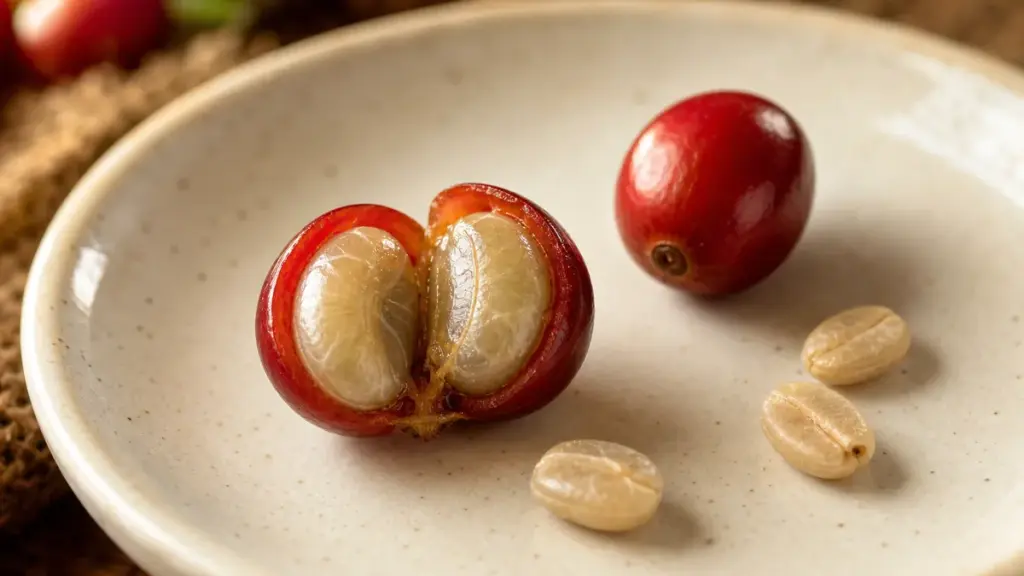
What we call a coffee bean is a seed. Kew describes arabica fruits as containing two seeds, although a fruit can sometimes contain only one.
That distinction makes a useful opening question because the everyday name points in the wrong botanical direction. “Bean” is familiar coffee vocabulary, but “seed” explains which part of the plant eventually reaches the roaster. The fruit around it is a separate structure.
Coffee flowers are white, but ripe fruits are not always red
Kew describes arabica flowers as white and sweetly scented. Its botanical account also records ripe fruits that are usually red but can be yellow or purple.
A photograph of yellow coffee fruit therefore needs context before anyone declares it unripe. Colour is a good subject for a picture round, provided the host knows what the image actually shows. A dramatic photograph is not, by itself, a reliable answer key.
Caturra is related to Bourbon
World Coffee Research identifies Caturra as a natural mutation of the Bourbon variety. It explains that a single-gene mutation gives Caturra its smaller, compact growth.
The interesting distinction is between a species, a broader botanical category, and a variety, a named group within a species. Caturra and Bourbon belong within arabica. They are not separate coffee species, and their relationship concerns the living plant rather than a roasting style.
UNESCO recognition concerns people as well as preparation
UNESCO inscribed Turkish coffee culture and tradition on its Representative List of the Intangible Cultural Heritage of Humanity in 2013. Its account includes finely powdered coffee, slow preparation, hospitality, conversation and knowledge passed through families.
The wording matters. This is recognition of a cultural practice, not a competition declaring one drink the world’s best. For a quiz, ask about the listed tradition or its inscription date rather than inventing a ranking UNESCO has not made.
A small cup movement can carry a message
UNESCO’s Arabic coffee entry describes shaking the cup as a customary signal that the drinker has finished. It also describes older people and guests being served first.
Treat these as practices documented in that heritage account, not as a universal script for every household or country. The appealing trivia is that hospitality can involve shared gestures as well as spoken invitations. Context makes the fact more interesting, not less memorable.
A London coffee house belongs in insurance history
Lloyd’s traces its history to Edward Lloyd’s Coffee House in London. Its historical timeline identifies 1688 as the year of the first recorded mention in the London Gazette and describes the establishment as a meeting place associated with shipping information.
Notice the careful wording: “first recorded mention” is not necessarily “opening day”. That distinction is useful whenever a quiz asks for the earliest date attached to a business, building or custom.
Espresso reached orbit
The Italian Space Agency records Samantha Cristoforetti drinking the first espresso prepared in orbit with ISSpresso on 3 May 2015. NASA’s accompanying record explains that the device could also prepare tea, broth and other hot drinks.
The surprising detail is not simply that an espresso machine travelled into space. The official description also gives it a broader drinks-making role. Remember that before answering the final true-or-false question.
Coffee Quizzes
Keep the answer section covered until you have completed all three rounds. Choose one answer for each question unless it asks for a name or year.
Round one: from plant to bean
1. Botanically, the part we call a coffee bean is a:
A. Root
B. Seed
C. Leaf
2. How many seeds does an arabica coffee fruit usually contain?
A. One
B. Two
C. Six
3. What colour are arabica coffee flowers?
A. White
B. Dark brown
C. Blue
4. Caturra is a natural mutation of which coffee variety?
A. Bourbon
B. It is a roasting method, not a variety
C. It has no relationship to another variety
Round two: coffee and hospitality
5. In which year did UNESCO inscribe Turkish coffee culture and tradition?
A. 1993
B. 2013
C. 2023
6. UNESCO describes the coffee used in Turkish coffee preparation as ground to a:
A. Fine powder
B. Coarse gravel-like texture
C. Whole-bean mixture
7. In UNESCO’s Arabic coffee account, what does shaking your cup signal?
A. You have finished
B. You would like a larger cup
C. The coffee needs stirring
8. Who does that account say should be served first?
A. Whoever brewed the coffee
B. Older people and guests
C. Whoever holds the largest cup
Round three: coffee beyond the kitchen
9. In which city was Edward Lloyd’s Coffee House?
A. London
B. Edinburgh
C. Bristol
10. What year does Lloyd’s give for the first recorded mention of the coffee house?
A. 1588
B. 1688
C. 1788
11. Which astronaut drank the first espresso prepared in orbit with ISSpresso?
Write the astronaut’s name.
12. True or false: NASA described ISSpresso as a device that could prepare only coffee.
Answers and explanations
- B, seed. “Coffee bean” is the everyday name for the seed found inside the fruit.
- B, two. That is the usual arrangement described by Kew, although single-seeded fruits also occur.
- A, white. Kew also describes the flowers as sweetly scented.
- A, Bourbon. World Coffee Research records Caturra as its natural mutation.
- B, 2013. This is the inscription year for the specifically named Turkish coffee tradition.
- A, fine powder. UNESCO includes this detail in its description of preparation.
- A, you have finished. That is the gesture’s meaning in the documented account.
- B, older people and guests. UNESCO includes this within the tradition’s serving etiquette.
- A, London. Lloyd’s identifies the coffee house’s early address as Tower Street.
- B, 1688. This is the first recorded mention in Lloyd’s timeline, not a verified opening date.
- Samantha Cristoforetti. Accept the surname alone if the player clearly identifies her.
- False. NASA says the device could also make tea, broth and other hot beverages.
Your score
These bands are simply encouragement for this quiz, not a recognised qualification.
| Score | Your quiz result |
|---|---|
| 0 to 4 | Curious newcomer: choose one surprising answer to remember |
| 5 to 8 | Well-informed regular: a solid mix of plant and cultural knowledge |
| 9 to 11 | Coffee quiz contender: ready to host the next round |
| 12 | Full marks: try the botanical tie-breaker |
Optional tie-breaker: Which two species gave rise to arabica through hybridisation?
Answer: Coffea eugenioides and Coffea canephora, according to Kew’s botanical account. Hybridisation means that different species or plant groups cross to produce offspring.
This question moves beyond recognising names to understanding their relationship. It is also a useful reminder that a botanical family history and a variety name are different kinds of information.
“What’s Your Coffee Personality?”
This round is playful, not scientific. It describes your choices in an imaginary coffee break, not your intelligence, character, health or suitability for a job.
Choose one answer for each question and count your letters.
Choose your coffee-break preferences
1. You have a spare half-hour. What sounds most appealing?
- A: Recreating a familiar drink and enjoying it without interruption.
- B: Comparing something unfamiliar with your usual choice.
- C: Inviting someone to sit down and catch up.
2. A friend offers to organise a coffee activity. You choose:
- A: A relaxed break with no programme.
- B: A mystery question followed by an explanation.
- C: A team quiz where everyone contributes.
3. Which imaginary notebook would you keep?
- A: Favourite drinks and the occasions they suit.
- B: Questions to investigate and things you have noticed.
- C: People to invite and conversations to continue.
4. Your ideal ending to a coffee gathering is:
- A: Feeling comfortably restored to your routine.
- B: Leaving with an interesting new question.
- C: Arranging another get-together.
Read your result
Mostly A: the ritual keeper.
In this little game, familiarity is part of the pleasure. Your suggested activity is to revisit something you already enjoy and notice a detail you usually overlook. There is no requirement to turn every coffee break into a project.
Mostly B: the curious explorer.
Your answers favour discovery. Try writing one carefully worded quiz question of your own, then find a dependable source for its answer. If a claim sounds wonderfully surprising, make checking it part of the enjoyment.
Mostly C: the coffee connector.
Your choices put company first. Host the factual quiz, invite everyone to explain a favourite answer, or share some coffee jokes and humour. Nobody needs a high score to belong at the table.
A tie: keep both descriptions, or ignore the categories altogether. These results were written for amusement and have not been validated as a personality instrument.
FAQ
Do I need to drink coffee to take part?
No, all the scored questions can be answered without drinking coffee. They concern plants, cultural practices, history and a documented space mission rather than recognising flavours. For a mixed group, let people join with whatever drink they prefer, or with no drink at all. Participation should not depend on consumption.
How can I make the quiz more accessible?
Offer the questions in writing as well as reading them aloud. Give everyone time to consider the options, avoid relying solely on colour photographs, and accept spoken or written answers. You can also remove the competitive scoring and discuss each answer together, keeping the explanations as the main activity.
Can I add a picture round?
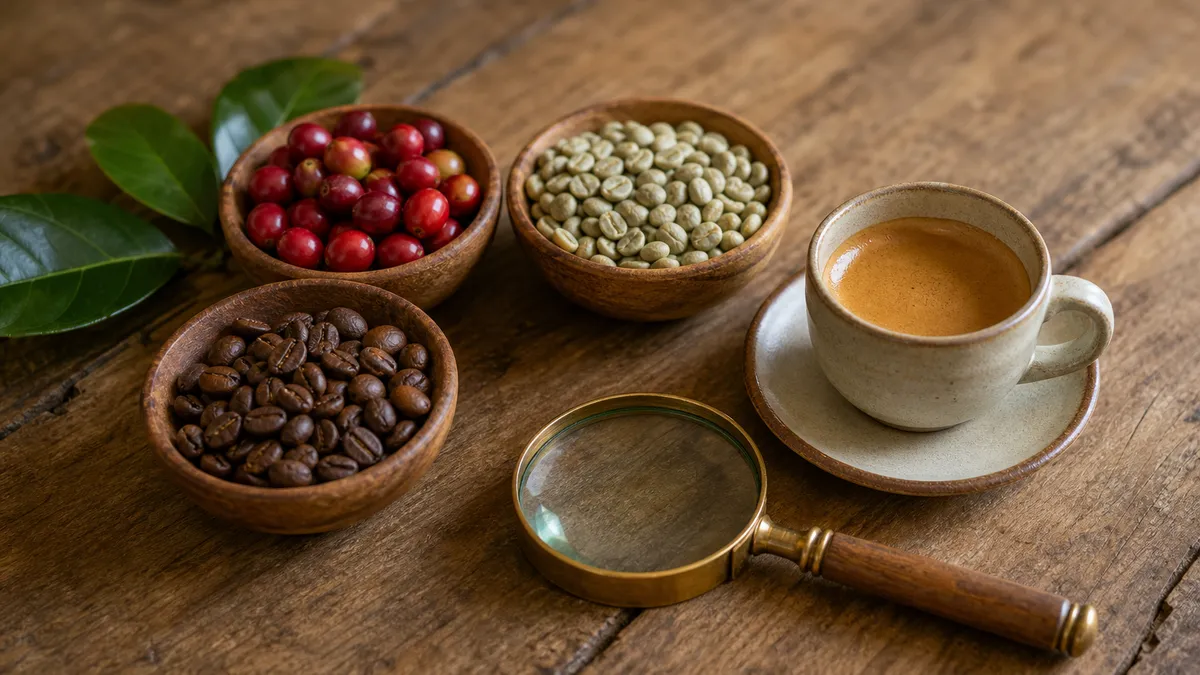
Yes, but choose pictures whose contents you can identify reliably. A useful home-made round could show whole roasted beans, ground coffee and brewing equipment, photographed without distracting packaging. Keep the answer key separate, use images you have permission to share, and avoid expecting players to identify a particular variety from appearance alone.
Where to go next
Visit Coffee Fun and Community for more ways to build a gathering around coffee, then try Coffee Jokes and Humour for a lighter follow-on round. Read Coffee Quotes by Famous Personalities before adding an attribution challenge, and explore Coffee and Social Media if you want to take your coffee trivia and quizzes into an online conversation.
Sources
-
S1. Royal Botanic Gardens, Kew. Arabica coffee, Coffea arabica. Undated live plant profile, consulted 2026. Supports flower colour and the identification of coffee beans as seeds.
https://www.kew.org/plants/arabica-coffee -
S2. Royal Botanic Gardens, Kew. Coffea arabica L., Plants of the World Online, general information. Undated live botanical reference, consulted 2026. Supports seed number, fruit colours and arabica’s hybrid parentage.
https://powo.science.kew.org/taxon/urn%3Alsid%3Aipni.org%3Anames%3A747038-1/general-information -
S3. World Coffee Research. Caturra, Coffee Varieties Catalog. Undated live variety profile, consulted 2026. Supports the relationship to Bourbon and compact growth.
https://varieties.worldcoffeeresearch.org/varieties/caturra -
S4. UNESCO. Turkish coffee culture and tradition, nomination file 00645, inscription 2013. Supports the inscription year, preparation and communal practices.
https://ich.unesco.org/en/RL/turkish-coffee-culture-and-tradition-00645 -
S5. UNESCO. Arabic coffee, a symbol of generosity, nomination file 02111, expanded inscription 2024. Supports the documented cup gesture and serving etiquette.
https://ich.unesco.org/en/RL/arabic-coffee-a-symbol-of-generosity-02111 -
S6. Lloyd’s. Coffee and commerce 1652 to 1811. Undated institutional history, consulted 2026. Supports the London location, shipping-information role and first recorded mention in 1688.
https://www.lloyds.com/about-lloyds/history/coffee-and-commerce -
S7. Italian Space Agency. @astrosamantha e il primo espresso spaziale. 3 May 2015. Supports the astronaut’s identity, date and first espresso prepared in orbit with ISSpresso.
https://www.tv.asi.it/media/v/c2b3a700-7c0f-4062-879b-4844eb1a9f65 -
S8. NASA. ESA Astronaut Samantha Cristoforetti Enjoys Her First Drink. 5 May 2015, describing an image dated 3 May 2015. Supports ISSpresso’s ability to prepare drinks other than coffee.
https://www.nasa.gov/image-article/esa-astronaut-samantha-cristoforetti-enjoys-her-first-drink-2/
The factual questions and explanations were checked through live searches of botanical references, UNESCO heritage records and official institutional accounts; the scoring bands and personality exercise are original editorial entertainment.
Last checked: November 2026