The best coffee jokes turn a familiar moment, such as an empty pot or an overambitious morning routine, into a small surprise. Here is a freshly written selection of clean jokes, puns, one-liners and coffee meme ideas, with something for the family breakfast table and the office tea point.
In short
- Choose question-and-answer jokes for telling aloud and one-liners for cards or captions.
- Keep workplace humour about shared situations, not a colleague’s habits or drink choice.
- The meme ideas below describe new scenes rather than reproduce existing images.
- All jokes here are newly written for this collection, not attributed quotations; similar wordplay may exist elsewhere.
- Start with one joke you genuinely like rather than sending the whole collection to the team.
Coffee-Related Jokes
If you are exploring coffee fun and community, a shared laugh is a good place to begin. These jokes need no specialist coffee knowledge, although an acquaintance with the office mug cupboard may help.
Quick question-and-answer jokes
Why did the coffee machine decline a promotion?
It was already responsible for everyone’s morale.
Why did the mug refuse to join the meeting?
It had already been taken round in circles by a spoon.
Why did the coffee pot start keeping a diary?
Everyone kept asking what it had been through.
Why did the coffee bean bring a tiny suitcase?
It had been told it was going on a round-the-world blend.
Why did the office appoint a biscuit to supervise the coffee break?
It wanted someone who could handle a short meeting.
Why did the mug apply for a quieter desk?
It was tired of being at the centre of every stir.
Why did the coffee machine request an assistant?
Apparently, making coffee also meant listening to everybody’s weekend.
Why did the spoon leave the talent show early?
Its act was getting repetitive.
Read the question plainly, then leave a brief pause before the answer. There is no need to announce that a particularly terrible pun is approaching. Let it arrive under its own steam.
Small stories for the breakfast table
The encouraging machine
I told the coffee machine I needed encouragement. It flashed “ready”.
That made one of us.
The household survey
I asked everyone at home which mug belonged to whom.
Apparently, all the clean ones are communal and all the dirty ones are mine.
The quiet morning
I promised myself a peaceful breakfast without checking any messages.
Then the coffee machine started blinking at me.
The ambitious notebook
I bought a notebook especially for recording my coffee recipes.
The first page says “find notebook”.
The office improvement plan
Our team suggested making the coffee area more welcoming.
Someone put a spare chair beside it. We have not seen the chair since.
The helpful guest
A guest asked whether they could help with the coffee.
I said, “Certainly. Please explain to the teaspoons why there are never enough of them.”
For telling aloud, my pick is the household survey: it needs no explanation and gives the listener a moment to recognise the situation. The notebook joke is better suited to someone whose carefully planned hobbies occasionally overtake the kitchen.
If you want a reflective line rather than a punchline, try coffee quotes and sayings. A joke is aiming for a turn at the end, not a statement to live by.
Coffee Puns and One-Liners
A pun uses a word’s different meanings, or words that sound alike, to create the joke. Coffee offers plenty of material through words such as grounds, blend, filter and roast, but a line still needs to make sense beyond containing a coffee word.
Puns with a little context
- My coffee has started attending local meetings. It wants stronger grounds for community involvement.
- The beans formed a choir. Rehearsals are mostly about getting the blend right.
- My mug is writing its autobiography. The working title is A Handle on Things.
- The grinder has joined our discussion group. It keeps asking us to be more granular.
- I asked the coffee filter for advice. It suggested letting a few things go.
- The espresso opened a small theatre. Every performance is a short shot at greatness.
- My coffee joined a detective agency. Its first assignment involved suspicious grounds.
- The roasting machine tried stand-up. The beans said the material was getting a little dark.
Choose the ones whose wordplay feels natural to you. If you have to explain both the coffee term and the punchline, save that joke for an enthusiast rather than a mixed audience.
One-liners without the wordplay
- My morning routine has three stages: find mug, lose mug, discover mug beside kettle.
- I have a favourite mug and several mugs that are still being interviewed.
- The coffee is ready. My ability to answer follow-up questions is not.
- I made a coffee and sat down to enjoy it. Naturally, the doorbell had other plans.
- My desk has a filing system: urgent, less urgent, and underneath the mug.
- I tried drinking coffee somewhere new. The other end of the sofa was lovely.
- My coffee notebook contains tasting notes, recipes and a surprisingly detailed shopping list for biscuits.
- I cleaned the coffee shelf and discovered enough lids to start a separate cupboard.
For a card, use just the line. For an office message, give it a reason to be there: a new mug shelf, a team breakfast or a coffee-break invitation. Repeating the same joke beneath every announcement is asking rather a lot of one sentence.
A few for the coffee enthusiast
These are aimed at the person who can turn a simple brew into a small research project:
- My brewing notebook now has an index. The coffee itself remains difficult to locate.
- I changed one variable at a time. Unfortunately, the variable was my entire morning.
- I arranged my coffee equipment neatly. Then I needed somewhere to make coffee.
- My tasting notes say “unexpected”. That covers both the flavour and the washing-up.
- I invited a friend over for a quick coffee. They asked whether that included the presentation.
The target here is enthusiastic overcomplication, not knowing a lot about coffee. Enjoying the details and laughing at yourself can happily share a table.
Humorous Coffee Memes
Here, a coffee meme means an image-led joke built around a recognisable situation and a short caption. The following are new concepts you could stage with ordinary cups and equipment, not descriptions of copied photographs or screenshots.
The mug selection committee
Scene: Several plain mugs stand in a row. One slightly chipped, well-used mug sits apart on a small tray.
Suggested caption: “The others have excellent qualifications. This one knows the job.”
The joke gives an everyday preference the seriousness of a recruitment decision. Keep the favourite mug visually ordinary: its appeal is loyalty, not grandeur.
The carefully planned coffee break
Scene: An overhead view shows a cup, a biscuit on a plate and an empty chair. In a second view, the biscuit has disappeared but the coffee is untouched.
Suggested caption: “Preparation complete. Biscuit testing also complete.”
Nothing needs to be spilt or broken. The missing biscuit supplies the whole story.
The expanding hobby
Scene: A simple mug and coffee pot occupy one side of a kitchen worktop. The other side holds an increasingly elaborate arrangement of brewing equipment.
Suggested caption: “I said I wanted a coffee. The kitchen heard ‘new department’.”
Give both sides equal space. The contrast is between the modest intention and the enthusiastic result, not between supposedly inferior and superior ways of brewing.
The disappearing teaspoon
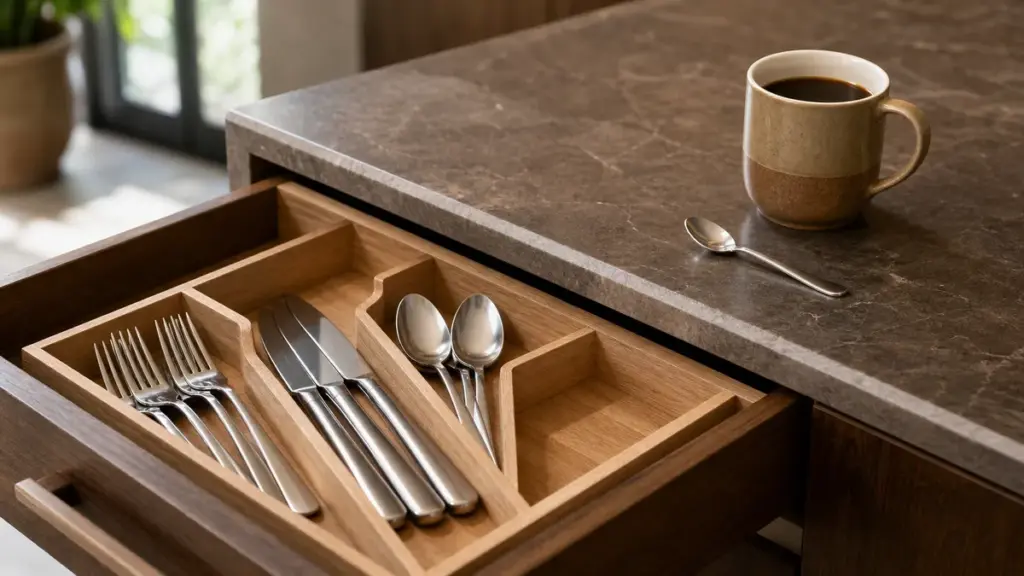
Scene: A tidy cutlery tray contains plenty of larger utensils but a conspicuously empty teaspoon compartment. One teaspoon rests beside a coffee cup elsewhere.
Suggested caption: “The search party has also gone missing.”
This is a small visual mystery rather than a complaint about whoever last washed up. Resist adding an accusation beneath it.
The coffee photograph
Scene: A neatly arranged cup sits beside a folded napkin. Several awkwardly positioned cushions suggest that someone has spent rather too long arranging the surroundings.
Suggested caption: “Coffee break: postponed until the cushion looks natural.”
The joke is about fussing over a picture, not about a particular platform or creator. For the wider subject of posting and sharing, see coffee and social media.
A real example of coffee-shaped absurdity
Coffee and computer humour have met before. RFC 2324, Hyper Text Coffee Pot Control Protocol, was published on 1 April 1998 and describes an intentionally humorous system for controlling coffee pots; it explicitly says it is not an Internet standard.
There was also a practical coffee-camera project at Cambridge: researchers pointed a camera at their shared pot so colleagues could check it remotely rather than make a fruitless trip. That everyday inconvenience is a useful starting point for your own humour: give a small problem an unexpectedly elaborate response.
Choose a Coffee Joke That Fits
Use this as an editorial checklist, not a rulebook for being funny:
- Picture the audience. Choose an everyday mug or biscuit joke for a mixed group. Keep equipment-heavy material for people who enjoy that subject.
- Give the joke one job. A card needs a warm line; a spoken joke needs a clear ending; a meme needs a readable visual contrast.
- Remove the explanation. Try cutting the sentence after the punchline. If the joke no longer works, simplify the setup.
- Keep people out of the firing line. Make the missing spoon, crowded shelf or elaborate routine the subject, rather than someone’s competence, accent or preferred drink.
- Check the image separately. For a meme, use a photograph you have created and can use, or an appropriately licensed image.
Finding a photograph online does not itself give permission to reuse it. UK Intellectual Property Office guidance explains that images are generally protected by copyright and that copying or sharing them usually needs permission unless an applicable exception or other permission covers the use.
For a team activity, invite everyone to write a caption for the same plain mug photograph. Let people pass rather than putting them on the spot. If the group would rather solve something than perform, coffee trivia and quizzes offers a different starting point.
FAQ
Which coffee jokes are suitable for children?
Choose jokes about talking mugs, missing teaspoons, biscuits and imaginary coffee-bean adventures. The question-and-answer selection above avoids adult themes and does not depend on children drinking coffee. Read your chosen joke aloud first: if understanding it requires a lengthy explanation of office politics or brewing equipment, pick a simpler one.
Can I put a coffee joke in a workplace email?
Yes, as an editorial choice, keep it brief, relevant and separate from essential information. A friendly line can accompany a coffee-break invitation without becoming the subject of the whole message. Avoid jokes aimed at an individual, and leave humour out of communications where readers need a serious or unambiguous response.
How can I write a coffee joke without copying a familiar pun?
Start with something you have noticed, then give it an unexpected explanation. A crowded mug shelf might become a recruitment panel; a missing teaspoon might require a search party. Write the ordinary situation first, try several endings, and keep the shortest ending that still makes sense. Avoid promising that nobody has ever made a similar joke.
Where to go next
Explore Coffee Fun and Community for more ways to make coffee a shared interest, or Coffee Trivia and Quizzes for a group activity with answers rather than punchlines. Coffee Quotes and Sayings covers memorable expressions, while Coffee Quotes by Famous Personalities is the next read when you want attributed words rather than newly written coffee jokes and humour.
Sources
The sources below informed the short factual passages and image-use guidance, not the original joke wording.
-
RFC Editor, L. Masinter, Hyper Text Coffee Pot Control Protocol (HTCPCP/1.0), RFC 2324, 1 April 1998. Primary example of deliberately humorous coffee-related technical writing.
https://www.rfc-editor.org/info/rfc2324/ -
University of Cambridge Computer Laboratory, Quentin Stafford-Fraser, The Trojan Room Coffee Pot: A (non-technical) biography, first published May 1995. First-person account of the shared-pot camera project and its practical purpose.
https://www.cl.cam.ac.uk/coffee/qsf/coffee.html -
Intellectual Property Office, Copyright notice: digital images, photographs and the internet, updated 4 January 2021. UK guidance supporting the advice on choosing images for memes.
https://www.gov.uk/government/publications/copyright-notice-digital-images-photographs-and-the-internet/copyright-notice-digital-images-photographs-and-the-internet
The factual context and image-use guidance were checked against these retrieved primary sources; the jokes, captions and fictional scenes were written for this article rather than collected from joke websites.
Last checked: November 2026