Coffee travel in the UK can mean a café weekend in Manchester or Cardiff, a roastery visit in Glasgow or Bristol, or a walk through coffeehouse history in London and Oxford. Choose the experience first, then build the trip around a confirmed opening, tasting or event rather than a long list of cafés.
In short
- London and Oxford offer specific coffee-history sites, but distinguish historic locations from surviving original premises.
- A roastery café, a guided production tour and a brewing class are different experiences. Check what you are booking.
- Manchester, Glasgow, Bristol, Cardiff and Belfast provide useful starting points beyond London.
- Festival calendars need checking individually: an old event listing does not confirm another edition.
- For a first trip, plan one main coffee experience and leave room for food, walking and an unplanned stop.
Choose your UK coffee trip by experience
Start with a question: do you want to taste different coffees, understand roasting, learn a brewing skill or follow coffee’s history? That choice matters more than finding a supposedly definitive coffee capital.
The destinations below are selected for identifiable visitor experiences, not ranked by cup quality. Their businesses and events provide practical starting points, rather than a claim that every café in one city outperforms those elsewhere.
| Destination | Useful starting point | Who it suits | Planning consideration |
|---|---|---|---|
| London | City coffeehouse sites and the London Coffee Festival | History readers and festival visitors | Treat the history walk and festival as separate outings |
| Oxford | The Grand Café and Queen’s Lane Coffee House | Readers interested in early English coffeehouses | Read “first” and “oldest” claims carefully |
| Manchester | ManCoCo Coffee Academy and Manchester Coffee Festival | Learners wanting a structured activity | Confirm the experience and festival session separately |
| Glasgow | Dear Green roastery tours and Glasgow Coffee Festival | Visitors interested in roasting and tasting | Book a tour date rather than assuming drop-in access |
| Bristol | Wogan’s Brew Bar, Bean Shop and cupping sessions | Visitors wanting coffee comparisons | Its published visitor hours currently run on weekdays |
| Cardiff | Hard Lines in Central Market and Canton | Travellers combining coffee with a city break | Its cafés and roastery are different destinations |
| Belfast | Established Coffee on Hill Street | Visitors wanting an uncomplicated café starting point | The café currently operates on a walk-in basis |
For a first outing, choose somewhere you already want to explore. Coffee works well as the organising thread of a trip without needing to fill every hour.
The wider coffee and travel guide explains how to choose between café visits, festivals and travel connected with coffee production.
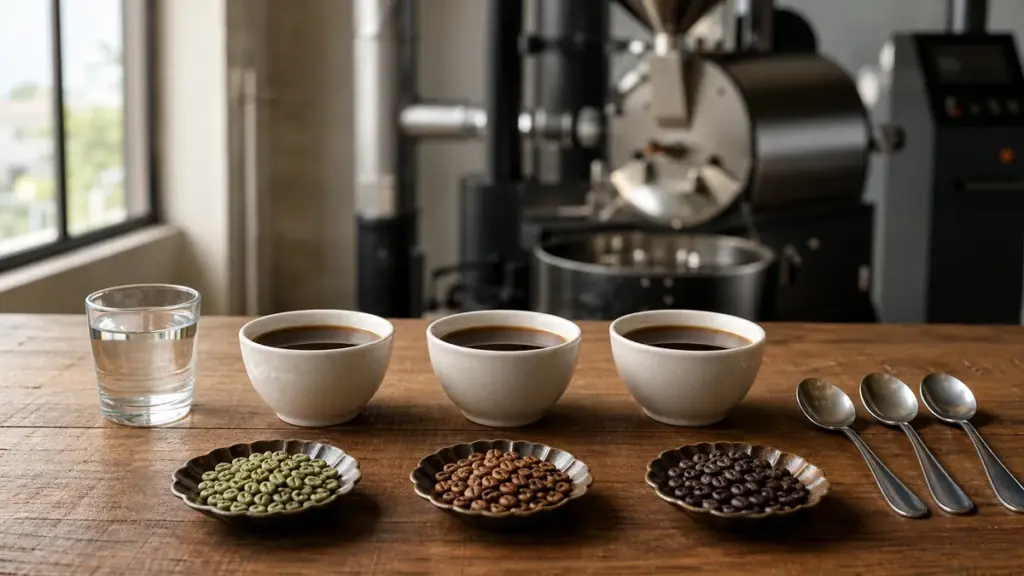
Visit a roastery, not just its café
A café attached to a roasting business does not automatically include access to production. Before travelling, establish whether you will see roasting, join a guided explanation, taste coffees or practise making drinks.
Glasgow: Dear Green. Its published roastery tour covers sourcing, roasting and tasting at its east-end premises. The operator describes an experience lasting about 90 minutes, limited to 10 people. This is a useful option if you want a scheduled visit with time for questions.
Manchester: ManCoCo. Its Coffee Academy advertises experiences incorporating a roastery tour, alongside brewing, home-barista and latte-art sessions. Pick the activity that answers your question: learning to texture milk is not the same outing as understanding how coffee is roasted.
Bristol: Wogan. Its visitor offer includes a Brew Bar, Bean Shop, coffee flights and bookable cupping sessions. Cupping is a comparative coffee tasting. Wogan also makes a useful distinction: visitors can see a roaster from the Brew Bar, but most production happens across the road, so seeing equipment does not guarantee watching a roast.
Cardiff: Hard Lines. Its Central Market espresso hatch and Canton café are visitor destinations, while its roastery is at Gwaelod y Garth. The company currently labels roastery opening as retail only. Do not turn that into an assumed production tour.
Before booking, ask:
- Will roasting actually take place during the visit?
- Is tasting included, and can beginners follow it?
- Is the activity public, private or intended for wholesale customers?
- Are there age restrictions or access limitations?
- Which address should visitors use?
UK roastery visits explore roasting and preparation, not a substitute version of a farm visit. For that different experience, see travel in coffee-growing countries.
Coffee festivals worth planning around
A festival is useful when you want several roasters, demonstrations and conversations in one outing. Choose it for breadth; choose a small tasting or class when you want more focused attention.
Festival information below was checked in November 2026. These dates are not interchangeable with a recurring annual calendar.
London Coffee Festival
The organiser currently lists 13 to 16 May 2027 at The Truman Brewery. Its visitor information distinguishes industry days from the public weekend, so check eligibility and session details before arranging travel.
Use the programme to choose a demonstration or tasting you particularly want to attend. Leave the rest of the session flexible rather than trying to visit every exhibitor.
Manchester Coffee Festival
The published dates are 20 to 22 November 2026 at Bowlers Exhibition Centre. The organiser lists tastings, competitions, talks and panel discussions.
Check the venue journey separately from your city-centre plans. A festival visit and a café walk need not fit neatly into the same afternoon.
Glasgow Coffee Festival
The 2026 edition took place on 18 and 19 April at The Briggait. At the November 2026 check, the organiser was inviting registrations for 2027 announcements rather than displaying confirmed new dates.
Treat April as the timing of the previous edition, not a booking instruction for the next one.
Birmingham Coffee Festival
Birmingham belongs in the discussion, but not as a currently confirmed festival booking. Community partner Farmers’ Voice Radio documents the 8 and 9 July 2023 event at the Custard Factory.
At the November 2026 check, the former official festival website displayed a stopped-site notice, and no forthcoming edition was verified. Plan a Birmingham café trip independently unless a current organiser publishes confirmed arrangements.
At any festival, decide what you want to learn before you start sampling. You do not need to finish every drink offered, and it is perfectly reasonable to decline another sample.
Follow coffeehouse history in Oxford and London
These are visits to places associated with early coffeehouses, not a promise of entering unchanged seventeenth-century rooms. A plaque, a trading name and an original building establish different things.
Oxford: High Street and Queen’s Lane
Begin at The Grand Café, 84 High Street, which presents its location as the site of England’s first coffeehouse in 1650. The Museum of Oxford also recounts the traditional story of Jacob, a Jewish entrepreneur, opening a coffeehouse at the Angel in 1650.
Nearby, Queen’s Lane Coffee House dates its foundation to 1654. The Museum of Oxford reports its claim to be Europe’s oldest continuously serving coffeehouse, but that superlative should remain an attributed claim, not an independently established verdict.
Visit both for the historical connection. Keep the foundation story separate from assumptions about the age of the present interiors, ownership or uninterrupted occupation of a particular room.
London: St Michael’s Alley, Change Alley and Lombard Street
Start at the Jamaica Wine House in St Michael’s Alley, off Cornhill. The venue identifies the site with Pasqua Rosée’s coffeehouse of 1652, widely regarded as London’s first. It is now a pub, so treat it as a historical stop rather than assuming a specialist coffee tasting awaits inside.
Continue to Change Alley, where the City of London’s plaque records Jonathan’s Coffee House. Its inscription identifies it as a principal meeting place of the City’s stockbrokers.
Then look for the Lloyd’s Coffee House plaque on Lombard Street. This corrects a potentially misleading shorthand: Jonathan’s plaque is in Change Alley; the City’s register places Lloyd’s at 10 to 15 Lombard Street, not in Change Alley itself.
A short timeline helps organise the walk:
- 1650: the traditional date associated with Jacob’s Oxford coffeehouse and the site claimed by The Grand Café.
- 1652: Pasqua Rosée’s London coffeehouse opened at the St Michael’s Alley site.
- 1654: the foundation date associated with Queen’s Lane Coffee House.
- 1680 to 1778: the period commemorated on Jonathan’s Coffee House plaque.
- 1691 to 1785: the period commemorated on the Lombard Street Lloyd’s plaque.
The interest is not simply that people once drank coffee here. The plaques connect coffeehouse meeting places with particular commercial communities.
For a different historical comparison, European coffeehouse travel explores destinations where the drinking traditions themselves are central to the visit.
Plan a manageable coffee itinerary
For a first trip, I recommend one organised activity and two optional café stops. That is an itinerary suggestion, not a target for how much coffee to drink.
- Choose the anchor. Book the tasting, class, tour or festival session that makes the journey worthwhile.
- Check the exact address. Separate a company’s café, shop, production premises and training venue.
- Verify opening directly. Recheck the operator’s website shortly before departure, especially for weekends and public holidays.
- Build a compact route. Add a meal, a walk or another attraction between coffee stops rather than crossing a city repeatedly.
- Confirm practical needs. Ask about step-free access, seating, toilets, children, dogs and dietary requirements where relevant.
- Keep a fallback. Save an alternative nearby café and the organiser’s contact details.
For an Oxford outing, make the two historic coffeehouse locations the focus and leave the rest of the day for the city. For Glasgow or Manchester, let a confirmed roastery experience determine the timing, then add a café stop only if you still want one.
Get more from each tasting
You do not need specialist vocabulary to make a useful comparison. Ask what is being served, who roasted it, where it was grown and why the café chose that brewing method.
For a more focused visit, request a comparison with a clear purpose: two coffees prepared the same way, or one coffee prepared in different ways. Ask the host what the comparison can reasonably tell you rather than treating every difference as proof of an origin or roast characteristic.
Keep notes in ordinary language: “rounded and chocolate-like”, “bright and citrus-like”, or “dry finish”. Record your preference, not the description you think you ought to produce.
The most useful souvenir from coffee travel in the UK may be a question you can ask at your next café, or a brewing habit you want to try at home.
FAQ
Do I need to know about speciality coffee before booking a trip?
No, but choose an experience explicitly suitable for beginners. Tell the organiser what you normally drink and what you hope to understand. You might want help distinguishing espresso from filter, or simply want to taste something different. A clear beginner question gives the host a better starting point than pretending familiarity with technical terms.
Should I take my own brewing equipment?
You do not need equipment for the café visits described here. For an organised class or tasting, check what the host supplies and whether you are expected to bring anything. Keep luggage simple unless brewing during the journey is part of the enjoyment; this guide focuses on experiences at the destination rather than travel-brewing equipment.
Can I organise a coffee outing for colleagues?
Yes, but request an activity suited to the group rather than assuming an ordinary café visit provides structured teaching. Ask about group size, beginner suitability, duration, access and alternatives for people who do not want coffee. Obtain a written outline of what is included before arranging the rest of the day.
Where to go next
Start with Coffee and Travel to choose the kind of experience you want. Read Coffee Travel in Italy, Vienna and Istanbul for contrasting coffeehouse traditions, or Coffee Travel in Ethiopia, Colombia and Costa Rica if your next journey should connect coffee drinking with producing countries.
Sources
Undated visitor pages below were retrieved in November 2026. Operator descriptions establish advertised activities, not independently tested quality.
- Wogan Coffee, Visit Us, undated. https://wogancoffee.com/pages/visit-us
- ManCoCo, Coffee Academy: Barista Training for Everyone, undated. https://mancoco.co.uk/pages/coffee-academy
- Dear Green Coffee Roasters, Dear Green Roastery Tour, undated. https://www.deargreencoffee.com/collections/experiences/products/dear-green-roastery-tour
- Hard Lines Coffee, About us, undated. https://hard-lines.co.uk/pages/about-hard-lines-coffee
- Established Coffee, The Cafe, undated. https://established.coffee/pages/the-cafe
- The London Coffee Festival, Visiting, current page advertising the 2027 edition. https://www.londoncoffeefestival.com/visiting
- Manchester Coffee Festival, Frequently asked questions, 2026 edition. https://www.manchestercoffeefest.com/faq
- Glasgow Coffee Festival, official visitor page and 2026 retrospective, 2026. https://www.glasgowcoffeefestival.com/
- Farmers’ Voice Radio, Birmingham Coffee Festival 2023, 20 July 2023; Birmingham Coffee Festival, former official website, status checked November 2026. https://www.farmersvoiceradio.org/post/birmingham-coffee-festival-2023 and https://www.birminghamcoffeefestival.com/
- Museum of Oxford, How the Jewish community of Oxford brought coffee to England, undated. https://museumofoxford.org/how-the-jewish-community-of-oxford-brought-coffee-to-england/
- The Grand Café, Menu, undated document in a 2015 file path, used only for its address and historical self-description. https://www.thegrandcafe.co.uk/wp-content/uploads/menus/GC-Menu-1-2015.pdf
- Jamaica Wine House, History, undated. https://www.jamaicawinehouse.co.uk/history
- City of London Corporation, Full List of CoL Blue Plaques in the City of London, revision dated 24 July 2025. https://www.cityoflondon.gov.uk/assets/Services-Environment/full-list-of-col-blue-plaques-2025.pdf
This article was researched through venue and organiser websites, a festival community partner’s report, the Museum of Oxford and the City of London’s plaque register; itinerary suggestions are editorial recommendations, not first-hand testing.
Last checked: November 2026