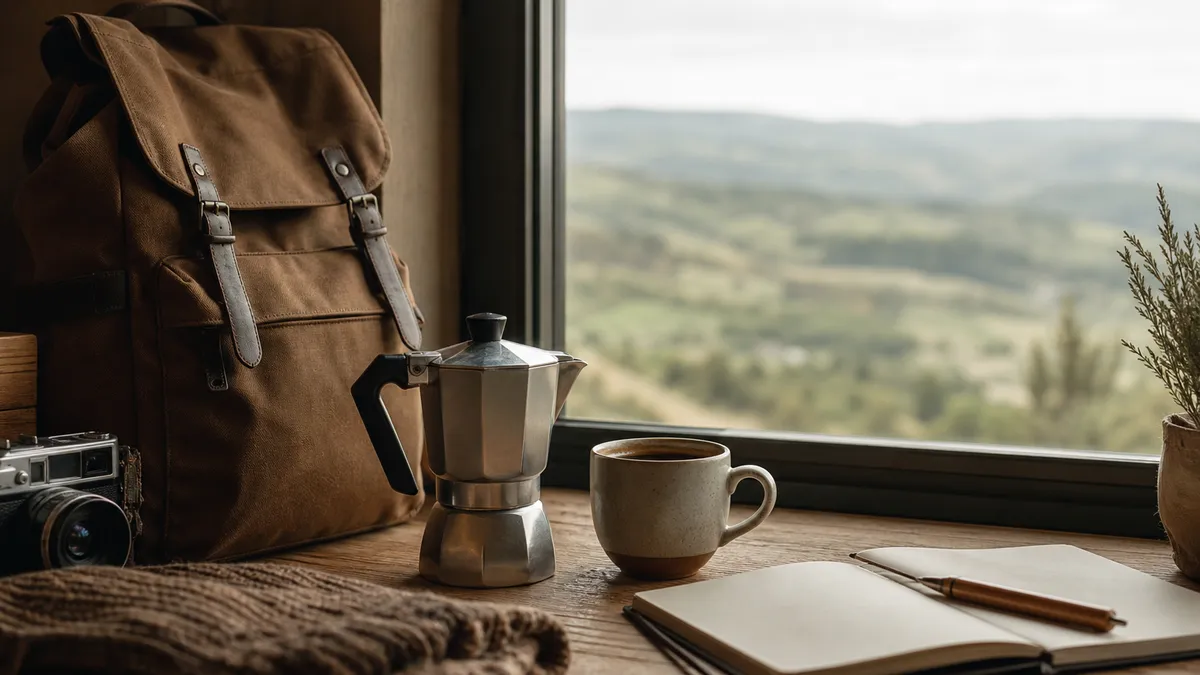
Coffee tourism is travel in which coffee helps shape what you visit, learn and experience, from working farms to neighbourhood cafés and festivals. It can be the purpose of a whole holiday or a thoughtful addition to an existing trip; responsible coffee tourism respects the people, places and working routines behind the drink.
In short
- Choose the experience first: growing and processing, café culture, or organised tastings and events.
- Ask what will actually be happening during your visit, rather than assuming every advertised activity is available.
- Check who owns and runs an experience, and how producers and local guides participate.
- Confirm access, transport, language and photography arrangements before booking.
- For overseas trips, check current FCDO advice and appropriate insurance, including cover for your planned activities.
What counts as coffee tourism?
Coffee tourism means treating coffee as a way to understand a place, rather than simply finding somewhere to order your usual drink. You might meet a producer, explore how a neighbourhood uses its cafés, or attend a workshop that changes how you taste coffee.
No specialist knowledge is required. A useful starting question is: “What would I like to understand that I cannot learn from a bag of beans?” The answer could be how coffee is grown, why a particular brewing tradition matters, or how a local roaster chooses its coffees.
The three broad approaches below are a planning framework, not an official classification.
| Experience | Best suited to | What to establish beforehand | Responsible approach |
|---|---|---|---|
| Origin tourism | Understanding production and meeting people involved | Which farm or facilities you will visit and what is operating | Let hosts set access and participation boundaries |
| City café tourism | Exploring everyday rituals, hospitality and brewing | Opening hours, ordering customs and any reservation requirements | Be a considerate customer, not an uninvited photographer |
| Festivals and events | Comparing coffees and joining organised learning | Public access, session arrangements and workshop bookings | Choose purposeful activities rather than collecting samples |
For the wider subject, start with coffee and travel. This guide focuses on choosing and approaching experiences, rather than ranking destinations or setting out individual country itineraries.

Origin tourism: understand the work behind the cup
Origin tourism takes you towards coffee production. A visit may involve a farm, a cooperative, processing facilities or a roastery, but the itinerary needs checking: a farm walk and a demonstration-led visitor attraction are different experiences.
For example, the Costa Rican cooperative Coopeldos describes a programme covering model farms, wet and dry processing, preparation for export, roasting and tasting. That is an operator’s description of its own tour, not an independent assessment or a promise about another provider.
Before choosing a visit, ask which activities you will observe directly. Will processing equipment be running? Is harvesting expected during your dates? Is the tasting connected to coffee from the property or cooperative? Request a clear distinction between normal production and demonstrations arranged for visitors.
Neither format is automatically better. A demonstration can make a process easier to follow, while an operating facility may provide less predictable access. Choose according to your learning goal, and do not expect production schedules to revolve around your arrival.
If meeting producers matters most, ask who normally leads the visit and whether conversation requires an interpreter. Avoid assuming that the person presenting the tour owns the farm, grows the coffee or represents every worker’s experience.
See coffee plantation tours for the detailed questions to ask when assessing a farm visit.
City café tourism: notice how coffee belongs to a place
City café tourism is about social habits as much as drinks. Approach a café as somewhere people use, not simply somewhere to photograph.
Two heritage examples show the distinction. UNESCO’s entry for Turkish coffee culture and tradition, inscribed in 2013, describes brewing alongside hospitality, conversation and social occasions. The Austrian Commission for UNESCO’s national inventory entry for Viennese coffee house culture, inscribed in 2011, emphasises its distinctive atmosphere and social setting.
These are different forms of recognition. Vienna’s entry belongs to Austria’s national inventory; it should not be presented as the same international inscription as Turkish coffee culture.
For your own visit, consider pairing a contemporary café with a venue practising a local tradition. Notice how people order, whether they linger, and what accompanies the drink. Ask staff about unfamiliar customs when they have time, rather than judging everything against your usual speciality coffee shop.
Keep your route manageable. My recommendation is to choose a few places with contrasting purposes and leave room to stay longer somewhere interesting. A quiet conversation can teach more than another hurried stop.
Ask before photographing staff or customers. Buying a drink does not entitle you to record the room, rearrange furniture or interrupt service.
Festivals: choose learning over collecting samples
Festivals offer another route into coffee tourism, particularly if you want organised activities rather than a self-guided itinerary. The London Coffee Festival’s official visitor information describes tastings, demonstrations, workshops and competitions, with separate industry and consumer arrangements.
Check the organiser’s current information before arranging travel. Confirm that your chosen session admits the public, whether a workshop needs its own reservation, and what happens if an advertised speaker or activity changes.
Build your visit around a question. You might want to compare unfamiliar coffees, understand a brewing technique or hear a discussion about sourcing. Read the programme with that purpose in mind instead of trying to see everything.
Leave gaps between activities. Ask exhibitors before recording a demonstration, and remember that a conversation at a stand is not an independent verification of a company’s sourcing or environmental claims.
For an introductory experience, a festival can work well without becoming the centre of an entire holiday. Equally, one carefully chosen workshop may suit you better than a large event.
Responsible coffee tourism: ask who benefits and who decides
Responsible travel begins with the host’s perspective. UN Tourism’s Global Code of Ethics calls for respect for local customs and for communities to participate in tourism’s benefits. It also stresses that cultural practices should not be standardised merely to satisfy visitors.
The Global Sustainable Tourism Council’s tour operator framework similarly considers local community benefits, cultural heritage and environmental impacts alongside management. These provide useful questions, not a guarantee that a particular coffee experience performs well.
Look for specific arrangements
Ask who operates the experience, who guides it and how the farm or community participates. If an intermediary organises the visit, request a clear explanation of the host’s role.
A locally owned business deserves consideration, but ownership alone does not answer questions about working conditions or environmental practice. Look for concrete explanations rather than relying on words such as “authentic”, “ethical” or “eco”.
An operator should be able to explain what visitors may do, which areas are private and how concerns can be raised. Treat reluctance to promise unlimited access as a potentially sensible boundary, not necessarily poor hospitality.
Respect work, privacy and consent
Do not pick coffee, handle equipment or join a task without an explicit invitation. If participation is offered, ask whether it is an educational demonstration and follow the host’s instructions.
Seek permission from the person you want to photograph, not just the guide accompanying you. Accept a refusal without negotiation, and do not make children, workers or domestic spaces into props for a travel story.
Be equally considerate about questions. Ask whether a topic is appropriate before pressing someone about personal income, employment or family circumstances. A farm visit is not an entitlement to someone’s private life.
Make environmental questions practical
Ask about group size, transport arrangements, waste and any restrictions protecting the site. Request an explanation of environmental claims, including what they cover and how they are checked.
As a planning preference, consider adding a coffee experience to a journey already being made, or choosing fewer stops with more time at each. Do not describe a trip as environmentally harmless simply because its activities involve agriculture.
How to plan a coffee tourism experience
Use this sequence before committing to an itinerary.
- Set one main learning goal. Choose production, café culture or structured tasting as your starting point. Let that goal determine the experience.
- Verify the provider directly. Use the venue or operator’s own current information and confirm that bookings are being accepted for your dates.
- Ask what the visit includes. Establish the locations, guide language, expected activities and whether demonstrations replace any production you hoped to see.
- Check access in practical terms. Ask about surfaces, steps, slopes, seating, toilets and vehicle access. Describe your requirements rather than relying on a general “accessible” label.
- Confirm the journey and return. Establish the meeting point, transport responsibilities and arrangements if weather or other disruption changes the visit.
- Read the conditions. Obtain written confirmation of inclusions, cancellation arrangements, group limits and any restrictions on children, photography or participation.
- Check overseas travel advice and insurance. The FCDO recommends destination advice checks and appropriate cover for existing conditions and planned activities. Travelling against FCDO advice may invalidate insurance.
- Check souvenirs before accepting them. Do not assume that a coffee seedling, seeds or other plant material can travel home with you. Great Britain’s rules depend on the product and its origin; Northern Ireland has different arrangements.
For planning beyond a single visit, use tours in coffee-growing regions. Keep a fallback activity and avoid making an entire journey depend on one unconfirmed appointment.
Ask better questions, bring home better notes
For a deeper visit, move beyond “What is your best coffee?” Ask what the host wants visitors to understand, what has changed recently, and which part of the work is hardest to explain.
Separate observation from interpretation in your notes. “We watched this batch being processed” is different from “all coffee here is processed this way”. Likewise, record whether a statement came from a grower, a guide or promotional material.
During a tasting, ask which differences the host intends to demonstrate. If several things change between samples, describe your preference without claiming to have isolated its cause.
Finally, avoid treating one encounter as representative of a whole country. The most useful souvenir from coffee tourism may be a more precise question, together with the name of the person who helped you ask it.
FAQ
Do I need to understand speciality coffee before going?
No, you can plan a worthwhile visit around beginner questions. Tell the organiser what you already know and what you hope to learn, then ask whether the experience suits that level. You do not need tasting vocabulary or brewing equipment to be interested in someone’s work, hospitality or local traditions.
Can I enjoy coffee tourism if I do not want to drink much coffee?
Yes, make culture, observation or conversation your main purpose. Ask whether tastings are optional and whether you can share samples or decline them. Choose an experience whose value does not depend on finishing every drink, and explain your preference beforehand rather than expecting the host to infer it.
What if the tour differs from its description?
Raise the difference with the organiser and refer to your written booking information. Ask what has changed and whether an alternative is available, while respecting any immediate safety or access restrictions. Afterwards, describe specific discrepancies in feedback rather than speculating about motives or making claims you cannot substantiate.
Where to go next
Read Coffee and Travel to place coffee tourism within your wider travel interests. Coffee Plantation Tours helps you assess a farm visit, while Tours in Coffee-Growing Regions is the next read when you want to connect individual experiences into a regional journey.
Sources
-
Coopeldos, Coffee Tours, undated operator information, retrieved November 2026. Programme details are the operator’s own description.
https://www.coopeldos.com/en/coffee-tours/ -
UNESCO, Turkish coffee culture and tradition, Representative List entry, 2013.
https://ich.unesco.org/en/RL/-00645 -
Austrian Commission for UNESCO, Viennese coffee house culture, national inventory entry, 2011.
https://www.unesco.at/en/culture/intangible-cultural-heritage/inventory/element/article/viennese-coffee-house-culture -
The London Coffee Festival, Visit The London Coffee Festival, current organiser information, retrieved November 2026.
https://www.londoncoffeefestival.com/visiting -
UN Tourism, Global Code of Ethics for Tourism, 1999, current explanatory page and code text retrieved November 2026.
https://www.untourism.int/global-code-of-ethics-for-tourism -
Global Sustainable Tourism Council, GSTC Tour Operator Standard, current framework overview, retrieved November 2026.
https://www.gstc.org/gstc-criteria/gstc-tour-operator-standard/ -
Foreign, Commonwealth & Development Office, Foreign travel insurance, updated 2024, retrieved November 2026.
https://www.gov.uk/guidance/foreign-travel-insurance -
GOV.UK, Bringing plants and wood into Great Britain: Overview, current guidance, retrieved November 2026.
https://www.gov.uk/bringing-plants-and-wood-into-great-britain/overview
This article was researched using official heritage records, tourism ethics frameworks, government guidance and providers’ published information; planning recommendations are editorial guidance, not first-hand tour reviews.
Last checked: November 2026