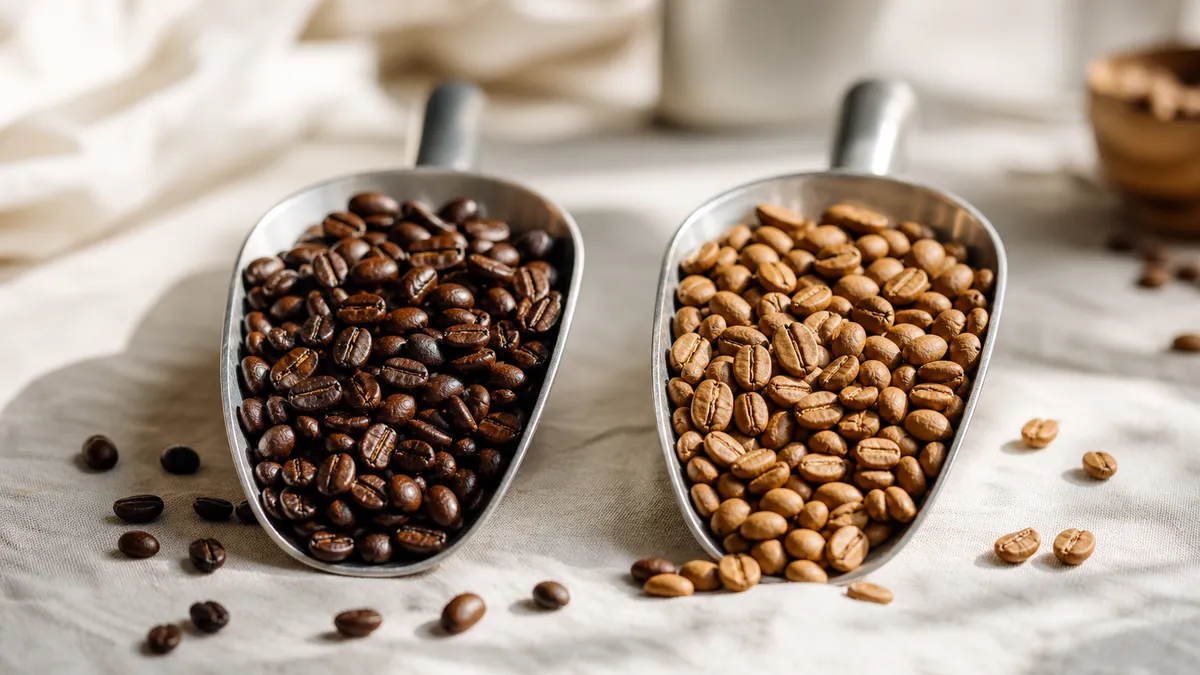
Dark roast coffee does not reliably have more caffeine than light roast. The answer depends partly on how you measure: a scoop of lighter-roasted beans will generally hold more coffee by weight, while equal weighed doses remove that density difference but still do not guarantee equal caffeine in the cup.
In short
- Compare weighed doses, not matching scoops, when assessing roast differences.
- Caffeine is relatively stable during roasting, but it is not completely unaffected.
- Beans expand and lose mass as they roast, changing how much coffee fits into a scoop.
- Laboratory brewing studies have produced different caffeine rankings across roast levels.
- Choose roast for flavour, not as a dependable caffeine guide.
Why measuring dark roast caffeine matters
“More caffeine” needs a denominator: more per gram of beans, per scoop, per millilitre of drink or per whole serving? These are different questions, and an answer to one cannot automatically answer the others.
Roasting changes both the chemistry and physical structure of coffee. Beans lose mass while expanding, so darker-roasted beans generally have a lower density, meaning less mass occupies the same space. That makes a scoop a particularly awkward tool for comparing roasts.
The wider lesson behind coffee myths and facts applies here: before accepting a claim, check what was actually compared. Matching the colour of the drink, the size of the mug or the number of scoops does not establish a matching caffeine dose.
What happens to caffeine during roasting?
Caffeine is relatively resistant to roasting heat compared with compounds such as chlorogenic acids, a group of naturally occurring coffee compounds. It is therefore misleading to imagine that roasting simply burns away most of the caffeine.
However, “relatively stable” does not mean “unchanged under every roasting condition”. Intense roasting can cause caffeine losses. Researchers have proposed sublimation, the passage of a solid directly into a gas, as one explanation, although evidence from brewed coffee does not directly measure every molecule leaving the bean.
There is also a concentration effect. If other material disappears faster than caffeine, the remaining coffee can contain more caffeine per gram without roasting having created any caffeine. The amount present and its proportion of the remaining bean are not the same thing.
A laboratory study published in Molecules in 2021 found no statistically significant overall difference in caffeine concentration across its green, light, medium and dark coffee groups. That supports caution about large, universal roast claims, rather than proving that all roasts are identical.
By weight versus by scoop
The following comparison assumes broadly comparable starting coffee. Comparing unrelated blends introduces another variable before roasting is considered.
| How you measure | What the comparison controls | What you can reasonably conclude |
|---|---|---|
| Equal scoops of whole beans | Approximate volume | Lighter roast generally supplies more bean mass, which can mean more caffeine |
| Equal scoops of ground coffee | Approximate volume, imperfectly | Grind size and packing also affect the dose, so the caffeine ranking is uncertain |
| Equal weighed doses | Mass of roasted coffee | The scoop-density effect disappears, but caffeine concentration and extraction can still differ |
| Equal volumes of brewed coffee | Drink volume only | You still need to know the dose, beans and brewing conditions |
The scoop explanation is a physical inference, not a universal laboratory measurement of caffeine in spoonfuls. It works best when comparing the same starting coffee at different roast levels, with similar caffeine concentrations per gram.
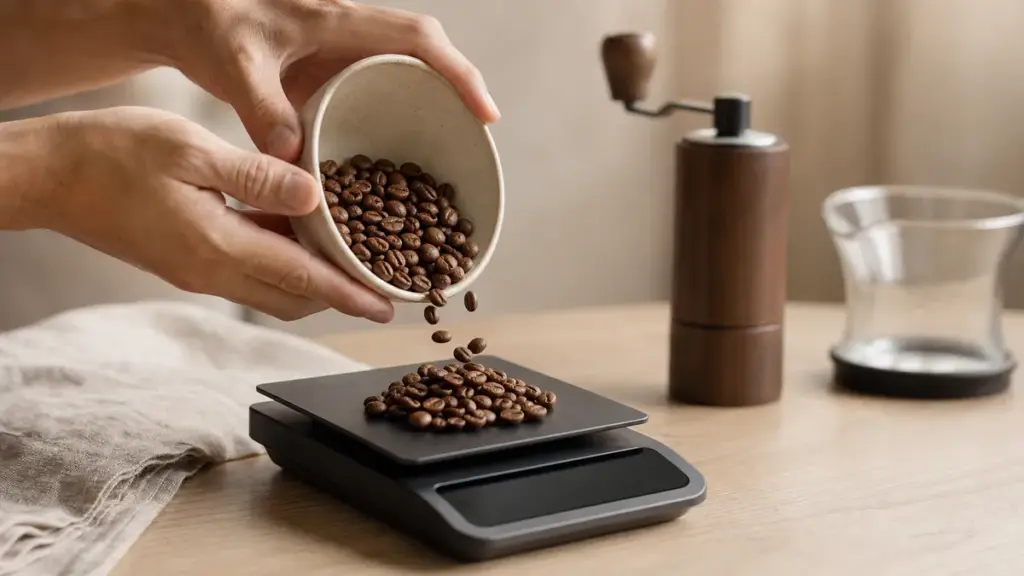
Weighing is the clearer comparison because it removes one source of uncertainty. It does not turn a kitchen scale into a caffeine analyser.
Nor does equal weight necessarily mean dark roast wins. The familiar claim that “dark roast has more caffeine by weight because you use more beans” skips a step: counting beans does not establish how much caffeine each contains after roasting.
What does brewing research show?
The evidence does not support one roast ranking for every brewing situation.
In a 2024 study published in Scientific Reports, researchers tested 30 combinations of coffee, roast degree and brewing time using an AeroPress. Under identical brewing conditions, darker roasts generally produced lower caffeine concentrations than light and medium roasts. The authors nevertheless cautioned against extending their results to every possible roast and extraction condition.
An earlier controlled brewing study, published in Applied Sciences in 2021, found the opposite direction: caffeine content increased with roast degree in its espresso and drip preparations.
These were laboratory experiments measuring coffee, not trials showing how alert drinkers felt. Their different findings also do not mean that measurement is pointless. They show why the answer must account for the starting beans, roast treatment and extraction, the transfer of compounds from grounds into water.
Think of the process in stages:
Caffeine in the weighed grounds → caffeine extracted into the drink → caffeine in the portion you consume.
Roast colour alone cannot supply all three answers. This distinction between a plausible explanation and a measured result is explored further in coffee science claims.
The practical answer for your next brew
Use the roast you enjoy, then make the dose repeatable. If you want to compare two coffees fairly:
- Weigh the grounds rather than counting scoops. Keep the coffee dose and water mass consistent.
- Keep the brewer and preparation consistent. Record grind setting, water temperature and contact time.
- Separate flavour preference from caffeine estimation. A taste comparison cannot establish caffeine content.
- Seek product-specific information if caffeine matters. Prefer a measured figure for a stated preparation and serving over a general claim about roast.
Coffee type matters too. A controlled study published in 2014 found higher caffeine levels in brews made from its robusta cultivar than from its arabica cultivar. Roast labels cannot account for differences between the beans or blends being compared.
Serving size adds another complication: caffeine concentration and the total amount consumed are different measurements. For that separate question, read espresso versus filter caffeine.
So, does dark roast have more caffeine? Not predictably. Weighing makes your brewing more consistent; it does not make roast darkness a dependable caffeine label.
FAQ
Can I work out caffeine content from the coffee’s weight?
Not precisely: weight tells you the amount of coffee used, not its caffeine concentration or how much reaches the drink. It is useful for repeating a recipe and removing scoop variation. To estimate caffeine more closely, you need information about the particular coffee and preparation, ideally supported by laboratory measurement.
Does adding water reduce the caffeine in my coffee?
Adding water reduces caffeine concentration, but not the total caffeine already present, provided you drink the whole diluted serving. You have spread the same amount through more liquid. Drinking only part of that mixture reduces the amount consumed, which is why caffeine per millilitre and caffeine per serving need to be kept separate.
Should I choose dark roast to limit caffeine during pregnancy?
No: dark roast is not a dependable way to control caffeine intake. NHS guidance advises no more than 200 mg a day during pregnancy, counting all sources. Ask for product-specific caffeine information rather than judging by roast colour, and speak to your midwife, GP or pharmacist if you need personal advice.
Where to go next
Read Coffee Myths and Facts for the broader collection, then Coffee Science Debunked for help assessing coffee claims. Is Espresso Stronger Than Filter Coffee? explains why concentration and serving size need separate answers.
Sources
-
American Society of Agricultural and Biological Engineers, Rodrigues and colleagues, Evolution of physical properties of coffee during roastin, 2002 ASAE Annual Meeting, paper 026030, 2002. Publisher’s title reproduced as listed.
https://elibrary.asabe.org/abstract.asp?aid=9759&redir=&redirType=&t=2 -
Molecules, Awwad and colleagues, Quantification of Caffeine and Chlorogenic Acid in Green and Roasted Coffee Samples Using HPLC-DAD and Evaluation of the Effect of Degree of Roasting on Their Levels, volume 26, article 7502, 2021.
https://pmc.ncbi.nlm.nih.gov/articles/PMC8705492/ -
Scientific Reports, Lindsey and colleagues, Caffeine content in filter coffee brews as a function of degree of roast and extraction yield, volume 14, article 29126, 2024.
https://pubmed.ncbi.nlm.nih.gov/39582028/ -
Applied Sciences, Jung and colleagues, Effect of Roasting Degree on the Antioxidant Properties of Espresso and Drip Coffee Extracted from Coffea arabica cv. Java, volume 11, article 7025, 2021.
https://www.mdpi.com/2076-3417/11/15/7025 -
Institute of Food Technology, Brazil, Tfouni and colleagues, Caffeine and chlorogenic acids intake from coffee brew: influence of roasting degree and brewing procedure, International Journal of Food Science and Technology, volume 49, pages 747 to 752, 2014.
https://repositorio.ital.sp.gov.br/jspui/bitstream/123456789/486/1/Caffeine%20and%20chlorogenic%20acids….pdf -
European Food Safety Authority, Caffeine, current topic page summarising the 2015 scientific assessment.
https://www.efsa.europa.eu/en/topics/topic/caffeine -
NHS, Foods to avoid in pregnancy, reviewed 15 June 2026.
https://www.nhs.uk/pregnancy/keeping-well/foods-to-avoid/
Research compared primary laboratory studies of roasted beans and brewed coffee, checked physical-density evidence, and consulted current official caffeine guidance; the scoop explanation is identified as an inference.
Last checked: November 2026