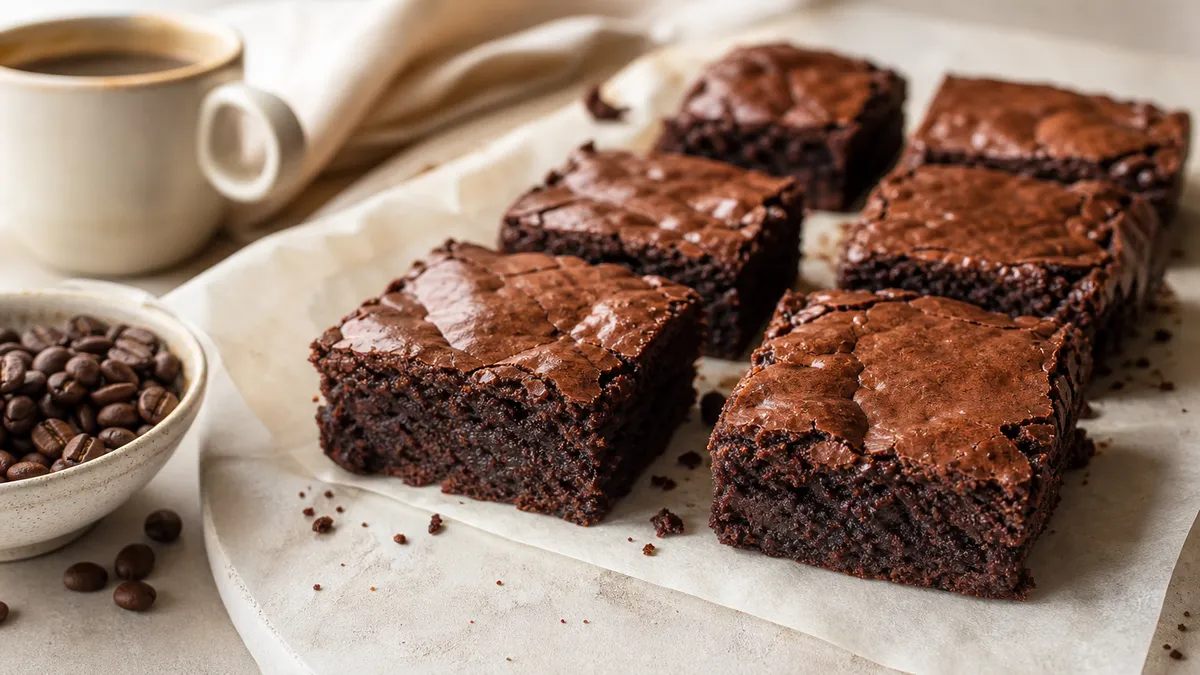
Espresso brownies combine a dense chocolate crumb with the roasted flavour of coffee. This cocoa-based recipe uses soluble espresso powder rather than a liquid espresso shot, keeping the added water controlled; bake until the centre is set but still moist, then cool before cutting.
In short
- Use soluble espresso powder, not finely ground coffee beans.
- Weigh the eggs without their shells: this recipe needs 150 g.
- Use a 20 cm square metal tin and start checking after 25 minutes.
- Look for moist crumbs on a skewer, not uncooked batter or a completely dry centre.
- Cool before slicing, then refrigerate or freeze using the storage guidance below.
Choosing coffee for espresso brownies
For this recipe, espresso powder means brewed coffee that has been dried into a soluble powder. Check the packaging: it should dissolve in water. Coffee labelled “espresso grind” is ground roasted beans, not the same ingredient.
Soluble powder is useful because it supplies coffee flavour without requiring a full shot of liquid. Here, it is dissolved in a measured amount of hot water before joining the batter, helping distribute it evenly.
Use 6 g for the recipe below. This is a suggested starting point, not a universal strength setting: different powders have different flavour profiles. Plain instant coffee is a workable alternative, although the result will taste different. Avoid sweetened latte or cappuccino sachets, which introduce other ingredients.
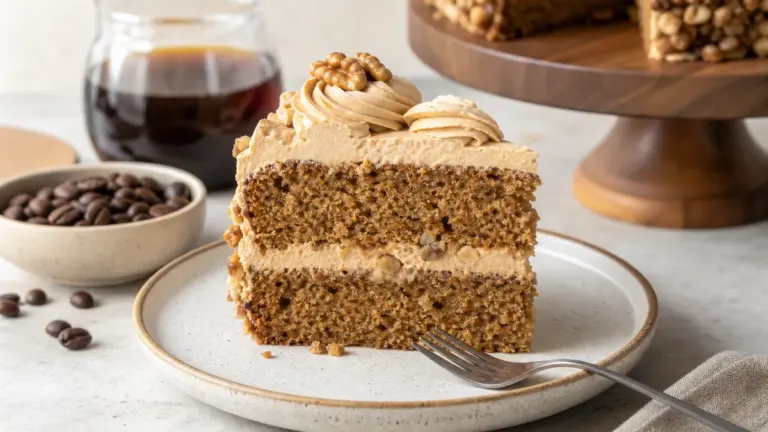
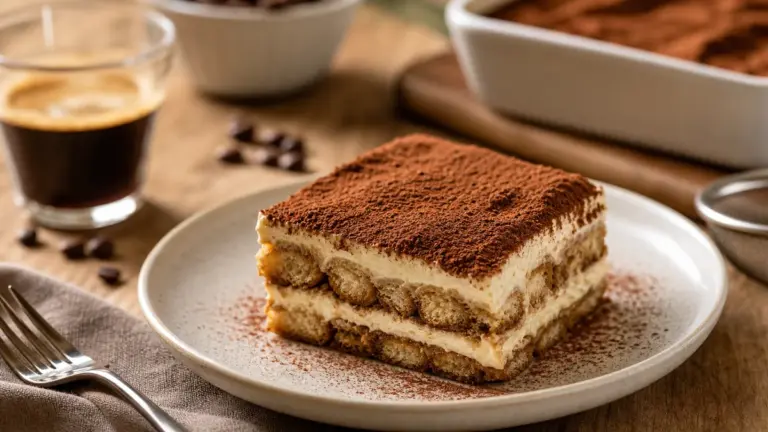
For other ways of putting coffee into puddings, start with coffee desserts. The soaking method used in tiramisu serves a different purpose and should not be transferred directly to brownie batter.
Espresso brownies recipe
This formulation aims for a compact, fudgy brownie rather than a light chocolate sponge. It uses cocoa powder for the chocolate component, with no melted chocolate or chocolate chips.
Recipe card
Makes: 16 small squares
Preparation: approximately 15 minutes
Baking: approximately 25 to 30 minutes
Cooling: approximately 1 hour, or until completely cool
Total: approximately 1 hour 45 minutes, allowing longer if necessary for cooling
Equipment: digital scales, 20 cm square metal baking tin, baking paper, heatproof bowl, small jug, whisk, flexible spatula, sieve, skewer and cooling rack.
Ingredients
- 175 g unsalted butter, plus a little for greasing
- 250 g caster sugar
- 65 g unsweetened cocoa powder
- 85 g plain flour
- 150 g beaten egg, weighed without shells
- 6 g soluble espresso powder
- 15 ml hot water
- 5 ml vanilla extract
- 2 g fine salt
Allergens: contains milk, egg and wheat. Check individual ingredient labels for additional allergens and cross-contact warnings.
Method
-
Prepare the oven and tin. Heat the oven to 180°C conventional or 160°C fan. Lightly grease the tin, then line its base and sides with baking paper, leaving enough overhang to lift out the cooled slab.
-
Dissolve the coffee. Stir the espresso powder into the 15 ml hot water until smooth. Add the vanilla and set aside.
-
Melt the butter. Put the butter in a heatproof bowl over a saucepan of gently simmering water, keeping the bowl clear of the water. Stir until melted, then remove from the heat.
-
Make the cocoa mixture. Whisk the sugar, cocoa and salt into the melted butter. The mixture will be thick rather than pourable. Leave it until warm, not hot, before adding the eggs.
-
Add eggs and coffee. Whisk in the beaten egg in several additions, followed by the dissolved coffee mixture. Stop once everything is evenly combined.
-
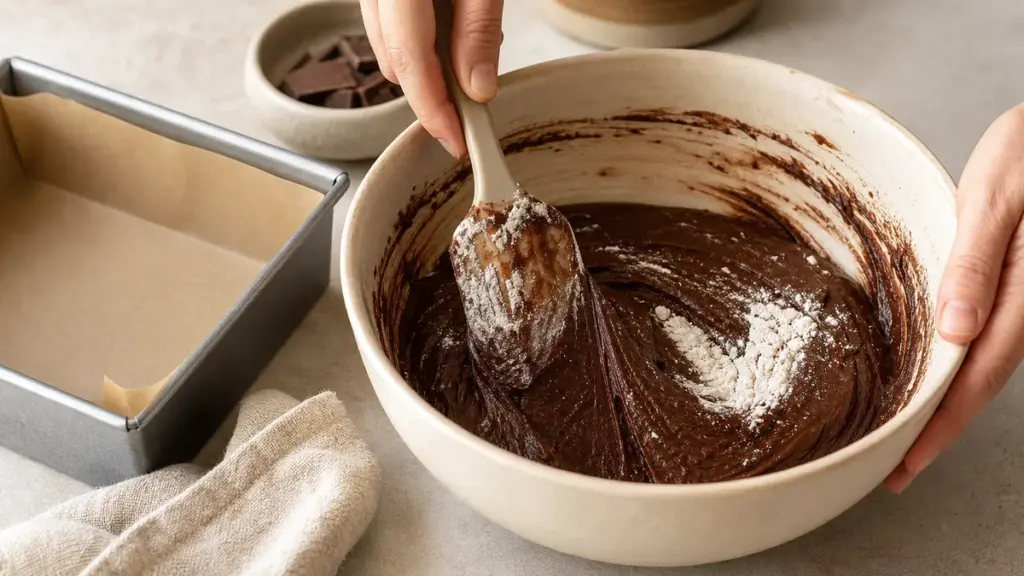
Fold in the flour. Sift the flour over the bowl and fold with a spatula, scraping around the sides and across the bottom. Stop when no dry flour remains.
-
Bake. Spread the batter evenly in the lined tin. Bake on the middle shelf for approximately 25 to 30 minutes, checking from 25 minutes. The edges should be set and a skewer inserted near the centre should carry moist crumbs, not a coating of glossy, uncooked batter. Continue baking if the centre is still liquid.
-
Cool and cut. Put the tin on a rack and leave until the brownies are completely cool. Lift out using the paper and cut into 16 squares, wiping the knife between cuts.
Do not taste the uncooked batter. Raw flour can carry food-poisoning bacteria, so the absence of raw-looking egg is not enough to make batter ready to eat.
Approximate caffeine
For the plain instant-coffee alternative, allow approximately 18 to 26 mg caffeine per square, assuming 16 equal portions.
The illustrative calculation uses:
- 6 g instant coffee at NESCAFÉ’s published range of 50 to 90 mg per 2 g: 150 to 270 mg.
- 65 g cocoa at the FSANZ reference figure of approximately 11 mg per 5 g: 143 mg.
- Estimated batch total: 293 to 413 mg, divided by 16.
This is an ingredient-based estimate, not a laboratory measurement, and assumes no caffeine loss during baking. It does not establish the caffeine content of an unspecified espresso powder. For that version, use the powder manufacturer’s information where available; do not assume all powders match the instant-coffee range.
In pregnancy, NHS advice is no more than 200 mg caffeine daily from all sources. Individual sensitivity varies. Ask a midwife, GP or pharmacist if you need personal advice.
Getting a fudgy texture without leaving raw batter
Fudginess comes partly from the balance of ingredients. Relatively little flour and no baking powder favour a compact crumb; increasing flour or adding a raising agent moves the result towards cake.
That is why weighing matters. Adding extra flour because the batter looks thick changes the intended balance. Likewise, adding an espresso shot on top of the measured water changes the formula rather than simply strengthening the coffee flavour.
Cooling is part of the method, not an optional pause. Judge the final texture when the slab is cool, rather than cutting into the hot centre and assuming it has failed.
The baking time is a checking window, not a guarantee. Tin dimensions and oven behaviour affect the result. Use the specified tin for the most useful comparison, and combine the clock with the doneness checks in the method.
| Symptom | Likely cause | What to do |
|---|---|---|
| Dry, crumbly centre | Too much flour or excessive baking | Weigh the flour and begin checking at the earlier time |
| Glossy, liquid centre | Insufficient baking | Return to the oven and check again before cooling |
| Brownies break during cutting | Cut before completely cool | Let the slab cool fully and wipe the knife between slices |
| Sandy coffee texture | Ground coffee used instead of soluble powder | Choose a dissolving product and mix it with the measured water first |
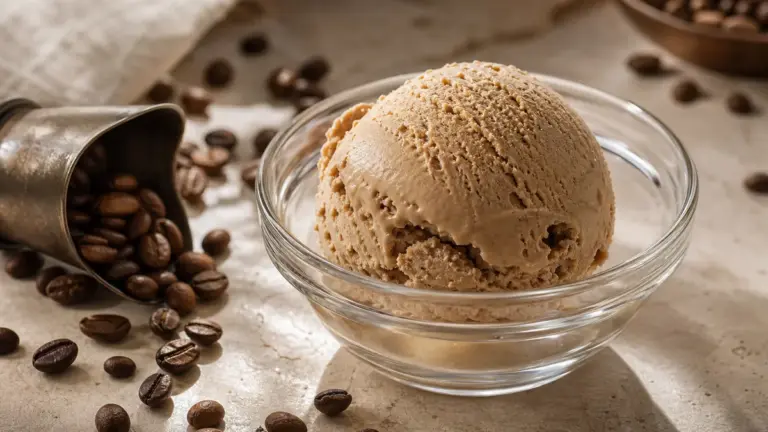
For a contrasting dessert, serve a small square alongside coffee ice cream. Keep any ice cream separate during brownie storage.
Storing and freezing espresso brownies
For a cautious home-storage approach, follow the FSA’s general leftovers guidance: cool the brownies and refrigerate within two hours, then eat within 48 hours or freeze. This is general food-safety guidance, not a measured shelf-life assessment of this particular recipe.
Store in a covered container in a fridge operating at 0 to 5°C. Separate layers with baking paper so the cut surfaces do not stick together.
For freezing, wrap individual portions and put them in a suitable sealed container. Use three months as a quality target, following published brownie guidance, rather than treating it as a precise safety deadline. Defrost in the fridge and follow the FSA advice to use food within 24 hours of being fully defrosted.
Keep this recipe unfrosted for straightforward storage. A cream, mascarpone or mousse topping needs its own handling instructions; see coffee cheesecake and mousse rather than borrowing brownie storage advice.
FAQ
Can I make these without a coffee machine?
Yes, this recipe needs no coffee machine. Soluble espresso powder is the coffee ingredient, and it is dissolved in a small measured amount of hot water. Check that you are buying a soluble product rather than coffee beans ground for an espresso machine. Plain instant coffee is an alternative, though its flavour will differ.
Can I halve the recipe?
Yes, halve every ingredient by weight, including the beaten egg. Use a smaller tin with roughly half the base area if you want a similar batter depth. Do not simply halve the baking time: begin checking earlier, but judge readiness from the set edges and moist crumbs rather than the clock alone.
Are these suitable for taking into work?
They can be portioned for sharing, but label them as containing coffee and caffeine as well as milk, egg and wheat. Keep the storage guidance with the container, and check your workplace’s food-sharing arrangements. Do not describe them as caffeine-free if you substitute decaffeinated coffee, because the cocoa also contributes caffeine.
Where to go next
Read Coffee Desserts for the wider choice of coffee puddings, or Tiramisu for a dessert built around coffee-soaked layers. Coffee Ice Cream offers a cold accompaniment to espresso brownies, while Coffee Cheesecake and Mousse explores softer, spoonable textures.
Sources
-
King Arthur Baking, “Deep-Dark Fudgy Brownies”, updated 2025. Reference for espresso powder in brownies, doneness cues, cooling and freezing quality guidance.
https://www.kingarthurbaking.com/recipes/deep-dark-fudgy-brownies-recipe -
King Arthur Baking, “Types of brownies: fudgy, chewy, and cakey explained”, 2025. Reference for the effects of flour, fat, liquid and raising agents on texture.
https://www.kingarthurbaking.com/blog/2025/05/21/types-of-brownies -
DeLallo, “Instant Espresso Powder”, undated manufacturer product information. Reference for soluble espresso powder’s manufacture and use.
https://www.delallo.com/delallo-instant-espresso-coffee-powder-1-94-oz/ -
NESCAFÉ UK and Ireland, “General FAQs”, undated manufacturer information. Reference for the stated caffeine range in Original and Gold instant coffees.
https://www.nescafe.com/gb/faqs -
Food Standards Australia New Zealand, “Consultation paper: naturally occurring caffeine and labelling”, 31 October 2025, section 2.3.1.1. Reference for the illustrative cocoa caffeine figure only, not UK dietary advice.
https://www.foodstandards.gov.au/sites/default/files/2025-10/P1056%20Consultation%20Paper_Oct2025.pdf -
Food Standards Agency, “Handling flour and flour products safely”, current guidance retrieved November 2026.
https://www.gov.uk/government/publications/handling-flour-and-flour-products-safely/handling-flour-and-flour-products-safely -
Food Standards Agency, “How to chill, freeze and defrost food safely”, published 2017, current guidance retrieved November 2026.
https://www.gov.uk/government/publications/how-to-chill-freeze-and-defrost-food-safely/how-to-chill-freeze-and-defrost-food-safely -
NHS, “Foods to avoid in pregnancy”, current guidance retrieved November 2026.
https://www.nhs.uk/pregnancy/keeping-well/foods-to-avoid/
This recipe is an editorial formulation informed by published baking guidance, manufacturer information and official food-safety sources; it is not presented as a first-hand kitchen test.
Last checked: November 2026