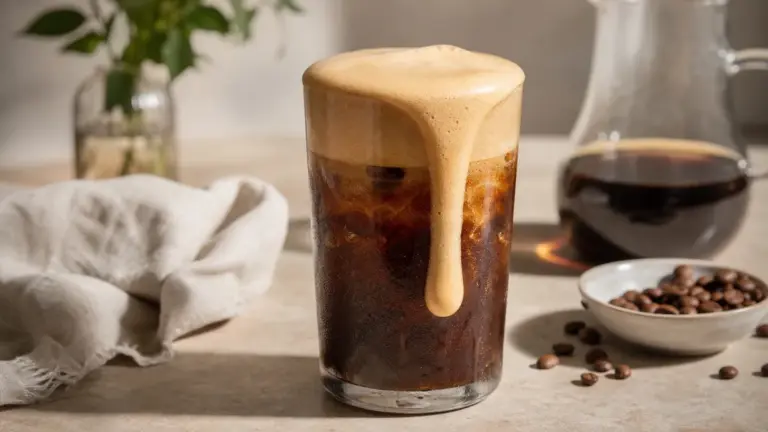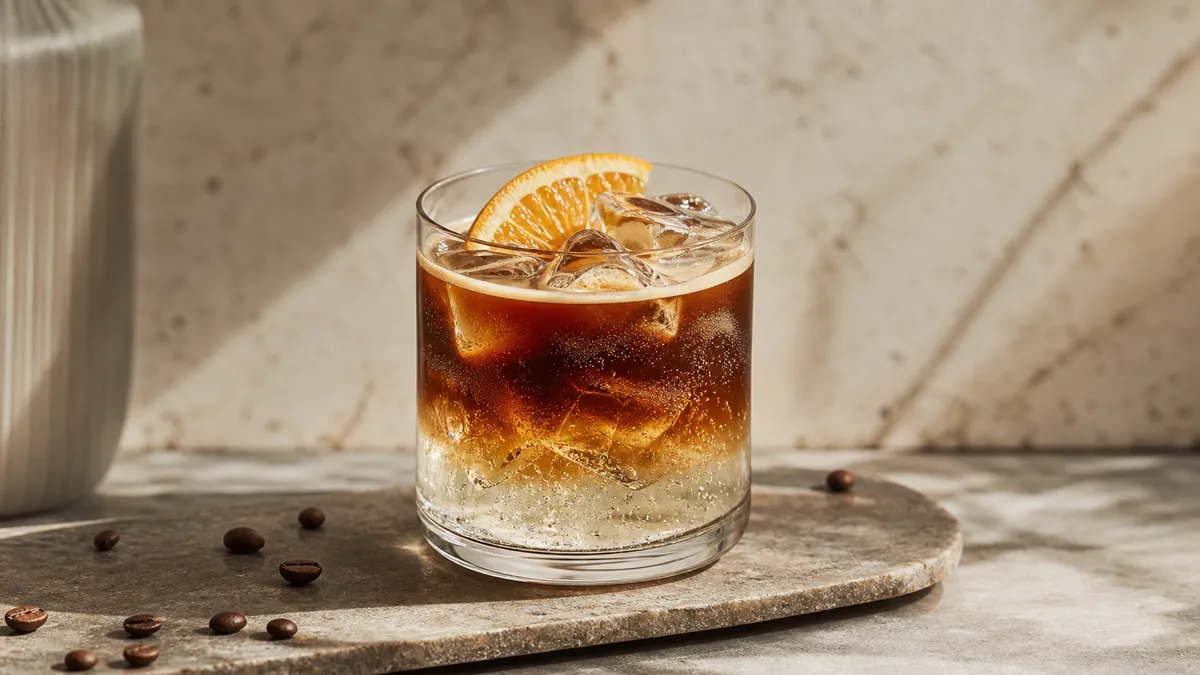
Espresso tonic is a cold drink made by pouring espresso over tonic water and ice, with an optional citrus garnish. Start with 40 ml espresso and 120 ml chilled tonic, then adjust the balance towards a stronger coffee flavour or a longer, gentler drink.
In short
- Build it in this order: ice, tonic, then espresso.
- Choose a plain tonic first, so you can judge the coffee and mixer together.
- Pour the espresso slowly, leaving room for foam.
- Try a coffee with citrus, berry or floral tasting notes, and keep the garnish restrained.
- Caffeine depends on the espresso used, not the size of the finished glass.
Espresso tonic recipe
This is an editorial starting recipe, not a formal brewing standard. It follows the ice, tonic, espresso sequence used in published manufacturer recipes, with quantities chosen to make adjusting the drink straightforward.
Serves: 1
Preparation time: approximately 5 minutes, with the coffee machine ready
Equipment: espresso machine or espresso capsule machine, measuring jug, spoon, and a tall glass of approximately 350 ml capacity
Ingredients
- 40 ml freshly brewed espresso
- 120 ml chilled tonic water
- Approximately 120 g ice cubes, adjusted to fit the glass
- Optional: one thin orange or lime slice, approximately 5 g
Approximate caffeine: 55 to 105 mg when made with one Nespresso Original espresso capsule covered by the manufacturer’s published 40 ml range. Some capsules fall outside that range, and it is not an estimate for an arbitrary espresso made from ground coffee. Use the coffee producer’s drink-specific information where available.
Caffeine sensitivity varies. During pregnancy, NHS guidance is no more than 200 mg daily from all sources; speak to a midwife, GP or pharmacist about personal concerns. EFSA’s caffeine guidance is a scientific risk assessment, not an individual intake target.
Method
- Prepare the garnish. If using citrus, wash the whole fruit under running water, rubbing the skin, before cutting it with clean utensils.
- Fill the glass with ice. Add approximately 120 g, but leave enough space for both liquids and a little foam.
- Add the tonic. Measure in 120 ml chilled tonic water. Let the initial fizz settle.
- Brew the espresso separately. Prepare 40 ml into a small cup or jug. Use your normal espresso programme or the coffee producer’s brewing instructions.
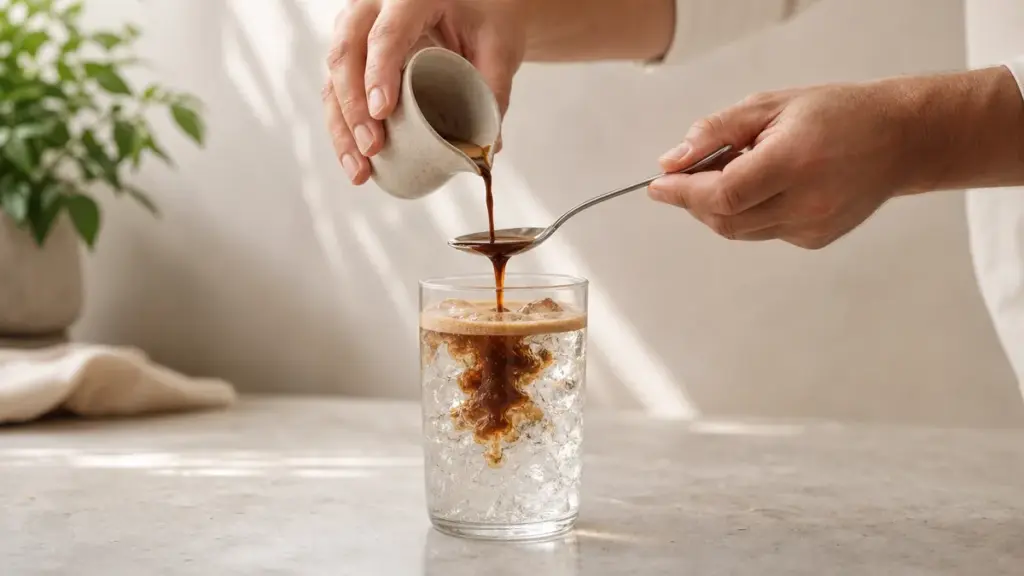
- Pour slowly. Add the espresso in a thin stream over an ice cube or the back of a spoon. Pause if foam approaches the rim.
- Finish and serve. Add the optional citrus slice. Admire the layers, then give the drink a gentle stir if you want a consistent balance from the first sip.
The layers are a presentation choice, not a test of success. A mixed drink can taste just as enjoyable as a sharply divided one.
For other straightforward drinks to make at home, browse coffee recipes.
Choosing the tonic
Start with plain Indian tonic water rather than an emphatically flavoured version. Quinine supplies tonic’s characteristic bitterness; botanical flavourings vary between products, so the mixer deserves as much attention as the coffee.
Taste a little tonic on its own before adding espresso. If you dislike it neat, choose another rather than expecting coffee to disguise it.
My starting recommendation is a regular, sweetened tonic with a restrained botanical character. That is a flavour preference, not a requirement: reduced-sugar and sugar-free versions are worth trying if you prefer them. Check the label rather than assuming that “light” means sugar-free.
Once you know the basic combination, try a citrus-led or gently floral tonic. Change only the mixer at first, keeping the coffee and quantities unchanged, so you can identify what you prefer.
There is no need to add syrup automatically. Taste the finished drink before deciding that it needs more sweetness.
Getting the ratio right
The starting combination is 40 ml espresso to 120 ml tonic. Expressed by volume, that is one part prepared espresso to three parts tonic, before ice melts. This is a drink-mixing ratio, not an espresso brewing ratio between dry coffee and liquid yield.
Use the following as tasting adjustments:
- For more coffee presence: keep the espresso at 40 ml and reduce tonic to 90 ml.
- For a longer drink: keep the espresso at 40 ml and increase tonic to 150 ml.
- For less bitterness: try a different tonic or coffee rather than simply adding more of the same tonic.
These are suggested recipe variations, not measured quality thresholds. Published recipes use different proportions, so there is no single compulsory formula.
Keep the espresso preparation consistent while you experiment. Changing the coffee, tonic and proportions together makes it harder to work out which change helped.
If you would rather start with coffee and water, read about iced espresso drinks.
Which espressos suit it?
My preferred starting point is a light-to-medium roast described by its roaster as citrusy, berry-like or floral. Those descriptors offer a useful pairing direction, rather than a guarantee of how a particular coffee will taste with tonic.
Published specialist recipes support that approach: James Hoffmann suggests different botanical pairings for different coffees, while La Cabra pairs a floral Typica coffee with a citrus-led tonic preparation. Neither makes a particular origin compulsory.
A familiar chocolate-and-nut espresso is still worth trying. You may prefer its contrast with tonic, especially if highly fruity coffee is not usually your choice. Very dark, smoky coffee would not be my first recommendation for someone already wary of bitterness.
Taste the espresso separately before mixing. If you do not enjoy the shot, change or adjust it first rather than treating tonic as a repair ingredient.
There is no need to buy a coffee solely for this recipe. Begin with one you know, then use the result to guide your next choice.
Pouring, garnish and troubleshooting
The simplest pouring rule is tonic first, espresso last. Brewing into a separate vessel gives you control over the final pour, particularly when the glass is nearly full.
Treat a slow pour as a practical precaution rather than a promise of perfect layers. Stop briefly if foam rises, and do not fill the tonic right to the rim before adding coffee.
For garnish, start with the optional thin orange or lime slice. Alternatively, try a small strip of citrus peel instead of the slice. My preference is a little aroma rather than a large squeeze of juice: taste first, then decide whether the drink needs extra citrus.
| Symptom | Likely cause | Fix |
|---|---|---|
| Foam reaches the rim | Too little headroom or an uncontrolled pour | Use a larger glass and add espresso slowly |
| Coffee tastes lost | The chosen tonic proportion dominates | Try 40 ml espresso with 90 ml tonic |
| Drink tastes unpleasantly bitter | The coffee and tonic pairing does not suit you | Taste both separately and change one |
| Citrus overwhelms the drink | Too much garnish or added juice | Use a smaller slice, peel only, or no garnish |
For a different cold-coffee direction, explore nitro cold brew, rather than trying to make every iced drink taste like espresso tonic.
FAQ
Can I use decaffeinated espresso?
Yes, decaffeinated espresso is a sensible variation. Use the same starting quantities, then adjust the tonic to suit the coffee’s flavour. Decaffeinated does not necessarily mean caffeine-free, so consult the producer’s information if you need to monitor intake closely. Do not apply the regular-capsule caffeine estimate in this recipe to a decaffeinated drink.
Can I make it for several people at once?
Yes, but assemble each glass individually just before serving. Set out the glasses, prepare the citrus and chill the tonic beforehand, then measure the mixer and add each espresso last. Individual assembly makes the pour easier to control. The five-minute preparation estimate is for one drink with the machine ready, not a whole batch.
Do I need citrus for espresso tonic?
No, citrus is optional. Manufacturer recipes include optional citrus, and the basic drink needs only espresso, tonic and ice. Try your first sip without garnish so you can judge the pairing clearly. Add a small slice or strip of peel afterwards if you want it, rather than assuming every espresso tonic needs extra acidity.
Where to go next
Visit Coffee Recipes for more drinks, or Iced Latte, Iced Americano and Shaken Espresso to compare other ways of serving espresso cold. For a different texture after espresso tonic, read Nitro Cold Brew.
Sources
-
Nespresso, “Espresso Tonic”, undated. Manufacturer recipe supporting the ingredients, optional citrus and ice, tonic, espresso pouring order.
URL: https://www.nespresso.com/pl/en/przepisy/espresso-tonic -
James Hoffmann, “Weird Coffee Science”, section “Espresso Tonic”, undated. First-party recipe using espresso, tonic and ice, with botanical pairing suggestions.
URL: https://www.jameshoffmann.co.uk/weird-coffee-science -
La Cabra, “Sagastume Typica”, undated. First-party example of a floral coffee paired with a citrus-led tonic preparation.
URL: https://lacabra.com/pages/sagastume-typica -
Fever-Tree, “Premium Indian Tonic Water”, undated. Manufacturer explanation of quinine and botanical ingredients.
URL: https://fever-tree.com/en-gb/products/premium-indian-tonic-water -
Nespresso Taiwan, “Product Information”, undated. Manufacturer caffeine range for brewed Original espresso capsules, with stated exceptions.
URL: https://www.nespresso.com/tw/en/faq-product-information -
Food Standards Agency, “Cleaning”, undated. Guidance on washing fruit and keeping preparation equipment clean.
URL: -
NHS, “Foods to avoid in pregnancy”, current online guidance. Pregnancy caffeine limit from all sources.
URL: https://www.nhs.uk/pregnancy/keeping-well/foods-to-avoid/ -
European Food Safety Authority, “Caffeine”, summarising the 2015 Scientific Opinion on the safety of caffeine. Evidence type: scientific risk assessment. Supports the distinction between population guidance and individual circumstances, and variation in coffee caffeine content.
URL: https://www.efsa.europa.eu/en/topics/topic/caffeine
This article was researched using retrieved first-party recipes, manufacturer ingredient and caffeine information, and official food-safety and health guidance; recipe adjustments and flavour preferences are identified as editorial recommendations, not first-hand testing.
Last checked: November 2026