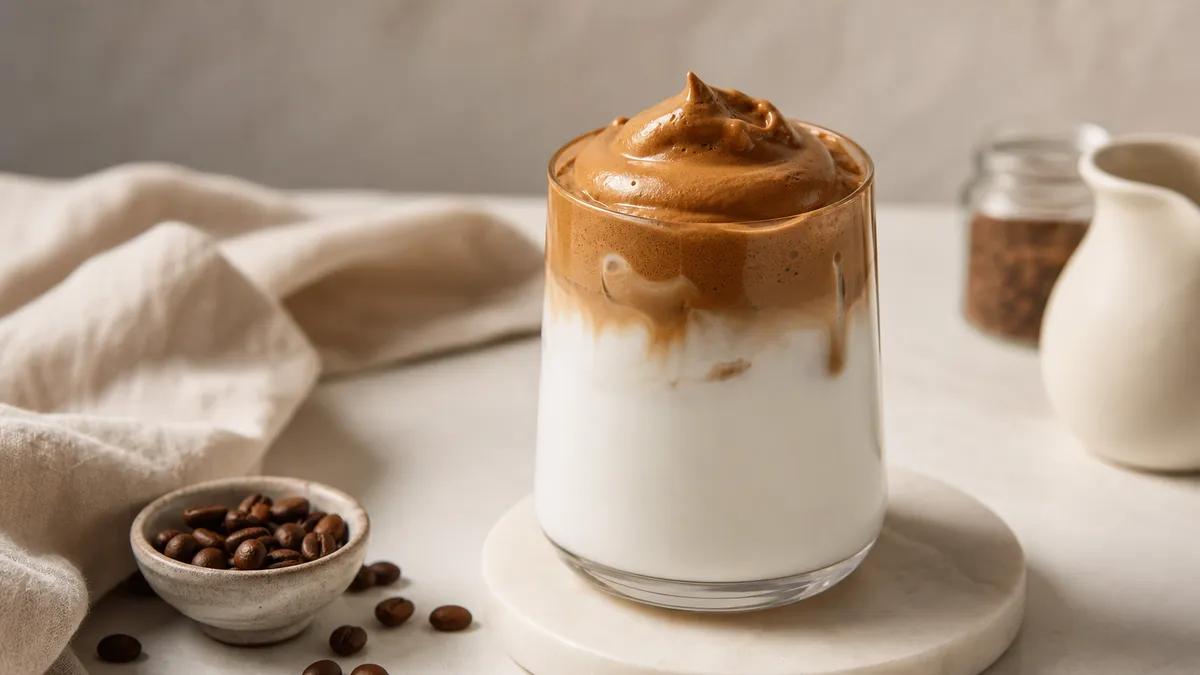
Dalgona coffee is milk topped with a thick foam made by whipping instant coffee, sugar and hot water together. For one serving, use 4 g instant coffee, 12 g sugar and 20 ml hot water, then spoon the whipped mixture over 170 ml milk and ice.
In short
- Use plain instant coffee, not ground coffee or a ready-mixed milky coffee sachet.
- The familiar equal-parts recipe measures ingredients by volume, not weight. Do not translate it into equal gram amounts.
- Whip until the topping holds a peak, rather than stopping as soon as bubbles appear.
- Serve over cold milk and ice, or warm milk without ice. Stir before drinking.
- This recipe contains approximately 100 to 180 mg caffeine when made with 4 g NESCAFÉ Original or Gold, calculated from the manufacturer’s UK figures. Other products can differ.
Dalgona coffee recipe
This is a single-serving adaptation of the manufacturer’s metric recipe, not an espresso recipe. Choose plain soluble instant coffee and keep the milk separate until the foam is ready.
Recipe card
Serves: 1
Time: allow about 10 minutes, including roughly 4 to 6 minutes of whipping; judge readiness by texture.
Ingredients
- 4 g plain instant coffee
- 12 g white sugar
- 20 ml hot water
- 170 ml semi-skimmed milk, or a plant-based alternative
- Ice, optional, enough to chill the milk while leaving room for the topping.
Equipment
Kitchen scales, a measuring jug, a deep mixing bowl, an electric hand whisk or balloon whisk, a spoon and a serving glass. An electric whisk is the less laborious choice; hand-whisking is possible, but may take longer.
Method
- Combine the topping ingredients. Put the instant coffee, sugar and hot water into the bowl. Stir to wet the coffee and sugar.
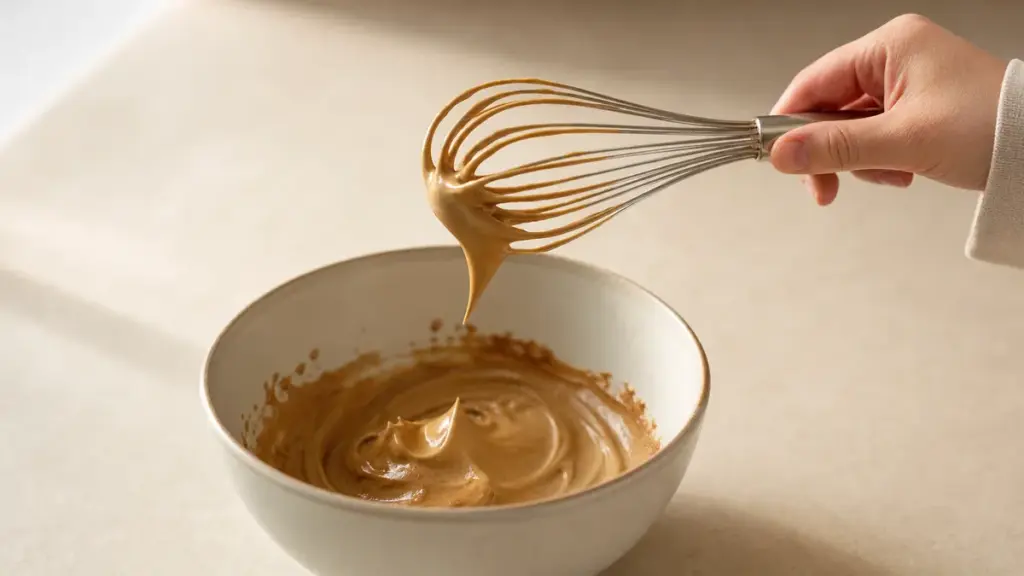
- Whip thoroughly. Beat until the dark mixture becomes pale, thick and fluffy. Allow several minutes, moving the whisk through the mixture so that it incorporates evenly.
- Check the peak. Lift the whisk. The foam should form a mound with a tip that largely holds its shape, rather than immediately running flat.
- Prepare the milk. Put ice in the glass, if using, then add the milk.
- Assemble and serve. Spoon the coffee foam over the milk. Serve with a spoon so the drink can be stirred together.
Approximate caffeine: 100 to 180 mg per serving using 4 g NESCAFÉ Original or Gold. The calculation is 4 g ÷ 2 g × the manufacturer’s stated 50 to 90 mg per 2 g. This is a product-specific estimate, not a measurement of the finished drink. During pregnancy, count it towards the NHS maximum of 200 mg daily from all sources; individual sensitivity also varies.
For other drinks to make at home, browse coffee recipes.
Getting the instant coffee, sugar and water ratio right
Many dalgona recipes call for equal volumes of instant coffee, sugar and water. Those ingredients do not have equal weights at equal volumes, so “equal parts” is not an instruction to weigh out identical gram amounts.
The recipe above uses an instant coffee to sugar to water ratio of approximately 1:3:5 by weight, treating 20 ml water as approximately 20 g for kitchen purposes. This is the topping mixture, not a brewing ratio: the milk is added separately.
Use the measured recipe for your first attempt rather than combining spoon measures from different recipes. Once you have a successful baseline, change one ingredient at a time. A university teaching recipe demonstrates a lower-sugar version, but that does not establish that every sugar substitute will behave identically.
Why whipping makes a thick coffee foam
Whipping introduces air into the concentrated coffee mixture. Coffee contains surface-active substances, meaning molecules that act at the boundary between air and water and help bubbles persist. Controlled laboratory research on instant-coffee foams supports this general mechanism, although experiments using added surfactants are not direct tests of a household dalgona recipe.
For the cook, the useful distinction is between bubbly liquid and finished foam. Continue until the mixture becomes thick enough to hold a peak. A few bubbles on a dark, runny surface are not the endpoint described in the recipe.
Do not replace the instant coffee with ground coffee or an ordinary brewed coffee. The published method is built around soluble instant coffee in a small quantity of water; brewed coffee is not a like-for-like substitute.
Variations and serving
Keep the topping method unchanged at first and vary what goes underneath it:
- Dairy-free: use a plant-based milk you enjoy drinking.
- Warm: omit the ice and spoon the foam over warm milk.
- Lower caffeine: choose decaffeinated instant coffee, checking the product information rather than assuming it is caffeine-free.
- Lightly spiced: finish with a little cinnamon instead of changing the whipping mixture.
If you would rather make an iced drink using espresso, follow iced coffee methods instead of trying to substitute espresso into this recipe.
Troubleshooting dalgona coffee
Use the recipe’s stiff-peak endpoint and measured ingredients as your reference. These are practical checks based on the published methods, not results from comparative testing.
| Symptom | Likely cause | Fix |
|---|---|---|
| Dark, bubbly liquid | Whipping stopped before peaks formed | Continue beating and check the texture periodically |
| Mixture remains very loose | Ingredient quantities differ from the recipe | Recheck the coffee, sugar and water measurements |
| Gritty coffee particles | Ground coffee used instead of soluble instant coffee | Restart with plain instant coffee |
| Topping tastes overpowering | Concentrated foam sampled separately | Stir it through the milk before judging the drink |
The first three checks follow the ingredients and whipping endpoints in the manufacturer and university recipes; stirring before drinking follows the university serving method.
Caffeine and food safety
More milk makes the drink more dilute, but does not remove caffeine from the coffee topping. If caffeine matters to you, weigh the instant coffee and use information for that particular product, not a generic figure for a mug of filter coffee.
EFSA’s 2015 scientific assessment found that single doses up to 200 mg and daily intakes up to 400 mg, spread across the day, raise no safety concerns for healthy non-pregnant adults. These are population benchmarks, not targets; EFSA also notes that 100 mg near bedtime can affect sleep in some adults. Speak to a GP, pharmacist or midwife about personal circumstances, medicines or pregnancy.
Keep milk refrigerated according to its packaging and prepare the drink close to serving. Food Standards Agency guidance recommends a fridge temperature between 0 and 5°C and keeping chilled food out for the shortest practical time during preparation.
FAQ
Can I make dalgona coffee without an electric whisk?
Yes, you can whip it by hand. Use a whisk and allow more time rather than expecting the electric-mixer timing to apply. Stop when the topping holds a peak: the texture is a more useful guide than a fixed number of strokes or an exact countdown.
Does dalgona coffee contain cream or eggs?
No, this recipe’s topping contains only instant coffee, sugar and water. Its creamy appearance comes from whipping those ingredients into a foam, not from adding cream or eggs. Dairy enters through the milk underneath, which can be replaced with a suitable plant-based alternative.
Can I make the topping in advance?
Yes, but keep it separate from the milk and refrigerate it in a covered container. A university recipe advises using refrigerated leftover topping within one day. For a first attempt, making only what you plan to serve immediately is the simplest approach and avoids needing to restore the texture later.
Where to go next
After Dalgona Coffee, try Iced Latte, Iced Americano and Shaken Espresso for espresso-based alternatives, or Espresso Tonic for a different cold-drink project. For another way to prepare coffee with milk, read Indian Filter Coffee.
Sources
- NESCAFÉ Singapore, Dalgona Coffee, undated manufacturer recipe, retrieved November 2026.
https://www.nescafe.com/sg/recipes/dalgona-coffee-recipe - University of California, Berkeley, University Health Services, Dalgona Coffee, recipe credited to Brunch at Home, Spring 2021.
- NESCAFÉ UK and Ireland, General FAQs, caffeine information, undated, retrieved November 2026.
https://www.nescafe.com/gb/faqs - Applied Food Research, Comparative study of stabilization of coffee bubbles at the air-water interface through different surfactants, volume 1, issue 2, article 100012, 2021.
https://www.sciencedirect.com/science/article/pii/S2772502221000123 - Alton Brown, How to Make Dalgona Coffee, undated recipe, retrieved November 2026.
https://altonbrown.com/recipes/how-to-make-dalgona-coffee/ - San Francisco State University, Health Promotion & Wellness, Dalgona Coffee, undated cookbook recipe, retrieved November 2026.
https://wellness.sfsu.edu/sites/default/files/documents/Accessible%20FINAL%20Nutrition%20Cookbook_0.pdf - NHS, Foods to avoid in pregnancy, current online guidance retrieved November 2026.
https://www.nhs.uk/pregnancy/keeping-well/foods-to-avoid/ - European Food Safety Authority, Caffeine, topic page summarising the Scientific Opinion on the safety of caffeine, 2015.
https://www.efsa.europa.eu/en/topics/topic/caffeine - Food Standards Agency, How to chill, freeze and defrost food safely, 2017, current GOV.UK version retrieved November 2026.
https://www.gov.uk/government/publications/how-to-chill-freeze-and-defrost-food-safely/how-to-chill-freeze-and-defrost-food-safely
Researched using published manufacturer and university recipes, product-specific caffeine information, a laboratory foam study and official health and food-safety guidance; no first-hand testing is claimed.
Last checked: November 2026