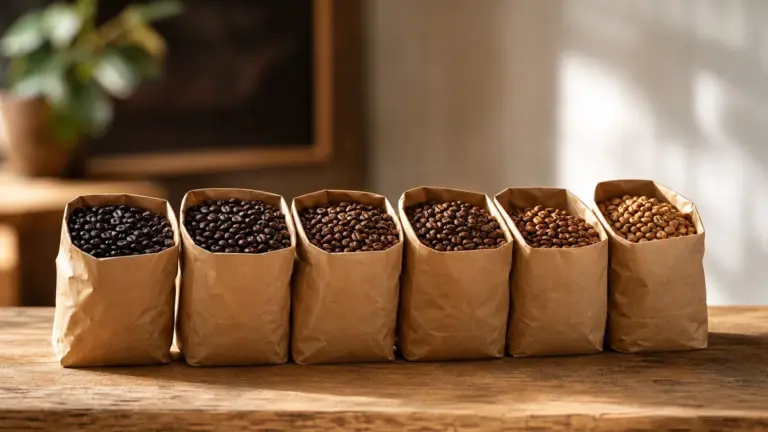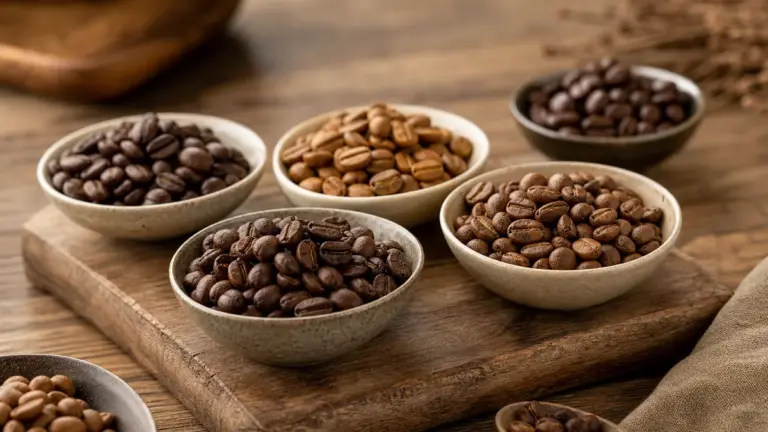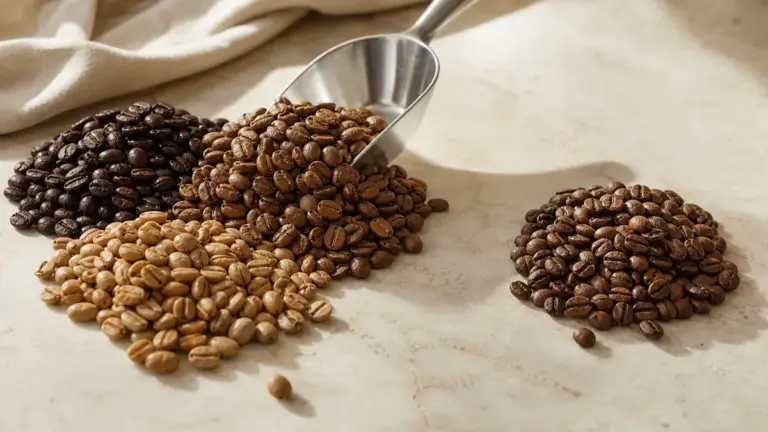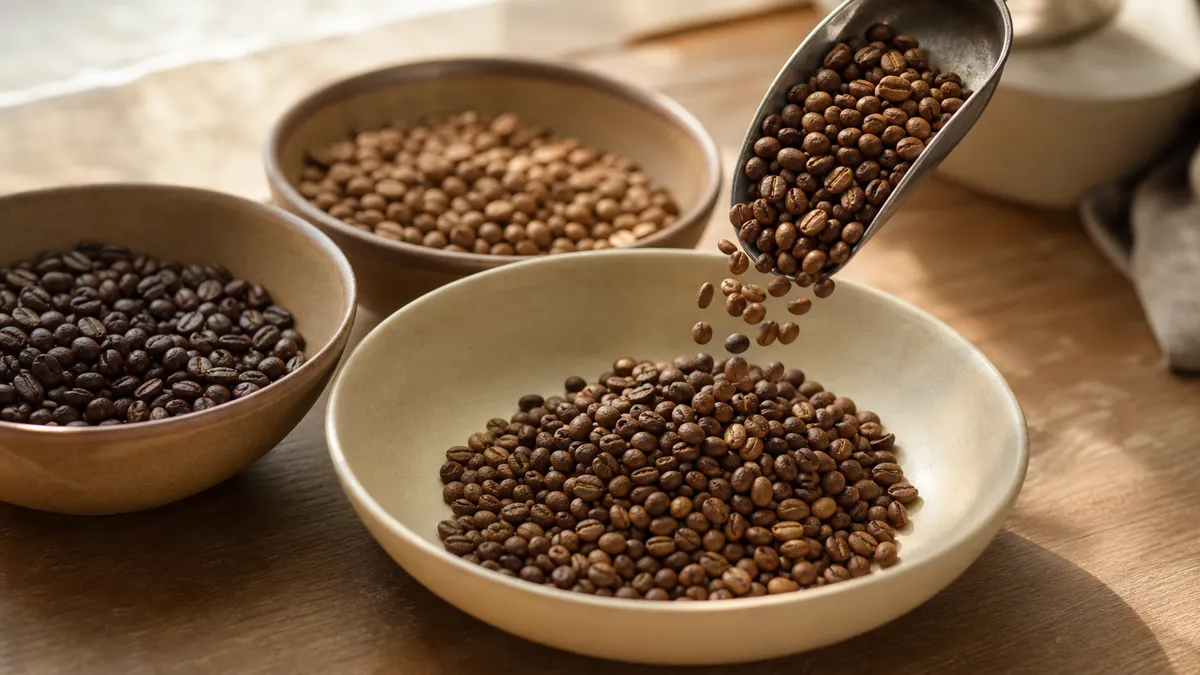
Coffee blending combines two or more coffees in measured proportions to create a particular flavour, suit a brewing method or maintain a recognisable cup through changing harvests. Roasters can mix green beans before roasting or combine separately roasted coffees afterwards, then refine the recipe by tasting.
In short
- Choose a flavour goal before choosing ingredients: a blend needs a purpose, not simply more components.
- Pre-roast blending combines green coffees; post-roast blending combines coffees roasted separately. Both are established approaches.
- Assess an espresso blend as espresso, including with milk if that is how it will be served.
- For your first experiment, try two coffees and compare measured recipes rather than mixing by eye.
- A consistent year-round blend may change its ingredients while keeping its intended flavour profile.
Blend Types
A blend is a mixture of coffee lots, meaning separately identified batches. Those lots need not come from different countries: blending can bring together coffees within an origin as well as across origins. For the wider terminology, start with coffee beans and blends.
It helps to distinguish the blend’s purpose from its ingredients:
- House or signature blends aim for a recognisable flavour associated with a roaster.
- Seasonal blends give the roaster freedom to change the flavour as different coffees become available.
- Brew-specific blends are developed around a particular preparation, especially espresso.
- Mixed-roast blends, sometimes called mélange blends, combine different roast levels, potentially using the same starting coffee.
These categories overlap. A house espresso blend might also combine different roast levels, while a seasonal blend might be intended for filter brewing.
For your own recipe, describe the intended cup before selecting beans. “Chocolate-led, rounded and clear enough to drink black” is more useful than “a bit of everything”. Give each ingredient a job, then ask whether the finished mixture actually benefits from it.
Origin descriptions are useful background, not a substitute for tasting the particular coffee. Keep the question of geographical identity separate from recipe design; single-origin coffees explains that distinction.
Espresso Blends
An espresso blend is designed for espresso preparation, not merely made by roasting a filter blend darker. That distinction matters: selecting components and developing their roasts are separate decisions.
Begin with a serving brief. Is the coffee mainly for short black drinks, or should its character remain clear in a latte? Write down the desired sweetness, acidity, mouthfeel and finish. Here, acidity means the bright, tart impression in the cup, while mouthfeel describes its tactile qualities.
For development, choose a promising base coffee and taste it alone before adding anything. Sweet Maria’s describes this base-first approach and notes that some espresso blends use robusta to contribute body, crema and a more forceful flavour. Robusta is an option, not a requirement.
Then test the proposed mixture on the espresso machine. Royal Coffee’s published development account describes separately roasting components, adjusting their proportions through espresso tasting, and subsequently checking the pre-roast version as well. The production method therefore needs its own validation.
For a useful comparison, record your dose, beverage yield, grind setting and extraction time. Keep the serving size and milk quantity consistent when judging candidates. Do not reject a recipe solely because its first shot needs a different grind setting.
A sensible acceptance checklist is:
- Pleasant when served as intended.
- No component dominates unintentionally.
- Clear enough flavour for the target drink.
- Repeatable results across several preparations.
For the broader buying choice, see single-origin versus blends.
Breakfast Blends
Treat “breakfast blend” as a product description rather than a precise recipe. Published examples differ: Fresh Roasted Coffee describes its version as light roasted and mild, while Community Coffee presents a medium-roast version. The name alone therefore cannot establish roast level.
When choosing one, look beyond the name to the stated roast, tasting notes and suggested preparation. Ask the roaster what they mean by “breakfast”: a gentle filter coffee, a brighter cup, or something intended to take milk?
For a home blending brief, make the goal more specific. You might seek a clean, rounded cafetière coffee with a little fruit character, rather than a powerful espresso-style finish. Choose components against that description and test the drink at your usual strength.
There is no reason to reserve the finished blend for the morning. The useful information is how it tastes and how you intend to brew it.
Coffee Blending Techniques
The main production choice is whether to blend before or after roasting. Compatibility matters in pre-roast blending because beans can differ in size, density, moisture and roasting behaviour. Post-roast blending allows each component to receive its own roast treatment.
| Criterion | Pre-roast blending | Post-roast blending |
|---|---|---|
| When coffees are combined | Green beans are mixed before roasting | Separately roasted coffees are mixed afterwards |
| Roast control | Components share a roast programme | Each component can have its own programme |
| Recipe development | Changes require another blended roast | Proportions can be changed using existing roasted samples |
| Main consideration | Components must work together in the roaster | Separate batches must be weighed and mixed accurately |
| Useful starting point | A tested production recipe | Small development trials |
These are practical trade-offs, not a ranking of quality.
Choosing the method
For an aspiring roaster, post-roast blending is a useful learning exercise because you can taste each component independently and change proportions without immediately roasting again. Keep the first trial manageable: use coffees you already understand rather than introducing several unfamiliar variables.
If you intend to move to pre-roast production, repeat the trial with the green mixture. Royal Coffee’s development example demonstrates why tasting the separately roasted version is only an intermediate step, not proof that the combined roast will perform identically.
State the weighing basis
Write green weight or roasted weight beside every recipe. Roasting changes bean mass, so a proportion measured before roasting need not remain the same afterwards.
For home trials, use roasted weight throughout. Mix whole beans thoroughly in a clean, dry container, then weigh the brewing dose from that mixture. Record the coffee names and roast dates so you can reconstruct the experiment.
The underlying ingredient is covered separately in green coffee beans.
Cupping Blends
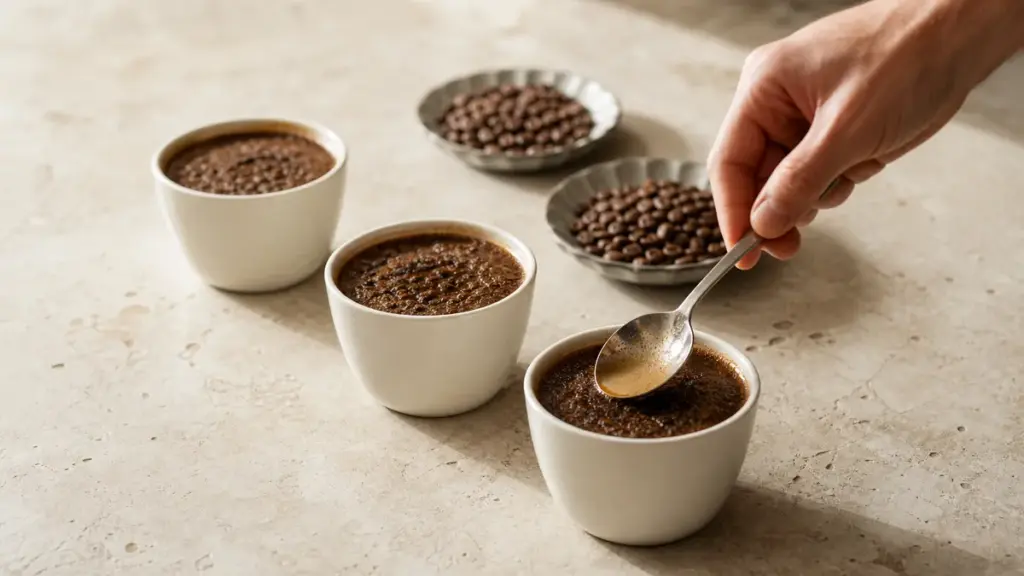
Cupping is a controlled tasting method in which ground coffee is infused directly in vessels. It provides a shared preparation for examining coffees, but formal assessment and an informal blend-development session are not the same exercise.
For a simplified home comparison:
- Use identical heatproof vessels.
- Follow the SCA dosing basis of 8.25 g per 150 ml of vessel capacity, equivalent to 55 g per litre.
- Use the same water and grind setting throughout.
- Pour water at 93 degrees Celsius, within the standard’s permitted variation of 3 degrees Celsius either side.
- Let the grounds infuse for 3 to 5 minutes, then break the surface crust and remove floating grounds.
- Compare the samples as they cool, once comfortable to taste.
This abbreviated exercise is not a full SCA assessment.
Keep description separate from preference. First write what you perceive, such as cocoa, citrus, bitterness or a drying finish; then decide whether you like it. World Coffee Research’s Sensory Lexicon supplies defined sensory terms and reference materials for developing a shared vocabulary.
Finally, brew the leading candidate using its intended method. Cupping is a development tool, not the final serving test.
Trial Blending
Use this suggested exercise to learn what changing proportions does. The quantities are an editorial trial design, not an established commercial recipe or a guarantee of a particular flavour.
Choose two roasted coffees:
- Coffee A: the coffee you want to provide the main character.
- Coffee B: a coffee you think could improve one specific feature.
Prepare these small batches by roasted weight:
| Trial | Coffee A | Coffee B | Total |
|---|---|---|---|
| A-led | 40 g, 80% | 10 g, 20% | 50 g |
| Middle | 35 g, 70% | 15 g, 30% | 50 g |
| More B | 30 g, 60% | 20 g, 40% | 50 g |
The calculation is simply total batch mass multiplied by each component’s percentage expressed as a decimal.
A repeatable trial method
- Write the target. Choose one improvement, such as a fuller mouthfeel or a clearer fruit note.
- Taste the components alone. Keep notes beside the blend results.
- Weigh and mix each recipe separately. Do not estimate proportions from scoop volume.
- Compare without seeing the recipes. Ask someone to assign temporary sample codes.
- Keep preparation consistent. Use the same equipment, water, dose and brewing routine.
- Choose the most useful change. Decide whether B improves A, rather than merely making it different.
- Repeat the winner. Make a fresh batch on another day before settling on the formula.
Use a simple decision sheet with spaces for aroma, flavour, acidity, mouthfeel, finish and preference. Add one final question: Would I choose this over either component alone?
If the answer is no, stop or change the brief. There is no obligation to create a blend when the individual coffee already does what you want.
Consistency Through the Seasons
Keeping a blend consistent does not necessarily mean keeping its ingredient list fixed. Counter Culture Coffee explains that it changes components in year-round offerings to maintain their intended flavour profiles as seasonal coffees change.
For an aspiring roaster, the useful principle is to maintain a sensory specification alongside the recipe. Write down the character you want to preserve: the balance of sweetness and acidity, the weight of the drink and the finish.
When a component changes, use this suggested handover checklist:
- Taste the replacement independently.
- Compare the revised mixture with your current reference.
- Adjust proportions before changing several roast variables.
- Check the intended brewed drink.
- Record the new component, proportions and acceptance notes.
Preserve both records: what went into the blend and what it was meant to taste like. That makes coffee blending a repeatable process rather than an increasingly vague memory of a good cup.
FAQ
Can I blend coffees that are already roasted?
Yes, combining already-roasted coffees is post-roast blending. It lets you adjust proportions without another roast and gives you the opportunity to assess each component first. Start with small weighed batches, record the recipe by roasted weight and compare the mixture with the individual coffees before committing a whole bag.
Can the same coffee appear at two roast levels in a blend?
Yes, a mixed-roast or mélange blend can combine different roast levels of the same coffee. This is a deliberate blending technique, not necessarily a mixture of different origins. To explore it yourself, keep the coffee source constant and compare whether the combined roast treatments produce a cup you prefer.
How many coffees should I put in my first blend?
Start with two as a learning exercise, not because two is a quality standard. You can compare the ingredients and change their proportions without making the trial difficult to interpret. Add another coffee only when you can describe the improvement you want it to make and can test whether it actually does so.
Where to go next
Read Coffee Beans and Blends for the wider subject, then Single-Origin vs Blends to compare the two approaches. Green Coffee Beans Explained provides the background for roasting trials, while Micro-Lot and Single Estate Coffee explains the sourcing descriptions you may encounter when selecting components.
Sources
-
Royal Coffee, Chris Kornman, What Is a Blend of Coffee? Guide to Coffee Blending, 2021.
https://royalcoffee.com/blogs/blog/roasters-practical-guide-to-coffee-blending -
Sweet Maria’s, Blending Basics, 2008. Used for blending approaches, mixed-roast blends and base-first espresso development, not its historical production statistics.
https://library.sweetmarias.com/blending/ -
Josuma Coffee Company, published in Roast, Blending for Italian Espresso, 2008 article reprint. Used for the author’s practical treatment of roast compatibility and blending methods.
https://josuma.com/wp-content/uploads/2013/09/Blending_reprint_Jan08.pdf -
Royal Coffee, Introducing 78 Espresso Blend, 2016. A first-party account of blend development, not independent performance testing.
https://royalcoffee.com/blogs/blog/78-espresso-blend -
Specialty Coffee Association, Coffee Value Assessment: Sample Preparation and Tasting Mechanics, SCA Standard 102-2024, 2024.
https://sca.coffee/s/AW_SCA-102_Sample-Preparation_281024_Secured.pdf -
World Coffee Research, Sensory Lexicon, version 2.0, 2017, accompanying resource page.
https://worldcoffeeresearch.org/resources/sensory-lexicon -
Counter Culture Coffee, Coffee Basics: Year-Round Coffee, undated webpage, retrieved November 2026.
https://counterculturecoffee.com/blogs/counter-culture-coffee/coffee-basics-year-round-coffee -
Fresh Roasted Coffee, Breakfast Blend, undated product collection page, retrieved November 2026. Manufacturer description used only to illustrate naming variation.
https://www.freshroastedcoffee.com/collections/breakfast-blend-1 -
Community Coffee, Breakfast Blend Ground Coffee, undated product page, retrieved November 2026. Manufacturer description used only to illustrate naming variation.
https://www.communitycoffee.com/products/breakfast-blend-ground-coffee
This article was researched using retrieved sensory standards, research resources and first-party blending accounts; the trial recipes are suggested learning exercises, not first-hand test results.
Last checked: November 2026