Micro-lot coffee is a small, separately handled batch selected for its particular origin, variety, processing or cup character, but the term has no universally enforced size definition. Single estate coffee comes from one named farm or estate, which may produce several different lots. Both labels can offer more detail than a broad single-origin description, but neither guarantees exceptional flavour.
In short
- Ask what makes the lot separate: its plot, variety, harvest batch, processing method or a combination.
- A single estate can produce both larger commercial lots and carefully separated micro-lots.
- Traceability means being able to follow the coffee back through its production and handling, not simply finding a farm name on the bag.
- Competition recognition belongs to the entered lot, not automatically to every coffee from the winning farm.
- Choose by documented provenance, roast suitability and flavours you enjoy, rather than rarity alone.
What does micro-lot coffee mean?
A lot is an identifiable batch of coffee handled or traded together. In its most useful sense, a micro-lot is a relatively small batch whose identity has been preserved instead of being mixed into a larger production lot.
There is no universally enforced maximum weight, bag count or farm area that makes coffee a micro-lot. Producers, exporters, importers and roasters use the term differently. KAHA Coffee Roasters, for example, describes uses involving separate processing, production volume, farm size and cup scores, rather than one agreed definition.
That variation matters. A producer may mean coffee from a particular picking and processing batch; a trader may mean an unmixed lot; a roaster may use the word for a limited release. These are not necessarily equivalent claims.
Ask the seller: “What was kept separate, and from which stage?” An answer describing the producer, harvest and processing batch tells you considerably more than “a very rare coffee”.
For the broader vocabulary surrounding origins and blends, start with the coffee beans and blends guide.
What is single estate coffee?
Single estate normally means coffee grown on one farm or estate, rather than coffee collected from several unrelated farms. Producer Kona Coffee & Tea uses the term explicitly to mean coffee coming exclusively from its own farm.
The label identifies a source, not a particular production scale. It does not, by itself, establish that every bean came from one plot, one variety or one processing batch. Ask for those details separately if they matter to your choice.
An estate can therefore sell a broader farm lot alongside smaller, individually identified selections. Those selections can be both single estate and micro-lot: the descriptions overlap rather than compete.
The following comparison uses source, separation and the questions left unanswered, not an assumed quality ranking.
| Description | What it principally identifies | What you should still ask |
|---|---|---|
| Single-origin | One stated origin, which needs defining | Does that mean a country, region, producer group or farm? |
| Single estate | One named farm or estate | Which harvest, varieties and processing methods are included? |
| Micro-lot | A separately identified, relatively small batch | What defines the batch, and what is its total size? |
| Single-estate micro-lot | A separated batch from one estate | How was its identity maintained through processing and sale? |
Do not assume that a washing-station name means a single farm. Where a seller describes a station or producer group, ask who supplied the coffee rather than silently treating it as estate-grown. Our guide to single-origin coffees explores the broader origin terminology.
How producers separate micro-lots
Separation is what makes a detailed origin claim useful. Café Imports describes maintaining variety-specific selections through harvesting, processing, drying, milling and shipping. Keeping a batch distinct at the start is insufficient if it is subsequently mixed with other coffee.
By plot or harvest batch
A producer may separate coffee from a particular part of a farm, or from a particular picking and processing batch. This gives the producer and buyer a defined selection to assess rather than an average of everything harvested.
However, “micro-lot” alone does not tell you which boundary was used. A plot selection and a day’s processing at a washing station describe different things, even when both are sold under the same term.
By variety
A variety is a named type of coffee plant within a species. Separating varieties allows a seller to offer coffee with a more specific plant identity instead of combining everything grown on the farm.
That identity deserves precision. World Coffee Research distinguishes Panamanian Geisha from other coffees sold under the Geisha name that do not share its distinct genetics. Its catalogue associates well-managed Panamanian Geisha grown at high altitude with delicate floral, jasmine and peach-like aromas, not with a guaranteed result in every bag.
By processing method
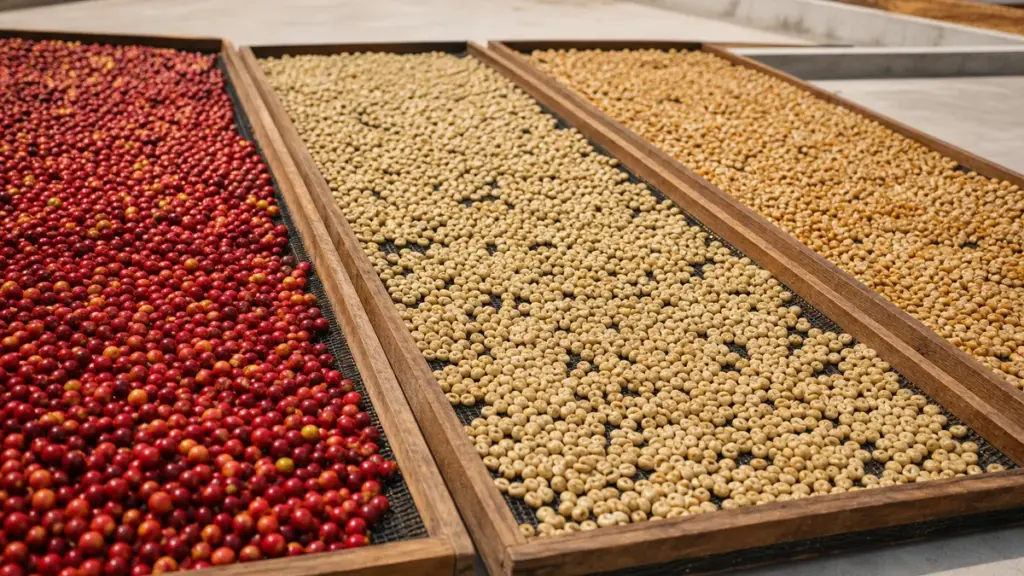
Processing is the work that removes the coffee fruit and prepares its seeds for roasting. A producer can keep selections apart according to how that work is done:
- Washed: fruit pulp and mucilage, the sticky layer around the seed, are removed before drying.
- Natural: the coffee dries inside the whole cherry before the dried fruit is removed.
- Honey: the skin is removed, but some mucilage remains during drying.
These are meaningful differences in handling, not quality grades. When comparing lots, check the actual method rather than assuming that a more elaborate description means better coffee.
Do smaller lots taste better?
Not automatically. The useful distinction is between a production description and evidence of cup quality.
Some sellers deliberately reserve the micro-lot category for their strongest coffees. Café Imports presents its micro-lots as limited-quantity, exceptional selections, while Ally Open differentiates its micro-lots by distinctive profiles or processing methods and seasonal availability. Those are the companies’ own selection practices, not universal rules governing the word.
For the drinker, the advantage is an opportunity to explore a clearly identified coffee. The limitation is that detailed provenance still does not tell you whether you will enjoy its flavour.
Our editorial advice is to choose the flavour description before the prestige language. If you want a rounded, familiar cup, ask for that explicitly; do not let a competition placing persuade you that you ought to prefer something very different.
Nor should you read “larger lot” as “anonymous”. Café Imports describes larger community and farm selections that retain traceability. A micro-lot is one way to organise and present coffee, not the only route to knowing its source.
For the separate question of combining coffees to achieve a desired result, see coffee blending.
Competitions, auctions and what awards actually prove
Competitions can give an individual lot independent sensory scrutiny. Cupping is structured coffee tasting; in blind cupping, judges assess coded samples without knowing the producer’s identity.
Cup of Excellence uses blind assessment through successive selection stages, followed by auctions of winning coffees. Its published process includes national and international juries, with farm, producer, variety, process and region information made available to buyers after selection.
The critical detail is that the award belongs to the submitted coffee lot. Alliance for Coffee Excellence explicitly states that its awards do not apply to an entire farm. Another coffee from the same producer is not automatically the award-winning coffee.
When checking a competition claim, look for the programme name, country, competition year and exact lot identifier. Match these to the organiser’s published record. If the connection remains unclear, ask the roaster to explain it.
Auctions are a sales mechanism, not a separate processing method or an automatic quality certificate. For Cup of Excellence auctions, buyers can assess samples before bidding. Do not treat every coffee described as an “auction lot” as having passed that particular competition.
What influences the price?
The relevant factors include the work of keeping a selection separate, the buyer’s assessment of quality and demand for that particular lot.
Café Imports says the premiums it pays for its micro-lots reflect additional planning, labour and attention as well as cup quality. That is a description of its purchasing practice, not evidence that every product carrying the label rewards producers in the same way.
Distinguish a retail claim about rarity from information about the supply chain. If producer remuneration matters to you, ask what the seller can document, including which stage a disclosed payment represents.
For workplace purchasing, request itemised written quotations showing the coffee supplied, delivery, minimum order, substitution arrangements and any associated service. Judge the proposal against your own requirements rather than assuming that a micro-lot designation settles the decision.
How to find and assess a genuine offering
Use this sequence when browsing a UK roaster’s website or speaking to a specialist retailer:
- Find the producer and source. Look for a named farm, estate, producer group or washing station, with the relationship between them explained.
- Identify the separation. Ask whether the selection is defined by plot, variety, picking batch, processing or sensory selection.
- Check the harvest and lot identity. Prefer a clear crop reference and lot code where available. If size is used to promote rarity, ask for the total green-coffee lot weight, not merely the retail bag size.
- Read the processing description. Ask for a plain explanation if the terminology is unfamiliar.
- Verify specific awards. Match the coffee to the organiser’s record, rather than accepting a general “award-winning farm” claim.
- Check suitability before ordering. Ask about the intended brewing method, roast approach and expected flavour. Consider trying a small pack before committing to a workplace supply.
For a more revealing tasting comparison, ask a roaster for selections from the same producer with a clearly explained difference between them. Keep your brewing approach consistent and record what you notice without trying to reproduce every tasting note.
The best micro-lot and single estate coffee descriptions make the producer’s work easier to understand. Buy the coffee whose identity and intended cup the seller can explain clearly, not simply the bag with the most exclusive-sounding label.
FAQ
Do I need special equipment to appreciate a micro-lot?
No special equipment is required simply because a coffee is labelled micro-lot. Ask the roaster whether the particular roast suits your existing brewer, then begin with its brewing guidance. Our advice is to use a familiar method first, so you can concentrate on the coffee rather than learning unfamiliar equipment at the same time.
Can a micro-lot contain more than one variety?
Yes, the label alone does not promise a single variety. Published trade usage includes different ways of defining a lot, so ask whether it is a variety-specific selection or contains several varieties. If your aim is to explore one variety’s character, look for an explicit variety declaration and a clear explanation of separation.
Will the same coffee be available again next year?
Do not assume that the identical lot will return. Ally Open, for example, describes its micro-lot availability as seasonal and harvest-dependent. If you enjoy a release, keep its producer, harvest, variety and process details, then ask the roaster which future offering is the closest comparison rather than relying on the product name alone.
Where to go next
Read Single-Origin Coffees to understand the wider family of origin labels, then Single-Origin vs Blends to decide which approach suits your drinking preferences. Coffee Blending explains why coffees are combined, while Coffee Beans and Blends: The Complete Guide provides the broader route through choosing and understanding beans.
Sources
-
KAHA Coffee Roasters, What is a Microlot?, 2020. Primary account of differing commercial uses.
https://kahacoffee.com/blogs/news/what-is-a-micro-lot -
Perfect Daily Grind, Janice Kanniah, What Is a Micro Lot in Specialty Coffee?, 2020. Original interviews with producers, buyers and quality specialists, used for their accounts of trade terminology.
https://perfectdailygrind.com/2020/04/what-is-a-micro-lot-in-specialty-coffee/ -
Kona Coffee & Tea, Our Story, undated, live page checked November 2026. Producer’s explanation of its single-estate claim.
https://www.konacoffeeandtea.com/pages/our-story -
Café Imports, Microlots, undated, live page checked November 2026. Importer’s published selection, separation and purchasing practices.
https://www.cafeimports.com/north-america/blog/microlots/ -
Café Imports, Select Coffees, undated, live page checked November 2026. Larger community and farm selections retaining traceability.
https://www.cafeimports.com/north-america/regional -
Ally Open, Help & FAQ, undated, live page checked November 2026. Importer’s micro-lot categories and seasonal availability.
https://www.allyopen.com/pages/help-and-faq -
World Coffee Research, Arabica Varieties Catalog: Geisha (Panama), undated, live entry checked November 2026. Variety identity and conditional sensory potential.
https://varieties.worldcoffeeresearch.org/varieties/geisha-panama -
Café Monteverde Farm and Roastery, Coffee Processing Explained: Washed, Honey, Natural and Anaerobic, 2026. Producer’s descriptions of processing methods.
https://cafedemonteverde.com/2026/10/08/natural-honey-washed-anaerobic-coffee-difference/ -
Cup of Excellence, FAQ, undated, live page checked November 2026. Blind assessment, jury stages and auction selection.
https://cupofexcellence.org/faq-2/ -
Alliance for Coffee Excellence, How do I know that I am buying a Cup of Excellence® or ACE National Winners?, 2019. Lot-specific awards and verification.
https://allianceforcoffeeexcellence.org/blog/faq-items/how-do-i-know-that-i-am-buying-a-cup-of-excellence-or-ace-national-winners/ -
Alliance for Coffee Excellence, How to Bid, undated, live page checked November 2026. Auction lots and advance samples.
https://allianceforcoffeeexcellence.org/how-to-bid/
This article was researched using retrieved producer and importer explanations, original trade interviews, World Coffee Research’s variety catalogue and the competition organisers’ own documentation; no first-hand testing is claimed.
Last checked: November 2026