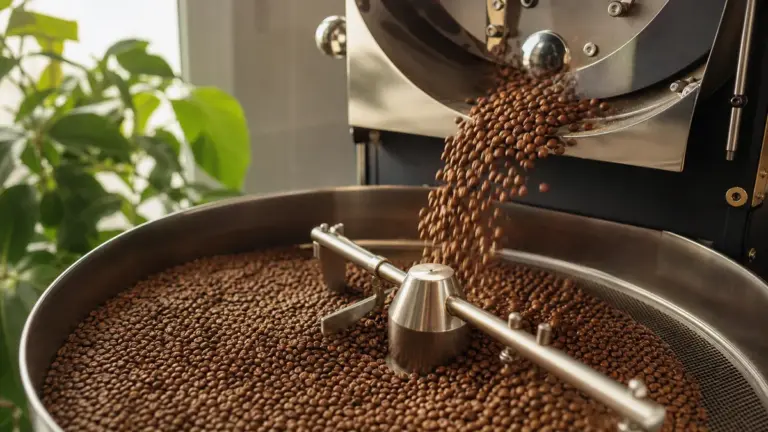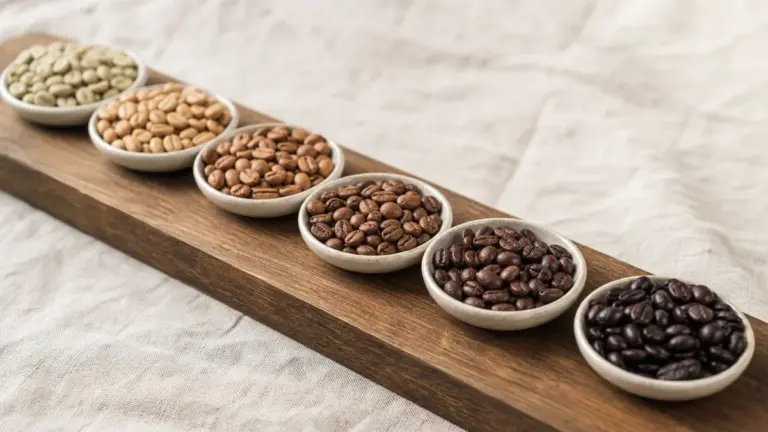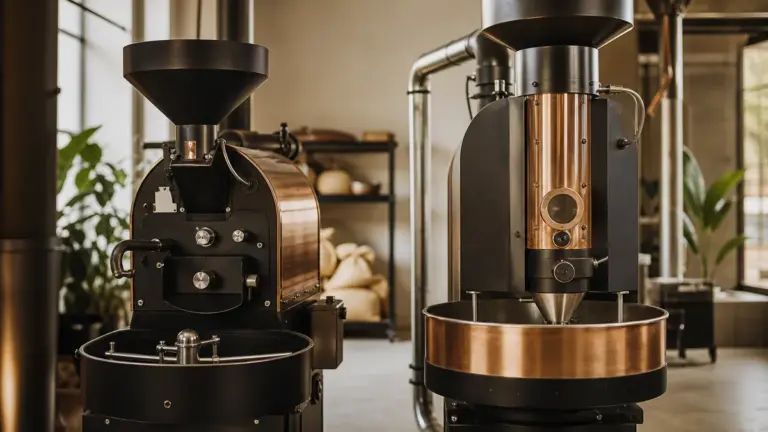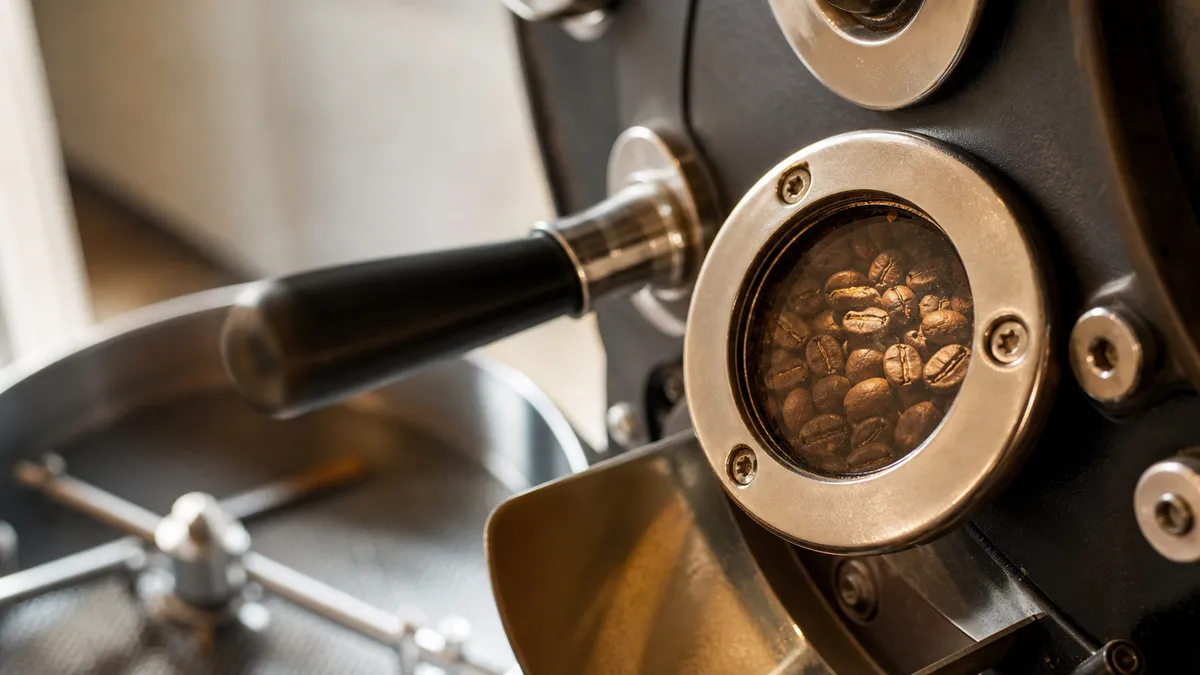
First crack and second crack are two audible stages in coffee roasting: first crack produces relatively loud pops as pressure builds inside the beans and their structure fractures, while second crack brings finer snaps as darker roasting causes further structural breakdown. They help roasters judge progress, but neither is an automatic stopping point or a substitute for checking colour, temperature and the finished coffee’s flavour.
In short
- First crack generally sounds louder and deeper; second crack produces quieter, finer snaps that can become more frequent.
- Record when cracking begins, but use a consistent definition: an isolated early pop and a sustained sequence are different reference points.
- Development time conventionally runs from the start of first crack to the end of roasting, not from its final pop.
- Second crack and visible surface oil do not necessarily arrive together. Oil may become apparent after the beans have cooled and rested.
- Continuing into very dark roasting increases smoke and can lead to ignition. Follow the roaster manufacturer’s limits, not a target sound or sheen.
What physically happens at first crack?
A coffee bean is a seed with a cellular structure, not a solid pebble. During roasting, water vapour and gases develop inside it, creating pressure against a structure whose mechanical properties are also changing with heat and moisture loss.
First crack is associated with pressure-driven expansion and fracture, accompanied by the release of steam and gases. The bean’s central crease opens further, and remaining silverskin, the thin covering that becomes papery chaff, can come loose.
The popcorn comparison is useful for recognising the noise, but it should not become an exact physical model. Coffee does not turn inside out like popped maize, and research on bean expansion has recorded continuous volume growth rather than one instantaneous expansion of the whole batch.
Nor does first crack mean that flavour chemistry has only just begun. Browning reactions are already happening beforehand and continue afterwards. The name given to a roast phase is a practical organising tool, not a boundary at which one set of reactions switches off and another switches on. For that chemistry, see browning reactions.
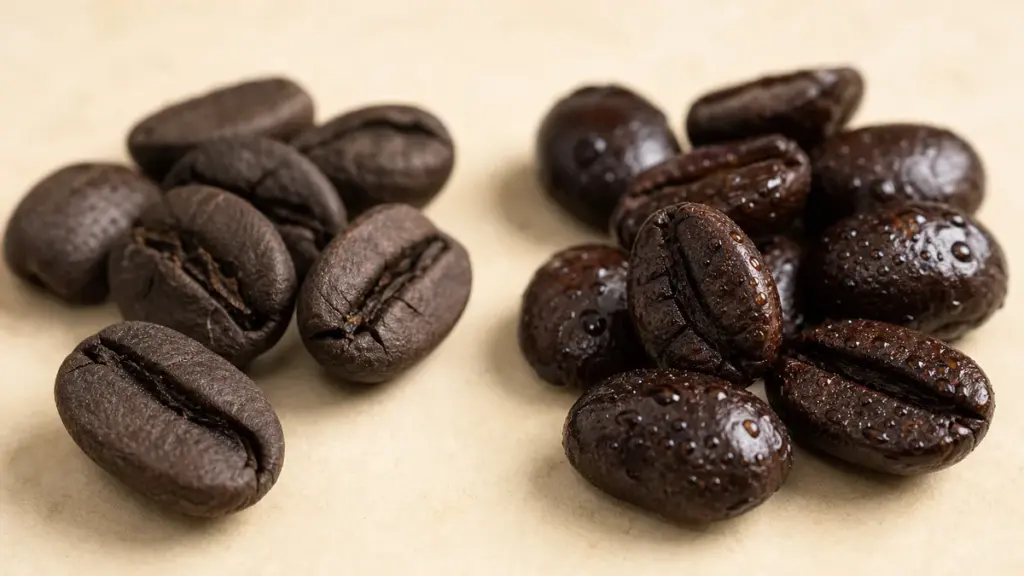
How first crack and second crack sound
First crack usually resembles separate popcorn-like pops. As more beans crack, those individual reports form a busier sequence before becoming sparse again. Second crack is typically a shallower snapping or crackling sound, closer to crisp cereal crackling in milk.
These are more than convenient descriptions. In a peer-reviewed acoustic experiment, first-crack sounds had greater amplitude and more low-frequency energy than second-crack sounds. The second-crack sequence also contained more cracks per unit of time in the recordings analysed. These findings describe that experiment, not a guaranteed acoustic fingerprint for every coffee and machine.
A quiet interval often separates the two stages, but it is not compulsory. Behmor’s operating guidance explicitly recognises coffees that move from first crack towards second crack without an obvious break. Silence is therefore useful supporting evidence, not proof that the next snap must be second crack.
For learning, listen for the combination of loudness, character and progression. A single sound is less informative than how the sequence changes alongside the beans’ appearance.
When do the cracks happen?
Temperatures are guides, not universal triggers
Sweet Maria’s practical glossary places first crack at approximately 199 to 210°C and second crack at approximately 227 to 232°C, converted and rounded from its published Fahrenheit ranges. These are roasting reference ranges, not guaranteed temperatures at the centre of every bean.
The measurement matters. A thermometer reading the air in a roasting vessel is not measuring bean temperature, and a displayed number should not overrule clearly observed roast progress. Before comparing readings, establish what the sensor measures and where it sits.
Elapsed time depends on the roast
There is no universal minute at which either crack should begin. In experiments using different heat-input profiles, researchers deliberately shifted when first crack occurred while maintaining the same total roast duration. The phase lengths changed with the profile.
For a concrete equipment-specific example, Sweet Maria’s FreshRoast SR540 guidance reports first crack at about four minutes in its example roast and second crack at about seven to eight minutes. Those observations belong to that setup, not to drum roasters or other batch sizes.
Use your own repeatable observations to build a reference. The wider relationship between heat application and elapsed time belongs in roasting profiles; differences between machines belong in roasting equipment.
Development after first crack
Development time is the conventional name for the interval from the onset of first crack until the roast ends. It includes the remaining first-crack sequence, not merely the quieter period afterwards. The term does not mean that the earlier roast was undeveloped or chemically inactive.
This interval can meaningfully alter the cup. In a controlled experiment using Colombian coffee roasted to a similar measured colour, changing development time changed both chemical composition and sensory character. Shorter development favoured fruity, sweet and acidic impressions; longer development shifted the balance towards roasted, nutty, chocolate-like and bitter impressions. The findings apply to the coffee and conditions tested, rather than establishing a recipe for every bean.
Consequently, “give it longer after first crack” is not a complete instruction. Useful records also need the earlier temperature history and final colour. A multi-study sensory investigation found that both colour and time influenced flavour, with colour the stronger predictor overall.
Is there an ideal development percentage?
Development-time ratio expresses this interval as a percentage of total roast time:
Development-time ratio = development time ÷ total roast time × 100
As an arithmetic illustration, two minutes of development within a ten-minute roast gives 20%. This is an example calculation, not a recommended profile.
Scott Rao’s influential practitioner guidance proposed a 20% to 25% range based on his roasting and tasting experience. Controlled research demonstrates that development timing matters, but does not establish that range as a universal requirement. Treat such percentages as a way to describe and compare roasts, not a pass-or-fail test.
What changes at second crack, and where do oils fit?
Second crack marks further fracture of the bean’s cellular structure during more advanced roasting. The practical explanation centres on structural breakdown as thermal decomposition progresses, rather than simply repeating the first steam-driven event. The audible snaps are a useful milestone, but they do not identify one isolated chemical reaction.
Oil migration is related, but it is not synchronised with the first snap. Roasting changes the bean’s pore structure, creating routes through which its existing oils can move towards the surface. Microscopy research has documented small surface oil droplets after storage.
Behmor specifically warns against judging roast degree by whether oils are visible: beans can reach dark stages without looking oily during roasting, then develop droplets afterwards. Conversely, Sweet Maria’s illustrated roast sequence shows a slight sheen near the approach to second crack. An oily surface is not a stopwatch for second crack.
Continuing further can bring increasingly smoky, carbonised flavours and brittle beans. More urgently, heavy smoke and vigorous second crack can indicate a dangerous progression towards ignition. Never keep roasting merely to make every bean shiny; remain present and follow the machine’s operating and emergency instructions.
How the cracks relate to roast levels
The following is a broad orientation based on sensory roast guides, not a universal classification. It compares audible stage, appearance and common roast descriptions; individual roasters may place their labels differently.
| Roast position | Audible cue | Typical appearance | Broad relationship |
|---|---|---|---|
| Around the completion of first crack | Loud pops become sparse | Brown, generally without surface oil | Often associated with lighter roasting |
| Between the cracks | Usually quieter, though not always | Progressively darker brown | Many medium descriptions sit here |
| Approaching or entering second crack | First fine snaps | Darker brown; oil may or may not be visible | Often described as medium-dark or dark |
| Further into second crack | More sustained crackling | Very dark; oil can appear during or after roasting | Increasingly roast-dominated character |
Table basis: Sweet Maria’s illustrated roast progression and Behmor’s guidance on delayed oil appearance.
Do not infer that a coffee must reach second crack to be properly roasted. Equally, stopping at first crack does not by itself demonstrate a successful light roast. Crack position is one observation among several; the fuller terminology belongs in roast levels.
A practical way to record the cracks
This is an observation checklist, not a roasting recipe. Use it within your machine’s instructions.
- Choose an onset convention. Record either the first isolated pop or the beginning of a sustained sequence, and write down which you use. Practitioner conventions differ.
- Record first crack alongside temperature and appearance. Keep the sensor description with the record so an air reading is not later mistaken for bean temperature.
- Note the progression. Describe whether first crack builds clearly, fades gradually or approaches second crack without an obvious pause.
- Record the endpoint separately. Note whether second crack was heard, then record the start of cooling. Residual heat can carry roasting onwards during cooling.
- Compare the finished coffees. Use sound records with colour and consistent tasting, rather than ranking batches by crack loudness. Research supports evaluating multiple roasting variables together.
For the wider sequence surrounding these observations, start with coffee roasting.
What the cracks can tell us about chemistry
Cracks are useful physical landmarks, but they are not complete chemical measurements. A controlled study of different roast profiles found that titratable acidity, a measure of the acids neutralised in a laboratory titration, peaked during first crack and declined towards its starting value by second crack in the coffees tested.
That does not mean second-crack coffee tastes like green coffee, or that every individual acid follows the same path. The researchers measured aggregate acidity rather than the concentrations of specific acids. First crack and second crack therefore help locate the roast’s progress, but cannot replace chemical analysis or tasting.
FAQ
Can cracking continue after the heat is switched off?
Yes, cracking can continue while the beans are still hot. Sweet Maria’s describes second crack continuing into cooling as “coasting”, because starting the cooling stage does not remove stored heat instantly. Record the cooling transition separately from the final sound, and use the cooling procedure specified for your roaster.
Does a louder first crack mean better coffee?
No, crack loudness is not an established quality score. Acoustic research measured differences between first and second crack, but did not establish that louder batches taste better. Sensory experiments instead show that roast colour and timing influence flavour. Use the sound to identify progress, then assess quality in the cup.
Can decaffeinated coffee move through the cracks differently?
Yes, some decaffeinated coffees can progress towards darker roasting more quickly. Behmor warns that decaffeinated coffee reaches darker stages faster than regular coffee and cautions against transferring its regular-coffee timing guides directly. Follow equipment-specific instructions and observe the actual roast rather than waiting for a familiar elapsed time.
Where to go next
Read Roasting Profiles to understand the heat history around the cracks, then Roast Levels for the language used to describe the endpoint. Maillard Reaction and Caramelisation explains the browning chemistry, while Roasting Equipment covers the machines in which these milestones are observed.
Sources
-
Acoustical Society of America, Preston S. Wilson, Coffee roasting acoustics, 2014, Journal of the Acoustical Society of America, 135(6), EL265 to EL269.
https://pubmed.ncbi.nlm.nih.gov/24907832/ -
Institute of Food Technologists, Schenker and colleagues, Pore Structure of Coffee Beans Affected by Roasting Conditions, 2000, Journal of Food Science, 65(3), 452 to 457. Retrieved published-paper copy.
https://www.expresssearch.com/sample-results/patentability/npl/Schenker%202000.pdf -
Beverages / University of Southern Denmark, Münchow and colleagues, Roasting Conditions and Coffee Flavor: A Multi-Study Empirical Investigation, 2020, 6(2), 29.
https://findresearcher.sdu.dk/ws/portalfiles/portal/169555397/M_nchow_et_al_2020_Beverages.pdf -
Beverages, Alstrup and colleagues, The Effect of Roast Development Time Modulations on the Sensory Profile and Chemical Composition of the Coffee Brew as Measured by NMR and DHS-GC, MS, 2020, 6(4), 70.
https://www.mdpi.com/2306-5710/6/4/70/pdf -
Scientific Reports, Anokye-Bempah and colleagues, The effect of roast profiles on the dynamics of titratable acidity during coffee roasting, 2024, 14, 8237.
https://www.nature.com/articles/s41598-024-57256-y.pdf -
Sweet Maria’s Coffee Library, First Crack, undated, live glossary entry.
https://library.sweetmarias.com/glossary/first-crack/ -
Sweet Maria’s Coffee Library, Second Crack, undated, live glossary entry.
https://library.sweetmarias.com/glossary/second-crack/ -
Sweet Maria’s Coffee Library, Using Sight to Determine Degree of Roast, undated, live illustrated guide.
https://library.sweetmarias.com/using-sight-to-determine-degree-of-roast/ -
Sweet Maria’s, FreshRoast SR540 Tip Sheet; Stovetop Coffee Roasting Tip Sheet; Roast Levels explanatory card, undated documents.
https://library.sweetmarias.com/wp-content/uploads/2020/09/freshroast_sr540_tip_sheet_1.pdf
https://library.sweetmarias.com/wp-content/uploads/2022/11/Stovetop-Coffee-Roasting-Tip-Sheet.pdf
https://library.sweetmarias.com/wp-content/uploads/2020/03/RoastLevelsBACK.pdf -
Behmor, Behmor Roaster Quick Start Guide, undated, live manufacturer guidance.
https://behmor.com/knowledge-base/behmor-roaster-quick-start-guide/ -
Scott Rao, writing in Daily Coffee News, Roast Development Time and the Prerequisite for Any Successful Roast, 2014. Primary practitioner account.
https://dailycoffeenews.com/2014/08/12/roast-development-time-and-the-prerequisite-for-any-successful-roast/
This article was researched from retrieved experimental papers, primary practitioner explanations and manufacturer instructions, distinguishing measured findings from practical roasting conventions.
Last checked: November 2026