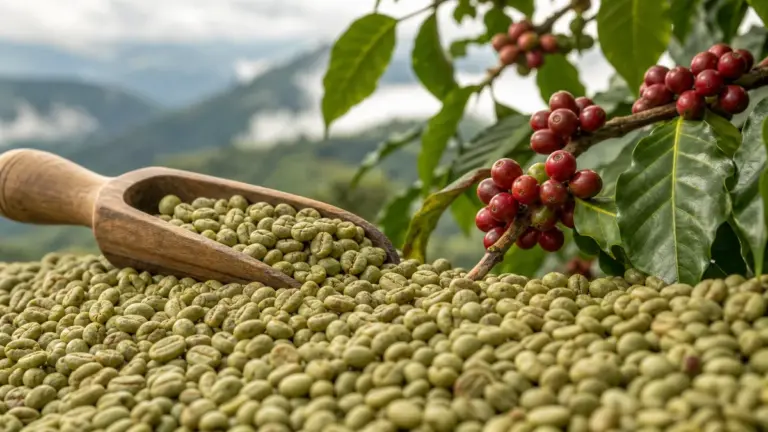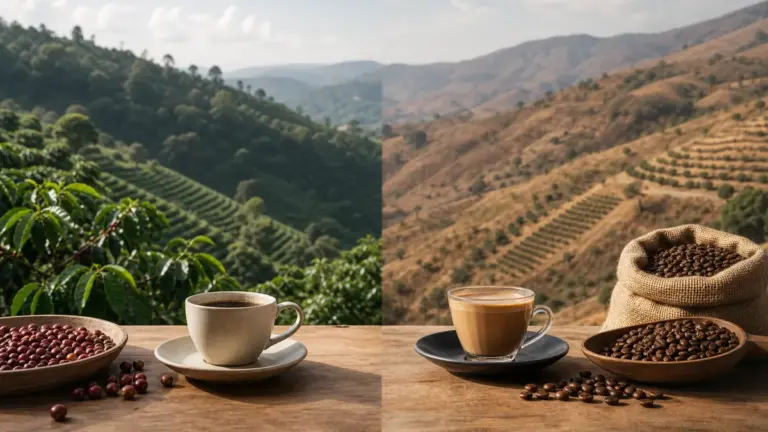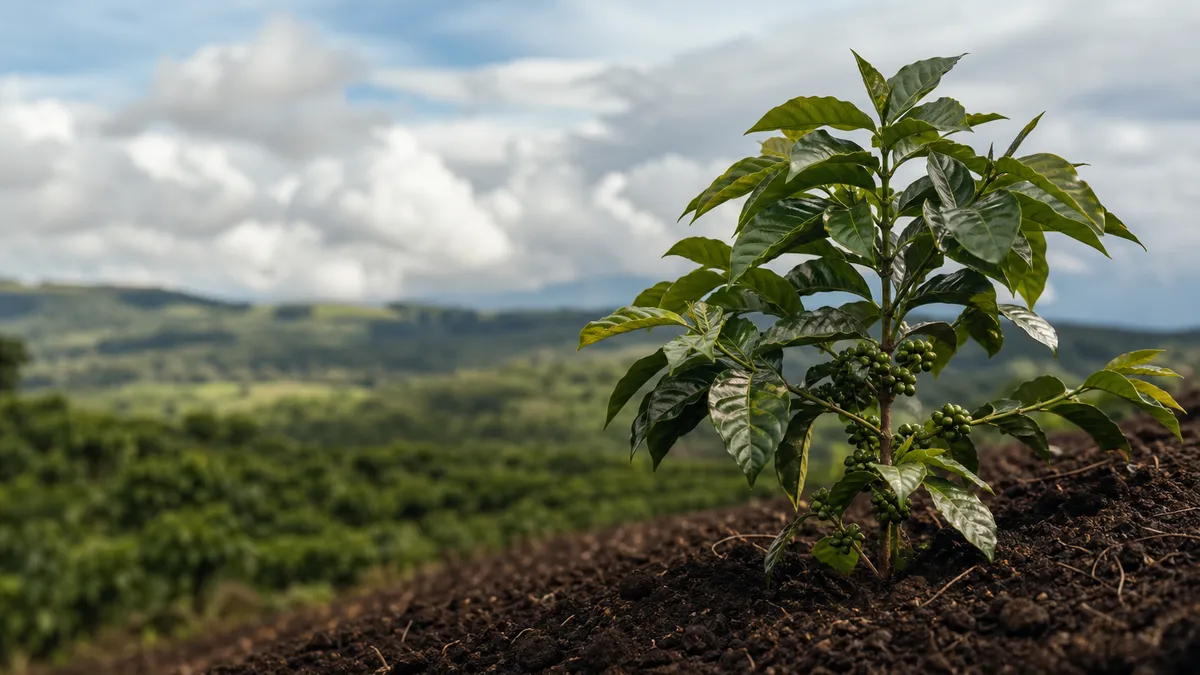
Coffee terroir is the influence of a growing place, interacting with the coffee plant and farming practices, on the character of the beans. Borrowed from wine, the idea connects climate, soil, terrain and local knowledge with what eventually reaches your cup, but it does not mean every flavour can be traced to a hillside or a mineral.
In short
- Terroir describes interacting influences, not a single ingredient called “place”.
- Altitude is useful context, but temperature, shade and growing conditions explain more than height alone.
- Genetics matter: the same variety can respond differently in different environments.
- Farming and processing help shape the result, although the boundaries of terroir are debated.
- To explore it, compare traceable coffees under similar roasting and brewing conditions, preferably without seeing their labels first.
What does coffee terroir mean?
Terroir asks a practical question: what difference does growing here make? It is more specific than knowing a coffee’s country of origin, and broader than knowing its soil type.
The wine sector’s formal definition includes interactions between the physical and biological environment and cultivation practices. Coffee researchers have adapted that thinking to a crop whose character also changes substantially during processing, roasting and brewing.
For this article, terroir means the growing environment interacting with plant genetics and locally applied farming knowledge. Processing belongs in the discussion where it reflects local conditions and practice, but it should remain separately identified rather than disappearing into a vague claim about place.
That distinction keeps the concept useful. “This coffee comes from a particular valley” describes provenance. Explaining how that valley’s conditions influence the crop begins a terroir argument. Showing a repeatable difference under controlled comparison makes the argument stronger.
The wider coffee terroir guide brings together the individual environmental influences. Here, the aim is to understand how they fit together, not to assign a tasting note to every location.
The factors that work together
There is no useful terroir formula in which altitude contributes one fixed share and soil another. These influences overlap, and changing one can alter the effect of another.
| Factor | What it contributes | What it cannot tell you alone |
|---|---|---|
| Altitude and topography | Context for temperature, sunlight, exposure and water movement | Whether a coffee will taste better |
| Climate and shade | Conditions affecting growth, stress and fruit maturation | A guaranteed flavour profile |
| Soil | Water availability, drainage and plant nutrition | A direct translation from rock to tasting note |
| Species and variety | The plant’s inherited characteristics and responses | An identical result wherever it grows |
| Farming | Decisions about shade, nutrition, pruning and crop load | A result independent of the environment |
| Processing and microbes | Changes to bean chemistry after picking | How much of the final character came from the growing site |
Climate operates at several scales
Macroclimate describes the broad regional climate. Mesoclimate describes a smaller area, such as a valley or slope. Microclimate describes conditions immediately around the plant, including those beneath its canopy.
These are useful scales of observation, not separate flavour ingredients. A regional weather average cannot fully describe the conditions experienced by cherries growing beneath shade trees on a sheltered slope.
Altitude and topography help organise these differences. However, a height printed on a bag is not a temperature record, nor does it describe shade or seasonal rainfall. Read altitude and temperature for the detailed relationship rather than treating the highest number as the best choice.
Soil supports the plant, not a flavour shorthand
Soil matters through its physical and chemical properties, including its capacity to hold water and supply nutrients. Those conditions influence plant growth and bean development.
That does not justify translating a soil description directly into a cup description. “Volcanic soil” is not, by itself, evidence that a coffee must taste smoky, mineral or unusually complex. A proposed link needs measurements and a plausible mechanism, not just an attractive geological story.
Genetics and farming change the response
A variety is a named type of coffee plant with inherited characteristics. Its genotype is its genetic makeup; researchers use genotype-by-environment interaction to describe how different genetic types respond differently to growing conditions.
Farming then changes those conditions. Shade management alters light exposure, while nutrient supply and the amount of fruit carried by a tree affect the resources available to developing beans.
An Ethiopian field study by Bote and Vos illustrates the interaction: the effect of light exposure on sensory quality depended on nitrogen supply. The lesson is not “shade always improves coffee”, but that a farming practice must be understood in its setting.
Is processing part of terroir?
There are two useful ways to draw the boundary.
A narrower approach treats terroir as the growing-site contribution and separates post-harvest processing. That makes experiments easier to interpret: if processing differs, it becomes harder to isolate the effect of the site.
A broader approach includes locally developed processing practices, particularly where environmental conditions influence how cherries can be handled. In their review of coffee terroir, Williams and colleagues argue that including processing can therefore be justified.
This article follows the broader approach cautiously: local processing can help express a place, but processing is not automatically proof of place.
Microbiology makes the distinction especially relevant. Fermentation involves microbial activity that can change bean chemistry. In a controlled on-farm experiment, adding a selected yeast changed the microbial community, aroma compounds and sensory characteristics compared with spontaneous fermentation.
That demonstrates a processing mechanism. It does not establish that the resulting character belongs uniquely to that farm. When a coffee has a striking fermentation signature, ask what is known about the processing before attributing everything to terroir.
What evidence supports coffee terroir?
The strongest evidence concerns measurable environmental and management effects. Claims that a precise location has an unmistakable flavour are harder to establish.
Research supports environmental effects
Ahmed and colleagues’ systematic review examined 73 studies of environmental and management influences on coffee quality. Higher altitude and reduced light exposure were among the more consistent associations with improved sensory attributes, although responses varied and shade benefits had limits.
This was a review of studies with different designs, not one controlled experiment. The authors could not combine their results into a universal numerical effect.
That distinction matters: evidence that growing conditions influence quality is not evidence that every high-grown coffee is superior.
Multi-location trials reveal interactions
World Coffee Research reported cupping results for 10 varieties grown at seven origins over the 2021 to 2023 harvests. Some varieties showed relatively stable cup quality; others responded more strongly to particular environments.
This is valuable evidence because it compares named varieties across sites, rather than comparing unrelated coffees carrying different country labels.
However, the researchers also identified noise from processing, storage, roasting, harvest year and cupper preferences. Their report calls for stronger control of these variables. The findings support an interaction between genetics and environment, not a clean flavour fingerprint for every origin.
A plausible explanation still needs testing
Cooler conditions and sufficient resources can support longer bean maturation, offering a biological explanation for some quality differences. Field experiments help test those relationships.
But several things usually change together on a real farm. A higher plot may also differ in shade, soil moisture, variety and management. Without controlling or measuring these influences, assigning the result to altitude alone is an inference.
Good terroir research therefore needs more than an appealing tasting note: it needs traceable samples, environmental measurements, suitable comparisons and repeated observations.
Where the concept reaches its limits
Terroir is not a guarantee of quality. Distinctiveness and preference are different questions. The Specialty Coffee Association’s Coffee Value Assessment separates descriptive assessment, which records sensory attributes, from affective assessment, which considers perceived quality or preference.
A country is not a controlled experiment. Comparing two bags with different varieties, processes and roast styles may reveal a clear difference, but it cannot tell you which variable caused it.
The finished drink is not an untouched sample of the farm. Roasting, grinding and brewing influence the expression of the coffee. They must be considered when comparing samples.
A flavour description is not a location detector. The World Coffee Research Sensory Lexicon provides shared descriptors and references for assessing their intensity. Its purpose is sensory measurement, not assigning exclusive ownership of a flavour to a region.
For the detailed discussion of acidity, sweetness, body and aroma, use impact on flavour profiles. Terroir explains a framework of influences, not a reliable conversion chart from geography to flavour.
How to explore terroir through tasting
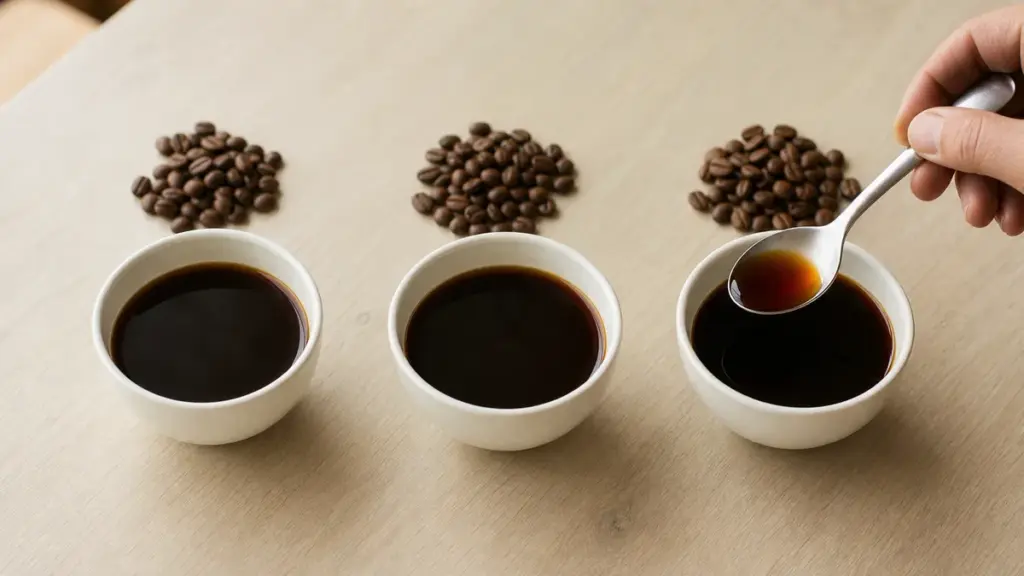
Treat this as a structured learning exercise, not a home experiment capable of proving causation.
-
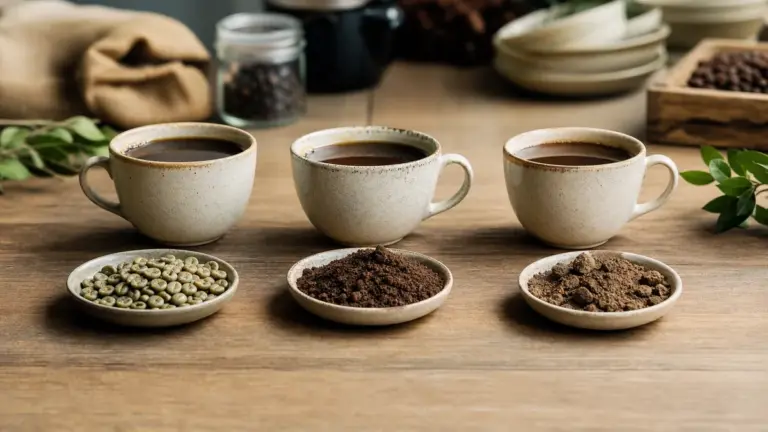
Choose a focused comparison. Ask a roaster for coffees of the same named variety and processing method from different growing sites. Seek comparable roast development and freshness. If those matches are unavailable, record the differences rather than ignoring them.
-
Keep preparation consistent. Use the same water, equipment, coffee-to-water ratio by weight, grind approach and brewing method. Professional assessment uses standardised sample preparation for the same reason: comparisons need consistent conditions.
-
Hide the origin information. Ask someone else to code the samples. Keep farm descriptions and tasting notes out of sight until you have written your observations.
-
Describe before judging. Record aroma, flavour, texture and aftertaste first. Start broadly, perhaps fruity, floral, nutty or roasty, then become more specific where you can. Separately record which coffee you prefer.
-
Taste as the coffees cool. Compare them at similar stages rather than judging one hot and another nearly cold. Repeat the exercise another day and change the serving order.
-
Reveal the details and qualify the result. Ask whether the difference was repeatable and which variables remained unmatched. “These samples differed consistently” is a defensible observation. “This soil caused that flavour” requires much stronger evidence.
The most useful habit is to keep observation and explanation separate. Coffee terroir becomes more interesting, not less, when the story remains open to testing.
FAQ
Does single-origin coffee automatically demonstrate terroir?
No, a single-origin label establishes a sourcing claim, not an experiment demonstrating environmental effects. To investigate terroir, you also need information about the variety, growing conditions, processing and preparation. Treat the label as a starting point for questions about traceability, rather than proof that the coffee has a unique or recognisable taste.
Can a coffee’s terroir remain the same between harvests?
The site can remain the same while its expression changes between harvests. World Coffee Research’s multi-year evaluations found variation across growing environments and evaluation periods, with harvest conditions and post-harvest handling among the possible influences. A useful comparison therefore records the harvest as well as the location, instead of assuming that a farm name promises an identical cup.
Do I need professional cupping skills to explore terroir?
No, you can make useful comparisons with a familiar brewing method and carefully matched preparation. Professional cupping adds standardisation and trained sensory assessment, but beginners can still practise describing differences before expressing preferences. Keep conclusions proportionate: a repeatable tasting difference is worth noticing even when you cannot establish its cause.
Where to go next
Read Coffee Terroir for the wider subject and its individual environmental influences, then Impact on Flavour Profiles for the sensory detail. Altitude and Temperature examines why elevation is useful context, but never a quality guarantee.
Sources
-
International Organisation of Vine and Wine, Definition of vitivinicultural “terroir”, Resolution OIV/VITI 333/2010, 2010.
https://www.oiv.int/node/3362
Official definition covering environmental interactions and cultivation practices. -
Texas A&M AgriLife Extension, The Concept of Terroir in Viticulture, teaching presentation, undated.
https://aggie-horticulture.tamu.edu/wp-content/uploads/sites/13/2018/06/The-Concept-of-Terroir-in-Viticulture.pdf
Reference for macroclimate, mesoclimate and microclimate terminology. -
Southern Cross University, Williams, Barkla, Rose and Liu, Does Coffee Have Terroir and How Should It Be Assessed?, Foods, 11(13), 1907, 2022.
https://researchportal.scu.edu.au/esploro/outputs/journalArticle/Does-Coffee-Have-Terroir-and-How/991013036385502368
Authors’ conceptual treatment of coffee terroir, processing boundaries and assessment. -
Ahmed and colleagues, Climate Change and Coffee Quality: Systematic Review on the Effects of Environmental and Management Variation on Secondary Metabolites and Sensory Attributes of Coffea arabica and Coffea canephora, Frontiers in Plant Science, 12:708013, 2021.
https://www.frontiersin.org/journals/plant-science/articles/10.3389/fpls.2021.708013/full
Systematic evidence synthesis and its methodological limitations. -
Wageningen University & Research, Bote and Vos, Tree management and environmental conditions affect coffee (Coffea arabica L.) bean quality, NJAS: Wageningen Journal of Life Sciences, 83, 2017.
https://research.wur.nl/en/publications/tree-management-and-environmental-conditions-affect-coffee-coffea/
Primary field research on interacting management and environmental effects. -
World Coffee Research, Evaluating cup quality in global arabica variety trial reveals complex interaction between genetics and environment, 10 June 2024.
https://worldcoffeeresearch.org/news/2024/cup-quality-gxe-imlvt
First-party report of multi-location sensory research, including acknowledged confounders. -
de Melo Pereira and colleagues, Conducting starter culture-controlled fermentations of coffee beans during on-farm wet processing: Growth, metabolic analyses and sensorial effects, Food Research International, 2015.
https://pubmed.ncbi.nlm.nih.gov/28454966/
Primary controlled fermentation study comparing selected-yeast treatments with spontaneous fermentation. -
World Coffee Research, Sensory Lexicon, version 2.0, 2017.
https://worldcoffeeresearch.org/resources/sensory-lexicon
Shared sensory descriptors and intensity references. -
Specialty Coffee Association, Coffee Value Assessment, current framework page, undated.
https://sca.coffee/value-assessment
Official explanation of descriptive, affective, physical and extrinsic assessment. -
Specialty Coffee Association, Coffee Value Assessment: Sample Preparation and Tasting Mechanics, SCA Standard 102-2024, 2024.
https://sca.coffee/s/AW_SCA-102_Sample-Preparation_281024_Secured.pdf
Official standard for consistent sample preparation and comparative tasting.
This article was researched using official definitions, first-party research reports, peer-reviewed field and fermentation studies, a systematic review and published sensory assessment resources; no first-hand testing is claimed.
Last checked: November 2026