Cleaning bean-to-cup milk systems means running the prescribed milk-cleaning programme and washing the removable milk-contact parts, not simply letting the machine rinse itself. Follow your model’s instructions after use and at the end of the day, because hose-fed frothers, detachable carafes and commercial milk circuits need different treatment.
In short
- A quick milk rinse and a detergent cleaning programme are different jobs. Complete both when your machine requires them.
- Dismantle only the parts shown as user-removable in the manual, including the small connectors and air inlet where specified.
- Use the approved cleaner at its stated concentration, temperature and contact time. There is no universal milk-system cleaning recipe.
- Keep refrigerated milk between 0 and 5 degrees Celsius, following its storage instructions and use-by date.
- Make weekly inspection an extra check, never a reason to postpone cleaning required daily or after each use.
Why milk residues matter
Milk left inside a tube, frother or carafe lid is both a hygiene concern and a source of blockages. Dried deposits can interfere with milk delivery and frothing, which is why manufacturers connect regular cleaning with both hygiene and correct operation.
The parts you cannot see from the front deserve particular attention. A clean-looking outlet does not establish that the intake tube, connector or channels inside a removable lid are clean.
There is also an important distinction between removing deposits and disinfecting equipment. A detergent is not automatically a disinfectant, and a rinse is not evidence that a system has been sanitised. Use the machine’s specified process rather than adding a household disinfectant of your own.
This article covers the milk pathway. For the wider maintenance schedule, start with coffee equipment care.
Identify your milk system before cleaning
Find the exact machine model and its milk-system cleaning instructions before removing anything. Check the cooler’s manual separately if it is an accessory rather than an integrated unit.
Hose-fed systems draw milk through a tube into a frother. Their instructions may require a chemical cleaning cycle as well as dismantling the outlet. For example, JURA’s Z8 manual requires daily dismantling and rinsing of the dual spout when milk has been prepared.
Detachable carafes contain milk-contact channels in their lids as well as an intake tube and outlet. A dial-operated rinse may be only one part of their cleaning routine.
Open, separable systems can have a different process. Philips’ 2300 and 3300 series manual instructs users to separate LatteGo’s container from its frame and wash the parts after every use, either in a dishwasher or with lukewarm water and washing-up liquid.
These differences matter more than the word “automatic” on the machine. Do not copy another model’s chemical dose, dishwasher instructions or dismantling sequence.
Daily method for cleaning bean-to-cup milk systems
Gather the model’s instructions, its specified cleaner, the cleaning container, fresh drinking water and any manufacturer-supplied cleaning tools. Keep cleaning products separate from milk and drinking vessels.
The sequence below is a framework. Where your machine specifies a different order, follow it.
-
Finish the prescribed after-use rinse.
Put the required collecting vessel beneath the milk outlet and keep hands clear of hot water and steam. Allow the programme to finish before disconnecting or dismantling parts. -
Remove the milk supply from the cleaning pathway.
Follow the instructions for emptying, refrigerating or discarding the remaining milk. Never run cleaning solution into a container of milk that someone might later use. -
Prepare the exact cleaning solution, if required.
Measure powder in grams and liquid in millilitres, using the product’s directions. As a product-specific example, Cafetto MFC Powder Red specifies a 500 ml water pre-flush, then 10 g dissolved in 500 ml water at 75 degrees Celsius, followed by a 1,000 ml fresh-water rinse. Those figures apply only where that product and procedure are approved for the machine. -
Run the milk-cleaning programme to completion.
Connect the milk tube to the cleaning container as directed and respond to each prompt. Complete every fresh-water rinsing stage. Do not assume that a coffee-system cleaning programme also cleans the milk circuit. -
Dismantle the user-removable milk parts.
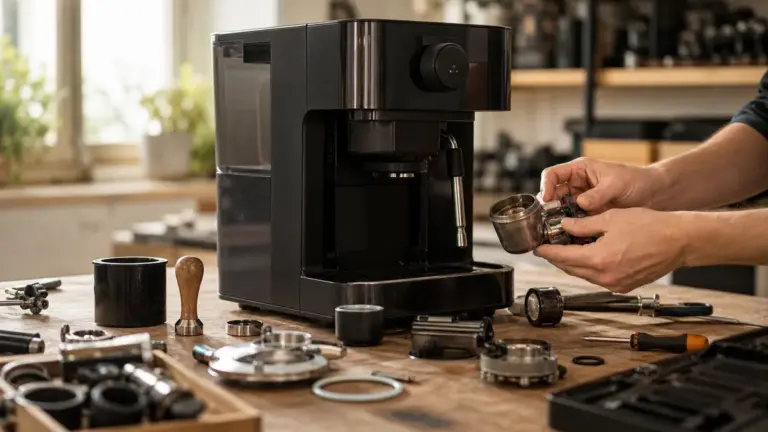
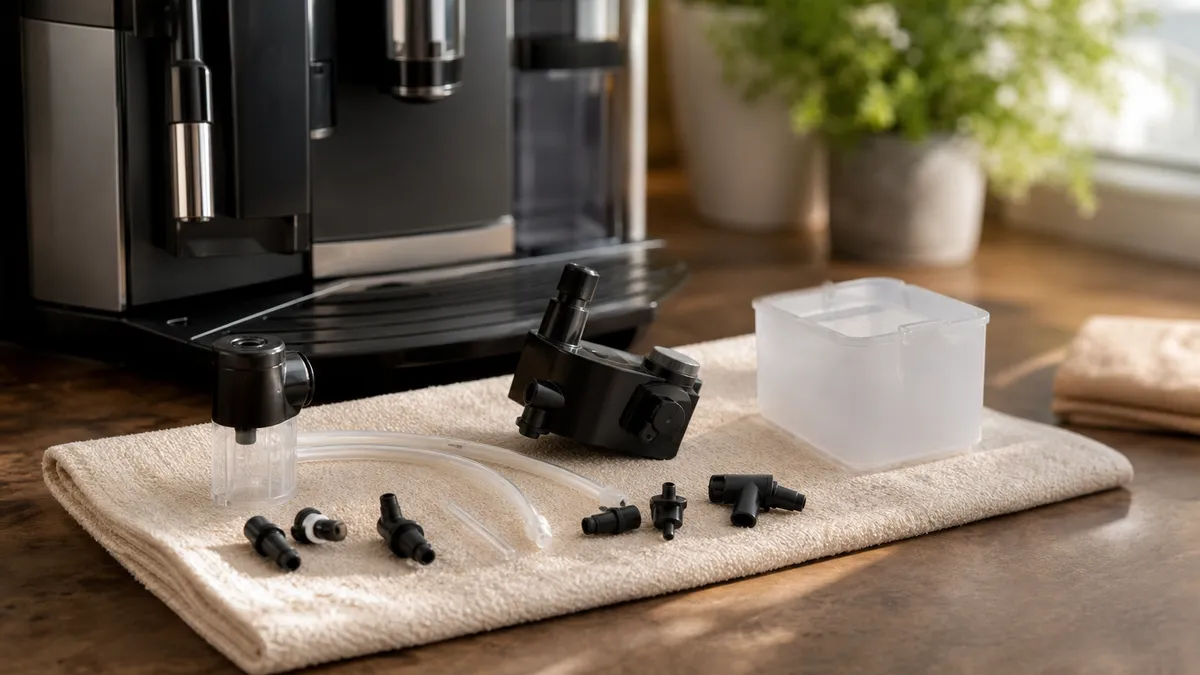
Once the machine is in the safe state specified by its manual and hot components have cooled, remove the permitted tube, connectors, frother pieces or carafe-lid components. Lay them out in order on a clean surface; a photograph before dismantling can help with reassembly. -
Wash or soak the parts as instructed.
Use the specified water temperature and contact time, not an improvised soak. For example, the retrieved De’Longhi Rivelia instructions prescribe water at least 40 degrees Celsius with washing-up liquid for at least 30 minutes for the hand-washing route. This is a removable-carafe procedure, not permission to circulate washing-up liquid through another machine. -
Rinse, inspect and reassemble.
Rinse thoroughly as directed, checking accessible channels for remaining deposits. Follow the manual’s drying instructions and refit each component in its proper position. If a part will not seat correctly, stop rather than forcing it. -
Record completion in a shared workplace.
A simple record should identify the machine, the cleaning completed, the person responsible and any defect. Make the handover explicit: the next user should not have to guess whether a container holds milk, cleaning solution or rinse water.
Daily and weekly routines
After use and at the end of the day
Respond to the milk-rinse prompt at the interval specified by the manufacturer. Some instructions allow a rinse after a sequence of drinks rather than between every drink.
At closing time, complete all cleaning due for that model, including chemical cleaning where specified and washing the removable parts. Clear milk splashes from the surrounding surface using an appropriate cleaning procedure.
For an office, appoint a named person and a deputy. “The last person making coffee” is an unreliable handover arrangement. Keep the instructions beside the machine, with chemicals stored safely elsewhere.
Weekly inspection
Use a weekly check to review the whole milk setup:
- Inspect removable tubes, connectors and seals for damage or deposits that routine cleaning has missed.
- Check that staff are separating every component identified in the manual.
- Review cooler cleanliness and temperature records.
- Check cleaner supplies and confirm that the instructions still match the product being used.
- Arrange replacement or service for parts that cannot be cleaned or reassembled properly.
This is an organisational check, not a universal weekly deep-clean interval. If the manual requires dismantling daily, doing it weekly is not enough.
Choosing milk-system cleaning products
Choose according to the machine manufacturer’s instructions and the cleaner’s stated application. A product intended for milk residues is not interchangeable with a coffee-oil tablet or the machine’s general descaler.
Milk cleaners themselves differ. Cafetto identifies MFC Blue as an alkaline milk-frother cleaner and MFC Powder Red as an acidic milk-frother cleaner. Their directions are different, so colour, bottle size or a familiar brand name is not a dosing instruction.
Never mix cleaning chemicals. Follow the label’s handling precautions and the machine’s compatibility requirements. If the two sets of instructions appear inconsistent, obtain clarification from the manufacturer before proceeding.
Washing-up liquid is appropriate for some removable components, as the Philips and De’Longhi examples show. That does not make it suitable for pumping through an internal milk circuit.
Keep the other maintenance jobs separate. Follow hard-water descaling guidance for the water circuit, and espresso machine backflushing only for equipment designed for that procedure.
Cleaning milk fridges and cooler units
A milk-cleaning programme does not wash the cooler cabinet or every part of its container. Treat the milk container, lid, pickup tube and cooler housing as separate cleaning tasks.
Keep refrigerated milk between 0 and 5 degrees Celsius and check with a fridge thermometer rather than relying solely on a control setting. Follow the milk packaging and the equipment instructions for storage after opening.
Do not continually top up old milk. JURA’s Cool Control instructions specifically warn against this and require cleaning of the container and metal tube after use.
Before cleaning an electrical cooler, disconnect it as instructed. Wipe the housing with a damp cloth rather than immersing it. Dishwasher suitability is model-specific: the retrieved Cool Control Type 591 manual permits several removable components, but an older Cool Control manual permits only the stainless steel container and metal pipe.
When a cooler is not maintaining the required temperature, stop using it for milk until the problem has been investigated. Cleaning the frother will not correct a refrigeration fault.
Signs of trouble and what to do
The following are starting points for checking, not definitive diagnoses.
| Symptom | Likely cause | Fix |
|---|---|---|
| Little foam or milk spraying from the outlet | Dirty frother or an incorrectly fitted or obstructed air-intake component | Clean and reassemble the permitted parts; follow the model’s air-intake checks |
| Large bubbles or under-frothed milk | Dirty carafe lid, unsuitable milk temperature or a change of milk | Clean the lid thoroughly and check the manufacturer’s milk recommendations |
| Visible deposits remain after cleaning | Incomplete dismantling or an unsuitable cleaning procedure | Repeat the approved process, checking hidden channels shown in the manual |
| Cleaner remains, or the rinse stage was missed | Incomplete cleaning cycle | Keep the machine out of use and complete the prescribed rinsing procedure |
| Milk is not staying cold | Cooler temperature or equipment problem | Stop milk service, check the temperature and obtain support if necessary |
Do not increase chemical strength to compensate for a fault. If correct cleaning and reassembly do not restore normal operation, consult coffee machine troubleshooting and the manufacturer’s support team.
Shared milk systems and allergens
Switching from dairy milk to a plant-based drink does not establish that a shared milk pathway is free from milk allergens. Nor should an ordinary rinse be described as an allergen-removal process without supporting evidence.
The Food Standards Agency’s review of allergen cleaning found no single method effective for every food and surface. Cleaning effectiveness depends on the residue, equipment, chemicals and process.
Where someone needs allergen avoidance, do not promise that a shared automatic system is suitable. Discuss separately managed equipment and handling arrangements, and assess cross-contact risks rather than relying on the drink’s ingredient list alone.
FAQ
Can I clean the milk system with water alone?
Only where the manufacturer specifies that method for the particular parts or cleaning task. Some removable systems permit washing under running water with washing-up liquid, while other machines require a dedicated chemical cycle. A quick water rinse should not replace a detergent clean that your model requires.
Can all the milk-system parts go in the dishwasher?
No, dishwasher suitability depends on the component and model. Even different generations of the same cooler can have different instructions. Check the exact manual before loading lids, adapters, seals or tubing, and follow any stated rack position or programme requirements. Never put an electrical cooler housing in the dishwasher.
Does oat or soya drink mean less cleaning?
No, changing the drink does not remove the need to follow the milk-system cleaning instructions. De’Longhi’s guidance covers both milk and vegetable drinks when discussing frothing performance. Where allergens matter, also assess the shared pathway and handling arrangements; changing the carton alone does not establish that equipment is suitable.
Where to go next
Use Coffee Equipment Care and Repairs to organise the wider maintenance schedule, and How to Descale a Coffee Machine in UK Hard Water for the separate water-circuit task. Coffee Machine Troubleshooting helps when cleaning bean-to-cup milk systems has not restored normal operation; Cleaning a Coffee Grinder covers another distinct maintenance job.
Sources
Manufacturer instructions below describe their own equipment or products, not independently tested performance. Undated documents are identified as such rather than assigned an assumed publication year.
-
JURA, Z8 Instructions for Use, undated, maintenance section. Daily dismantling and rinsing of the milk-contact spout.
URL: https://us.jura.com/-/media/global/pdf/manuals-na/Home/Z8/download_manual_z8-us.pdf -
Philips, Fully Automatic Espresso Machine: 2300 Series, 3300 Series User Manual, undated. LatteGo cleaning after every use.
URL: -
De’Longhi, Rivelia Instructions for Use, document EN-57132C8735, undated. Carafe cleaning, hand-washing conditions and milk-frothing troubleshooting.
URL: https://www.delonghi.com/medias/EXAM44055B-287353?context=bWFzdGVyfGRhbV9tYW51YWxzfDEyMDA5NTUzfGFwcGxpY2F0aW9uL3BkZnxhRFE0TDJobFpDODRNams1TnpRNU9EY3dOems1T0M5RldFRk5ORFF3TlRWQ0xUSTROek0xTXd8ZTU2MzllMjI4YzgyNzViZjhkNjYwN2ZlZjM1ZDAzOTI3MWE1Yjk3YzlkNzIyZmVhYzM1OTFjMGYxMTUzNzlmNA -
Cafetto, MFC Powder Red Product Information, undated. Product-specific powder dose, water temperature and rinse volumes.
URL: https://cdn.cafetto.com/general-downloads/PIS-MFC-Powder-Red.pdf -
Cafetto, MFC Blue Product Information, undated. Alkaline cleaner classification and prohibition on mixing chemicals.
URL: https://cdn.cafetto.com/general-downloads/042310-PIS-MFC-Blue.pdf -
JURA, Cool Control 1.0 l Instructions for Use, Type 591, December 2022 file; and Cool Control 1 l Instructions for Use, older undated edition. Container hygiene, electrical cleaning precautions and differing dishwasher permissions.
URLs: https://uk.jura.com/-/media/global/pdf/manuals-global/accessories/cool-control-1l/download_manual_cool_control_1l_eb.pdf?la=en&sc_lang=en
https://uk.jura.com/-/media/global/pdf/manuals-global/accessories/download_manual_cool_control_1l.pdf?la=es&sc_lang=es -
Food Standards Agency, How to Chill, Freeze and Defrost Food Safely, 2017, current retrieved version on GOV.UK. Recommended refrigeration temperature and thermometer use.
URL: https://www.gov.uk/government/publications/how-to-chill-freeze-and-defrost-food-safely/how-to-chill-freeze-and-defrost-food-safely -
Food Standards Agency, Cleaning Effectively in Your Business, undated retrieved PDF; GOV.UK, Food Hygiene for Businesses: Cleaning, undated current page. Suitable products, cleaning schedules, records and product-label checks.
URLs: https://www.gov.uk/food-hygiene-businesses/cleaning
https://www.gov.uk/food-hygiene-businesses/cleaning -
Food Standards Agency, Review of the Literature and Guidance on Food Allergen Cleaning: Lay Summary, 2023. Review evidence on the limitations and variability of allergen cleaning.
URL: https://science.food.gov.uk/article/156158-review-of-the-literature-and-guidance-on-food-allergen-cleaning-overview-and-acknowledgements/attachment/327854.pdf -
Food Standards Agency, Precautionary Allergen Labelling, 2023, current retrieved GOV.UK version, cleaning section. Dismantling, dedicated cleaning equipment, inspection and cross-contact assessment.
URL: https://www.gov.uk/government/publications/precautionary-allergen-labelling/precautionary-allergen-labelling
Researched by comparing manufacturer manuals and cleaning-product instructions with UK food-hygiene guidance; no first-hand machine testing was undertaken.
Last checked: November 2026