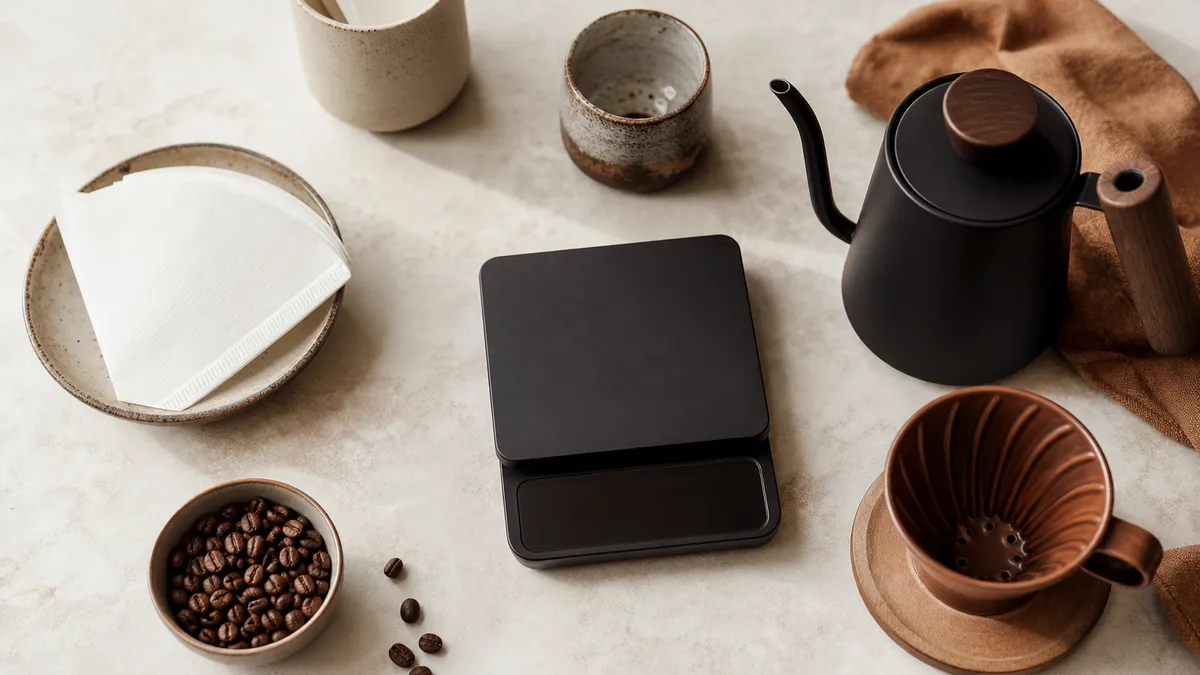
The essential brewing accessories are the ones that help you measure coffee, use the right grind and repeat a method reliably. For most manual brewers, start with scales, a kettle, a timer and the correct filter; add a grinder when using whole beans, and espresso or milk tools only when your brewing method needs them.
In short
- Check what your brewer already includes before buying separate accessories.
- Prioritise measurement and grind adjustment over decorative or specialist tools.
- A phone timer and an ordinary kettle can be enough to begin.
- Match filters, tampers and milk jugs to the equipment, not just their appearance.
- Check your local water report before choosing water treatment.
Which essential brewing accessories fit your method?
Our selection criteria are straightforward: does the accessory make the method possible, control something useful, fit your equipment and remain manageable to clean? The table separates a workable starting kit from additions worth considering later. These are editorial priorities, not a ranking based on product testing.
| Brewing method | Start with | Add when useful | Usually leave until later |
|---|---|---|---|
| Cafetière | Kettle, scales, timer, suitable ground coffee | Adjustable grinder for whole beans | Gooseneck kettle, specialist server |
| Manual pour-over | Dripper, matching papers, kettle, scales, timer | Grinder, gooseneck kettle | Connected scales, refractometer |
| Automatic filter brewer | Correct filter, scales, suitable ground coffee | Grinder if not built in | Pouring kettle, separate brew timer |
| Traditional espresso machine | Compatible basket and tamper, suitable grinder or permitted ground coffee, scales | Milk jug for steam-wand drinks, knock box | Specialist distribution tools |
| Automatic bean-to-cup machine | Accessories and cleaning supplies specified by its manual | Milk container where required | Separate tamper or pouring kettle |
Start with the row that describes your routine, not the most elaborate collection. The brewing accessories guide provides the wider route through this equipment category.
Scales and a timer: make the recipe repeatable
Scales let you record the amount of coffee and water rather than relying on a scoop. For pour-over, placing the brewer and receiving vessel on the scales also lets you follow the water addition as you pour.
As a buying criterion, look for a display resolution of 0.1 g, a tare button that resets the reading to zero, and enough capacity for the whole loaded setup. Resolution means the smallest displayed increment, not a guarantee of accuracy. Check the specification across the weighing range rather than assuming every load receives the same resolution.
For espresso, check that the scales fit beneath the cup without touching the machine. For filter brewing, check that a large server does not hide the display. Read the auto-off instructions too: a device that switches off during your routine is an awkward match.
A phone timer is a sensible starting point. An integrated timer is convenient, but it need not be the reason to replace working scales. Our scales guide covers the detailed selection questions.
Grinder: essential for whole beans, conditional for everything else
If you buy whole beans, you need access to a grinder. If you buy coffee already ground for your brewer, a separate grinder is not required to get started.
For a new purchase, our recommendation is an adjustable burr grinder, which grinds between opposing surfaces with an adjustable gap. Choose it for the method you actually use. Manufacturer guidance treats grind settings as starting points: the recipe, roast, coffee and your taste can all require adjustment.
For espresso, ask specifically about the grinder’s suitability for your machine and basket. A broad description such as “fine grind” is less useful than clear guidance on espresso adjustment.
A hand grinder suits someone happy to grind each dose manually. An electric grinder suits someone who wants less manual work, particularly when preparing successive drinks. Before choosing either, check access for cleaning and the availability of replacement parts.
Kettle and filters: compatibility before extra features
When is a gooseneck kettle useful?
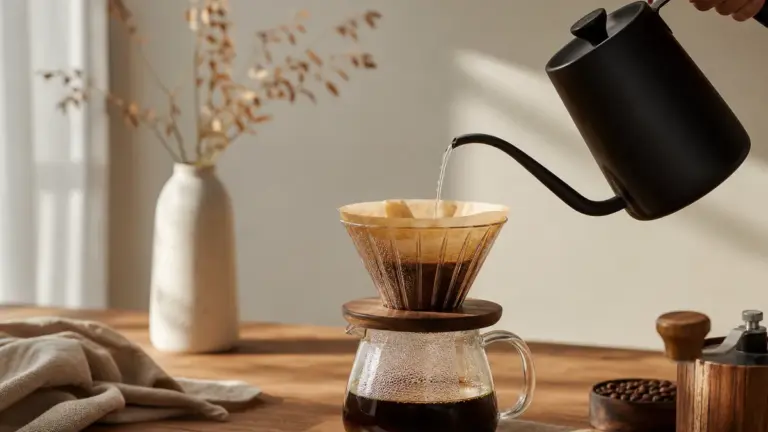
A gooseneck kettle has a narrow, curved spout designed for slower, more controlled pouring. It is most relevant to manual pour-over, where you direct water across the coffee bed.
An ordinary kettle remains a reasonable starting choice if you can pour safely and steadily. For immersion brewing, where coffee sits in the water rather than receiving a carefully directed series of pours, we would not prioritise a specialist spout.
Variable temperature control can make a chosen recipe easier to repeat. Treat it as a convenience, not a universal requirement. Follow your brewer’s recipe rather than applying one temperature to every coffee method.
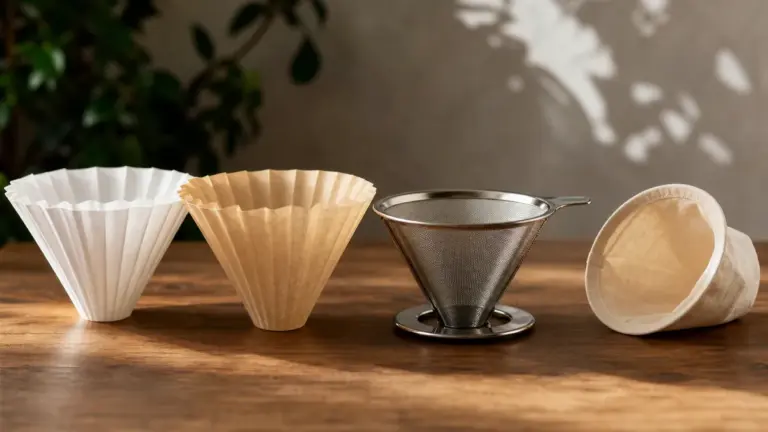
Buy the filter your brewer specifies
Check the filter’s shape and size against the brewer’s instructions. Hario, for example, pairs its size 02 V60 dripper with size 02 V60 papers in its published brewing guide.
Do not assume that a paper which can be pushed into a basket is a suitable replacement. Equally, do not order paper filters automatically if your brewer already uses a reusable filter.
Follow the manufacturer’s preparation instructions, including rinsing where advised. The filters guide explains the choices without turning this starter checklist into a separate filter comparison.
Water: check the supply before buying treatment
Start with your water supplier’s postcode-level information. Yorkshire Water, for example, provides a hardness checker and a unit-conversion tool. A national description of “UK water” is not a useful specification for choosing your own treatment.
Hardness describes dissolved calcium and magnesium. Reports commonly express it as mg/L as calcium carbonate, a reporting convention rather than a statement that chalk particles are floating in the water. Keep the reported units attached when discussing treatment with a supplier.
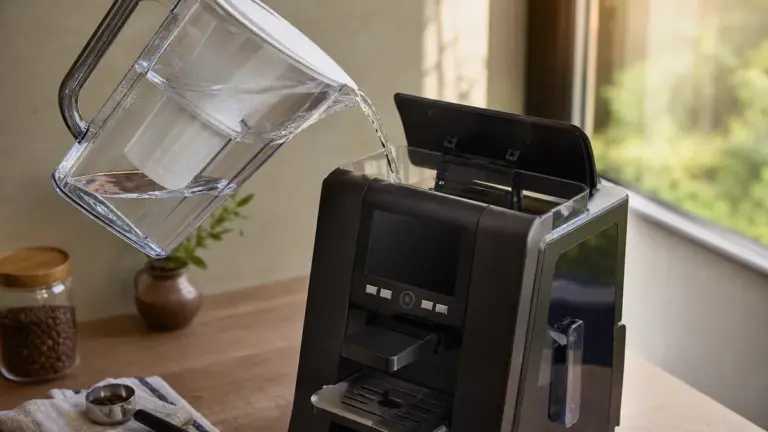
A filter intended to improve taste is not necessarily a scale-control filter. BRITA’s published information, for example, distinguishes filters that retain calcium and magnesium from cartridges designed to reduce limescale-forming hardness. Check the particular cartridge’s function, not just the brand.
For powered coffee machines, follow the machine manufacturer’s water requirements and maintenance instructions. Do not assume a jug filter makes descaling unnecessary.
For readers going deeper, SCA Standard 102-2024 specifies cupping water with no chlorine, calcium hardness of 50 to 175 mg/L as calcium carbonate, and alkalinity at or near 40 to 70 mg/L as calcium carbonate. These are sensory-assessment specifications, not a universal espresso-machine protection standard. That distinction matters more than buying a water-testing gadget immediately.
Espresso tools and the milk jug
For a traditional espresso machine, begin with the compatible basket, a correctly fitting tamper and a way to measure the coffee dose and drink yield. Check the supplied accessories first.
The tamper compresses the grounds in the basket. Before buying a replacement, confirm the required fit with the machine or basket manufacturer. Our starter recommendation is to learn a repeatable preparation routine with the supplied equipment before adding specialist distribution tools.
A dosing funnel and knock box are workflow additions rather than automatic essentials. Consider them when transferring grounds or disposing of used coffee is the part of the routine you want to improve.
Buy a milk jug when you need a vessel for a steam wand, not simply because espresso accessories are sold together. Follow the machine’s instructions on jug compatibility and fill limits. Some automatic steaming systems require the supplied jug and a particular position on a temperature sensor.
Keep a dedicated clean cloth ready for wiping the steam wand, then purge it as the manual directs. These routine requirements deserve priority over latte-art accessories.
Storage and cleaning: the quiet essentials
For everyday storage, choose an airtight, opaque container in a cool, dark location. The National Coffee Association identifies air, moisture, heat and light as conditions to avoid, and recommends grinding only what you need immediately before brewing.
A specialist vacuum container is an optional addition. Our starter recommendation is to establish a good storage location and a reliable seal before adding another mechanism.
Check the cleaning instructions before assembling a cleaning kit. Brushes, cloths and manufacturer-specified cleaning products are more useful than a drawer of tools with uncertain compatibility.
Do not assume removable grinder parts can all be washed. Baratza’s Encore manual, for example, permits washing certain external parts but warns against getting its burrs wet because they can rust.
Minimal starter kits and a first-brew check
For the simplest starter kit, keep working equipment and fill genuine gaps:
- Cafetière: use your existing kettle and mug; add scales and a phone timer. Buy coffee ground for the method or add a suitable grinder.
- Pour-over: add a dripper and matching papers to that basic measuring setup. Consider a gooseneck only if pouring control becomes the limitation.
- Espresso: check the machine’s supplied basket, tamper and milk jug before ordering duplicates. Confirm grinder and scale compatibility.
A short trial brew can reveal whether you need another accessory. For a compatible V60 setup, this manufacturer-based starting method puts the basic tools to work:
- Prepare 15 g of medium-fine ground coffee and 250 g of brewing water, a coffee-to-water ratio of approximately 1:16.7. Heat additional water for rinsing.
- Fit and rinse the correct paper, discard the rinse water, then place the setup on scales and tare.
- Add the coffee. Start the timer as you wet the grounds with water at 92 to 96 degrees Celsius.
- Wait around 30 seconds, then pour steadily until the water addition reaches 250 g.
- Use approximately 2 minutes 30 seconds total as a starting reference, not a pass-or-fail target.
| Symptom | Likely cause to investigate | First fix |
|---|---|---|
| Brew drains unusually slowly | Grind too fine for the setup | Try a coarser setting |
| Weak-tasting brew with the dose checked | Grind may be too coarse | Try a finer setting |
| Scales cannot carry the complete setup | Insufficient capacity | Check loaded weight before replacing them |
Before ordering, confirm dimensions, compatibility, cleaning requirements and replacement consumables in writing. For a workplace order, request an itemised written quotation separating equipment, consumables, maintenance and any ongoing commitments.
FAQ
Can I start with pre-ground coffee?
Yes, provided it is ground for your brewing method. It removes the need for a grinder at the start, although you cannot then adjust grind size yourself. Buy manageable quantities, store them airtight away from heat and light, and consider a grinder when you want control over that variable.
Does SCA certification cover my whole accessory kit?
No, certification applies to the equipment evaluated under the relevant programme, not automatically to everything used alongside it. The SCA’s published certification process involves equipment testing against its standards. Check the exact certified product rather than treating a logo on one appliance as approval of the kettle, scales or filters beside it.
Can I return an accessory bought online if it does not suit me?
UK consumer distance-selling rules generally allow you to notify the retailer of cancellation within 14 days of receiving goods, followed by another 14 days to return them. Exceptions and handling conditions apply. Faulty-goods rights are separate, and a workplace business purchase should not automatically be treated as a consumer purchase.
Where to go next
Read Brewing Accessories to explore the wider category, then Scales for measurement and fit. Use Filters to check the consumable your brewer needs before expanding your essential brewing accessories.
Sources
-
Hario UK, Expert V60 Brew Guide, undated. Equipment pairing, weighing, rinsing, grind adjustment, temperature and timing.
https://www.hario.co.uk/pages/brew-guides-v60-expert -
Baratza, Encore Operations Manual, December 2022, version 4.3. Grind adjustment and cleaning restrictions.
https://assets.breville.com/ZCG485/manual-encore-en-v4-3-120122.pdf -
Fellow, Compare Kettles, undated, checked November 2026. Manufacturer’s distinction between general-purpose spouts and slow-pouring gooseneck spouts.
https://fellowproducts.com/pages/compare-kettles -
Yorkshire Water, Drinking Water Quality: A Customer Guide, undated. Local hardness lookup and unit conversion.
https://www.yorkshirewater.com/media/vbad2wnh/42679-drinking-water-quality-guide-a5-v3-1.pdf -
BRITA UK, FAQ: Filters & Cartridges, undated, checked November 2026. Differences between taste filtration and hardness reduction.
https://www.brita.co.uk/pages/faq-maxtra -
Specialty Coffee Association, Coffee Value Assessment: Sample Preparation and Tasting Mechanics, SCA Standard 102-2024, section 7.4 and table 2. Cupping-water specifications.
https://sca.coffee/s/AW_SCA-102_Sample-Preparation_281024_Secured.pdf -
Sage/Breville, The Bambino Plus: Instruction Book, BES500, undated retrieved edition. Espresso preparation, jug compatibility, steaming and cleaning instructions.
-
National Coffee Association, Storage and Shelf Life, undated. Storage conditions and grinding before brewing.
https://www.aboutcoffee.org/beans/storage-and-shelf-life/ -
Specialty Coffee Association, SCA Certified Equipment Program, current page checked November 2026. Scope and process of equipment certification.
https://sca.coffee/certified-home-brewer -
GOV.UK, Accepting Returns and Giving Refunds: The Law, current guidance checked November 2026. Consumer cancellation, returns and faulty-goods distinctions.
https://www.gov.uk/accepting-returns-and-giving-refunds
Research used retrieved manufacturer instructions, SCA documents, water-supplier guidance and GOV.UK consumer guidance; starter-kit priorities are editorial recommendations, not first-hand product-test findings.
Last checked: November 2026