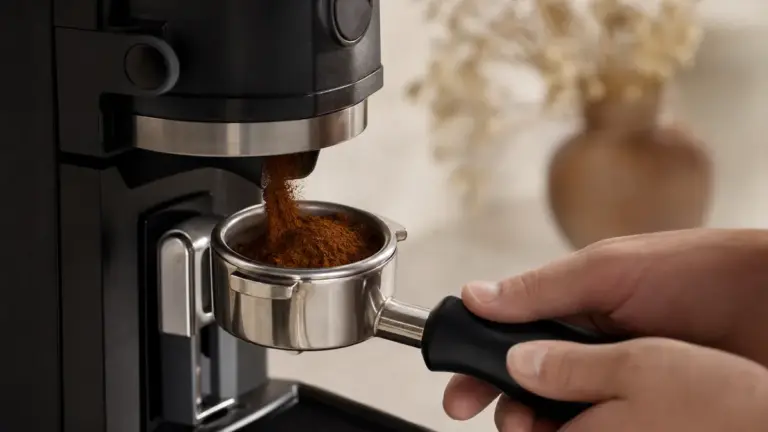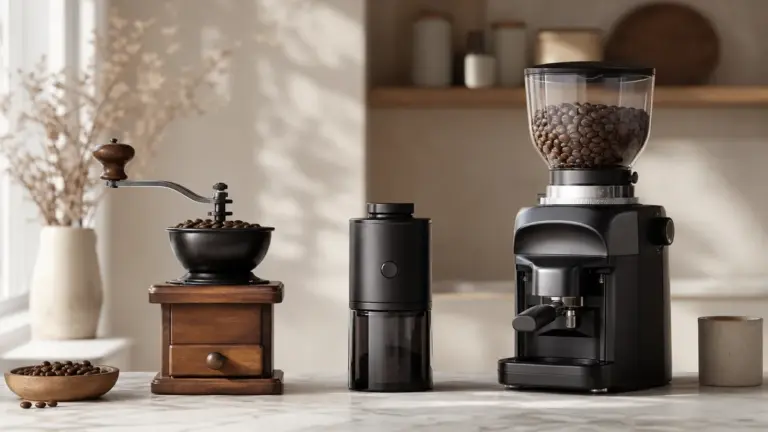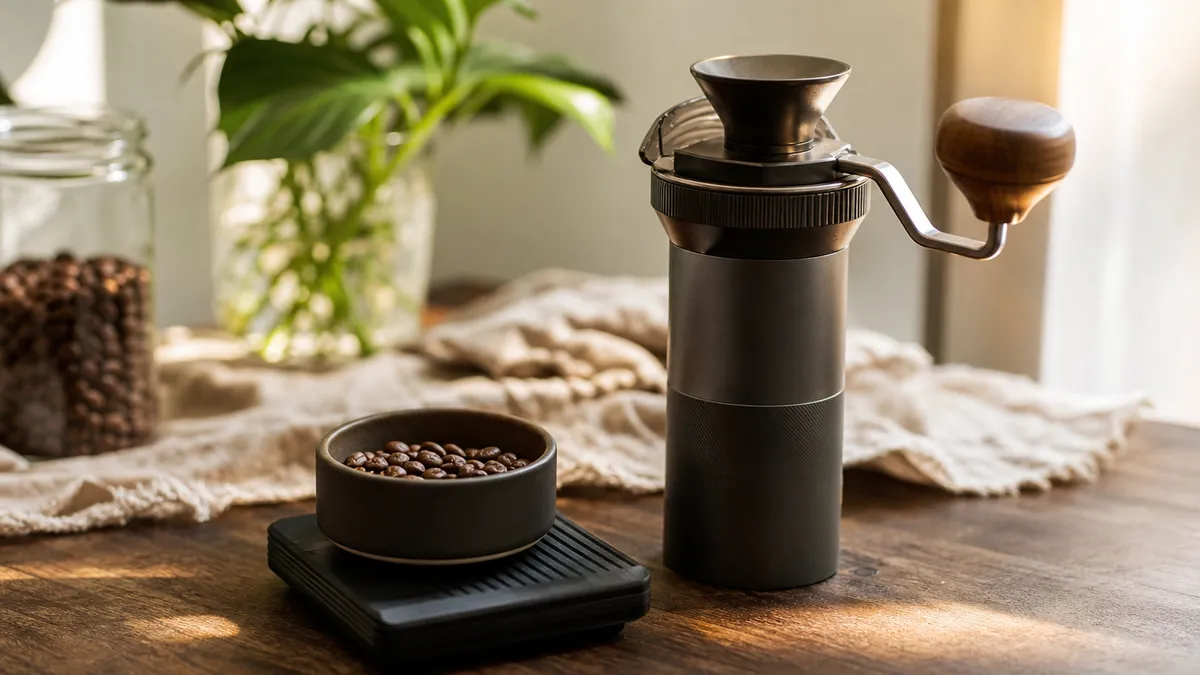
A single-dose grinder grinds a weighed portion of beans for one brew, rather than drawing from a hopper kept full of coffee. It is particularly useful if you switch beans regularly or alternate between regular and decaffeinated coffee, provided you are happy to weigh and load each portion yourself.
In short
- Single dosing describes a workflow, not a guarantee of better grinding or espresso capability.
- Low retention means little coffee remains inside; matching input and output weights does not prove that no old grounds were exchanged.
- Bellows push air through the grinding path to help release grounds, but do not replace cleaning.
- Choose for your brewing method first, then compare adjustment, retention, handling and support.
- For a busy shared coffee point, test whether weighing each portion is practical before choosing this workflow.
What makes a grinder single-dose?
The defining feature is that you load only the beans needed for the next brew. A purpose-built single-dose grinder combines this workflow with a small loading funnel or hopper and design features intended to minimise coffee left inside.
That differs from keeping a hopper stocked and asking the grinder to dispense a portion, perhaps using a timer or a built-in weighing system. Single dosing controls the amount entering the grinder; hopper dosing controls what comes out.
It does not necessarily mean one cup. A weighed portion for a cafetière shared between colleagues is still a single dose if it is loaded and ground as one batch.
Some conventional grinders also accept single-dose accessories. Baratza, for example, offers a replacement hopper for compatible grinders, with a lid used for measuring and transferring beans. However, changing the hopper does not redesign the grinding chamber beneath it.
For the wider equipment choices, start with our guide to coffee grinders.
What “zero retention” really means
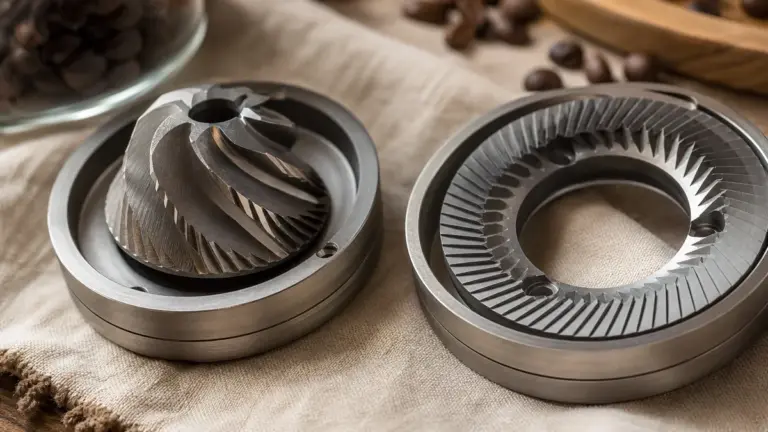
Retention is coffee remaining inside the grinder after grinding. It can collect around the burrs, which are the cutting surfaces, or in the chamber and outlet.
Purpose-built designs tackle this through features such as short discharge paths, inclined chambers, anti-static systems and mechanisms that dislodge grounds. Niche describes its Zero as having a straight-through path; Eureka describes an inclined chamber in its Mignon Single Dose documentation. These are manufacturers’ design descriptions, not proof that every particle leaves.
Three measurements deserve separating:
- Total retention: all the coffee remaining inside after a specified grinding and emptying procedure.
- Exchange: retained coffee that is displaced into a later dose and replaced by newly ground coffee.
- Dose difference: the difference between the weight of beans loaded and grounds collected.
The last measurement is easiest to check at home, but it cannot tell you everything. A grinder could release some grounds from the previous brew while retaining the same weight from the current one. Your scales would show matching weights even though an exchange had occurred.
As a concrete example, Kaffeemacher’s published October 2025 test of the Niche Zero reported 0.9 g total retention, including 0.2 g of temporary, exchanging retention. That was their measurement under their procedure, not a universal result for every machine or coffee.
Read “zero retention” as a claim to investigate, not a promise that cleaning is unnecessary. Ask what was measured, whether a clearing mechanism was used and whether the result describes total retention, exchange or simply input versus output.
A straightforward single-dosing workflow
You need beans, a suitable scale, a receiving cup and your grinder’s instructions. A scale displaying 0.1 g increments is a useful practical choice for checking small dose differences, although display resolution is not the same as verified accuracy.
The following method uses an illustrative 18 g portion. Use the quantity required by your recipe and, for espresso, your basket.
- Weigh the beans. Put an empty dosing cup on the scale, zero it, then add 18 g of beans.
- Check the setting. Select the appropriate grind setting, following the manufacturer’s instructions about when adjustment is permitted.
- Position the receiving cup. Make sure it sits properly beneath the outlet before loading.
- Load and grind. Follow the specified starting sequence. Do not assume every grinder should be running before beans enter.
- Complete the clearing routine. Use the supplied bellows or knocker as instructed, keeping the receiving cup in place.
- Weigh the grounds. Record the collected amount before transferring it to the brewer or portafilter.
- Keep a brief note. Record the coffee, setting and any persistent dose difference, especially when changing beans.
Do not impose a universal grinding time. Models have different speeds, stopping behaviour and operating limits.
For espresso, keep bean input and beverage yield separate: the amount loaded into the grinder is not the amount of espresso collected in the cup. The value of weighing both beans and grounds here is checking what actually reaches your brewing basket.
What bellows do
Bellows are a flexible air chamber, usually fitted above the grinding path. Compressing them sends air through the grinder to help dislodge retained grounds.
They are one solution, not a defining requirement. Fellow’s Ode Gen 2 uses a grinds knocker and anti-static technology instead. Judge the complete emptying routine rather than assuming a grinder without bellows must retain more.
Follow the instructions for the particular mechanism. Do not improvise a forceful pumping routine, remove safety components or assume that an aftermarket bellows accessory is approved for your model.
Why switching beans is the main attraction
The clearest benefit is that the hopper does not need emptying whenever your choice changes. You can load one coffee for breakfast, another for a filter brew and decaf later, leaving the unused beans in their storage containers.
Low exchange also helps keep successive coffees separate. This matters when comparing coffees: carry-over from a darker roast can make it harder to judge a lighter coffee on its own terms.
There are limits. Reduced carry-over is not a guarantee of complete separation, and a shared grinder should not be represented as eliminating regular-coffee residue before a decaf dose.
Switching beans also does not remove the need to adjust the grind. “Dialling in” means finding settings that make a particular coffee brew as intended. A saved setting is a useful starting point, not a guarantee that the next brew needs no adjustment.
If you want to move between espresso and filter, check both the supported grind range and the adjustment system. Niche advertises the Zero for both; Fellow states that Ode is not suitable for espresso. Single-dose loading alone tells you neither.
For a filter-focused choice, our guide to filter coffee grinders examines the brewing requirements separately.
Who single-dose grinders suit
The comparison below uses workflow, bean changes and suitability for shared use as its criteria. It is a decision aid, not a performance ranking.
| Approach | Bean changes | Main trade-off | Best fit |
|---|---|---|---|
| Purpose-built single-dose grinder | Load the next weighed portion | Weighing and loading every batch | People who rotate coffees |
| Compatible grinder with single-dose hopper | Convenient portion loading | Original internal design remains | Owners assessing an existing grinder |
| Hopper-fed grinder | Hopper contents need managing | Less convenient for frequent changes | Repeated brewing with one coffee |
| Separate grinders for different coffees | Each can remain dedicated | More equipment and maintenance | Regular use of distinct coffees or methods |
Our recommendation is to favour single dosing when choosing the coffee is part of the pleasure, rather than when everyone wants the same drink with minimal handling.
The drawbacks are practical. Each batch involves beans, scales, loading and usually a receiving cup. A bellows or knocker adds another action; transferring grounds introduces another opportunity for spills.
A small office enthusiast station may accommodate that easily. A shared tea point needs a more demanding trial: ask occasional users to make coffee without coaching, then observe the weighing, setting changes and clean-up. This is a workflow test, not just a test of grinding speed.
For repeated workplace service, use commercial coffee grinders to assess suitability beyond the domestic single-dose category.
How to choose without being distracted by extras
Start with your brew method and preferred routine. Then compare documented capabilities, the operating manual and the practical support available in the UK.
Rather than relying on price bands, separate the options by what they provide:
- A compatible conversion: a smaller hopper or dosing accessory for a grinder you already own. Confirm compatibility and assess whether its existing retention is acceptable.
- A dedicated single-dose design: a loading system, grinding path and clearing routine designed to work together.
- A more adjustable specialist design: additional controls or burr choices. Require a clear reason for each extra feature in your own brewing.
Do not assume more controls mean a better match. A filter-only user does not need espresso adjustment simply because another model offers it. Equally, an espresso user needs suitable fine adjustment, not merely a small hopper.
Before ordering, ask for:
- The manual for the exact model and version.
- Its supported brewing methods and maximum batch quantity.
- An explanation of any retention claim and its test procedure.
- Instructions for cleaning, adjustment and recalibration.
- Confirmation of UK electrical suitability, spare parts and service arrangements.
- Confirmation that the intended workplace use is supported, where applicable.
For a workplace purchase, request itemised written quotations covering the grinder, necessary accessories, delivery, servicing and replacement parts. Compare the same inclusions across suppliers, without treating a headline offer as the complete commitment.
Our guide to how to choose a coffee grinder provides the broader selection framework.
Checking performance and solving problems
For a useful home check, keep the coffee, dose, setting and clearing routine unchanged across several batches. Record input and output separately rather than judging the grinder from one result.
An illustrative calculation is:
18.0 g beans loaded − 17.8 g grounds collected = 0.2 g apparent dose shortfall.
That describes the measured batch. It does not establish total internal retention or prove how much coffee will exchange next time.
| Symptom | Likely cause | Practical response |
|---|---|---|
| Grounds appear after removing the cup | Delayed release from the outlet | Complete the specified clearing routine before moving the cup |
| More grounds cling around the chute | Static or a dirty anti-static system | Follow the manufacturer’s cleaning guidance |
| Output sometimes exceeds input | Previously retained grounds may be leaving | Check the weighing routine and record successive doses |
| Grounds remain despite bellows use | Clearing does not remove every deposit | Clean accessible parts according to the manual |
Some manufacturers permit the Ross Droplet Technique, or RDT: lightly dampening beans to reduce static. Fellow provides a damp-spoon method for Ode and explicitly warns against pouring water into the grinder. Treat this as model-specific guidance, not permission to add water to any grinder.
Unplug before accessing internal parts for cleaning, and follow the manual’s disassembly instructions. Low retention is useful; safe, repeatable handling is what makes it useful every day.
FAQ
Can I single-dose a grinder I already own?
Possibly, but check the manufacturer’s instructions and compatible accessories first. Baratza supplies single-dose hoppers for specified models, demonstrating that a dedicated new grinder is not always necessary. However, a different hopper does not establish lower internal retention. Assess the resulting workflow and dose consistency before deciding that replacement equipment is needed.
Do single-dose grinders need purging?
Some situations may still require it, depending on the grinder and its instructions. Purging means grinding and discarding coffee to clear previously retained material. Low exchange can reduce the reason for doing this, but “single-dose” is not a universal no-purge guarantee. Avoid adding a fixed discard quantity without a documented reason.
Does matching the input weight prove that I collected only fresh grounds?
No. Matching weights establish the net amount collected, within your measurement’s limitations, but not the identity of every particle. Some older grounds could leave while an equal weight of newly ground coffee remains inside. This is why a useful retention assessment distinguishes dose difference from exchanging coffee and total internal deposits.
Where to go next
Read Coffee Grinders for the wider equipment picture and How to Choose a Coffee Grinder to turn your routine into selection criteria. Filter Coffee Grinders helps narrow a filter-focused choice, while Commercial Coffee Grinders addresses workplace requirements that a domestic single-dose grinder may not meet.
Sources
-
Niche Coffee, Niche Zero, undated product page, checked November 2026. Manufacturer’s descriptions of single dosing, straight-through design and espresso-to-filter adjustment.
https://www.nichecoffee.co.uk/products/niche-zero -
Eureka, Mignon Single Dose, undated manufacturer brochure. Inclined chamber, retention terminology and supplied clearing accessory.
https://blog.eureka.co.it/hubfs/Mignon%20Single%20Dose%20-%20Best%20practice%20ENG.pdf -
Baratza, White Single Dose Hopper for Conical Burr Series Grinders, undated product page, checked November 2026. Measuring lid and stated compatibility.
https://www.baratza.com/en-us/product/white-single-dose-hopper-for-conical-burr-series-grinders-zga6116wht0zxx1 -
Fellow, Ode Brew Grinder Gear Guide, undated live guide, checked November 2026. Anti-static technology, retention claims and maintenance guidance.
https://fellowproducts.com/pages/gear-guide-ode?view=gg-ode-2 -
Fellow, Ode Gen 2 Safety and Maintenance Guide, version 3, undated. Operation, safe handling and cleaning.
https://cdn.shopify.com/s/files/1/0057/6235/1219/files/Ode_Gen2_SafetyManual_V3.pdf -
Fellow, How can I reduce the mess and retention with my Ode Brew Grinder?, 6 October 2026. Delayed grounds release, RDT and anti-static prong cleaning.
https://help.fellowproducts.com/hc/en-us/articles/360050042652-How-can-I-reduce-the-mess-and-retention-with-my-Ode-Brew-Grinder -
Fellow, Pulling Your First Great Shot on Series 1, 2026. Explicit distinction between Ode and espresso-capable grinding, plus weighing beans and grounds.
https://help.fellowproducts.com/hc/en-us/articles/47232986639515-Pulling-Your-First-Great-Shot-on-Series-1 -
Kaffeemacher, Niche Zero Test: the single-dosing grinder with almost no retention, updated August 2026, incorporating October 2025 measurements. Primary equipment testing used to distinguish total and exchanging retention, not as a universal performance guarantee.
https://kaffeemacher.de/en/blogs/kaffeewissen/niche-zero-test
This article was researched using manufacturer documentation and published primary equipment testing; workflow recommendations and illustrative calculations are identified separately from measured performance.
Last checked: November 2026