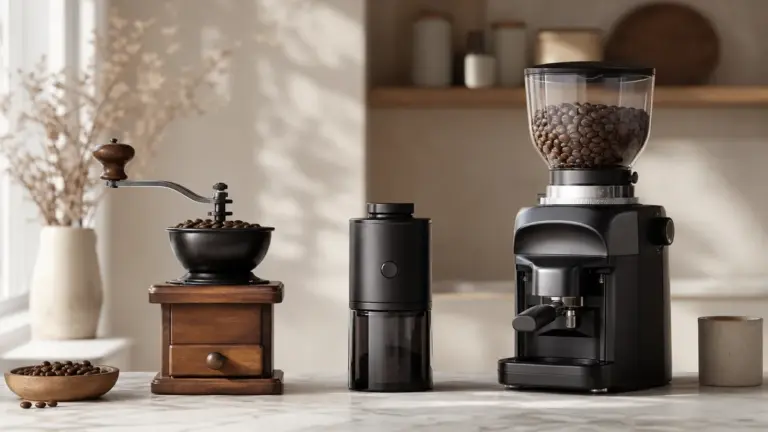
Manual hand grinders are worth buying if you make small batches of coffee and are happy to turn a crank rather than press a button. Choose one for its burrs, adjustment and comfortable handling, not simply because it is manual: a well-specified filter grinder and an espresso-focused model can be quite different tools.
In short
- Look for a firmly supported shaft, clearly documented burrs and a setting you can return to reliably.
- CNC-machined stainless steel burrs and dual-bearing shafts are useful features, but do not prove cup quality on their own.
- For espresso, check adjustment precision as well as whether the grinder can grind finely enough.
- Test grinding effort with your usual beans and dose. Published specifications do not establish a universal grinding time.
- For travel, check packed dimensions, weight, grounds-container security and replacement-part availability.
How manual hand grinders work
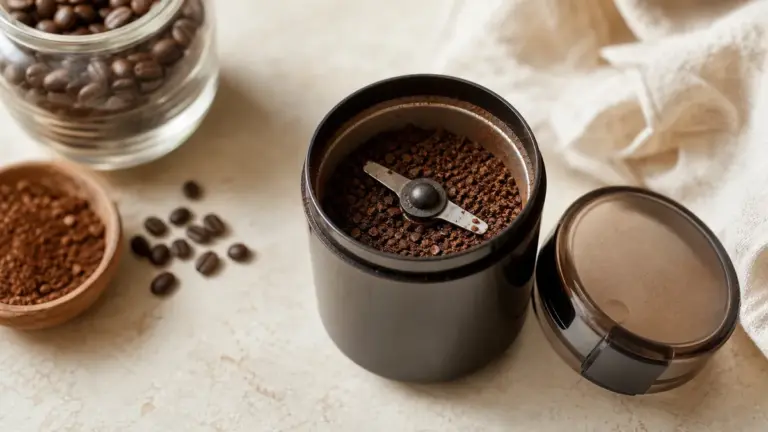
A hand grinder uses a crank to rotate a shaft connected to a burr, a toothed grinding component. In a typical conical design, the rotating inner burr works inside a stationary outer burr. Beans enter from above, break into smaller pieces and leave through the space between the burrs.
The adjustment mechanism changes the burrs’ relative position. A finer setting produces smaller grounds; a coarser setting produces larger ones. Click-based mechanisms divide that movement into repeatable steps, while stepless mechanisms allow continuous adjustment.
The motor is missing, but the grinding mechanism still needs careful engineering. Read the parent coffee grinders guide for the wider choice between manual and electric equipment, and burr grinders for a fuller explanation of burr construction.
The main buying question is therefore not “Does it have burrs?” It is “Are those burrs supported, adjusted and driven well enough for the coffee I make?”
Burr quality: look beyond steel versus ceramic
Machined steel burrs and shaft support
Several manufacturers document substantial engineering behind their hand grinders. Timemore describes its C3-series burrs as CNC-machined stainless steel, with dual-bearing support. CNC machining means computer-controlled cutting of the component.
Comandante specifies a high-nitrogen stainless steel burr set cut from solid metal, with the central axle supported by two sealed ball bearings. KINGrinder describes the K6’s burr geometry as heptagonal, meaning seven-sided.
You may also encounter pentagonal, or five-sided, burr descriptions. These describe aspects of the burr geometry, not a quality grade. Neither the number of sides nor the phrase “CNC-machined” establishes that one grinder tastes better than another.
Shaft support matters because the burrs need to maintain their intended relationship while beans resist the crank. Bearings are part of that system, alongside the frame, burr mounting and manufacturing tolerances. Treat “dual bearing” as a feature to examine, not a complete performance verdict.
Ceramic does not automatically mean poor
Ceramic burrs remain part of established manufacturers’ ranges. Hario’s Mini-Slim Pro uses ceramic burrs, while Porlex’s Tall Professional has a redesigned ceramic burr set.
It would be misleading to describe every Hario or Porlex grinder as an unsupported shaft that inevitably wobbles. Equally, ceramic material alone does not prove that a grinder is slow or inconsistent. Model, generation, mounting and adjustment all need checking.
Porlex claims that its Professional burr design produces more ground coffee per rotation than its predecessor. That is a manufacturer comparison, not independent evidence that it outperforms a particular steel-burr grinder.
Our buying preference is a well-supported steel-burr model with clear documentation, provided it suits the intended brew method. That preference is based on the documented construction and adjustment options, not on a claim that ceramic cannot grind good coffee.
How much effort and time should you expect?
There is no defensible stopwatch figure for all hand grinders. A useful comparison must hold the coffee, dose, target grind and testing procedure reasonably constant.
Do not assume that every steel-burr model will finish a dose within the same short interval, or that every ceramic model takes several minutes. The manufacturer documents retrieved for this guide do not substantiate those blanket claims.
Instead, ask for a demonstration using your normal coffee and brew method. A demonstration at a coarse setting does not establish how comfortable the same grinder will be when adjusted for espresso.
Check two separate things:
- Cranking effort: can you turn the handle smoothly without straining?
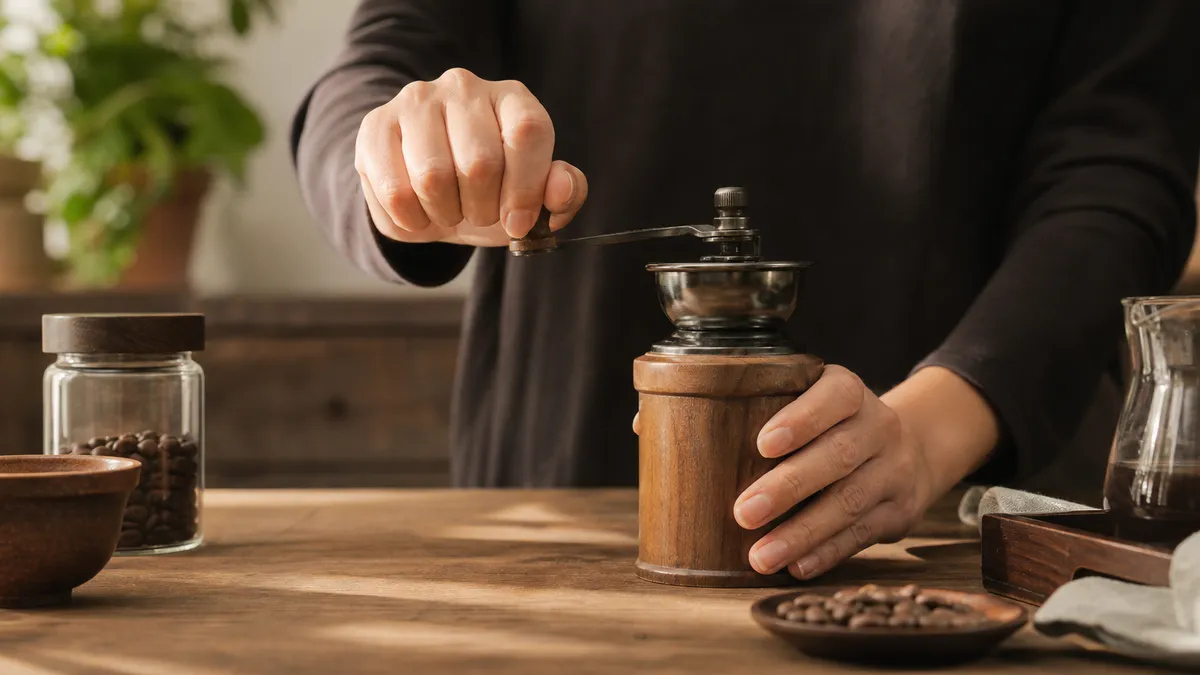
- Holding effort: can your other hand stop the body rotating without an uncomfortable grip?
A textured body, usable handle and comfortable knob deserve as much attention as an impressive specification. If possible, grind a complete dose rather than turning an empty grinder.
For repeated drinks, test the whole routine: filling, grinding, emptying and starting again. Our recommendation is to favour electric grinding when that repetition feels like an obstacle rather than a pleasant part of making coffee.
Can a manual grinder make espresso?
Yes, but “fine enough for espresso” is only the first requirement. You also need enough adjustment control to find a workable setting and return to it.
Consider an espresso-focused example. The 1Zpresso J-Ultra manual specifies burr movement of 8 micrometres per click. Timemore distinguishes the finer-control ESP adjustment from the classic adjustment within its C3 family.
Those specifications describe adjustment mechanisms. They do not mean every ground particle measures that size, nor do they establish a direct conversion between different grinders’ settings.
For espresso, look for:
- Explicit manufacturer support for espresso use.
- Fine adjustment that is practical to operate.
- A clear reference point or readable setting.
- Comfortable grinding with your usual dose.
- A manageable routine when several attempts are needed.
A grinder can produce very fine coffee yet remain frustrating if adjacent settings offer too little useful control. See espresso grinders for the broader requirements, rather than choosing from grind-range claims alone.
For pour-over and immersion brewing, start with the requirements in filter coffee grinders. An espresso-focused adjustment system is not automatically the most convenient choice for a filter-only routine.
Build, capacity and travel practicality
Portability involves more than fitting the grinder into a bag. Check whether the crank detaches or folds, how securely the grounds container attaches, and whether any exposed parts need protection.
Weight also varies. The J-Ultra’s manufacturer lists it at 700 g, with a claimed grounds capacity of 35 to 40 g. Those figures may suit a home routine, but they deserve consideration before packing it for a walking trip.
Capacity figures need careful reading. A grounds-container capacity is not necessarily a promise that the hopper accepts the same quantity of every bean. Leave room rather than packing beans tightly into the mechanism.
Check the exact model rather than relying on a family name. Timemore lists different capacities, handle arrangements and adjustment systems within the C3 range. A photograph of a folding handle does not establish that every version includes one.
For longer-term ownership, ask about replacement containers, handles, bearings and burr servicing. Comandante explicitly offers spare-part support through dealers or its support team. Do not assume another maker offers the same parts or repair arrangements.
Choosing a manual hand grinder by capability
Rather than relying on price bands, compare what each design actually lets you do. The criteria below are burr documentation, shaft support, adjustment, handling and intended workload.
| Capability group | What to check | Who it suits | Main compromise |
|---|---|---|---|
| Simple occasional-use grinder | Exact burr design, adjustment and comfortable handling | Infrequent brewing with modest expectations | Must be assessed model by model |
| Steel-burr filter grinder | Documented burrs, stable shaft and repeatable settings | Regular individual filter brewing | Espresso adjustment may be unsuitable |
| Espresso-focused grinder | Fine adjustment and comfortable operation at espresso settings | Someone making espresso who accepts manual work | Repeated grinding can interrupt the routine |
| Travel-focused grinder | Packed size, weight, protected handle and secure container | Travellers prioritising compact equipment | Smaller capacity or less convenient handling |
Our recommendation: choose for the brewing method you use most often. Do not accept awkward daily handling merely to gain a theoretical ability to cover every method.
If you are comparing a hand grinder with a chopping-style machine, read blade grinders before treating them as equivalent alternatives.
A practical first-use and buying check
Use this sequence during a demonstration or when setting up your grinder. The 18 g dose below is a suggested comparison amount, not a manufacturer performance standard.
- Read the exact model’s manual. Identify the adjustment direction, starting reference and any prohibited settings.
- Weigh 18 g of your usual beans, provided the hopper permits it. For a smaller grinder, use a smaller recorded dose.
- Select the manufacturer’s starting setting for your brew method. Do not force the adjustment tightly shut.
- Attach the handle and container securely. Grind in the specified direction, keeping your grip comfortable.
- Record grinding time and effort separately. Include filling and emptying when assessing daily convenience.
- Brew using your established recipe. Keep the other variables unchanged while assessing a setting change.
- Return to the original setting. Check whether the adjustment is easy to read and repeat.
This is a practical comparison procedure, not a laboratory particle-size test. Appearance alone cannot establish the complete distribution of ground-particle sizes.
| Symptom | Likely cause | What to do |
|---|---|---|
| Crank will not turn freely near the starting point | Adjustment may be too tight | Follow the manual and move to a permitted coarser setting |
| Hand slips around the body | Grip or body shape does not suit you | Reassess handling rather than gripping harder |
| Grounds spill during removal | Container attachment or removal technique | Check the model’s instructions and attachment |
| Setting is difficult to recover | Reference point or counting method is unclear | Record the setting in that grinder’s own notation |
Cleaning without damaging the grinder
Follow the manufacturer’s instructions rather than applying one cleaning method to every hand grinder.
1Zpresso recommends a dry brush and air blower and explicitly says not to wash its grinders with water. By contrast, Hario says the Skerton Pro’s burr section can be disassembled for washing, while only its glass parts are dishwasher-safe.
That difference matters more than a generic instruction to “wash the burrs”. Keep parts in their correct order, observe any disassembly restrictions and follow the reassembly procedure.
For storage, protect the handle and container from knocks. Check that everything is dry before packing, and do not leave loose beans or grounds where they can escape into luggage.
FAQ
Is a hand grinder a sensible choice for an office?
It can be a sensible personal tool, but we would not choose one as the shared grinder for a busy tea point. Assess the repeated filling, turning and emptying rather than only the time for a single dose. A demonstration covering the expected sequence of drinks is more useful than a capacity claim alone.
Can you compare click settings between brands?
No, click counts are not a universal grind-size scale. Manufacturers use different adjustment mechanisms, burrs and reference points. The J-Ultra’s stated movement per click, for example, describes its own mechanism. Start with the instructions for the exact grinder, then adjust for your brewing result rather than copying another model’s setting.
Will one hand grinder cover both filter coffee and espresso?
Some manufacturers explicitly design models for both, but suitability is not the same as convenience. Check the usable adjustment, the effort at each setting and how easily you can move between them. If you mainly make filter coffee, do not let occasional espresso ambitions determine every part of the daily routine.
Where to go next
Read Coffee Grinders for the wider manual-versus-electric decision, then Burr Grinders to understand the mechanism. Espresso Grinders and Filter Coffee Grinders explain the requirements of each brewing method, helping you choose manual hand grinders for the work they will actually do.
Sources
Manufacturer specifications below were retrieved in November 2026. They are published claims, not results from independent comparative testing.
-
Comandante, C40 MK4 Nitro Blade Manual, Q3 2021 edition. Burr construction, axle support and operation.
-
Timemore, C3s / C3 Series, undated product page. Burr construction, bearing support and model differences.
https://www.timemore.com/collections/coffee-grinder-manual/products/c3-series -
KINGrinder, Comparison, undated manufacturer guide. K6 heptagonal stainless steel burr description.
https://www.kingrinder.com/blog/comparison?categoryId=257473 -
Hario USA, Mini-Slim Pro Ceramic Coffee Mill, undated product page. Ceramic burr specification.
https://www.hario-usa.com/products/ceramic-coffee-mill-mini-pro -
Porlex Grinders, PORLEX Tall Grinder Professional, undated product page. Ceramic burr redesign and claimed comparison with its predecessor.
https://www.porlexgrinders.com/collections/frontpage/products/porlex-tall-grinder-professional -
1Zpresso, User Manual: J-Ultra, undated online manual. Adjustment movement, operation and cleaning.
https://1zpresso.coffee/manual-jultra-en/ -
1Zpresso, J-Ultra Manual Coffee Grinder, undated product page. Claimed weight and grounds capacity.
https://1zpresso.coffee/product/jultra/ -
1Zpresso, FAQ, undated support page. Tight adjustment, burr contact and dry-cleaning instructions.
https://1zpresso.coffee/faq/ -
Hario, Skerton Pro Ceramic Coffee Mill, undated product page. Washing and dishwasher restrictions.
https://globalhario.com/products/ceramic-coffee-mill-skerton-pro -
Comandante, FAQ, undated support page. Spare and replacement-part support.
https://comandantegrinder.com/pages/faq
This guide was researched from manufacturers’ manuals, specifications and support pages; no first-hand testing or unsupported cross-brand grinding-time comparison is claimed.
Last checked: November 2026