Commercial coffee grinders should be chosen around peak demand, dosing workflow and service support, not simply burr size or hopper capacity. For cafés and offices using traditional espresso machines, our buying preference is an on-demand grinder whose permitted operating cycle comfortably covers the busiest period, with grind-by-weight worth considering where several people share preparation duties.
In short
- Record your busiest ordering period as well as daily drinks before approaching suppliers.
- On-demand describes when coffee is ground; grind-by-weight describes how the dose is measured.
- Ask for the permitted operating cycle, not just grinding speed.
- Plan burr replacement around the manufacturer’s guidance for the exact burr set and your recorded throughput.
- Include cleaning access, calibration, staff training and breakdown support in the buying decision.
What makes a commercial grinder suitable for your business?
Start with a practical brief: which drinks you make, who prepares them, how many arrive together and what happens if the grinder stops working. For an office, specify actual attendance and coffee use rather than the organisation’s total headcount. For a café, record the queue at the busiest point, not just the daily till total.
Ask suppliers to demonstrate the grinder with your beans, baskets and portafilters, the handled holders used in a traditional espresso machine. Assess preparation speed, mess, noise and how easily staff can repeat the recipe. A demonstration should include several consecutive orders, not one carefully prepared dose.
This article concentrates on commercial operation and ownership. The broader coffee grinders guide explains the main grinder categories, while espresso grinders covers espresso-specific selection in more detail.
On-demand versus doser: choose the workflow first
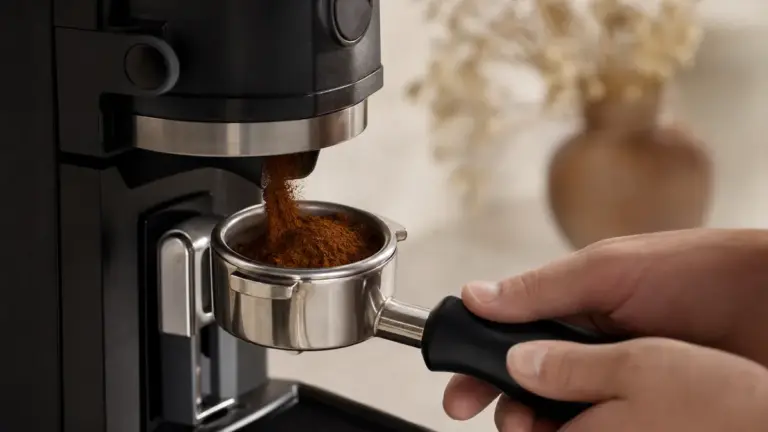
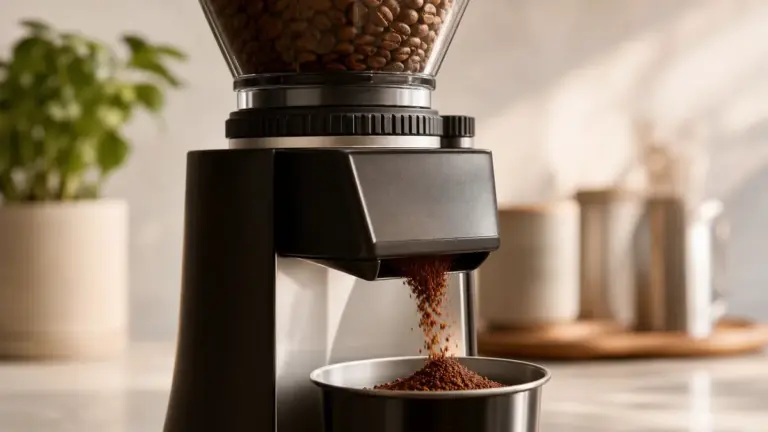
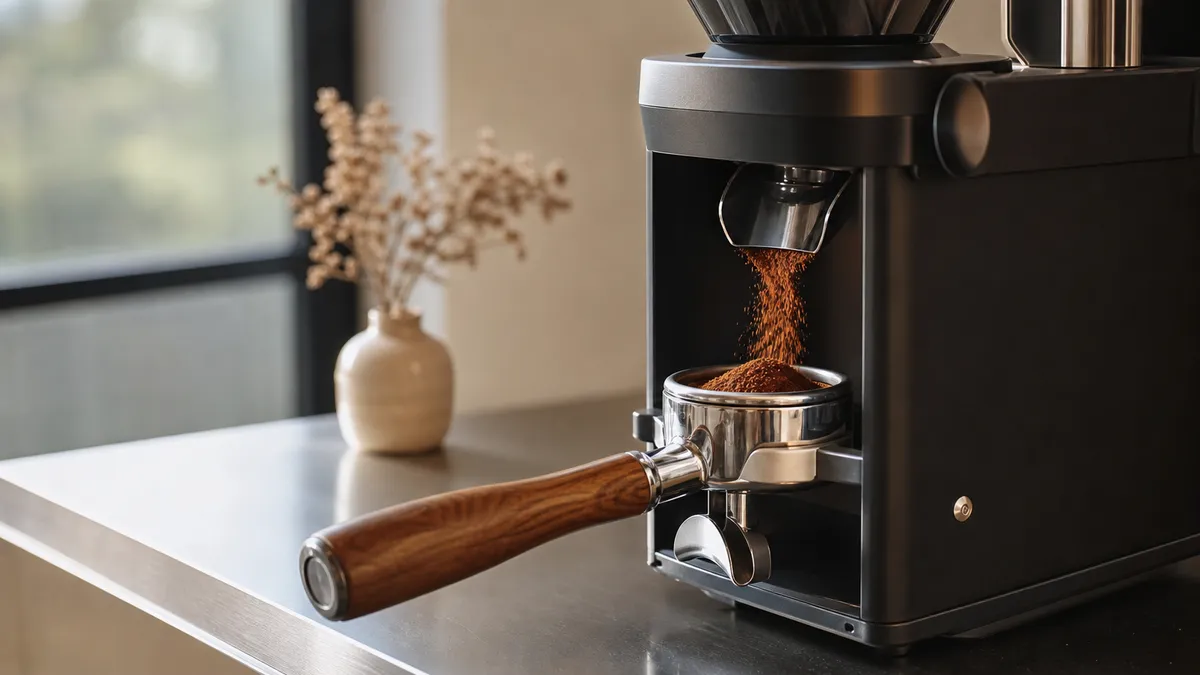
An on-demand grinder grinds when a dose is requested, usually straight into a portafilter. A traditional doser grinder instead collects ground coffee in a chamber and dispenses portions through a lever-operated mechanism. Timed on-demand machines control the grinding duration; traditional dosers portion coffee mechanically. Neither method directly measures each dose’s mass unless weighing is added.
Our comparison criteria are preparation workflow, dose checking, coffee held between orders and operator involvement. The recommendations below are buying judgements, not results from comparative testing.
| Workflow | How it portions coffee | Main trade-off | Best fit |
|---|---|---|---|
| Timed on-demand | Runs for a programmed duration | Requires separate weighing checks | Trained teams comfortable checking and adjusting doses |
| Grind-by-weight on-demand | Uses an integrated weighing system | Adds weighing hardware and calibration procedures | Shared preparation duties and frequent recipe checks |
| Traditional doser | Releases portions from a ground-coffee chamber | Adds chamber management and cleaning | Teams with an established, closely managed doser workflow |
| Single-dose | Operator weighs beans for each preparation | Adds a handling step to every order | Occasional coffees or a separate rotating-bean station |
The operating distinctions are documented in the manufacturers’ manuals; suitability depends on your service pattern.
For intermittent office use, our preference is on-demand: it avoids having to manage a separate chamber of ready-ground coffee between widely spaced orders. A doser is not automatically unsuitable, but ask who will empty, clean and manage that chamber.
If changing beans for individual drinks is central to the business, compare a separate single-dose grinder rather than assuming a hopper-fed machine will suit that workflow.
What grind-by-weight does, and what it does not
Grind-by-weight uses an integrated weighing system to control the mass dispensed. For example, Mahlkönig describes its E65W GbS as using a high-precision scale for real-time dosing control. This is a manufacturer’s specification, not an independently verified accuracy result.
Treat weighed dosing as control of one recipe variable, not automatic control of the finished drink. Keep checking the coffee in the basket, the beverage yield and the result in the cup. Ask the demonstrator to show how an interrupted dose is resumed and what happens when the portafilter is positioned incorrectly.
There is also a distinction between weighing calibration and grind calibration. Mahlkönig’s software manual, version 1.36, describes separate procedures for calibrating the load cell, the weighing sensor, and the burr-distance system. Its load-cell procedure uses a reference weight.
Before ordering, establish who may perform these tasks, what equipment is needed and whether your exact portafilters fit without touching surrounding surfaces.
Size capacity around the rush, not the hopper
Separate three questions:
- How much coffee must be ground during the day?
- How quickly must consecutive doses be delivered?
- What operating and resting pattern does the manufacturer permit?
Published grinding speed is not permission to run continuously. For example, the E65W GbS instructions specify an operating cycle of 5 seconds on and 15 seconds off for the 220 to 240 V version, described as three double espressos per minute. The manual also warns against exceeding the permitted cycle. These are model-specific manufacturer limits, checked in November 2026.
An illustrative office demand matrix
The following is a planning exercise, not a grinder rating or a claim about typical consumption. Assume everyone listed is present, each person orders two espresso-based drinks daily, every drink uses one 18 g dose, and there are no visitors, discarded doses or dial-in beans.
| People present | Drinks per person daily | Drinks daily | Recipe beans daily |
|---|---|---|---|
| 10 | 2 | 20 | 360 g |
| 25 | 2 | 50 | 900 g |
| 50 | 2 | 100 | 1,800 g |
| 100 | 2 | 200 | 3,600 g |
The calculation is people × drinks per person × dose. Replace every assumption with your own records.
For a separate peak example, 12 drinks in 10 minutes at 18 g require 216 g of recipe coffee. Ask suppliers to demonstrate that sequence within the machine’s permitted cycle, including weighing, basket preparation and any necessary pauses. Do not convert a headline grams-per-second figure directly into a promised drinks-per-hour capacity.
For batch brewing, prepare a separate brief using the coffee mass required per batch and the interval between batches. Our filter coffee grinders guide covers that application.
Cooling, installation and staff workflow
Active cooling is a feature to investigate, not a substitute for checking operating limits. Mahlkönig lists active cooling on the E65W GbS, while its instructions still impose an operating cycle and describe thermal protection. A fan does not cancel the manual.
During the demonstration, compare the beginning and end of your simulated rush. Record delivered dose, grinding time and drink results. Ask the supplier to explain any change rather than accepting a general assurance that a larger motor will cope.
Measure the proposed position with the hopper fitted, then allow access for filling, removal and cleaning. Check that the operator can move the portafilter naturally without reaching across a sink or another appliance. In an office, arrange the noise demonstration while nearby desks are occupied.
For Great Britain, HSE advises checking electrical equipment for damage, stopping use when it appears faulty and having repairs undertaken by a competent person. Include cable condition and safe positioning in the installation check.
Burr life: plan in kilograms, not birthdays
There is no useful universal replacement interval for commercial burrs. Mazzer’s published indicative figures distinguish both model and burr specification: it lists 400 kg for a Super Jolly V Pro single-phase 233M burr set and 1,200 kg for its T233M titanium alternative. These are manufacturer service-life guides, not guaranteed replacement dates.
Ask for the guidance covering the precise burr part supplied. Then estimate a planning interval:
Indicative burr throughput in kg ÷ actual kg ground per working day = working days.
Using the illustrative 400 kg guide and an assumed 2 kg daily throughput gives 200 working days. That is arithmetic for maintenance planning, not a promise that the burrs remain satisfactory until that point.
Record actual bean use, burr installation dates and service findings. Ask the technician to assess declining performance rather than replacing burrs solely because a calendar reminder has appeared.
Cleaning and calibration need named owners
Before purchase, ask someone to demonstrate the full approved cleaning procedure and identify which tasks ordinary operators may perform. Check whether deeper access requires a technician, whether reassembly preserves the setting and what must be checked afterwards.
Mazzer advises dry cleaning of the grinding chamber with a brush, vacuum cleaner or dry cloth, without water, cleaners or abrasives. Its broader manual places restrictions on who may carry out particular cleaning and maintenance operations, so do not transfer another grinder’s instructions to yours.
A sensible workplace handover is:
- Assign an operator responsible for routine cleaning and a deputy for absences.
- Keep the correct manual beside the cleaning schedule.
- Switch off and unplug before cleaning or internal checks, and follow the manual’s access restrictions.
- Reassemble, restore the approved settings and verify a weighed dose and test drink before service.
- Record faults and escalate repeated problems rather than repeatedly resetting the machine.
HSE supports isolation before cleaning or checks and the use of competent people for repairs. Powered calibration or adjustment routines should be performed only as expressly instructed by the manufacturer.
For routine recipe adjustment, keep a written target for dose, beverage yield and preparation method. Avoid turning burrs towards contact as an improvised calibration procedure: Mazzer specifically warns against bringing them into contact while the motor is turning.
Service, quotations and the final buying decision
Request an itemised written quotation covering the grinder, installation, training, burr replacements, cleaning materials, planned servicing, breakdown attendance and any replacement-machine arrangement. Ask which items are included, which are excluded and how VAT is presented.
To compare whole-life ownership, use the same period and expected drink volume for every quotation. Add the applicable equipment, consumable and support items, then divide by expected drinks if you need an internal per-drink figure. Include coffee used for dialling in and clearing retained grounds rather than counting only served recipes.
Put response arrangements in writing: who answers the telephone, who holds parts, whether attendance means repair, and what happens during a prolonged outage. For a used grinder, request its service record and an inspection rather than relying on appearance.
A UK business purchase should not be treated as an ordinary consumer purchase. Section 2 of the Consumer Rights Act 2015 defines a consumer as an individual acting wholly or mainly outside their trade, business, craft or profession. Have the purchasing terms and warranty reviewed for the actual transaction.
For the final shortlist, use how to choose a coffee grinder alongside your demand record. Commercial coffee grinders earn their place through a repeatable workflow and support arrangements that your team can actually use.
FAQ
Can grind-by-weight replace a separate scale?
Keep a separate suitable scale for verification and beverage weighing. Integrated weighing controls the grinder’s dose, but it is a different function from measuring the espresso collected in the cup. Mahlkönig’s documentation distinguishes grind weight and beverage weight within recipe setup, as well as providing a load-cell calibration procedure.
Should an office buy a second grinder for decaf?
Consider one if decaf is requested regularly, but make the decision from your order pattern. Compare a dedicated station with the handling involved in switching beans. Ask the supplier to demonstrate the complete changeover, including clearing previous coffee, and record the time and discarded coffee before deciding which arrangement staff can manage consistently.
Does a commercial grinder need a water filter?
A standalone dry coffee grinder does not have a brewing-water circuit to filter. Its cleaning requirements are a separate matter: Mazzer instructs users to keep water out of the grinding chamber. Assess water treatment for the connected espresso machine separately, rather than applying brewer water specifications to grinder selection.
Where to go next
Read Espresso Grinders for espresso-focused selection, or Filter Coffee Grinders when the requirement is batch brewing. Single-Dose Grinders helps assess individual-bean workflows, while How to Choose a Coffee Grinder provides the broader shortlisting framework.
Sources
-
Mahlkönig, E65W Grind-by-Sync, live manufacturer specification page, undated, retrieved November 2026.
https://www.mahlkoenig.com/en-de/products/e65w-grind-by-sync -
Mahlkönig, E65W GbS: Original Instructions, undated retrieved edition, especially operation, technical data and maintenance sections.
https://downloads.mahlkoenig.de/Service/Mahlkoenig_E65W_GbS_Original_instructions_EN_WEB.pdf -
Mahlkönig, Grind-by-Sync Software Manual, software version 1.36, undated retrieved edition, especially recipe management and service calibration.
https://downloads.mahlkoenig.de/Service/Mahlkonig_Software_Manual_Grind_by_Sync.pdf -
Mazzer, Burrs Tutorial, live manufacturer guidance, undated, retrieved November 2026.
https://www.mazzer.com/en/burrs-tutorial/ -
Mazzer, Instruction Manual: Kony S, Major V, Major VP, Robur S, Super Jolly V Pro, revision IMJ0L0080, December 2020, manufacturer document hosted by La Marzocco.
https://lamarzoccousa.com/wp-content/uploads/2023/09/Mazzer-V-S-Grinder-Manual_EN.pdf -
Health and Safety Executive, Introduction to Electrical Safety, current guidance retrieved November 2026.
https://www.hse.gov.uk/electricity/introduction.htm -
Health and Safety Executive, Work Using Electrically Powered Equipment, current guidance retrieved November 2026.
https://www.hse.gov.uk/electricity/electricequip.htm -
UK Parliament, Consumer Rights Act 2015, section 2, published legislation retrieved November 2026.
https://www.legislation.gov.uk/ukpga/2015/15/body/2023-01-08?timeline=false&view=plain
Research used manufacturer specifications and operating documents, HSE guidance and published legislation; calculations are explicitly illustrative, and no first-hand testing is claimed.
Last checked: November 2026