The best filter coffee grinders use burrs, offer useful adjustment through the medium-fine to medium-coarse range, and comfortably handle your largest brew. Choose by repeatable settings, practical capacity and ease of use, rather than assuming that flat burrs, a powerful motor or an espresso label guarantees better filter coffee.
In short
- Check how much of the adjustment range serves filter brewing, not just the total number of settings.
- Judge uniformity by brewing results, not whether the grounds look perfectly identical.
- At a starting dose of 60 g per litre, a 500 ml brew needs 30 g of coffee and a 1.25 litre batch needs 75 g.
- Fellow explicitly excludes espresso from the Ode’s intended uses. Wilfa lists espresso among the Uniform’s uses, so the same restriction should not be applied to both.
- Ask for a demonstration with your actual dose, including loading, grinding and transferring the grounds.
What makes a good filter coffee grinder?
A useful filter grinder makes it straightforward to find a setting that tastes balanced, then return to it tomorrow. For most buyers, the priorities should be:
- An appropriate grind range with manageable changes between settings.
- Consistent results at the doses you actually brew.
- Enough bean and grounds capacity for the largest batch.
- A convenient adjustment, cleaning and transfer routine.
- Accessible replacement parts and suitable support.
These are the criteria used throughout this guide. The named machines below illustrate different designs, rather than forming a tested ranking.
Start with a burr grinder, which passes beans between shaped grinding surfaces with an adjustable gap. Both conical and flat burr arrangements are used in coffee grinders. The broader coffee grinder guide explains the main equipment categories; here, the question is how well the design serves filter brewing.
Before comparing machines, write down your smallest brew, largest brew and whether espresso is genuinely part of the plan. That short list is more useful than an unusually long specification sheet.
Filter coffee grinders need a useful range, not a universal setting
“Medium grind” is a starting description, not a transferable measurement. Baratza’s Encore ESP manual, for example, suggests different initial settings for a Hario V60, an automatic brewer and a Chemex, while explicitly allowing further adjustment for the recipe and taste.
Look for adjustment spanning medium-fine grounds for some smaller pour-overs through medium-coarse grounds for other filter recipes. Do not assume that every paper-filter brewer needs the same setting, or that all filter coffee should resemble coarse cafetière grounds.
The useful question is: can you make a small, repeatable change around your preferred filter setting?
A grinder may advertise many settings while allocating much of its adjustment to espresso. Conversely, a filter-focused model may put its available steps into the range you use every morning. Neither arrangement is inherently wrong, but they suit different routines.
Manufacturer settings are starting points
The Encore ESP illustrates this distinction clearly. Its manual divides adjustment into settings 1 to 20 for espresso and 21 to 40 for filter coffee, with larger changes between steps in the filter range.
Its suggested starting points include 25 for a V60, 28 for an automatic brewer and 30 for a Chemex. Those numbers belong to that model and manual, not to grinders generally. Record your own successful settings alongside the coffee, dose and brewer.
For buying purposes, ask whether the filter steps provide enough control for your recipes. A large adjustment range is little help if the two settings you need sit awkwardly between clicks.
Uniformity: look beyond the average particle size
Grinding produces a distribution of particle sizes, not identical grains. “Fines” are the much smaller particles within that distribution; the precise size used to define them varies between studies.
Research combining measurements and mathematical modelling explains why this matters. Smaller particles extract more quickly, while fines can allow closer packing of the coffee bed and increase resistance to water flow. Consequently, the average grind size alone does not fully describe how grounds will brew.
For the buyer, the aim is not a visually perfect pile or a promise of “zero fines”. It is a grinder that produces repeatable, enjoyable results without making your normal recipe difficult to manage.
Ask to compare adjacent settings using the same coffee and brewing method. Can you make a useful change in flavour and drainage, or does one setting rush through while the next becomes frustratingly slow? Treat this as a practical acceptance test, not a laboratory measurement of particle uniformity.
Flat or conical burrs?
Conical burrs use a cone-shaped inner burr within an outer ring. Flat burrs pass coffee between two circular grinding surfaces.
Both architectures appear in manufacturers’ filter-capable ranges. Flat burrs therefore are not a prerequisite for filter coffee, and conical burrs should not be dismissed simply because filter-focused flat-burr machines receive attention.
Compare the complete grinder:
- Does the manufacturer identify the fitted burr set and intended brewing methods?
- Is adjustment convenient within the filter range?
- Can the burr chamber be accessed for cleaning?
- Are replacement burrs and other wear parts available?
- Does a demonstration support the claimed performance?
Steel and ceramic burrs also appear in manufacturers’ ranges. Material alone should not decide the purchase. Nor should burr diameter: it identifies a physical specification, not a complete explanation of the resulting cup.
Why the Fellow Ode is not an espresso grinder
Fellow states that the Ode’s grind range is not fine enough for espresso and that its burrs and motor are geared towards drip and immersion brewing. This is an intentional application limit, not a missing feature that the buyer should assume can be corrected by turning the dial harder.
However, the often-repeated explanation that “flat burrs minimise fines, so they cannot make espresso” is too broad. Burr shape alone does not establish a grinder’s usable range.
The Wilfa Uniform needs a separate qualification. Wilfa’s support information for the WSFB-100S and WSFBS-200B explicitly includes espresso among their brewing methods. It also describes the newer Uniform Evo as offering greater espresso fine-tuning.
The manufacturer evidence therefore does not support grouping the original Uniform with the Ode as a grinder that categorically cannot grind for espresso. If an unpressurised espresso basket is essential, seek confirmation for the exact grinder and burr configuration, then consult espresso grinders for that separate buying decision.
Choose the design that fits your routine
The comparison below uses intended brew methods, adjustment, handling and batch suitability as its criteria. It is a decision aid, not a claim that one category always tastes better.
| Design | Best suited to | What to prioritise | Main compromise to assess |
|---|---|---|---|
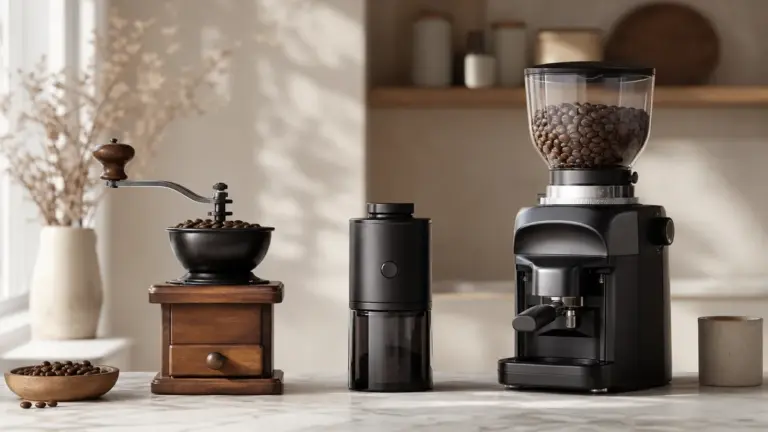
| Manual burr grinder | Someone happy to grind by hand | Comfortable grip, filter adjustment, usable dose capacity | Whether repeated batches are acceptable |
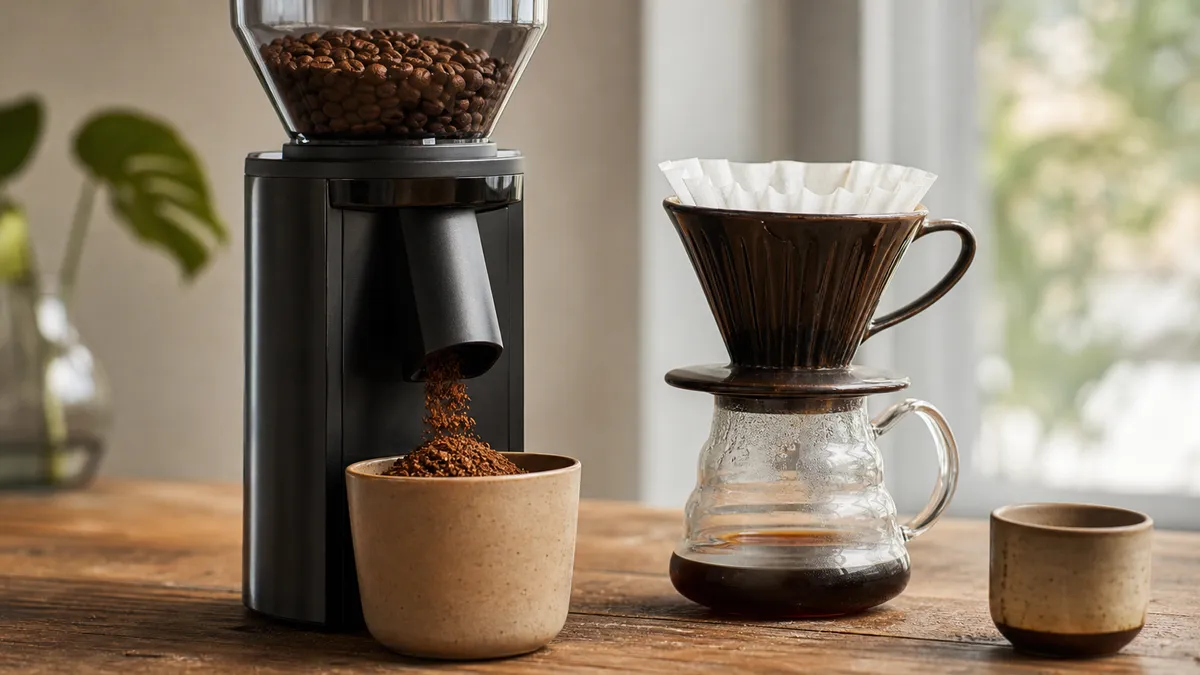
| Filter-focused electric grinder | Pour-over and automatic filter brewing without an espresso requirement | Filter control, clean transfer, largest dose | Possible exclusion of espresso |
| Espresso-and-filter electric grinder | A household genuinely using both methods | Clear settings and convenient switching | Whether filter adjustment is sufficiently useful |
| Commercial batch grinder | Repeated workplace or service batches | Approved workload, batch handling and support | Whether the equipment suits the available space and routine |
A manual model deserves consideration when hand operation fits the routine. Try the intended dose before deciding, especially if more than one person will use it. Our guide to manual hand grinders covers that choice without turning this article into a hand-grinder comparison.
For regular changes between coffees, consider whether loading only the amount required suits you. The details of retained grounds and changing beans belong in single-dose grinders.
Examples of published specifications
Specifications below are manufacturers’ claims, checked in November 2026. They are not independent measurements of flavour, noise, durability or grinding speed.
Fellow Ode Brew Grinder Gen 2: Fellow lists 64 mm stainless-steel flat burrs, 31 adjustment steps and a 100 g grinding capacity. It is a relevant shortlist candidate for brewed-coffee-only use, provided its capacity and handling fit your routine. Its explicit espresso exclusion is the main limitation for mixed-method buyers.
Wilfa Uniform WSFB-100S: Wilfa lists 58 mm stainless-steel flat burrs, 41 settings and a 75 g capacity. Its stated capacity makes it worth considering against a larger filter batch. Check the exact model designation, rather than assuming that specifications for Uniform, Uniform Black and Uniform Evo are interchangeable.
Baratza Encore ESP: Its published division between espresso and filter settings makes it a useful example of a dual-purpose approach. The buying question for a filter-only user is whether its filter adjustment and workflow are preferable to a dedicated alternative, not whether espresso capability sounds more advanced.
Speed and capacity: measure the whole job
Compare speed using an actual dose, rather than treating motor wattage or burr revolutions as a direct measure of convenience. Ask how long the complete task takes: loading beans, grinding, waiting for the grinder to finish and transferring the grounds.
For a fair demonstration, use the same beans, dose and intended brew method. Include any required pause between batches. Listen in the room where the grinder will operate, rather than relying on a recording.
Capacity needs similar care. Establish whether a published figure refers to beans, collected grounds or the maximum permitted grinding batch.
Wilfa recommends 60 g of coffee per litre of brewing water as a starting dose. On that basis:
- 250 ml needs 15 g.
- 500 ml needs 30 g.
- 1 litre needs 60 g.
- 1.25 litres needs 75 g.
These are input-water quantities, not promised beverage yields. Use your brewer’s permitted capacity and your own recipe when sizing the grinder.
For repeated workplace batches, obtain written confirmation that the intended workload is supported. A container large enough to hold the beans does not establish suitability for repeated operation. Higher-throughput selection belongs in commercial coffee grinders.
Buying tiers without price bands
Use three feature-led tiers to organise a shortlist, rather than assuming that a higher tier guarantees a better cup.
Essentials: require burr grinding, repeatable filter settings, sufficient usable capacity and straightforward cleaning. Leave decorative finishes and connected features out of the initial decision.
Workflow-focused: add the conveniences your routine genuinely needs, such as automatic stopping, easier grounds transfer or clearer adjustment references. Ask to see each feature used rather than accepting a list of benefits.
Specialist: investigate alternative burr configurations, more detailed adjustment or equipment approved for repeated batches. Require evidence that the added capability answers an actual limitation in your present routine.
For ownership comparisons, request itemised written quotations covering the grinder, delivery, replacement burrs, other wear parts, servicing and any required accessories. Compare the same intended workload and ownership period, with VAT status clearly stated.
Before ordering, confirm the exact UK model, electrical suitability, cleaning instructions, replacement-part route and whether workplace use is covered. The best shortlist is the one that survives those practical questions, not merely the one with the largest burrs.
FAQ
Does a grinder need stepless adjustment for filter coffee?
No, stepless adjustment is not a prerequisite for filter brewing. Stepped adjustment gives defined positions that can be recorded and revisited. Judge whether the available changes around your preferred recipe are useful, rather than treating the absence of clicks as an automatic upgrade. A demonstration with adjacent settings is more informative than the adjustment label alone.
Can I use the grinder I already have for espresso?
Possibly, but check its intended brewing methods and filter adjustment before replacing it. The Encore ESP is an example of a grinder whose manufacturer explicitly provides both ranges. Try your existing machine with a consistent filter recipe first, then identify any specific limitation, such as awkward switching or unsuitable adjustment steps.
Should I replace the burrs immediately?
Not without identifying a problem the replacement is intended to solve. Confirm compatibility with the manufacturer, including any installation or calibration instructions. For an Ode, do not assume that fitting different burrs removes Fellow’s stated espresso restriction. Compare the standard configuration first, then seek evidence relevant to the proposed replacement.
Where to go next
Manual Hand Grinders helps you decide whether hand operation suits your daily brewing, while Single-Dose Grinders examines the workflow of weighing beans for each brew. Read Espresso Grinders if pressure brewing is essential: filter coffee grinders should be chosen for the methods they are designed to support.
Sources
-
Baratza, “Shop by Burr Type”, undated, retrieved November 2026. Burr arrangements and examples of filter-capable architectures.
https://www.baratza.com/en-au/landing/shop-by-burr-type -
Baratza, Encore ESP Operations Manual, January 2023, version 1.0. Adjustment ranges, initial brewing settings and care instructions.
https://assets.breville.com/ZCG495/manual-encoreesp-v1-0-en-010923.pdf -
Moroney and colleagues, “Analysing extraction uniformity from porous coffee beds using mathematical modelling and computational fluid dynamics approaches”, PLOS ONE, 2019. Particle distributions, extraction mechanisms and flow resistance.
https://journals.plos.org/plosone/article?id=10.1371/journal.pone.0219906 -
Fellow, “Ode Brew Grinder Gen 2”, undated, retrieved November 2026. Published burr, adjustment and capacity specifications.
https://fellowproducts.com/products/ode-brew-grinder-gen-2 -
Fellow, “Ode Brew Grinder Gear Guide”, undated, retrieved November 2026. Intended brewing methods and explicit espresso limitation.
https://fellowproducts.com/pages/gear-guide-ode?view=gg-ode-2 -
Wilfa, “WSFB-100S / WSFBS-200B Uniform”, 7 September 2026. Supported brewing methods and distinction from Uniform Evo.
https://support.wilfa.com/en/articles/800500-wsfb-100s-wsfbs-200b-uniform -
Wilfa, “Uniform”, model WSFB-100S, undated, retrieved November 2026. Published burr, adjustment and capacity specifications.
https://wilfa.com/products/svart-uniform-steel -
Wilfa UK, “How Much Coffee Per Litre? The Wilfa Dosing Guide”, 29 September 2026. Starting dose and batch calculations.
https://wilfa.co.uk/blogs/learning/how-much-coffee-per-litre-the-wilfa-dosing-guide
This article was researched using manufacturers’ published specifications and instructions, with peer-reviewed research for grinding mechanisms; recommendations are editorial assessments, not first-hand test results.
Last checked: November 2026