Blade grinders can make enjoyable everyday coffee, especially if you already own one and are willing to accept some inconsistency. They chop beans rather than grind them through an adjustable gap, so our recommendation is to keep using one if you like the results, but choose a suitable burr grinder when repeatability or espresso becomes the priority.
In short
- Grinding for longer makes the coffee finer overall, but does not make every particle the same size.
- Pulse rather than run continuously, and redistribute the beans between bursts with the motor stopped.
- A kitchen sieve can separate large pieces for regrinding; kitchen paper can remove some fine dust.
- A hand-cranked coffee mill is not necessarily a blade grinder. Check whether it contains adjustable burrs.
- Upgrade when mixed sour and harsh flavours, slow filter drainage or repeated sorting become a regular frustration.
Electric Blade Grinders
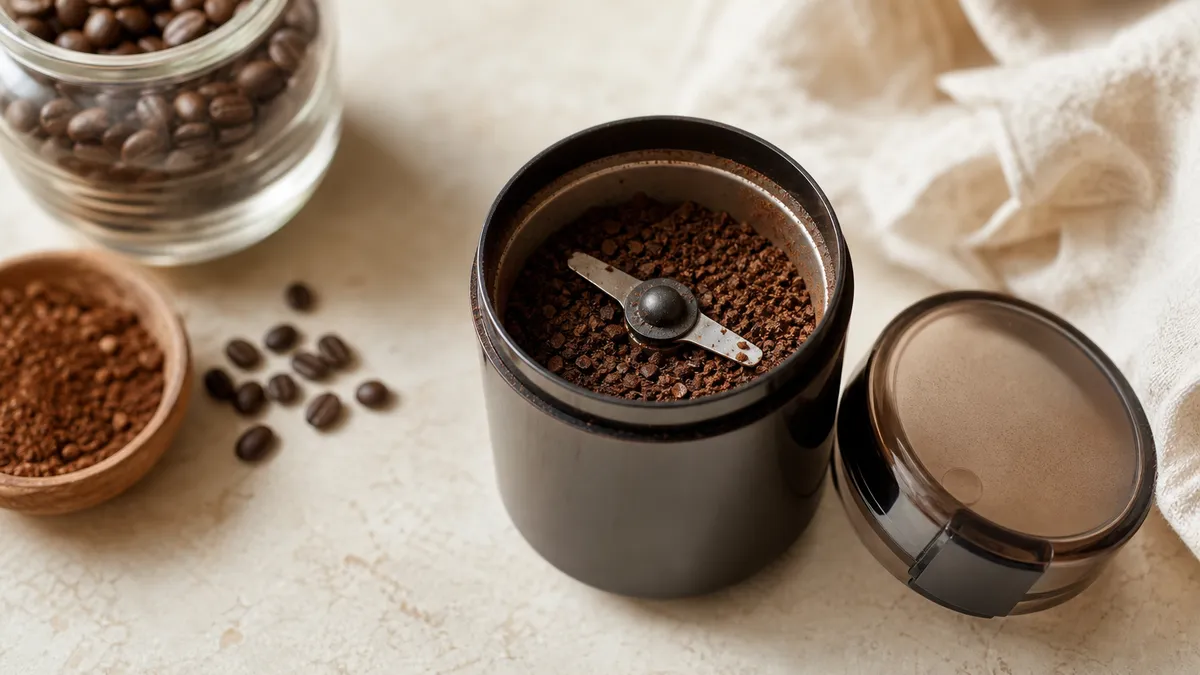
An electric blade grinder has a motor-driven blade inside a small chamber. Beans and fragments meet the spinning blade repeatedly, breaking into progressively smaller pieces. Unlike a burr grinder, it has no adjustable exit gap that determines when particles leave the grinding mechanism.
Grinding time is therefore your main control. KRUPS explains this directly in its F203 instructions: less grinding time produces a coarser result, while more produces a finer one. Bodum’s published BISTRO blade-grinder description likewise specifies push-button pulse or continuous operation.
The attraction is straightforward operation: put in beans, fit the lid and press the button. The limitation is that the entire batch remains together, so already-small particles continue being broken while larger fragments are still circulating.
For the wider choice of mechanisms, start with our coffee grinders hub.
Why the unevenness matters
Blade-ground coffee contains a broad mixture of particle sizes. The smallest fragments are called fines; unusually large pieces are often called boulders. Extraction, the dissolving of soluble material from coffee into water, does not progress equally through this mixture.
Large pieces can remain insufficiently extracted, contributing sharp sourness and little sweetness. Fine material extracts more readily and can contribute harsh, bitter or drying results under unsuitable brewing conditions. It can also restrict water flow through a coffee bed or filter.
That creates an awkward adjustment problem. Grinding longer to tackle the chunks also creates more dust; stopping earlier to limit dust leaves more chunks behind.
There is a qualification: fines are not automatically undesirable, and bitterness alone does not prove over-extraction. Roast character, brewing conditions and water flow also matter. Experimental research on capsule coffee supports the connection between a greater proportion of fines and longer extraction times, but it is not a direct test of blade-ground cafetière or filter coffee.
When a blade grinder is fine
Our practical judgement is to keep a blade grinder if its coffee tastes good to you and the routine remains simple. A cafetière is a sensible starting point because brewing does not depend on water draining through a paper filter, although suspended particles can still affect the drink’s texture.
For buying decisions, judge the following rather than motor power alone:
| Criterion | What to check | Why it matters |
|---|---|---|
| Grinding mechanism | A blade or a genuine burr assembly | The mechanism determines how grind size is controlled |
| Operation | Pulse control and clear instructions | Short bursts make it easier to inspect progress |
| Batch suitability | The manufacturer’s stated capacity and use limits | Your intended dose must suit the appliance |
| Cleaning | Accessible chamber and approved cleaning method | Old coffee oils can introduce unwanted flavours |
For pump espresso, take a different route. KRUPS specifically advises against using its F203 blade grinder for pump espresso machines and recommends a burr grinder instead. Our espresso grinders guide explains the adjustment and repeatability that this brewing method needs.
Manual Blade Grinders
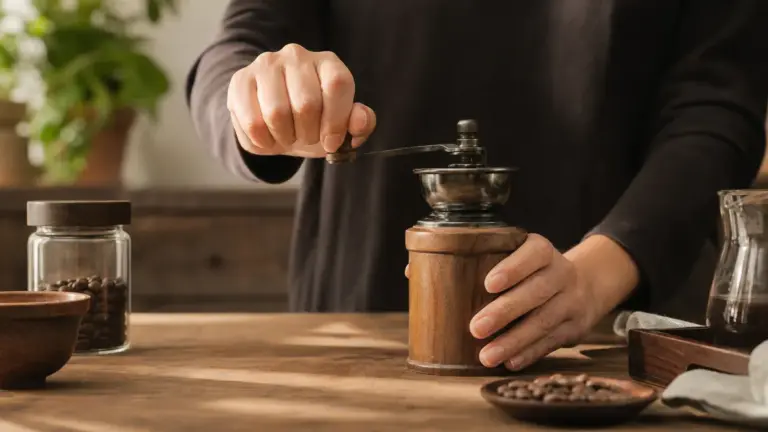
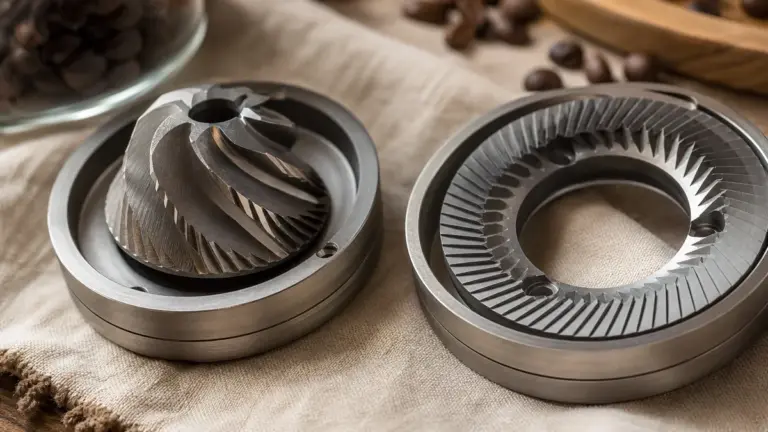
“Manual” describes how a grinder is powered, not how it breaks beans. A hand-cranked mill may contain burrs, which are shaped grinding surfaces with an adjustable gap, rather than chopping blades.
For example, Hario describes its Dome hand mill as having ceramic burrs. Do not mistake a visible metal shaft, crank or cutting-looking component for evidence that a grinder uses blades.
If a listing says “manual blade grinder”, inspect the mechanism and instructions before buying. Does it have freely rotating chopping blades in a bowl, or beans passing between an inner and outer burr? Do not assume that advice for an electric blade grinder applies to an unfamiliar hand-operated chopper.
If you want a grinder without a motor, our manual hand grinders guide is the more useful next stop. The meaningful comparison is blade versus burr, not simply electric versus manual.
How to Get Better Results from a Blade Grinder
Use the following as a suggested trial routine, not a universal grind-time prescription. Your appliance’s instructions take priority, particularly its capacity, maximum operating time and cooling requirements.
- Weigh a consistent batch. For example, try 20 g if that quantity suits your grinder’s instructions. Keep the bean mass unchanged while comparing results.
- Fit the lid and pulse briefly. Try bursts of about 1 to 2 seconds rather than one uninterrupted run.
- Stop before redistributing. Release the button, wait for the blade to stop and gently shake the closed appliance between bursts, provided its instructions permit handling it this way. Return it to the worktop before restarting.
- Inspect safely. Unplug before removing the lid. Look for obvious chunks among the smaller grounds rather than expecting perfect uniformity.
- Weigh the finished dose. If you sort the grounds, weigh what remains for brewing. Otherwise, removing material changes your coffee-to-water ratio unintentionally.
- Record and compare. Note the bean mass and pulse routine. Keep the brewing recipe unchanged while deciding whether the adjustment helped.
Optional sorting: what the Hoffmann workaround actually does
James Hoffmann popularised a blade-grinder routine combining pulsing and shaking, sieving, and kitchen paper in his 2018 video Coffee Hack: The Best Blade Grinder Results. He credits Ben Kaminsky with teaching him the sieving and paper-towel techniques.
The sieve retains large pieces for regrinding. To separate fines instead, you need sufficiently fine mesh that lets dust through while retaining the grounds you want.
For the paper step, spread grounds over clean, unscented kitchen paper, then tip them off; some fines remain attached. It is not a paper towel rested over the grinder bowl to catch static chaff. Never put paper inside an operating grinder.
These are optional workarounds, not necessary rituals. They add handling and discard some coffee.
Troubleshooting
Treat these as likely explanations, not certain diagnoses.
| Symptom | Likely cause | Fix |
|---|---|---|
| Sharp sourness alongside visible chunks | Some large particles remain under-extracted | Redistribute between pulses or separate and regrind the chunks |
| Slow paper-filter drainage | Excess fine material is restricting flow | Try less grinding or an optional fines-removal step |
| Bitter, drying coffee with powdery grounds | Excess fine material or unsuitable extraction | Compare a shorter grinding routine; also review the brew recipe |
| Stale flavours despite fresh beans | Old coffee oils remain in the chamber | Clean according to the manual |
Unplug before cleaning. Bodum advises brushing out its blade grinder and wiping with a damp cloth, not immersing the appliance. Follow your own model’s instructions for removable parts.
When to Upgrade
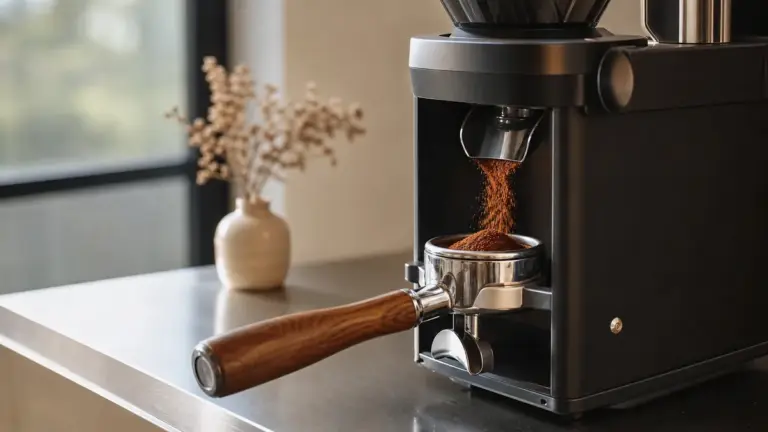
Upgrade when you want a repeatable adjustment rather than another workaround. An adjustable burr grinder gives you a mechanical setting to return to, although it will still produce a distribution of particle sizes rather than identical grains.
Our recommendation is to move on when:
- improving sourness repeatedly makes the coffee harsher;
- filter drainage remains unpredictable despite a consistent recipe;
- sieving and paper sorting become your normal routine;
- you want to prepare pump espresso.
Choose according to your brewing method, useful adjustment range, batch size and cleaning access. The burr grinders guide explains those mechanisms without assuming that every burr grinder suits every brewer.
There is no need to retire blade grinders on principle. Keep yours while it delivers coffee you enjoy; replace it when its lack of control becomes the thing preventing improvement.
FAQ
Can I use the same blade grinder for coffee and spices?
Only if the manufacturer permits it. KRUPS allows spices, nuts and whole grains in certain fixed-blade models, but that permission should not be applied to every appliance. Our preference is to keep coffee equipment separate from strongly aromatic ingredients and follow the cleaning instructions carefully.
Should I use the same grinding time for every coffee?
Use your previous routine as a starting point, not a guarantee. Grinding time controls overall fineness, but does not measure the finished particle-size distribution. Keep the batch mass consistent, inspect the result safely and judge the brewed coffee before deciding whether another pulse is needed.
Will removing all the fines make better coffee?
Not necessarily. Fine particles contribute to extraction and texture as well as affecting flow, so removing as much dust as possible is not automatically an improvement. Compare otherwise identical brews with and without the optional sorting step, weighing the finished coffee dose each time.
Where to go next
Read Coffee Grinders: The Complete Guide for the wider equipment choices, then Burr Grinders for adjustable grinding mechanisms. Manual Hand Grinders covers hand-powered alternatives, while Espresso Grinders explains when blade grinders no longer provide the control your brewing method needs.
Sources
-
Bodum, BISTRO Electric Coffee Grinder, undated manufacturer product page, retrieved November 2026. Used for the blade mechanism, pulse operation and cleaning instructions.
URL: https://www.bodum.com/us/en/11160-911us-3-bistro -
KRUPS, F203 Instructions for Use, undated manufacturer manual, retrieved through the official F203 support page in November 2026. Used for time-based grinding, safe operation, cleaning and pump-espresso limitations.
Support URL: https://www.krupsusa.com/instructions-for-use/csp/8000035981 -
James Hoffmann, Coffee Hack: The Best Blade Grinder Results, 26 November 2018. Primary practitioner source for the workarounds and credit to Ben Kaminsky.
URL: https://www.youtube.com/watch?v=3y7d-5KWHCU -
Hario USA, “Dome” Ceramic Coffee Mill, undated manufacturer product page, retrieved November 2026. Used to distinguish hand operation from blade grinding.
URL: https://www.hario-usa.com/products/dome-ceramic-coffee-mill -
Eiermann, A. and colleagues, Scientific Reports, Extraction of single serve coffee capsules: linking properties of ground coffee to extraction dynamics and cup quality, 2020, volume 10, article 17079. Experimental evidence concerning fines and restricted flow, with its capsule-specific scope retained.
URL: https://www.nature.com/articles/s41598-020-74138-1.pdf -
Barista Hustle, Coffee Extraction and How to Taste It, 30 January 2017. Practitioner teaching source for extraction, sour under-extraction, bitter and drying over-extraction, and roast-related bitterness.
URL: https://www.baristahustle.com/coffee-extraction-and-how-to-taste-it/
Researched using manufacturer instructions, primary practitioner material and peer-reviewed experimental research; the suggested routine and upgrade decisions are editorial guidance, not first-hand product testing.
Last checked: November 2026