Office coffee machine descaling and servicing should follow the machine manufacturer’s instructions, the workplace’s water conditions and its actual use, not a universal monthly or annual rule. Staff should run a descaling programme only where the manual explicitly permits it; internal boiler work, repairs and engineer-only maintenance belong with a suitably qualified technician.
In short
- Keep separate schedules for cleaning, scale management, professional servicing and any statutory pressure-system examination.
- Set the machine’s water hardness correctly, and record the filter type, capacity and replacement date.
- Never feed acid into a plumbed-in machine unless its exact manufacturer-approved operator procedure requires it.
- Filters can change the descaling regime, but fitting a filter does not automatically remove the need for descaling or servicing.
- Obtain a written maintenance schedule and itemised quotations covering labour, parts, filters, descaling and any separate safety examination.
Why scale forms inside a coffee machine
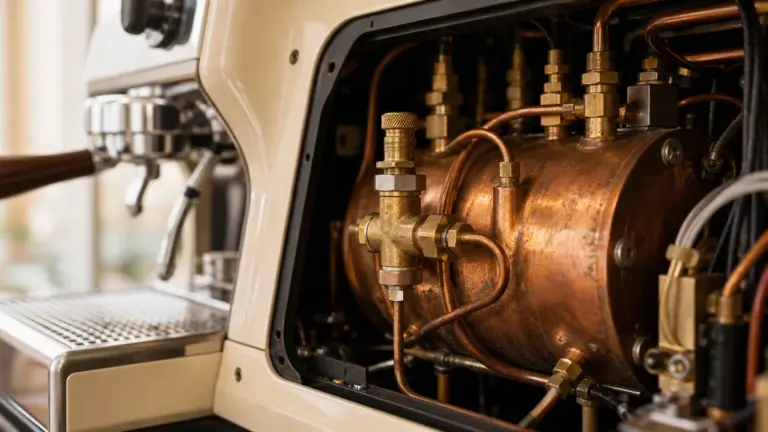
Limescale is a mineral deposit, not accumulated coffee. Water hardness comes mainly from dissolved calcium and magnesium. When water containing temporary hardness is heated, some dissolved minerals form solid deposits on heating surfaces and inside the water circuit.
These deposits make heating elements less efficient and can shorten their working life. Cleaning coffee oils from a brewing unit does not address the same problem: a machine can look spotless while still needing attention to its internal water system.
Scale management therefore sits alongside, rather than replaces, daily cleaning and hygiene. Keep the manufacturer’s cleaning products and descaling products clearly separated, and never assume that a tablet intended for one programme belongs in another.
For the wider maintenance plan, start with installation and maintenance, then assign a named person to keep the machine’s records.
How often should an office coffee machine be descaled?
Use the interval or prompt specified for the exact model, with its water hardness and filtration settings correctly configured. A fixed instruction such as “descale every three months” cannot safely cover every office machine.
Establish the following before setting a schedule:
- The machine and configuration: identify the exact model and whether it uses a refillable tank, a mains connection or a dedicated descaling cartridge.
- The incoming water: obtain the local supplier’s hardness information and carry out any test required by the machine or filter manufacturer.
- The water treatment: record the cartridge, its settings and its replacement requirements.
- The workload: record the drink counter and, where available, water consumption.
- The approved trigger: confirm whether maintenance is prompted by time, water throughput, drink count or a combination.
Understand the hardness reading
Hardness is often expressed as mg/L as calcium carbonate, a common comparison basis rather than a measurement of visible chalk floating in the water. Some machines and test kits instead use German degrees, written °dH, or Clark degrees.
Check the units before entering a result. Also distinguish total hardness from carbonate hardness, the latter being especially relevant to some scale-reduction filters. Use whichever measurement the manufacturer specifies.
Thames Water, for example, publishes hardness categories for its supply area, but those are not a reading for every UK workplace. Ask your own supplier for local information, then follow the equipment’s testing instructions.
When filters change the descaling regime
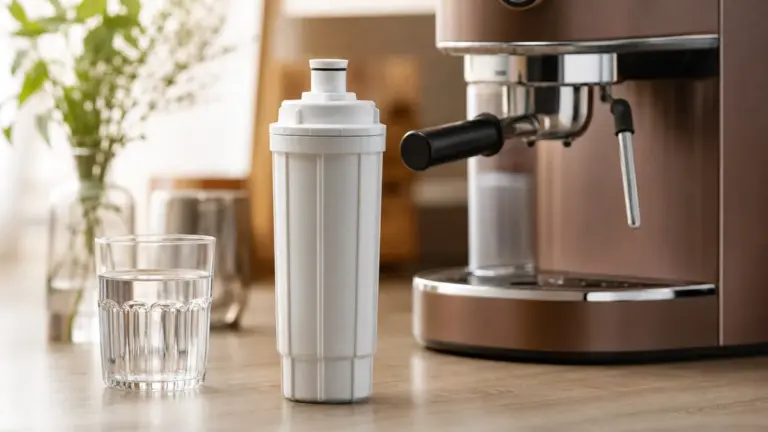
The word “filter” does not by itself describe what a cartridge removes. BRITA’s professional range, for example, includes cartridges designed to reduce carbonate hardness and others primarily intended to reduce substances affecting taste and odour.
For scale-reduction cartridges, capacity and settings depend on the water and application. A bypass setting controls the proportion of water that avoids the treatment medium. It should be set according to the cartridge instructions, not adjusted casually to make the cartridge last longer.
Follow both the cartridge’s throughput limit and its maximum installed life. BRITA’s July 2023 PURITY C manual specifies replacement at the stated capacity, an earlier applicable manufacturer requirement, or no later than 12 months after commissioning, whichever occurs first. That is a product-specific instruction, not a universal filter interval.
Some machines alter their maintenance prompts when an approved filter is active. The JURA X8 manual reviewed here states that the machine does not prompt for descaling when its CLARIS Pro Smart filter is in use. That instruction depends on using and replacing the specified filter correctly; it is not permission to ignore filter changes.
See office water filtration for cartridge selection and treatment options.
What staff may do, and what needs an engineer
An operator descaling programme is a defined maintenance task. Engineer servicing may involve internal inspection, component replacement, boiler work and fault diagnosis. Having access to a cleaning menu does not authorise staff to open the casing or work on pressurised components.
Do not pour vinegar, kettle descaler or a homemade acid mixture into a commercial machine’s tank or water supply. First establish whether that exact machine permits operator descaling at all.
Manufacturer approaches differ:
- Some tank-fed machines provide a guided operator programme.
- Some machines use a dedicated descaler cartridge. Franke lists a specific concentrate cartridge for its A300 range.
- Other machines require technician-led scale management. WMF lists descaling by a technician among its service options.
- La Marzocco’s Home guidance explicitly tells owners not to descale its machines themselves and reserves internal inspections and boiler servicing for qualified technicians.
These are different equipment designs and procedures, not contradictory advice.
The wrong chemical can damage a machine or leave residues. Avoid the equally sweeping claim that one mistake automatically “voids the whole warranty”: the relevant wording may instead exclude damage caused by failing to follow the instructions. JURA’s X8 manual contains such an exclusion.
A safe operator descaling method
The following is a planning sequence, not a replacement for the machine’s manual. Stop before starting if the manual does not explicitly authorise staff to perform the procedure.
- Match the instructions to the machine. Check the model, configuration and maintenance message. Do not copy a procedure from a similar-looking machine.
- Reserve the machine for maintenance. Tell colleagues it is unavailable and prevent anyone dispensing a drink during the programme.
- Prepare the specified materials. Use the approved descaler, suitable collecting containers and the protective measures stated on the product label and safety data sheet.
- Follow the prescribed preparation. Empty the tray and tank, or fit the dedicated cartridge, only as instructed. Follow any filter-removal instructions.
- Measure exactly. Record the prescribed dose in g, ml or tablets, water volume in ml, any stated temperature in degrees Celsius and the programme time. Do not invent a mixing temperature or convert tablets to a guessed powder weight.
- Run the complete programme. Follow every collection, emptying and refill prompt. Do not interrupt it merely because liquid has stopped flowing temporarily.
- Complete the prescribed rinses. Return the machine to service only when the programme finishes successfully. Record completion and report any error.
A model-specific example
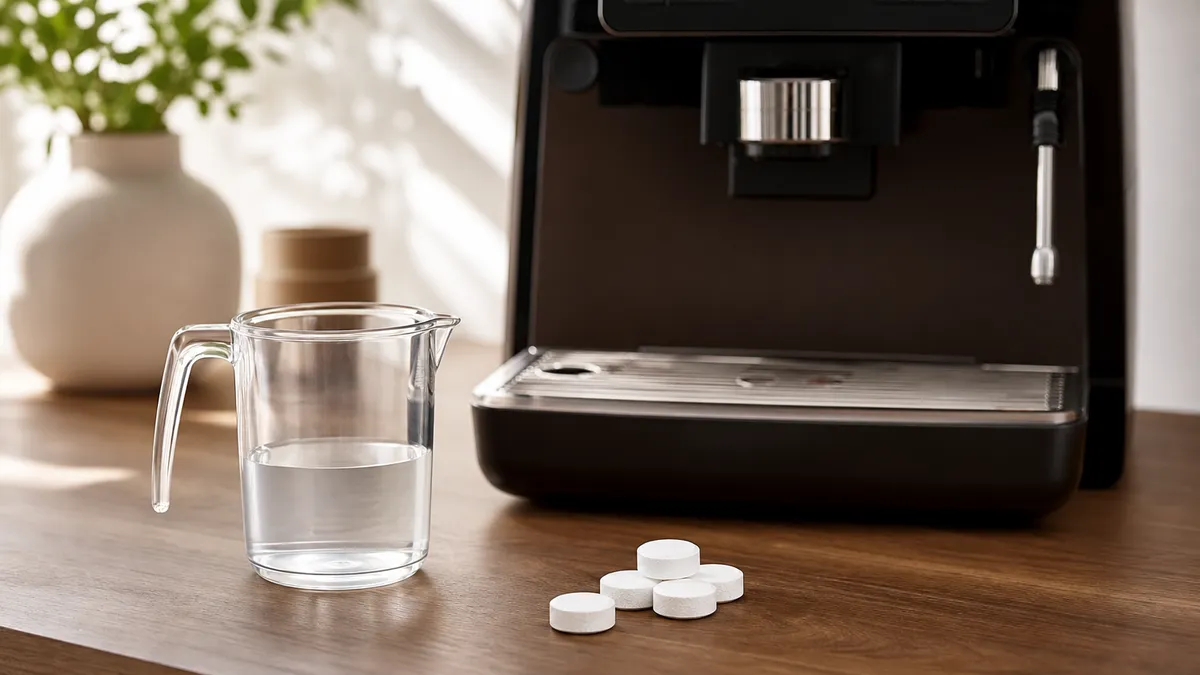
For the JURA X8 covered by the retrieved manual, the descaling instructions specify three original JURA descaling tablets dissolved completely in 600 ml of water. The programme takes approximately 45 minutes.
Its prompts include emptying the tray, collecting discharge beneath the outlets, rinsing the tank and refilling it with fresh, cold water. The instructions do not supply a gram-based substitute or a numerical mixing temperature, so neither should be improvised.
These figures must not be transferred to another model, including another JURA.
Professional servicing and overdue-service signs
Book servicing against the manufacturer’s written schedule and the machine’s actual workload. Ask the supplier to state the next calendar deadline and any earlier drink-count or water-throughput trigger.
WMF’s international service information includes annual and twice-yearly maintenance options. These demonstrate possible service arrangements, not a rule that every office machine needs the same interval. Obtain a schedule specific to your equipment and operating conditions.
Ask the engineer to document the work completed, components replaced, water-treatment findings, functional checks and next maintenance trigger. Keep this with the machine’s maintenance history.
A deterioration in performance deserves investigation, but it does not prove that scale is responsible.
| Symptom | Possible cause | Appropriate response |
|---|---|---|
| Descaling message appears | Manufacturer’s maintenance trigger reached | Follow the approved operator programme or contact the service provider |
| Filter replacement message appears | Cartridge replacement is due | Follow the specified replacement and flushing procedure |
| Coffee comes out only in drips | Grind too fine, among other possible faults | Check the manual’s troubleshooting guidance; do not automatically descale |
| Poor milk delivery or foam | Milk-system contamination or assembly problem | Complete the approved milk-system cleaning checks |
| Burning smell, visible damage or persistent fault | A fault needing professional assessment | Stop use, isolate safely and contact the service provider |
Do not repeatedly run descaler as a general cure for faults. Use breakdowns and repairs when the approved user checks do not resolve the problem.
Servicing is not the same as a statutory examination
In Great Britain, machines with steam boilers can fall within the Pressure Systems Safety Regulations 2000. HSE identifies steam at any pressure as a relevant fluid: ask the supplier and consult HSE guidance rather than assuming that a small machine is excluded.
Where required, a competent person must draw up or certify a written scheme of examination. That scheme sets the examination requirements and frequency. Routine servicing does not replace the statutory examination, and the examination does not replace maintenance.
Northern Ireland has a separate regulatory framework. Confirm the applicable requirements for the workplace’s location. The detailed explanation belongs in boiler safety and PSSR compliance.
What to include in servicing quotations
Request itemised written quotations rather than comparing an unexplained “service” package. Ask whether each quotation includes:
- Planned visits, engineer travel and labour.
- Maintenance kits, seals, replacement parts and consumables.
- Water testing, filter replacement and flushing.
- Descaling, including whether internal boiler work is separate.
- Fault diagnosis, emergency attendance and return visits.
- Any required pressure-system examination and its documentation.
- VAT, exclusions and the arrangements if the machine needs workshop attention.
To estimate your workplace’s maintenance requirement, list the scheduled visits and consumable replacements over the same period, then add separately quoted work that the package excludes. Avoid counting included items twice.
A useful service agreement makes the responsibilities clear: who monitors prompts, who replaces filters, who books the engineer and who confirms that the machine can return to use. That written allocation is the foundation of dependable office coffee machine descaling and servicing.
FAQ
Can we keep making drinks after a descale warning appears?
Only if the exact manual permits continued operation at that stage. Treat the warning as a task to arrange, not a reminder to dismiss indefinitely. Check whether the machine allows a limited period of use or requires immediate action, and contact the service provider if its instructions are unclear.
What should we do if the descaling programme is interrupted?
Keep the machine unavailable and follow its recovery instructions. Do not assume that switching it off has removed the chemical solution or completed the rinses. JURA warns that interrupting its X8 descaling programme can cause damage. If the programme cannot be completed, contact the service provider before dispensing drinks.
Should a filtered machine’s service appointment be cancelled if it has no warning?
No, not unless the supplier confirms that the appointment is unnecessary. A filter changes water treatment, while professional servicing has a wider purpose. Confirm the written maintenance deadline and any usage trigger rather than treating the absence of a descaling warning as evidence that all maintenance is complete.
Where to go next
Read Office Coffee Machine Water Filtration to understand how treatment and cartridge changes fit the maintenance schedule, and Office Coffee Machine Daily Cleaning and Hygiene for the separate cleaning routine. Commercial Boiler Safety and PSSR Compliance explains statutory examination duties, while Office Coffee Machine Breakdowns and Repairs helps distinguish maintenance reminders from faults needing professional attention.
Sources
- Drinking Water Inspectorate, Water Hardness / Hard Water, undated guidance, retrieved November 2026. Source.
- Thames Water, Hard water, undated guidance, retrieved November 2026. Source.
- BRITA, PURITY C Water Filter System Manual, revision July 2023, particularly sections 2, 4 and 5. Source.
- JURA, X8 Instructions for Use, Type 739, undated retrieved edition, particularly maintenance, troubleshooting and safety instructions. Source.
- JURA, X8: Descaling the machine, short instructions, August 2017. Source.
- Franke Coffee Systems, Cleaning solutions, UK product and compatibility guidance, undated, retrieved November 2026. Source.
- WMF Professional Coffee Machines, Service packages, international service information, undated, retrieved November 2026. Source.
- La Marzocco Home, La Marzocco Home Machine Maintenance: Turning Your Machine On, Off, and Keeping It Clean, undated retrieved page, November 2026. Source.
- HSE, Pressure Systems Safety Regulations 2000 (PSSR), updated December 2025. Source.
- HSE, Introduction to pressure equipment, updated January 2026. Source.
Researched from retrieved manufacturer manuals and service guidance, water-authority information and HSE guidance; no first-hand testing was undertaken.
Last checked: November 2026