Clean an office coffee machine by completing its prescribed rinse and cleaning programmes, cleaning the milk-contact parts, emptying and washing the drip tray and grounds drawer, and wiping the exterior. Follow the manufacturer’s instructions for the exact model: an automatic rinse is not a substitute for the milk-system cleaning programme.
In short
- Assign a named daily cleaner and a trained deputy, rather than leaving the job to whoever notices.
- Complete milk-system cleaning after the day’s milk preparation, following the machine’s prescribed procedure.
- Use only the specified cleaner, dose, water quantity and programme. Do not transfer another machine’s recipe to yours.
- Use separate, colour-coded cloths for the coffee area and other cleaning areas; keep reusable cloths hygienically maintained.
- Record completed cleaning and any faults. Food-business settings need cleaning within their food safety management arrangements.
Set up a machine-specific cleaning routine
Keep the operating manual beside the cleaning schedule, accessible electronically or in print. Identify the machine model, milk-system configuration and approved cleaning products before writing the checklist. Manufacturer schedules differ, including how frequently staff must dismantle milk-contact components.
For example, the JURA X8 instructions require daily milk-system cleaning when milk has been prepared, alongside daily dismantling and rinsing of its dual spout. The WMF 1500 S+ manual distinguishes daily manual milk-system cleaning for Basic Milk from weekly manual cleaning for certain other configurations. These are equipment-specific differences, not interchangeable routines.
Build the local checklist around the actual installation, using the wider installation and maintenance guide to organise responsibilities.
As an editorial recommendation, assemble a dedicated cleaning kit containing:
- The approved coffee-system and milk-system cleaners.
- The machine’s cleaning container and permitted brushes.
- A measuring vessel where liquid cleaner requires dilution.
- Clean, colour-coded microfibre cloths.
- Any protective equipment specified on the chemical label.
- The cleaning checklist and fault-reporting details.
Keep cleaning products away from food, and follow their handling instructions. A detergent is not automatically a disinfectant: check what the product is intended to do.
Office coffee machine daily cleaning: step by step
Use this sequence as a checklist framework, not a replacement for the manual. Move individual steps where the manufacturer requires a different order.
1. Take the machine out of use
Tell colleagues that cleaning is underway. Wash your hands and put on any protective equipment required by the cleaning product.
Leave the machine powered as required for its automatic programmes. Before manual access, follow its isolation and cooling instructions. Do not reach beneath dispensing outlets during a cycle or remove components while the machine is operating.
2. Complete the prescribed rinse and coffee cleaning
Allow scheduled rinses to finish, using the collection container specified by the machine. Run the coffee-system cleaning programme when its schedule or display requires it, adding the approved tablet or cleaning agent at the instructed point. Daily rinsing does not mean every machine needs a coffee-cleaning tablet every day.
Give the checklist separate entries for “rinse completed” and “coffee cleaning completed or not due”. That makes it harder to mistake one operation for the other.
3. Clean the milk circuit
Disconnect the milk supply and connect the cleaning container exactly as instructed. Measure the approved product accurately, complete the programme and finish every required rinse. Do not leave chemical solution in the circuit.
Product-specific example, not a universal machine recipe: Urnex specifies one 4.0 g Rinza W61 tablet in 250 ml warm water for its autofrother-cleaning method, followed by thorough rinsing with clean water. Its separate steam-wand and pitcher instructions specify a 15 to 30 minute soak. Those soak times are not an automatic machine programme duration. Use this product and method only where the equipment manufacturer permits them.
Do not invent a cleaning-water temperature. Where the approved instructions say “warm water” without a numerical temperature, retain that wording rather than substituting boiling water.
4. Clean removable milk-contact parts and the cooler
Remove and dismantle only the user-serviceable parts identified in the manual. Clean the milk hose, connectors, outlet and container as prescribed, then rinse and reassemble them carefully. Some machines require this daily even when an automatic programme has run.
Include the milk refrigerator in the local schedule. Follow the milk’s storage and use-by instructions, and operate refrigeration at 5°C or below, consistent with Food Standards Scotland’s recommended practice. Refrigeration controls bacterial growth; it does not replace cleaning.
5. Empty and clean the drip tray and grounds drawer
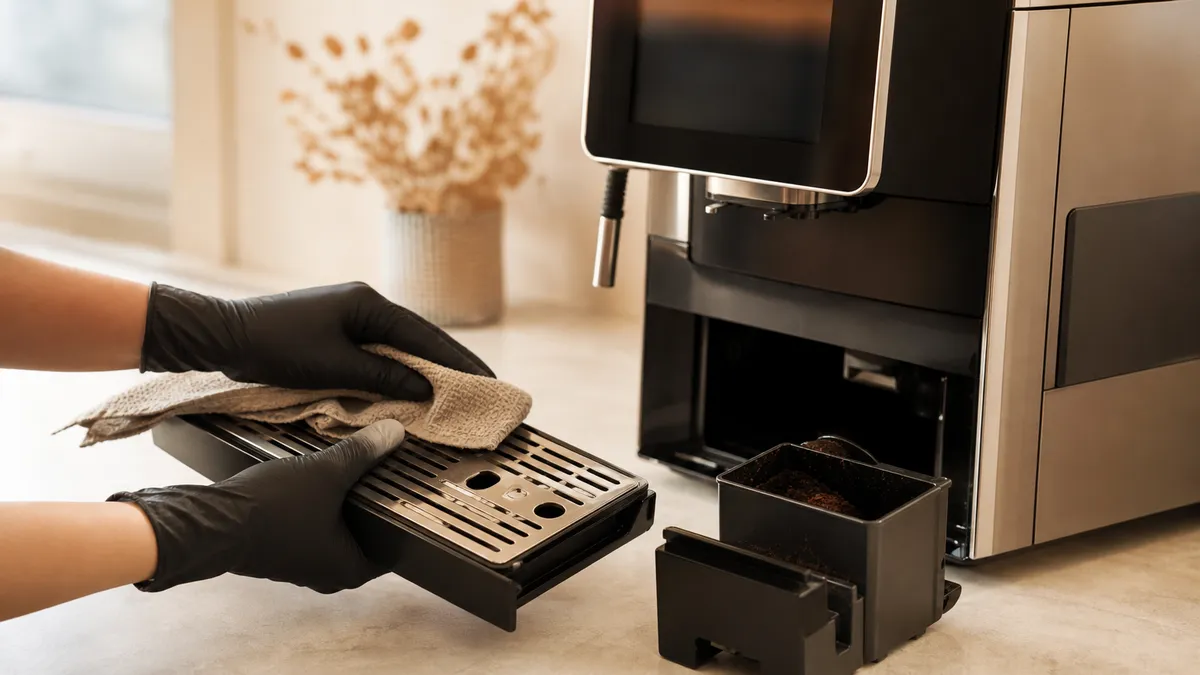
Remove the tray carefully because it may contain hot liquid. Empty both containers, remove residue from corners and grilles, and wash or rinse them using the permitted method. Dry and refit them securely. Emptying alone is not the same as cleaning.
Follow the machine’s instructions about whether it should be switched on when removing the grounds drawer. On the JURA X8, for example, this affects resetting the grounds counter.
6. Refresh the water supply
For a tank-fed machine, empty and rinse the tank and refill with fresh cold drinking water according to its daily instructions. Do not add milk, cleaner or other liquids unless a specific maintenance procedure explicitly requires them.
A plumbed-in installation needs its own maintenance arrangements. Use the separate water filtration guide for that subject rather than adding improvised filter work to the cleaning checklist.
7. Wipe the exterior and surrounding surface
Use a clean, soft, damp cloth on permitted exterior surfaces. Lock the touchscreen with its cleaning function where provided. Check surface compatibility before applying chemicals: WMF’s instructions, for example, restrict cleaning agents on its display and housing.
For the local colour code, reserve one cloth colour for the coffee area and a different one for waste-container cleaning. Never bring a washroom cloth into the coffee area. Colour coding helps distinguish uses, but reusable cloths still need effective laundering or disinfection.
8. Inspect and sign off
Check that components are seated correctly and all required programmes have finished. Record incomplete work and prevent use of the affected function until the problem is resolved.
The recommended handover is simple: name, completion time, exceptions and action taken. Do not sign a task as complete merely because its programme was started.
Alkaline and acidic milk cleaners: different jobs
Alkaline milk-system cleaners target milk fat and protein deposits. Acidic milk cleaners target mineral and calcium deposits, often described as milk stone. Urnex publishes separate products for these purposes.
However, “alkaline daily, acidic weekly” is not a universal manufacturer-approved schedule. The verified product instructions explain the different cleaning functions, but do not establish that timetable for every office machine. Use a daily alkaline product where specified, and add periodic acidic milk cleaning only at the interval and by the method approved for your equipment.
Treat them as separate procedures, never a combined cleaning mixture. General chemical guidance is to follow product labels; the machine manufacturer determines which products its components can tolerate.
Milk-circuit cleaning and boiler descaling are also separate maintenance tasks. Follow the appropriate procedure described in descaling and servicing, not whichever cleaner happens to be available.
Weekly tasks and deeper cleaning
Make the weekly session a check of tasks due, rather than permission to postpone daily hygiene. Manufacturer instructions may allocate different intervals to the milk assembly, water tank, mixers, hoppers and brewing unit.
Recommended weekly management checks are:
- Review the machine’s maintenance menu and outstanding prompts.
- Complete any manual milk-system or mixer cleaning due.
- Inspect accessible milk hoses and seals for deterioration, arranging replacement under the manufacturer’s schedule.
- Check the cooler, cleaning tools and chemical supplies.
- Review the log for missed tasks or recurring faults.
Do not assume that the brewing unit should be removed weekly, or that removable parts are dishwasher-safe. The WMF 1500 S+ manual, for example, recommends a different brewing-unit interval and explicitly prohibits dishwasher cleaning of that component.
Who is responsible, and what should the record contain?
Appoint an accountable facilities or office manager, a trained daily operator and a deputy. This is a recommended management arrangement, not a claim that legislation prescribes those job titles.
Agree explicitly whether the cleaning contractor handles the machine, just the surrounding worktop, or neither. Ask the supplier to demonstrate the complete routine, including manual work that remains after automatic cleaning.
Use a paper or electronic record with:
- Date, machine identifier and operator initials.
- Required tasks and completion status.
- Milk-cooler temperature where included in the local controls.
- Faults, missed cleaning and corrective action.
- Confirmation that the machine is ready for use.
Additional requirements in food-business settings
Where the coffee operation forms part of a food business, include it in the food safety management system based on HACCP, meaning Hazard Analysis and Critical Control Point principles. The system must address relevant hazards, controls, checks and corrective action. An ordinary staff refreshment point should not automatically be treated as identical to a catering operation. Seek local-authority advice if the operation’s status is unclear.
For England and Wales, Safer Food, Better Business (SFBB) provides cleaning schedules and diary-based records. Northern Ireland has separate Safe Catering guidance; Scotland provides CookSafe guidance. A machine’s electronic cleaning history can support the record, but manual cleaning and corrective actions still need to be covered.
Symptoms, likely causes and fixes
These are initial checks, not diagnoses. Follow the model’s troubleshooting instructions and escalate persistent faults.
| Symptom | Possible cause | Safe first action |
|---|---|---|
| Milk splutters or foam quality falls | Dirty milk outlet or milk-system components | Complete the prescribed clean and permitted dismantling; escalate if unresolved |
| Dried milk remains after a rinse | Rinsing has not removed deposits | Use the approved milk-cleaning procedure, not repeated rinses alone |
| Grounds warning remains after emptying | Drawer handling has not reset the counter | Check the model-specific emptying and refitting sequence |
| Liquid escapes around the tray | Tray not seated correctly, or another fault | Stop use, check seating safely and report continuing leakage |
| Cleaner may remain after cleaning | Rinsing incomplete or incorrect chemical use | Keep the affected function out of use and obtain supplier advice |
The first checks above reflect manufacturer guidance on milk-system cleaning, grounds-counter operation, tray seating and cleaning-agent residues.
FAQ
Does a black-coffee-only machine still need daily cleaning?
Yes, it still needs its prescribed daily maintenance. Without a milk circuit there are fewer milk-related tasks, but water tanks, waste containers, trays and exterior surfaces remain on the cleaning schedule. Follow the machine’s coffee-cleaning prompts rather than assuming that either daily tablets or automatic rinses alone are appropriate.
Can disposable cloths replace microfibre cloths?
Yes, suitable single-use cloths are an alternative for relevant surface-cleaning tasks. Food Standards Scotland identifies single-use cloths as a reliable way to avoid cloth-related cross-contamination. Whichever system you choose, keep cleaning materials separate by use and follow the machine’s surface-care instructions. A cloth does not replace internal cleaning programmes.
How long should the office allow for cleaning?
Allow the full time required by the machine’s programmes plus its manual cleaning tasks. There is no single verified duration that applies across office machines and milk-system configurations. As a practical recommendation, have the supplier demonstrate the routine, time the complete process locally and include it in the operator’s scheduled duties.
Where to go next
Use Office Coffee Installation and Maintenance to place office coffee machine daily cleaning within the wider maintenance plan. Read Office Coffee Machine Descaling and Servicing for scheduled maintenance, and Office Coffee Machine Water Filtration for water-treatment arrangements that need their own checks.
Sources
Undated documents below are identified as such rather than assigned an inferred publication year.
-
JURA, X8 Instructions for Use, Type 739, undated manufacturer manual, daily operation and maintenance chapters.
https://is.jura.com/-/media/global/pdf/manuals-global/professional/X8/download_manual_x8.pdf?la=en&sc_lang=en -
WMF, WMF 1500 S+ User Manual, English, undated manufacturer manual, care and HACCP cleaning schedule sections.
https://assets.wmf-coffeemachines.com/f/267357/x/078c561443/wmf-1500splus-operating-instructions-en.pdf -
Urnex, Rinza Tablets (W61), undated product instructions, tablet mass, dilution, rinsing and soaking instructions.
https://urnex.com/rinza-w61-milk-system-cleaning-tablets -
Urnex, Rinza Liquid (Alkaline), undated product instructions, milk protein and fat removal.
https://urnex.com/rinza-alkaline-milk-system-cleaning-liquid -
Urnex, Rinza Liquid (Acid), undated product instructions, mineral and calcium deposit removal.
https://urnex.com/rinza-acid-milk-system-cleaning-liquid -
GOV.UK, Food hygiene for businesses: Cleaning, current undated web guidance, cleaning records, chemical labels and storage.
https://www.gov.uk/food-hygiene-businesses/cleaning -
Food Standards Agency, Safer Food Better Business: Cleaning Schedule, undated downloadable template, task frequency, precautions and methods.
https://assets.publishing.service.gov.uk/media/69cac36ab66990e31f67e9ed/fsa-sfbb-cleaning-schedule_0.pdf -
GOV.UK, Safer food, better business (SFBB), 2025, published 5 June 2025, territorial guidance and diary arrangements.
https://www.gov.uk/government/publications/safer-food-better-business-sfbb/safer-food-better-business-sfbb -
GOV.UK, Food safety management systems for businesses: Overview, current undated web guidance, HACCP principles and records.
https://www.gov.uk/food-safety-management-systems -
GOV.UK, Managing food safety, current undated web guidance, proportionate procedures and local-authority advice.
https://www.gov.uk/government/publications/managing-food-safety/managing-food-safety -
Food Standards Scotland, CookSafe, Section 3, current web edition, undated, cleaning materials, colour coding, cloth hygiene and refrigeration.
https://www.foodstandards.gov.scot/business-guidance/running-a-food-business/publications/cooksafe-guide/cooksafe-guide-web-version/cooksafe-guide-web-version-section-3
Research combined manufacturer operating instructions, cleaning-product directions and official food-hygiene guidance; the general checklist is an editorial framework, not first-hand machine testing.
Last checked: November 2026