Sustainable coffee in the office starts with buying beans with credible sourcing evidence, wasting less coffee and milk, reusing cups and matching machine operating hours to actual demand. Judge improvements across the whole drink, not just its packaging, and make sure every recycling claim matches a collection service your workplace can actually use.
In short
- Ask for certification and traceability evidence for the coffee you buy, not simply the supplier’s sustainability policy.
- Offer a plant-based milk option, but also measure how much milk is discarded.
- Keep reusable cups in circulation and organise efficient, hygienic washing.
- Compare pods and beans using coffee consumption, electricity and actual waste treatment, not bin appearance alone.
- In England, coffee grounds belong in the food-waste stream; compostable packaging needs a different disposal decision.
Start with what your office actually uses
Before changing suppliers or equipment, record a representative working week. Count drinks, note attendance and measure discarded coffee and milk separately. Include meeting rooms and visitor drinks, rather than looking only at the main machine.
Use the following matrix as a starting assumption, not a consumption forecast:
| People present daily | Assumed coffees per person | Illustrative daily coffees |
|---|---|---|
| 10 | 2 | 20 |
| 30 | 2 | 60 |
| 50 | 2 | 100 |
These are calculated examples: people present multiplied by two coffees each. Replace the assumption with your own count, especially where hybrid working changes attendance.
Record beans used in grams, milk discarded in millilitres, disposable cups issued and machine electricity in kilowatt-hours where suitable metering is available. Keep wet grounds separate from unused coffee in your records: they measure different things.
For wider arrangements, including who manages supplies and maintenance, use our guide to coffee in the workplace. Here, the aim is to identify specific environmental changes rather than redesign the whole coffee service.
Choose certified beans with useful traceability
Certification gives procurement teams defined requirements to check. It does not establish that every certified coffee has a smaller environmental footprint than every uncertified alternative.
Two useful starting points are:
- Fairtrade: its coffee standard includes forest and ecosystem protection and biodiversity requirements, alongside trading requirements. Ask which certified coffee you will receive and what documents connect it to your order.
- Rainforest Alliance: its certification programme includes environmental and social requirements. Its Sustainable Agriculture Standard and Regenerative Agriculture Standard are distinct, so ask which standard supports the particular product’s claim.
Do not treat the supplier’s membership, charitable activity or certification of another product as evidence for your beans. Request the exact product name, certification scheme, producer or producer organisation where available, and supporting supply-chain documentation.
For uncertified coffee, ask equally concrete questions about sourcing and verification. A detailed answer can inform your decision, but it is not the same thing as independently assessed certification.
Make milk choices count
Milk deserves its own place in the plan, rather than being treated as an incidental addition. A major peer-reviewed synthesis of food life-cycle assessments found lower greenhouse-gas emissions and land use for soya drink than dairy milk per litre on average. These are modelled supply-chain comparisons, not measurements of your office’s particular cartons.
Offer a plant-based option that staff will actually use. Soya is one evidence-backed starting point; do not turn that finding into a claim that every plant-based product is best on every environmental measure.
Also tackle avoidable waste. Try smaller opened containers where demand is low, review automatic milk portions and record leftovers before changing orders. Follow storage instructions and the machine’s approved cleaning procedure.
Consult staff before changing the default. Our guide to workplace coffee and employee satisfaction considers preferences and participation more broadly; the environmental task here is to reduce waste without creating an unwanted service.
Reuse cups, then make washing work
UNEP’s review of life-cycle evidence supports reusable cups when they receive repeated use and are washed efficiently. It also shows why a universal claim such as “a reusable cup becomes greener after a fixed number of drinks” is unreliable: material, washing, electricity and disposal assumptions change the result.
Start with serviceable cups already in the office. Provide a clear return point and assign responsibility for washing, rather than issuing more cups while existing ones disappear into cupboards.
Use appropriately loaded dishwasher cycles where available, following hygiene requirements and equipment instructions. Avoid unnecessary washing under continuously running hot water.
If disposable cups remain necessary, confirm the collection route for the exact cup and lid. “Paper”, “plant-based” and “compostable” describe different properties; none alone proves that your collector will recycle or compost the item.
Make the same arrangements for coffee for clients and visitors, so meeting-room service does not quietly bypass the reusable-cup policy.
Set machine hours around demand
Check the machine’s own manual for automatic switch-off, standby or energy-saving settings. Availability and behaviour vary, so there is no universal timer setting for every workplace.
As a manufacturer-published example, JURA’s W8 instructions provide an automatic switch-off setting intended to reduce energy use. That confirms a feature, not a measured reduction in your office’s electricity consumption.
Ask the service provider to configure available settings around opening hours and quiet periods. Where cup warming is optional, review whether it is needed.
Do not interrupt required rinsing or milk-system cleaning by cutting power prematurely. Nor should an overnight shutdown instruction accidentally turn off milk refrigeration. Check the complete arrangement with the supplier.
Compare electricity over similar working periods before and after changes, recording drinks and attendance alongside it. A quieter week alone does not demonstrate improved efficiency.
Compare pods and beans across the whole system
Bean-to-cup service avoids a separate capsule around each drink, but still produces grounds and supply packaging. Pods add individual packaging and need a suitable recovery route. Those differences matter, but packaging is not the entire environmental assessment.
Research illustrates the danger of universal rankings. A comparative life-cycle study by Hicks found pod preparation performed better than drip brewing across several assessed impacts under its assumptions, with electricity influencing the result. A later streamlined study by Moresi and Cimini favoured bulk-packaged ground coffee over the single-serving systems it assessed.
These are not interchangeable tests of every office machine. They use different systems, boundaries and operating assumptions. Neither establishes a universal winner between commercial bean-to-cup machines and pods.
For your workplace, compare:
- coffee used and discarded for equivalent drinks;
- brewing, standby and washing electricity;
- packaging supplied;
- the proportion actually collected for recycling or composting;
- equipment manufacture, maintenance and expected service life.
A tidy capsule bin is not proof of low impact. Equally, visible grounds are not proof that beans are the worse option.
Put coffee grounds in the correct waste stream
England: Simpler Recycling
England’s workplace separation requirements took effect on 31 March 2025 for businesses with at least 10 full-time-equivalent employees. Micro-firms with fewer than 10 have until 31 March 2027. Assess staffing across the business, not just one office.
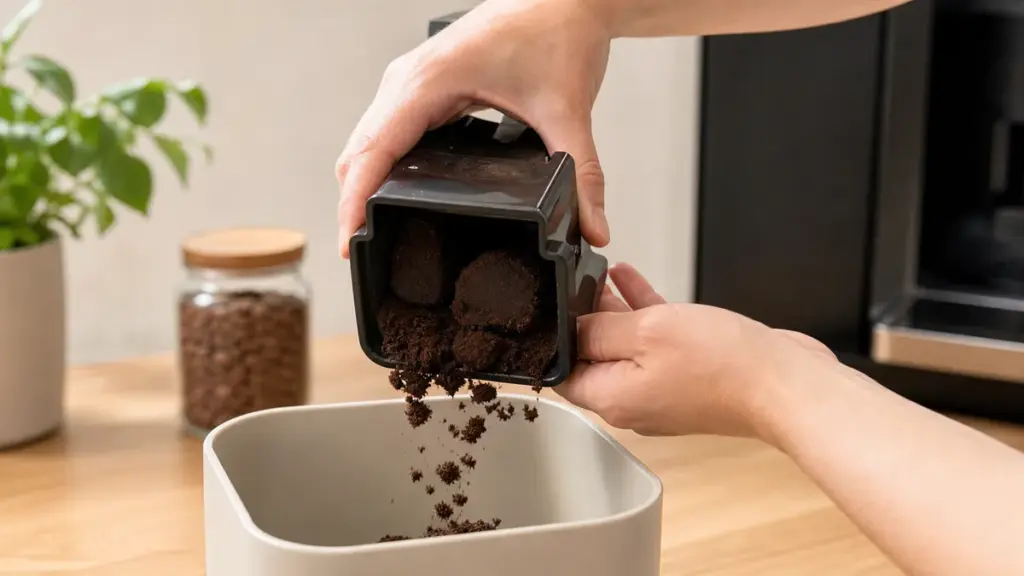
Coffee grounds and tea bags are food waste. Packaging labelled compostable or biodegradable must go into non-recyclable waste or a dedicated collection, not the ordinary food-waste stream. DEFRA separately permits food-caddy liners, including compostable liners.
Put a suitable caddy near the machine and agree emptying arrangements with cleaners.
Scotland, Wales and Northern Ireland
Do not apply England’s deadlines across the UK. Wales has separate workplace recycling requirements; Scotland and Northern Ireland have their own food-waste rules and exemptions.
Ask the relevant regulator and your collector which requirements cover your premises, particularly where an office has catering facilities.
Understand compostable pods before ordering them
EN 13432 concerns packaging recoverable through industrial composting and biodegradation. Certification against it is not evidence that a pod will compost in an office planter or a home compost heap.
“Biodegradable” is not a complete disposal instruction either. It needs context about conditions and treatment. The CMA’s Green Claims Code specifically warns against compostability claims that omit the circumstances and action required.
Before ordering, ask for certification covering the finished pod, not merely its raw material. Then obtain written acceptance from the intended treatment service.
If no dedicated route exists, follow the applicable residual-waste instructions. A compostable label does not create a composting service, and general waste disposal must not be described as composting.
Ask suppliers what take-back actually delivers
Ask about take-back for coffee bags, pods, filters and redundant equipment, but assess each stream separately. Get written confirmation that the service accepts business waste from your premises and the exact materials you use.
Request the receiving facility, treatment process, preparation instructions and evidence of collected quantities. Distinguish material collected from material successfully recycled.
In England and Wales, business waste responsibilities include checking the carrier’s registration and completing the required waste-transfer documentation. Take-back should fit your waste arrangements, not replace due diligence.
For procurement comparisons, request itemised written quotations covering supplies, servicing, consumables, collections and end-of-life arrangements. Do not assume these are all included in a general service description.
Avoid green claims that promise too much
The CMA’s Green Claims Code calls for truthful, clear, substantiated claims that consider relevant life-cycle impacts. Use it to question supplier marketing and to check your own staff communications.
| Claim to question | What a defensible statement needs |
|---|---|
| “Eco-friendly coffee” | A specific environmental attribute and supporting evidence |
| “Compostable pods” | Applicable certification, conditions and a usable treatment route |
| “Fully recyclable packaging” | Clarity about every component and how it is collected |
| “Carbon-neutral coffee” | Scope, calculation method, reductions and any offsets clearly explained |
Prefer statements about actions you can demonstrate, such as introducing a separate grounds collection, to claims that the entire coffee service is sustainable.
A practical sustainable coffee checklist
- Establish the baseline: count drinks and record discarded ingredients, disposable cups and electricity where measurable.
- Check sourcing: retain evidence for the beans actually supplied.
- Reduce avoidable waste: adjust orders and portions using your records.
- Make reuse convenient: provide cups, returns and a workable washing routine.
- Configure equipment: use approved energy settings without compromising cleaning or refrigeration.
- Verify disposal: obtain written instructions for grounds, packaging and take-back.
- Report precisely: describe measured changes without converting them into unsupported carbon claims.
Repeat the review after changes have settled. For sustainable coffee in the office, a documented improvement is more useful than an ambitious label.
FAQ
Does locally roasted coffee necessarily have a lower environmental impact?
No, local roasting alone does not establish a lower whole-life environmental impact. It identifies where one stage happens, not how the coffee was grown, processed, transported, brewed or discarded. Ask suppliers to explain the scope and evidence behind any comparison, rather than treating distance from the roastery as a complete environmental assessment.
Can staff take coffee grounds home instead of a workplace collection?
Not as a substitute for the required arrangements in England: DEFRA says workplaces should not ask staff to take food waste home. Establish a compliant workplace route first. If someone proposes an additional reuse project, check its suitability with the waste provider rather than assuming that an informal arrangement satisfies the workplace’s obligations.
Should we replace a working machine with a newer efficient model?
Not automatically. Compare the existing machine’s measured consumption and condition with credible information about the replacement, including manufacture and likely service life. Start by checking settings and maintenance. A manufacturer’s energy feature is useful information, but it does not by itself demonstrate that replacing functioning equipment produces a lower overall environmental impact.
Where to go next
Read Coffee in the Workplace for the wider management framework, then Workplace Coffee and Employee Satisfaction for involving staff in changes they will use. Office Coffee for Clients and Visitors helps extend the same practical arrangements to meetings and guest service.
Sources
-
DEFRA, Simpler Recycling in England: policy update (2024). Workplace implementation dates and micro-firm timetable.
https://www.gov.uk/government/publications/simpler-recycling-in-england-policy-update/simpler-recycling-in-england-policy-update -
DEFRA, Simpler recycling: workplace recycling in England (updated 3 October 2025). Business-wide staffing assessment, grounds, tea bags, packaging, liners and staff take-home guidance.
https://www.gov.uk/guidance/simpler-recycling-workplace-recycling-in-england -
Fairtrade International, Fairtrade Standard for Coffee, version 15.07.2021_v.2.11. Coffee-specific environmental and trading requirements.
https://www.fairtrade.net/content/dam/fairtrade/fairtrade-international/standards/small-scale-producer/coffee/Coffee_SPO_EN.pdf -
Rainforest Alliance, How the Rainforest Alliance Developed the Regenerative Agriculture Standard (2026). Scope of the Sustainable Agriculture and Regenerative Agriculture standards.
https://knowledge.rainforest-alliance.org/docs/how-the-rainforest-alliance-developed-the-regenerative-agriculture-standard -
Poore and Nemecek, Reducing food’s environmental impacts through producers and consumers, Science (2018, author-hosted copy noting the 2019 erratum). Food life-cycle synthesis, including dairy milk and soya drink.
https://josephpoore.com/data/science-2018/Poore%20and%20Nemecek%20%282018%29%20Reducing%20foods%20environmental%20impacts%20through%20producers%20and%20consumers.pdf -
UNEP, Addressing Single-Use Plastic Products Pollution Using a Life Cycle Approach (2021). Reusable cups, washing and assessment assumptions.
https://www.lifecycleinitiative.org/wp-content/uploads/2021/02/Addressing-SUP-Products-using-LCA_UNEP-2021_FINAL-Report-sml.pdf -
JURA, W8 (EA/SA/INTA): Instructions for Use, Type 773, retrieved edition, undated. Manufacturer-published switch-off and maintenance instructions.
https://uk.jura.com/-/media/global/pdf/manuals-global/professional/W8/W8-EA/download_manual_w8.pdf?la=en&sc_lang=en -
Hicks, Environmental Implications of Consumer Convenience: Coffee as a Case Study (2018), with corrigendum (2019). Comparative brewing-system life-cycle assessment and corrected calculations.
https://onlinelibrary.wiley.com/doi/abs/10.1111/jiec.12487
https://onlinelibrary.wiley.com/doi/10.1111/jiec.12775 -
Moresi and Cimini, Streamlined life cycle assessment of packaging waste in coffee preparation and consumption, Italian Journal of Food Science (2025). Comparison of bulk and single-serving formats within stated assessment boundaries.
https://www.itjfs.com/index.php/ijfs/en/article/view/3256 -
Welsh Government, Workplace recycling: guidance for workplaces (updated September 2026); SEPA, Recycling and food waste (for business) (undated); DAERA, Guidance: The Food Waste Regulations (Northern Ireland) 2015 (2015). Separate national requirements.
https://www.gov.wales/workplace-recycling-guidance-workplaces
https://beta.sepa.scot/topics/waste/recycling-and-food-waste-for-business/
https://www.daera-ni.gov.uk/sites/default/files/publications/doe/waste-guidance-food-waste-regulations.pdf -
DIN CERTCO, Application for Certification/Registration: Products Made of Compostable Materials, edition December 2025, printed January 2026. EN 13432 and industrial compostability.
https://origin.dincertco.de/media/dincertco/dokumente_1/antragsformulare/antrag_baw_de.pdf -
Competition and Markets Authority, Making environmental claims on goods and services (2021). Green Claims Code principles, life-cycle scope and compostability qualifications.
https://www.gov.uk/government/publications/green-claims-code-making-environmental-claims/environmental-claims-on-goods-and-services -
GOV.UK, Dispose of business or commercial waste: Your responsibilities (undated, retrieved November 2026). Waste hierarchy, carrier checks and transfer documentation in England and Wales.
https://www.gov.uk/dispose-business-commercial-waste
This article was researched using official waste guidance, certification documents, manufacturer instructions and published life-cycle research; the planning matrix is an explicitly illustrative calculation, not measured workplace data.
Last checked: November 2026