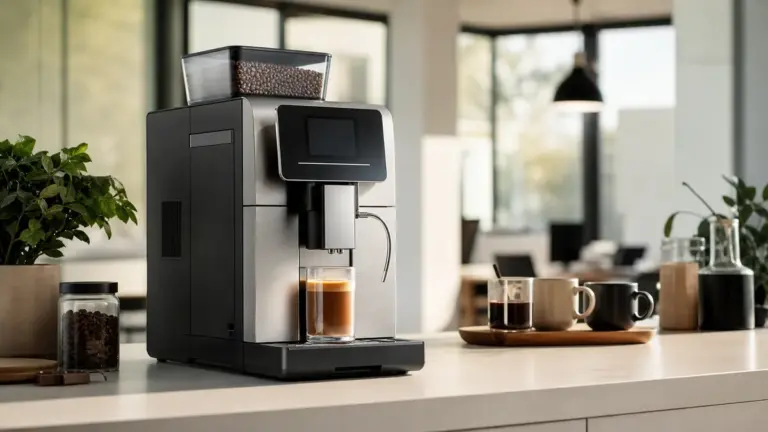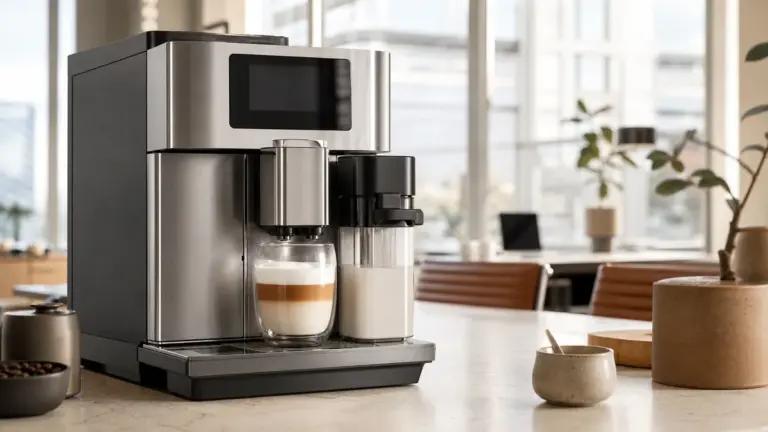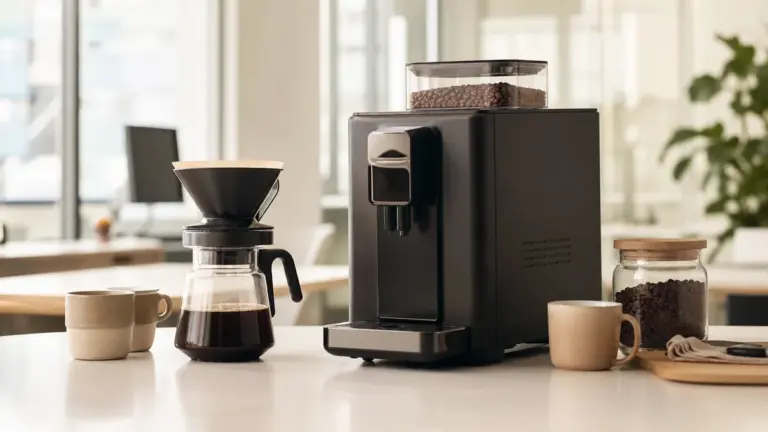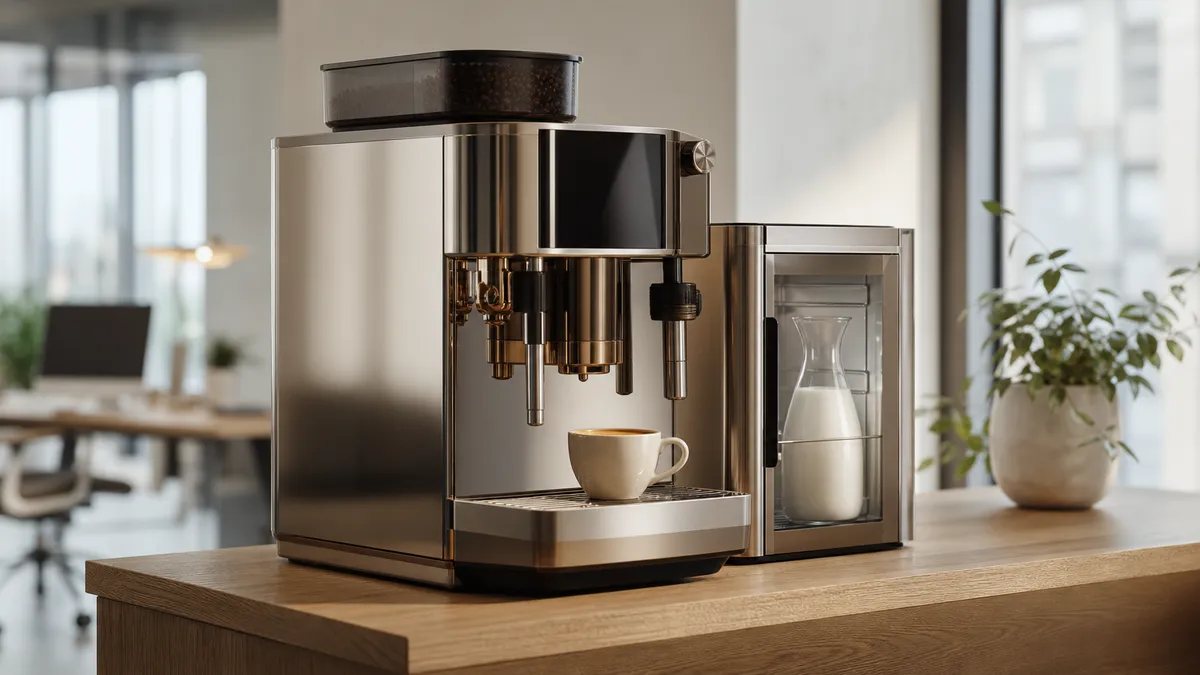
Gaggia Milano professional coffee machines cover automatic bean-to-cup service and traditional espresso preparation, with the professional business operated within Evoca Group under a brand licence. For an office, start with the current G Line, then choose the milk system, capacity and UK service arrangement, rather than treating a familiar Gaggia home machine as its commercial equivalent.
In short
- Professional and domestic Gaggia are different buying routes: Evoca operates the professional range; Versuni markets Gaggia within its licensed consumer-brand portfolio.
- The current catalogue extends beyond familiar names: it includes G 50, G 100, G 300 Prime, G 300, G 500 and G 700.
- Published daily outputs are manufacturer claims: examples include up to 100 cups for G 100, 150 for G 300, 250 for G 500 and 300 for G 700.
- Milk configuration matters: powdered milk, fresh milk and different automatic foaming systems are not interchangeable specifications.
- UK availability is established, but service is contractual: obtain written confirmation of the exact machine, installation requirements, maintenance responsibilities and engineer coverage.
Gaggia Professional: company, ownership and history
The most accurate description is Gaggia Professional within Evoca Group, using the Gaggia brand under licence. Evoca’s relaunch announcement explicitly says it held the licence for professional use from 2017. That is more precise than saying Evoca owns every use of the Gaggia name.
Domestic Gaggia belongs to a separate consumer marketing portfolio. Versuni lists Gaggia among its brands and identifies it as a licensed trademark. Neither that relationship nor the shared badge makes a domestic machine part of the professional catalogue.
Gaggia Professional is also separate from Cimbali Group. Readers comparing the two should use our Cimbali profile, not assume that Italian heritage means common ownership.
Brand fact panel
| Item | Published position |
|---|---|
| Professional business | Gaggia Milano / Gaggia Professional, operated within Evoca Group |
| Brand arrangement | Evoca states that it has held the professional-use licence since 2017 |
| Country and manufacturing | Italian heritage; manufacturing location must be checked by model. Evoca UK’s G 300 brochure names Mapello, Italy |
| Main machine classes | Superautomatic bean-to-cup machines and traditional espresso machines |
| UK route | Evoca UK and commercial equipment suppliers; service coverage depends on the supplying agreement |
Do not assume that every current machine is manufactured at SaGa Coffee’s historic Gaggio Montano site. The model-specific G 300 brochure identifies a different location. For procurement records, request the current declaration of conformity and machine identification details.
A short history
Gaggia’s history began with professional espresso, not domestic kitchen appliances:
- 1938: Achille Gaggia filed the patent identified in the manufacturer’s history as the starting point for its steam-free extraction system.
- 1948: the Gaggia company was founded in Milan and production of the Classica professional machine began.
- 2017: Evoca’s professional-use brand licence began, according to its subsequent relaunch announcement.
- 2018: Evoca announced the professional brand’s relaunch, with La Reale, La Radiosa and La Giusta forming the initial collection.
That history explains the name’s association with espresso. It does not establish present-day reliability or service quality, which need evidence about the actual model and supplier.
For the wider shortlist, start with our office coffee machine brands guide.
Gaggia Milano office coffee machines: the current range
The manufacturer’s November 2026 superautomatic catalogue lists G 50, G 100, G 300 Prime, G 300, G 500 and G 700, alongside GS MasterBrew and GS DualBrew.
A superautomatic machine automates grinding, dosing and brewing. Milk preparation depends on the version, so the model name alone is not enough to specify an office installation.
Compact and general office machines
G 50 is the compact addition announced on 31 August 2026. Gaggia claims a height of 560 mm and output of up to 80 cups daily. Its announcement describes a powdered-milk version, while the catalogue still marks the fresh-milk configuration as coming soon. Do not order that configuration without confirmed UK availability.
G 100 is the more flexible compact option to investigate. The manufacturer lists fresh-milk and powdered-milk versions, with a suggested output of up to 100 cups daily. Some configurations offer two grinders, allowing two bean selections.
G 300 and G 300 Prime belong on the shortlist where soluble ingredients suit the workplace. The published G 300 specification identifies powdered-milk technology and suggested output of up to 150 cups daily. It should not be mistaken for a fresh-milk machine simply because it prepares cappuccino-style drinks.
Fresh-milk machines
G 500 has a manufacturer-stated output of up to 250 cups daily, with PrimeMilk and LatteVelluto configurations. Gaggia describes LatteVelluto as providing adjustable hot and cold milk foam; DualMilk is an option on specified versions.
G 700 is the higher-output option here, with a manufacturer-stated suggested output of up to 300 cups daily. Its EvoMilk system offers adjustable milk dose, temperature and foam density, with an optional DualMilk arrangement.
These are reasons to arrange a demonstration, not proof that everyone will prefer the drinks. Compare espresso, a long black coffee and your usual milk drink using the beans and serving sizes you intend to use.
What about La Radiosa, La Solare and La Brillante?
These names remain visible in UK supplier catalogues. They belong to the professional superautomatic range, not the domestic collection. Gaggia’s La Radiosa product address now redirects to G 700, but that does not establish that every older machine and current configuration is identical.
When offered La Radiosa, La Solare or La Brillante, ask for the exact product code, current specification sheet and production status. Compare supplied features rather than assuming a straightforward name change across the whole range.
Matching capacity to your workplace
Choose by daily consumption, peak demand, milk preference and support arrangements. Headcount is only a starting point.
The matrix below uses an illustrative assumption of two machine drinks per person daily, with no visitor demand. These are calculated planning examples, not observed consumption or manufacturer headcount recommendations.
| People present daily | Calculated drinks daily | Initial model to investigate | Manufacturer’s suggested daily output |
|---|---|---|---|
| 20 | 40 | G 50, subject to configuration availability | Up to 80 |
| 40 | 80 | G 100 | Up to 100 |
| 60 | 120 | G 300, if powdered milk suits | Up to 150 |
| 100 | 200 | G 500 | Up to 250 |
| 125 | 250 | G 700 | Up to 300 |
The calculation is people present × two drinks. Add visitors and other users separately, then check the busiest period rather than relying on the daily total.
Ask the supplier to demonstrate a representative sequence of orders, including consecutive milk drinks. Record waiting time, refilling, grounds emptying and cleaning interruptions. A daily output claim does not tell you how smoothly a meeting break will run.
Where filter-style provision is also under consideration, our Bravilor Bonamat profile provides a separate comparison route.
Traditional Gaggia machines and how they differ from home models
The current traditional catalogue lists Ruby, GT 3, La Vetro and GT 7. La Vetro includes standard and Pro versions, with two-group and three-group configurations. A group is the brewing position into which the portafilter, the handled coffee basket, locks.
Older professional literature also features La Reale and La Dea. Treat an offer for either as a specific procurement enquiry: request confirmation of current UK supply, parts support and warranty rather than assuming every historically advertised model remains in the current core catalogue.
For office use, a traditional machine makes most sense at a staffed hospitality point. It requires an operator to prepare the coffee and manage milk service. My assessment is that a self-service tea point should normally begin with a superautomatic shortlist, while a staffed reception lounge can reasonably consider traditional equipment.
Gaggia’s domestic site separately markets manual and automatic home machines, including Classic, Cadorna, Magenta and Accademia families. A home machine’s professional-style steam wand or portafilter does not establish commercial capacity, workplace warranty cover or an on-site service arrangement.
The useful distinction is not simply appearance. It is the documented intended use, supplied configuration, maintenance regime and support contract.
UK availability, servicing and installation
Evoca UK’s published G 300 brochure provides a UK contact in Kingswinford, and UK commercial suppliers list both current G Line machines and earlier named models. This establishes a supply route, not a guaranteed response time for your postcode.
Before accepting a quotation, obtain written answers covering:
- Machine identity: full product code, milk system, grinders and included accessories.
- Installation: electrical supply, water connection, drainage, filtration and clearance.
- Cleaning: operator tasks, chemicals, removable components and expected staff involvement.
- Service: engineer coverage, response arrangements, planned maintenance and exclusions.
- Continuity: parts availability and what happens when the machine cannot be repaired immediately.
For space planning, the manufacturer lists G 300 at 410 mm wide, 582 mm deep and 770 mm high with its standard hopper. Those are machine dimensions, not the complete working envelope. Ask for a layout showing access for filling, cleaning, ventilation and any separate milk refrigerator.
For water treatment, request a site assessment and the manufacturer’s required inlet-water specification. Avoid accepting a filter recommendation based only on a broad description such as “hard-water area”.
Pressure systems and responsibilities
In Great Britain, equipment falling within the Pressure Systems Safety Regulations needs the appropriate written scheme of examination and examination arrangements before use. HSE identifies steam at any pressure as a relevant fluid.
Ask the supplier and a competent person to confirm the requirements for the exact machine. Do not assume a normal service visit includes the statutory examination, and use the relevant Northern Ireland guidance for an installation there.
Comparing the complete running commitment
Request itemised written quotations covering the machine, installation, accessories, filtration, servicing, cleaning products, ingredients and any separate examination arrangements.
To calculate your own cost per drink, combine the fixed commitments over your chosen comparison period with ingredients, utilities and routine consumables, then divide by expected drinks served. Use the same period and VAT basis for every proposal, and include staff cleaning time separately.
Pros, cons and who Gaggia Professional suits
These are editorial assessments based on published features, not hands-on testing or independently measured failure rates.
Advantages
- A varied professional range: compact automatic machines, fresh-milk systems and traditional equipment allow different service styles within one brand.
- Configuration choice: the G 100 offers fresh or powdered milk, while G 500 and G 700 provide more specialised milk options.
- Service access features: Gaggia describes removable brewing groups on the automatic models discussed here, which is useful to explore during a cleaning demonstration.
Limitations
- Naming needs care: current G Line products and earlier named models coexist in supplier listings.
- Options change the specification: DualMilk, milk systems and other equipment must be confirmed against the product code.
- Published capacity is not independent performance evidence: it does not establish queue length, drink quality or reliability at your site.
Best suited to: workplaces wanting an espresso-based drink menu, with a named cleaning owner and a credible local service arrangement; also staffed hospitality areas considering traditional preparation.
Less suited to: buyers expecting the badge alone to resolve capacity, support and maintenance questions. Compare the service proposal as closely as the machine.
FAQ
Can an office buy a Gaggia machine intended for home use?
Only after confirming that the manufacturer and supplier accept the proposed workplace use. Ask for written confirmation of warranty coverage, expected workload and repair arrangements. A domestic machine may be physically suitable for a small room without offering the support or capacity needed for shared office service.
Does DualMilk guarantee allergen separation?
No, the feature name alone does not establish allergen separation. Gaggia describes DualMilk as supporting two milk types, but that is not an allergen-control statement. Request written information about the complete milk paths, shared components and cleaning procedure before making any assurance to employees or visitors.
Should we choose Gaggia instead of a competing commercial brand?
Choose it only after comparing equivalent configurations and support terms. Use the same beans, drink sizes and order sequence at demonstrations, then compare cleaning tasks, installation requirements and service coverage. A supplier who can document those details is more useful than a brand comparison based mainly on appearance or heritage.
Where to go next
Read UK Office Coffee Machine Brands to build a shortlist, then Cimbali Office Coffee Machines to compare a separate professional manufacturer. Rex-Royal and Eversys Office Coffee Machines is another useful next read when assessing alternatives to Gaggia Milano office coffee machines.
Sources
-
Evoca Group, “Evoca Group relaunches Gaggia Milano”, 2018. Professional-use licence and relaunch history.
https://www.evocagroup.com/en/news-media/news-events/evoca-group-relaunches-gaggia-milano -
Gaggia Professional, “About Gaggia”, undated, current page retrieved November 2026. Patent and company history.
https://gaggiaprofessional.evocagroup.com/en/about-gaggia -
Versuni, “Brands”, undated, current page retrieved November 2026. Consumer portfolio and trademark statement.
https://www.versuni.com/about-us/brands/ -
Gaggia Professional, “Superautomatic Machines”, undated, current catalogue retrieved November 2026. Current model families and configurations.
https://gaggiaprofessional.evocagroup.com/en/products/superautomatic-machines -
Gaggia Professional, “Introducing G 50, the latest addition to the G Line”, 2026. Launch, dimensions, output and milk availability.
https://gaggiaprofessional.evocagroup.com/en/news-media/news/introducing-g-50-latest-addition-g-line -
Gaggia Professional, current G Line product specifications, undated, retrieved November 2026.
– G 100: https://gaggiaprofessional.evocagroup.com/en/products/superautomatic-machines/g-100
– G 300: https://gaggiaprofessional.evocagroup.com/en/products/superautomatic-machines/g-300
– G 500: https://gaggiaprofessional.evocagroup.com/en/products/superautomatic-machines/g-500
– G 700: https://gaggiaprofessional.evocagroup.com/en/products/superautomatic-machines/g-700
Manufacturer-claimed outputs, dimensions and configurations. -
Evoca UK, “G 300: Reliability. Refined.”, undated UK brochure, retrieved November 2026. UK contact and model manufacturing location; manufacturer document hosted by a supplier.
https://mannvend.com/wp-content/uploads/2025/11/G300-Brochure_UK-v1.pdf -
Gaggia Professional, “Traditional Machines” and “La Vetro”, undated, retrieved November 2026. Current traditional catalogue and configurations.
– https://gaggiaprofessional.evocagroup.com/en/products/traditional-machines
– https://gaggiaprofessional.evocagroup.com/en/products/traditional-machines/la-vetro -
Gaggia Professional, “Gaggia at Triestespresso: come and sip an amazing experience”, 2022. Earlier La Dea and La Reale professional range.
https://gaggiaprofessional.evocagroup.com/en/news-media/news/gaggia-triestespresso-come-and-sip-amazing-experience -
Gaggia, domestic product website, undated, retrieved November 2026. Home-machine positioning and product families.
https://www.gaggia.com/ -
Cimbali Group, “Brands”, undated, retrieved November 2026. Separate group portfolio.
https://www.cimbaligroup.com/en/brands-2/ -
Caffia, “Gaggia Bean-to-Cup Coffee Machines UK”, undated, retrieved November 2026. Evidence of UK supplier listings only, not independent performance evidence.
https://caffia.com/brands/gaggia-coffee-machines/ -
HSE, “Pressure Systems Safety Regulations 2000 (PSSR)”, current guidance retrieved November 2026. Relevant fluids and examination requirements.
https://www.hse.gov.uk/pressure-systems/pssr.htm
Research used current manufacturer catalogues, corporate statements, a published UK manufacturer brochure, UK supplier listings and HSE guidance; no first-hand machine testing was undertaken.
Last checked: November 2026