Coffee aroma comes from volatile compounds, molecules that escape from the grounds or drink into the air and reach smell receptors inside your nose. Coffee flavour is the combined experience of that aroma, basic tastes such as sourness and bitterness, and sensations including temperature and texture. Roasting creates and transforms aroma compounds; brewing determines which reach the cup and how you experience them.
In short
- Smelling above the cup and smelling while drinking use different routes to the same olfactory system.
- A compound’s concentration alone does not determine its importance: some coffee odorants are detectable in exceptionally small amounts.
- 2-Furfurylthiol contributes the recognisable roasted-coffee smell; other compounds add nutty, caramel-like, floral, fruity and smoky notes.
- Roast colour does not tell the whole story: different roasting profiles can produce different flavours at similar final colours.
- Compare coffee at similar drinking temperatures, then revisit it as it cools.
How coffee aroma and flavour reach your senses
Taste supplies the basic qualities
Taste receptors respond to at least five established basic qualities: sweet, sour, bitter, salty and umami, meaning savoury. These qualities are not confined to separate zones on a neat “tongue map”.
For coffee, start by separating these basic sensations from more specific descriptions. “Sour” describes a taste quality; “orange-like” describes a broader flavour impression that can include aroma. Likewise, caramel aroma and sugar sweetness are related experiences, but they are not interchangeable measurements.
Temperature and texture also contribute to flavour. Describing a coffee as thick, thin or drying is therefore doing something different from describing it as floral or nutty. Keeping those categories separate makes your observations more useful, even before you learn any chemical names.
The wider coffee science guide places these sensory mechanisms alongside other questions about coffee.
Smell works through two routes
Orthonasal smell is the familiar route: airborne molecules enter through your nostrils when you sniff freshly ground coffee or lean towards a cup.
Retronasal smell happens from inside the mouth. Aroma molecules travel through the passage connecting the throat and nasal cavity, reaching smell receptors high inside the nose. This route helps explain why a flavour seems to belong to the drink in your mouth even though its aromatic detail depends on your nose.
Both routes use the olfactory system, but the circumstances differ. Sniffing grounds and drinking brewed coffee are not equivalent sensory tests. One samples the air above the grounds; the other combines aroma with taste, warmth and mouthfeel.
The volatile compounds behind familiar coffee aromas
A volatile compound can move into the gas phase under the conditions in which you smell or drink coffee. The air immediately above a sample is called its headspace. Analysing that air helps researchers investigate which molecules are available to smell.
Not every volatile compound is an important odorant, meaning a substance that contributes an odour. Some occur below their detection threshold; others make a noticeable contribution at very low concentrations. Nor does every member of a chemical family smell alike.
| Compound or family | Associated aroma | What the description does and does not mean |
|---|---|---|
| 2-Furfurylthiol, a sulphur-containing compound | Roasted coffee, roasty and sulphurous | A signature coffee odorant with an exceptionally low odour threshold, not the whole aroma by itself |
| Pyrazines | Nutty, roasted, earthy or musty | Different pyrazines contribute different qualities |
| Furanones, including furaneol | Caramel-like and sweet-smelling | A sweet aroma does not establish a high sugar content |
| Aldehydes and ketones | Depending on the molecule, fruity, malty or buttery | Decanal can smell orange-like and floral; 2,3-butanedione, also called diacetyl, is butter-like |
| Linalool and geraniol, terpene alcohols | Floral; geraniol is rose-like | Detected in coffee research, including studies of Panama Geisha, but not exclusive markers of an origin or variety |
| Guaiacol and related phenols | Smoky, woody and, for some related compounds, spicy | Part of coffee’s aromatic balance, not simply a label for an undesirable roast |
These descriptions concern contributions within mixtures, not a set of isolated flavour switches. A coffee containing a smoky-smelling molecule does not necessarily smell predominantly smoky.
For the broader reactions and molecular groups, see coffee chemistry. Here, the useful question is how those molecules become a sensory experience.
How roasting builds and reshapes aroma
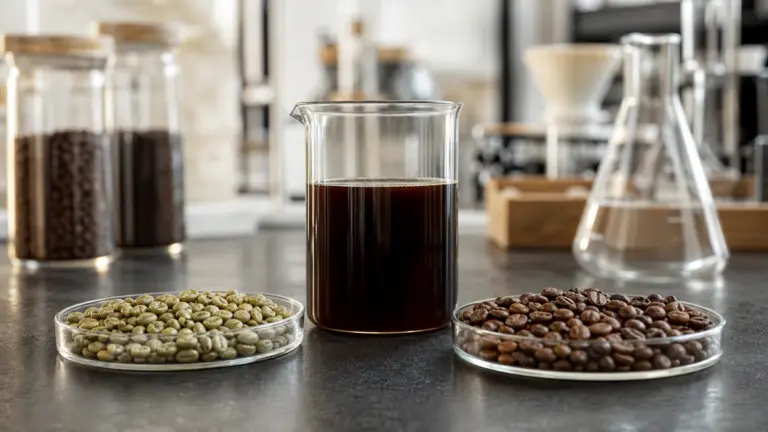
Roasting does more than release an aroma already waiting inside green coffee. Heat drives chemical reactions that create new compounds while transforming or breaking down others.
Several overlapping processes matter:
- Maillard reactions involve sugars and amino compounds, producing numerous aroma compounds as well as brown reaction products.
- Strecker degradation, connected with Maillard chemistry, transforms amino acids and produces aldehydes among other products.
- Caramelisation and other thermal breakdown reactions transform sugars and additional bean constituents.
These are interacting pathways, not tidy stages that each produce one flavour. “Nutty equals Maillard” is a useful starting association, but not a complete chemical explanation.
The roasting profile, the way temperature changes over time, also matters. In a controlled study published in 2020, researchers varied development time, the period after first crack until roasting ended, while keeping final roast colour similar. Shorter development favoured fruitiness, sweetness and acidity; longer development shifted the tested coffee towards roasted, nutty and bitter characteristics.
That result does not establish a universal roasting recipe. It came from a particular coffee and experimental design. It does show why two coffees with similar-looking beans can smell and taste different.
A separate study of Panama Geisha likewise found sensory differences between roasting treatments taken to the same final colour. For choosing coffee, roast labels are helpful clues, but they cannot describe every aromatic consequence of the roast.
What brewing changes, and what cooling changes
Brewing transfers compounds from ground coffee into water. Aroma compounds do not all transfer at the same rate: their chemical properties, including their affinity for water, influence extraction.
An instrumental espresso study found distinct extraction patterns among volatile compounds. Changing water temperature and pressure altered those patterns, with temperature having a particularly strong effect on some less water-affine compounds late in extraction. Brewing therefore changes the balance of aroma, not simply its overall intensity.
However, more extracted volatile material does not automatically mean better flavour. An instrument measures chemical signals; a person judges the resulting mixture.
Brewing temperature is not drinking temperature
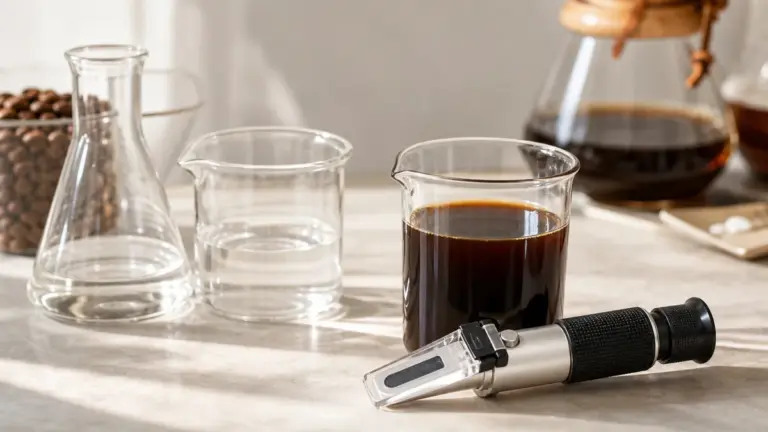
A controlled drip-coffee study compared brewing at 87, 90 and 93°C, adjusting grind size and brewing time to match beverage strength and extraction yield. Within that experiment, brewing temperature had little independent effect on the sensory profile.
Strength means how concentrated the beverage is. Extraction yield means the proportion of the dry coffee transferred into the drink. The finding does not mean temperature never matters: it means that its effects cannot always be separated from changes in extraction.
Drinking temperature is a different variable. Controlled sensory research found that serving the same coffees at different temperatures changed the perceived intensity of numerous attributes.
The practical lesson is to compare like with like. Taste two coffees at similar temperatures before deciding one is more aromatic, then revisit both as they cool. There is no need to turn that exercise into a search for one supposedly perfect tasting temperature.
Try separating smell from taste
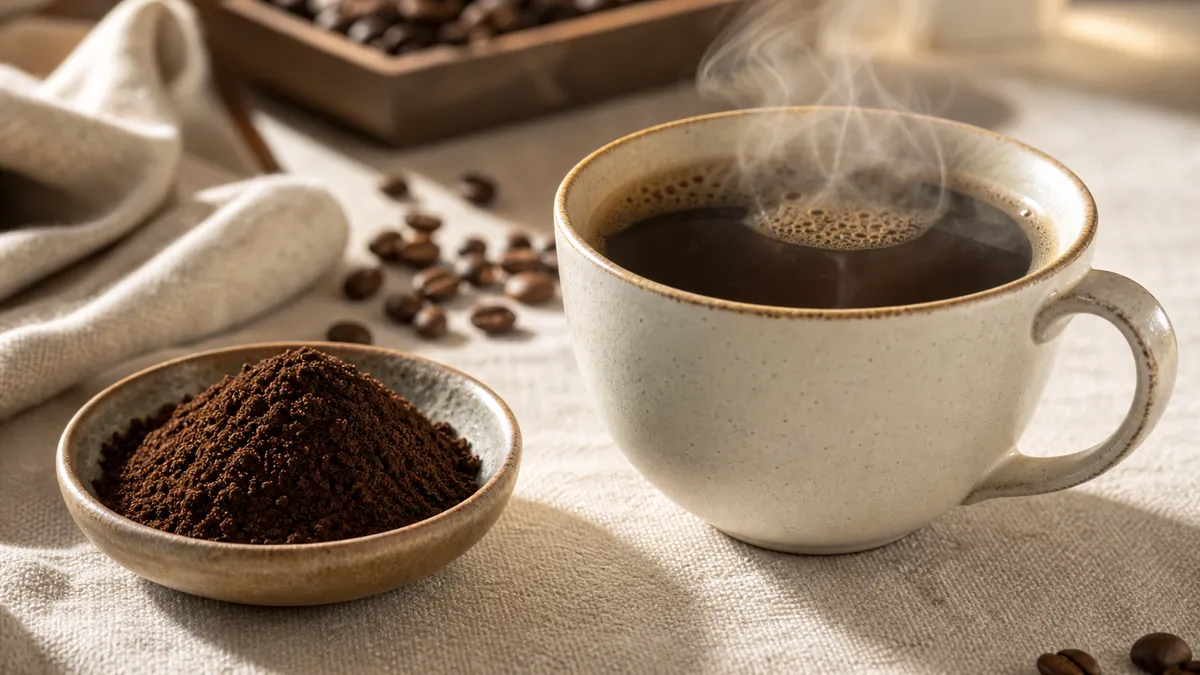
This short exercise illustrates the sensory routes rather than testing your ability to name compounds. Use plain brewed coffee that has cooled to a comfortable drinking temperature.
- Smell before sipping. Take a gentle sniff and choose a broad description, such as roasted, nutty or floral.
- Briefly pinch your nostrils. Take a small sip while keeping your nose closed. Concentrate on sourness, bitterness and texture.
- Release your nose. With the coffee still in your mouth, release your nostrils and breathe out gently through your nose. Notice whether aromatic detail becomes clearer.
- Repeat after cooling. Compare the overall impression rather than trying to recover exactly the same words.
You may find the contrast striking or modest. Treat it as an observation, not a pass-or-fail test or a medical assessment.
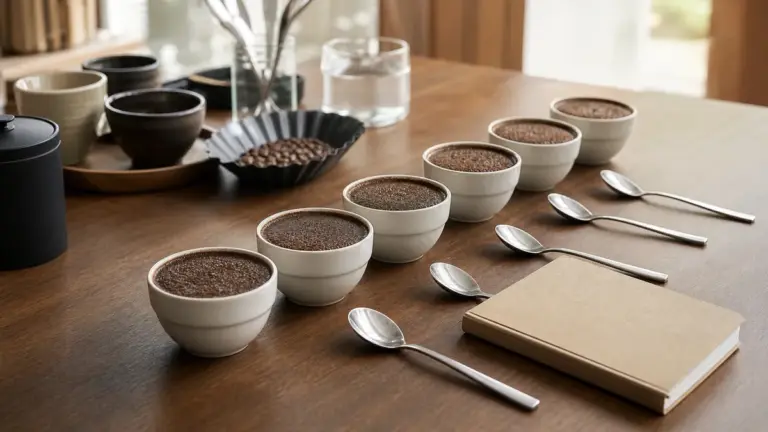
For a more structured vocabulary, use sensory science and the flavour wheel. Broad, repeatable descriptions are more useful than an elaborate tasting note you cannot recognise again.
Why a list of molecules cannot predict the whole cup
Detection is not the same as sensory importance
Researchers use an odour activity value, or OAV, as an initial guide:
OAV = concentration of a compound ÷ its odour threshold
The concentration and threshold must use compatible units. A value above one suggests that the compound may contribute to aroma under the relevant conditions. It does not give a score for pleasantness or prove that the compound dominates the mixture.
Thresholds also depend on the test medium. A threshold measured in water cannot automatically describe behaviour in brewed coffee, where other constituents affect aroma availability.
Stronger evidence comes from recombination and omission experiments. Researchers rebuild an aroma using measured compounds, then remove individual compounds or groups and ask assessors whether the result changes.
A foundational roasted-arabica study recreated a close aroma model using 27 odorants. Omission tests helped identify which contributed most to that particular coffee. Such experiments establish sensory relevance more directly than merely detecting a chemical.
Floral coffee is not a two-molecule formula
Linalool and geraniol deserve attention, but “these compounds explain all floral Ethiopian or Geisha coffee” is too strong.
In the Panama Geisha roasting study, floral treatments showed differences in linalool, geraniol and linalyl acetate. Yet terpene levels did not track the desired sensory profile in a simple linear relationship. The authors pointed to masking and flavour interactions as likely explanations.
Controlled model-system research has also shown that changing the type of bitter compound can change the perceived retronasal profile of a coffee aroma. The nose and mouth do not operate as independent measuring instruments.
Aroma keeps changing after brewing
Aroma loss is not only evaporation. Laboratory work on brewed coffee found that 2-furfurylthiol could become chemically bound to other coffee constituents, reducing the amount freely available for aroma release.
That mechanism helps explain why retaining liquid in a container does not guarantee an unchanged aromatic experience. It does not establish one universal freshness deadline for every coffee or holding system.
When reading coffee research and studies, ask whether the evidence comes from chemical measurements, controlled sensory work or both. The most convincing explanation connects molecules with what people actually perceive.
FAQ
Does caramel-smelling coffee contain lots of sugar?
No, caramel aroma is not evidence of a high sugar concentration. In a controlled study of drip-coffee fractions, researchers found perceived sweetness even though the measured monosaccharides, simple sugars, were below perceptible concentrations. They suggested that sweet-associated aromas and masking effects helped explain the experience, rather than sugar concentration alone.
Can you identify a coffee’s origin from its aroma compounds?
Not reliably from a few compounds alone. In a study comparing single-origin coffees, roasting conditions strongly influenced the volatile profiles and outweighed geographical origin in the analysis. Origin can inform an investigation, but an aroma fingerprint must be interpreted alongside roasting, processing and the particular samples studied.
Why does coffee seem less flavourful when my nose is blocked?
A blocked nose can prevent aroma molecules reaching smell receptors through the retronasal route. Basic tastes may remain, while the aromatic detail becomes harder to recognise. That is why coffee can seem comparatively plain during congestion. If a change in smell persists or concerns you, speak to your GP.
Where to go next
Read Coffee Chemistry for the reactions behind coffee aroma and flavour, then Coffee Acids, Oils and Sugars to distinguish aroma from the substances shaping taste and texture. Coffee Sensory Science and the Flavour Wheel provides a practical vocabulary, while Coffee Research and Studies explains how to assess the evidence behind sensory claims.
Sources
-
National Institute on Deafness and Other Communication Disorders, Taste Disorders, updated 2023.
https://www.nidcd.nih.gov/health/taste-disorders -
National Institute on Deafness and Other Communication Disorders, Smell Disorders, updated 2023.
https://www.nidcd.nih.gov/health/smell-disorders -
Molecules, MDPI, Zakidou et al., Single Origin Coffee Aroma: From Optimized Flavor Protocols and Coffee Customization to Instrumental Volatile Characterization and Chemometrics, 2021. Full paper retrieved as a publisher-PDF copy.
https://pdfs.semanticscholar.org/1684/7b6041f837a77272cf20255d083df20eb3da.pdf -
Flavour and Fragrance Journal, Wiley, Mayer and Grosch, Aroma simulation on the basis of the odourant composition of roasted coffee headspace, 2001. Full paper retrieved through a university-hosted copy.
https://www2.hcmuaf.edu.vn/data/lhquang/file/Coffee/Aroma%20simulation%20on%20the%20basis.pdf -
Foods, MDPI, Identification of Key Aroma-Active Compounds in Commercial Coffee Using GC-O/AEDA and OAV Analysis, 2025.
https://pmc.ncbi.nlm.nih.gov/articles/PMC12469716/ -
Journal of the Science of Food and Agriculture, Society of Chemical Industry, Koyner et al., Characterizing Panama Geisha coffee aromas: sensory and chemical analysis across roasting methods, 2025. Author abstract retrieved through PubMed.
https://pubmed.ncbi.nlm.nih.gov/40457597/ -
Beverages, MDPI, Alstrup et al., The Effect of Roast Development Time Modulations on the Sensory Profile and Chemical Composition of the Coffee Brew as Measured by NMR and DHS-GC-MS, 2020.
https://www.mdpi.com/2306-5710/6/4/70/pdf -
International Journal of Mass Spectrometry, Elsevier, Sánchez López et al., Extraction kinetics of coffee aroma compounds using a semi-automatic machine: On-line analysis by PTR-ToF-MS, 2016. Full paper retrieved through a university-hosted copy.
https://pages.uoregon.edu/chendon/coffee_literature/old_literature/2016%20Int.%20J.%20Mass.%20Spec.%2C%20Extraction%20kinetics%20from%20mass%20spec%20–%20acidified%2C%20real-time.pdf -
Scientific Reports, Nature Portfolio, Batali, Ristenpart and Guinard, Brew temperature, at fixed brew strength and extraction, has little impact on the sensory profile of drip brew coffee, 2020; author correction, 2021.
https://pubmed.ncbi.nlm.nih.gov/33020560/
https://www.nature.com/articles/s41598-021-82505-9.pdf -
Food Research International, Elsevier, Chapko and Seo, Characterizing product temperature-dependent sensory perception of brewed coffee beverages: Descriptive sensory analysis, 2019.
https://www.sciencedirect.com/science/article/pii/S0963996918309761 -
Food Chemistry, Elsevier, Sun et al., Aroma binding and stability in brewed coffee: A case study of 2-furfurylthiol, 2019. Accepted manuscript retrieved through the University of Nottingham repository.
https://nottingham-repository.worktribe.com/OutputFile/2291102 -
Journal of Agricultural and Food Chemistry, American Chemical Society, Czerny, Mayer and Grosch, Sensory study on the character impact odorants of roasted arabica coffee, 1999. Author abstract retrieved through PubMed.
https://pubmed.ncbi.nlm.nih.gov/10563955/ -
PLOS ONE, Paravisini et al., Impact of bitter tastant sub-qualities on retronasal coffee aroma perception, 2019.
https://journals.plos.org/plosone/article?id=10.1371/journal.pone.0223280 -
Journal of the Science of Food and Agriculture, Society of Chemical Industry, Batali et al., Sensory and monosaccharide analysis of drip brew coffee fractions versus brewing time, 2020.
https://scijournals.onlinelibrary.wiley.com/doi/10.1002/jsfa.10323
Research combined authoritative sensory physiology guidance with primary coffee chemistry and controlled sensory studies, distinguishing measured compounds from demonstrated sensory effects.
Last checked: November 2026