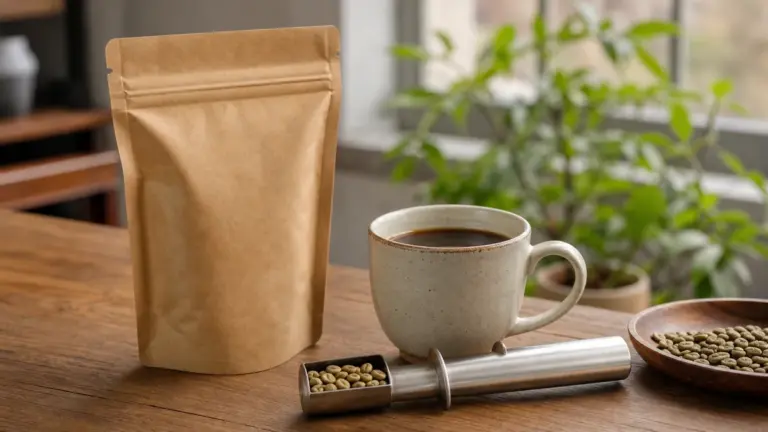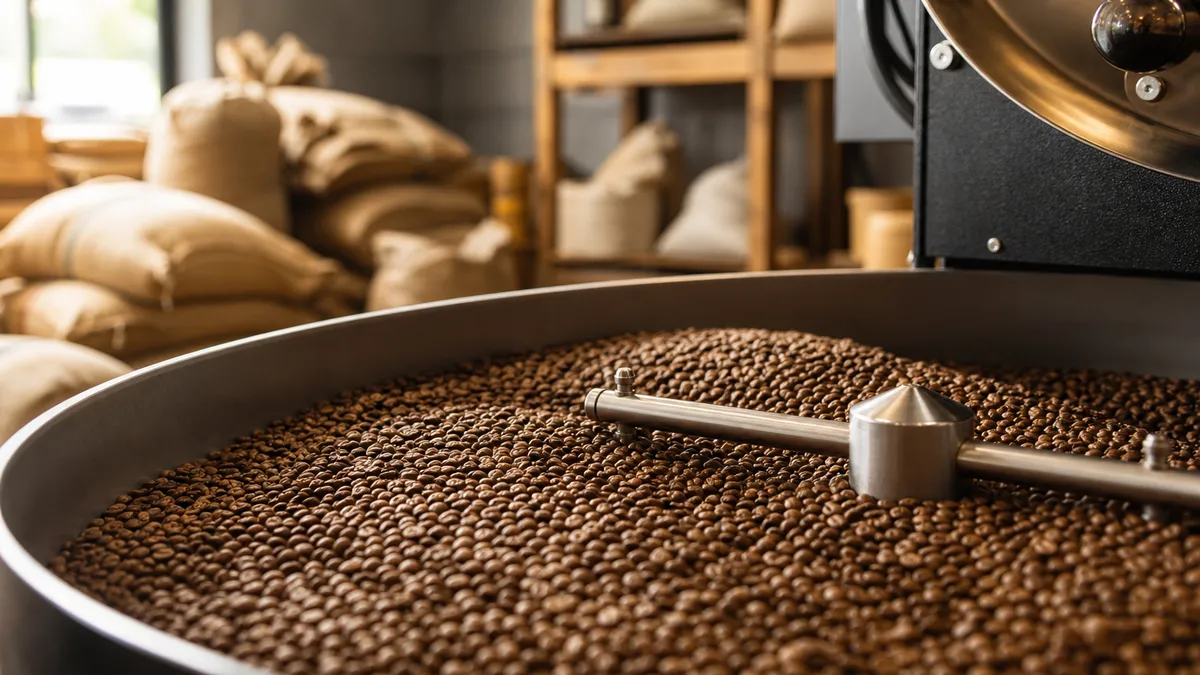
A coffee roastery is a place where green, unroasted coffee beans are roasted to develop the aromas and flavours we recognise in brewed coffee. The work includes choosing coffees, testing samples, controlling the roast and checking the finished result, not simply turning beans brown. A roastery may sell coffee directly, but it is not necessarily a café or somewhere you can visit without booking.
In short
- Check whether a roastery has a public café, a collection point or appointment-only access before travelling.
- Ask what the coffee tastes like and which brewing method it suits, rather than choosing by roast colour alone.
- “Direct trade” can still involve exporters and importers; ask what the relationship actually includes.
- Use the roast date alongside the roaster’s resting and storage advice, not as a competition to buy the youngest beans.
- Judge a roastery by its coffee, useful information and consistency, rather than the size of its machinery.
What happens inside a coffee roastery?
The central job is to turn an agricultural ingredient into coffee with an intended flavour. That begins before the production machine is switched on: roasters assess green coffee samples, taste trial roasts and decide how to approach the larger batch. Tinker Coffee, for example, describes receiving samples from direct-trade and importer partners, sample-roasting them and evaluating them before purchase or delivery approval.
A useful way to picture the workflow is:
Green coffee selection → sample roasting → tasting → roast development → production roasting → cooling → quality checks → packing.
These stages answer different questions. Sample evaluation asks whether a coffee has the qualities the buyer wants. Roast development asks how to bring those qualities into the finished drink. Quality checking asks whether the result matches the intention. IKAWA distinguishes sample evaluation from profiling, the process of adjusting roasting conditions towards a particular outcome.
Cupping means assessing coffee by tasting prepared samples in a consistent way. In a roastery, it helps connect production decisions with flavour: a temperature curve records what happened during roasting, but tasting assesses the result. Neither a handsome machine nor an attractive graph replaces that final check.
For the wider context, our coffee shops and roasteries guide brings together the places that prepare coffee and the businesses that roast it.
Small roasteries and larger operations
Roasting takes place at very different scales. A sample roaster handles small quantities for evaluation or experimentation; a production roaster prepares the coffee intended for sale. IKAWA describes profiling with samples of 50 or 100 g, compared with production batches measured in kilograms.
For a concrete equipment example, PROBAT’s published P Series specifications list batch ranges of 1 to 6 kg, 1 to 15 kg and 1 to 30 kg for different machines. These are manufacturer-claimed operating ranges, checked in November 2026, not independent measurements or a classification system for roasteries.
When comparing businesses, separate three questions:
- Production: who physically roasts the beans?
- Retail: who sells the packaged coffee?
- Hospitality: where can you sit down and drink it?
Do not assume one address performs all three functions. Square Mile, for instance, states that its roastery is a production location rather than a walk-in café or retail shop. Its published policy illustrates why checking the actual operation matters more than interpreting the business name.
As a buying rule, treat scale as context, not a quality verdict. Ask how the coffee is assessed and what support you receive when brewing it. For a focused business profile alongside this general explanation, read iKhofi.
How roasteries source their coffee
Roasteries can buy through green coffee importers, build relationships with producers or combine those approaches. These routes are not cleanly separated: a roaster may select coffee with a producer while an exporter and importer handle shipping, documentation, finance and delivery. Royal Coffee’s buying guide explains why the idea of simply removing all intermediaries misrepresents many working supply chains.
That makes “direct trade” a starting point for questions, not a complete explanation. Ask who produced the coffee, who exported and imported it, and what the roaster means by the relationship. An importer’s involvement does not, by itself, tell you whether the coffee is traceable or whether the producer relationship is meaningful.
When reading a bag or product page, look for information you can use:
- A named producer, co-operative or identifiable source.
- The growing region and processing method.
- A clear description of the intended flavour.
- An explanation of sourcing claims, rather than an unexplained badge or slogan.
Use these as prompts, not a rigid scoring system. A plainly described coffee that suits your taste is a more sensible purchase than a densely documented one you will not enjoy.
Roasting styles: what changes in the bean?
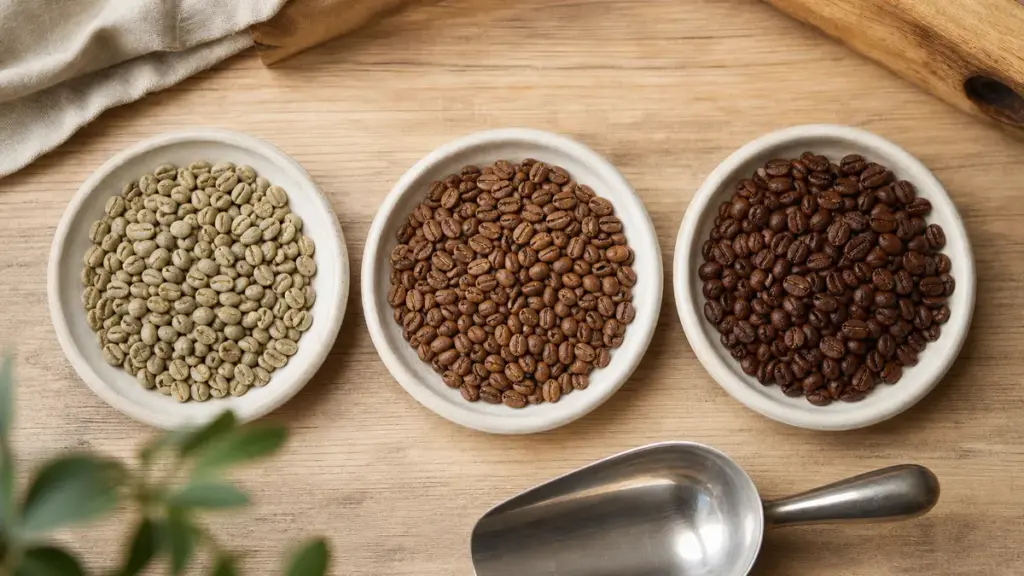
During roasting, coffee loses moisture, changes structure and develops new colour and aroma compounds. Maillard reactions, a family of reactions involving sugars and amino compounds, contribute to browning and aroma formation. The beans move from greenish tones through yellow towards brown; an audible expansion called first crack is one of the milestones a roaster can monitor.
A roast profile describes the course of the roast, including temperature over time. Roasters adjust their approach according to the coffee and the intended result, rather than assuming that every batch needs identical treatment. Moisture, density and bean size are among the characteristics that can influence that approach.
The following comparison is a broad sensory guide, not a promise about every bag:
| Roast description | General tendency | Useful question to ask |
|---|---|---|
| Light | More emphasis on origin and processing character | Is this lively and fruit-led, or more restrained? |
| Medium | A broad label that needs further explanation | What does “medium” mean in your range? |
| Dark | More emphasis on roast flavours and bitterness | How pronounced are the roasted flavours? |
These labels are not perfectly consistent between businesses. SCA reporting on roast-colour research describes the difficulty of agreeing what “light”, “medium” and “dark” mean, even among professionals. Ask for a flavour description and brewing recommendation alongside the label.
Roast colour is useful, but it is not the whole account. Two coffees can look similar while having followed different roasting paths. For someone looking beyond the bag description, a revealing question is: “What were you trying to achieve with this roast, and how did you check it?”
Visiting roasteries
Before setting out, check the roastery’s own website for public access, booking requirements and whether roasting will actually take place during your visit. A tasting event, a café visit and a production tour are different experiences. Square Mile’s appointment-only production site is a useful reminder that a searchable address is not an invitation to walk in.
Use this short visit plan:
- Confirm the format. Ask whether you will see production, taste coffee or attend a class.
- Check practical access. Confirm accessibility, age restrictions and any visitor instructions.
- Bring a brewing question. Explain what equipment you use and the flavours you enjoy.
- Ask for a comparison. If tasting is available, request coffees with a clear difference.
- Record the useful details. Note the coffee, roast date and recommended preparation.
During a tour, ask the guide to connect each piece of equipment with its purpose. Why is a sample roasted separately? What is monitored during production? How is the batch assessed afterwards? Those questions make the visit more informative than concentrating only on the largest machine.
If your main aim is somewhere to drink coffee, use a café-focused guide such as London coffee shops, then check the venue’s current details directly.
Buying directly from a roastery
Start with your brewing method and preferences. Tell the roaster whether you want a bright, fruit-led cup or something with a more pronounced roasted character. Ask which of its coffees best matches that description, rather than requesting whichever bag is newest.
Freshly roasted coffee releases carbon dioxide, a process called degassing. SCA freshness guidance explains that roasting creates both aroma compounds and gas, and that grinding greatly accelerates gas loss. Coffee therefore changes after roasting; the roast date is useful information, but not a complete prediction of how it will brew.
Ask when the roaster recommends starting the bag and how to store it. Resting advice depends on the roast, packaging and brewing method, so avoid imposing one universal waiting period. Once opened, keep the coffee sealed in a cool, dark place, following the supplier’s instructions.
For a first purchase, choose a manageable quantity and keep the product information. Brew it consistently before making several changes at once, then describe the result when asking for advice. “Too sharp for my taste” gives the roaster a more useful starting point than “I didn’t like it”.
The best reason to buy from roasteries is not proximity to a cooling tray. It is the opportunity to make a better-informed choice, understand the intended flavour and get practical help turning those beans into a drink you enjoy.
FAQ
Does “freshly roasted” mean I should brew the coffee immediately?
No, freshly roasted coffee does not have to be brewed immediately. It continues releasing carbon dioxide after roasting, and the appropriate resting period varies with the coffee and preparation method. Ask the roaster for guidance for that particular bag rather than treating one waiting period as a rule for everything.
Can I buy ground coffee from every roastery?
No, check before ordering if you do not own a grinder. Square Mile, for example, states that it supplies whole beans only. Where grinding is offered, explain your brewing method and buy accordingly: ground coffee loses gas and flavour more quickly, so preparation and storage become particularly relevant.
What should I ask if a roastery describes its coffee as “direct trade”?
Ask what the relationship involves in practice. Useful questions include who the producer is, how the coffee reaches the roastery and which partners handle export and import. A direct producer relationship can coexist with specialist intermediaries, so the phrase alone does not explain the whole supply chain.
Where to go next
Read Coffee Shops and Roasteries for the wider guide to places that serve and roast coffee, then iKhofi for a focused business profile. For a drinking-focused visit rather than a production tour, Top Coffee Shops in London is the useful next read.
Sources
-
Royal Coffee, Chris Kornman, Buying Green Coffee, 2024.
https://cdn.royalcoffee.com/wp-content/uploads/2024/07/11160626/Buying-Green-Coffee-Booklet.pdf -
IKAWA, Small-Batch Roasting, 2022.
https://www.ikawacoffee.com/blog/small-batching-roasting/ -
Tinker Coffee Co., Roasting, undated, retrieved November 2026.
https://www.tinkercoffee.com/pages/roasting -
PROBAT, P Series, current manufacturer specifications, retrieved November 2026.
https://www.probat.com/products/specialty-coffee/p-series/ -
Specialty Coffee Association, What Color is Your Coffee?, 25, Issue 21, undated webpage, retrieved November 2026.
https://sca.coffee/sca-news/25/issue-21/what-color-is-your-coffee-37lk7 -
Specialty Coffee Association, Coffee Decoded: What is “freshly roasted” coffee?, undated webpage, retrieved November 2026.
https://sca.coffee/sca-news/coffee-decoded-9-fresh-coffee -
STANZ Coffee, Coffee Roasting: Development Beyond Colour, 2026.
https://www.stanz-kaffee.at/en/blogs/coffee-knowledge/coffee-roasting-roast-levels -
Square Mile Coffee Roasters, FAQ, undated, retrieved November 2026.
https://shop.squaremilecoffee.com/pages/faq
This article was researched using SCA scientific explanations, a green coffee importer’s buying guide, manufacturer documentation and roasteries’ own descriptions of their operations; no first-hand testing or visits are claimed.
Last checked: November 2026