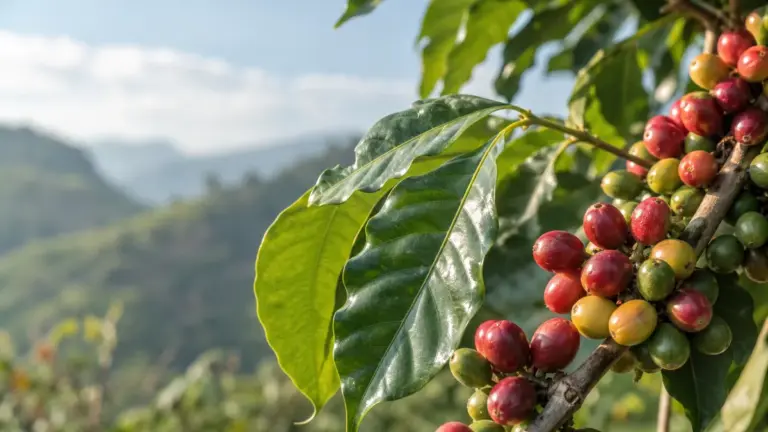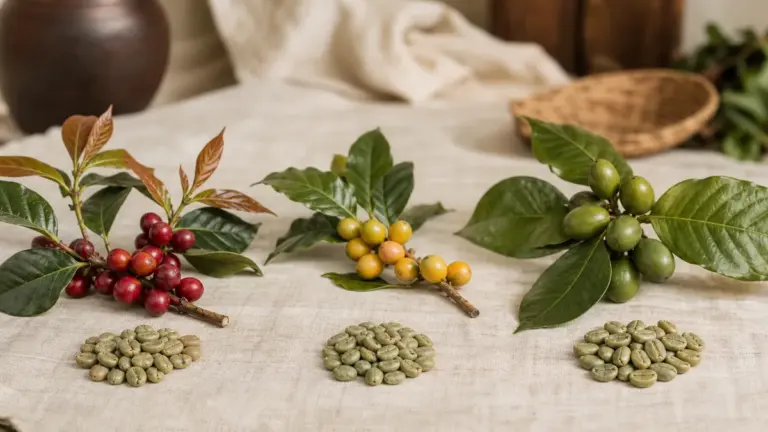
Pink Bourbon and Sudan Rume are distinctive arabica coffees sought out for their unusual flavours and genetic backgrounds. Despite its name, tested Pink Bourbon material points towards Ethiopian landrace ancestry rather than traditional Bourbon, while Sudan Rume traces its recorded origin to the Boma Plateau in present-day South Sudan and has contributed disease resistance to coffee breeding.
In short
- Pink Bourbon takes its familiar name from pink or salmon-coloured ripe cherries, not a reliably established Bourbon pedigree.
- RD2 Vision places Pink Bourbon within its Core Ethiopia landrace group and Rume Sudan within its Sudan group.
- Sudan Rume, also written Rume Sudan, contributes ancestry to both Ruiru 11 and Batian.
- Expect lot-specific descriptions: Pink Bourbon can show bright citrus and floral notes; Sudan Rume can combine flowers, fruit, mint and spice.
- Choose by producer, processing method and harvest information, not rarity alone.
Two names, two different histories
Both names refer to material within Coffea arabica, rather than separate coffee species. Their interest lies partly in the cup and partly in what they reveal about coffee identification: a familiar name can conceal a complicated family history.
A landrace is a locally established population shaped by cultivation and selection over time, rather than necessarily a uniform variety created through a formal breeding programme. RD2 Vision’s classification places these coffees in different genetic groups, so they should not be treated as close relatives simply because both appear among unusual specialty offerings.
For a wider route through these relationships, start with coffee varieties. Here, the useful distinction is between a coffee’s name, its documented genetic background and the particular beans being sold.
Pink Bourbon’s story centres on Colombian cultivation and a reassessment of its ancestry. Sudan Rume’s connects South Sudanese wild coffee, research collections, disease-resistance breeding and small specialty harvests elsewhere.
Pink Bourbon: pink cherries, but not a dependable Bourbon pedigree
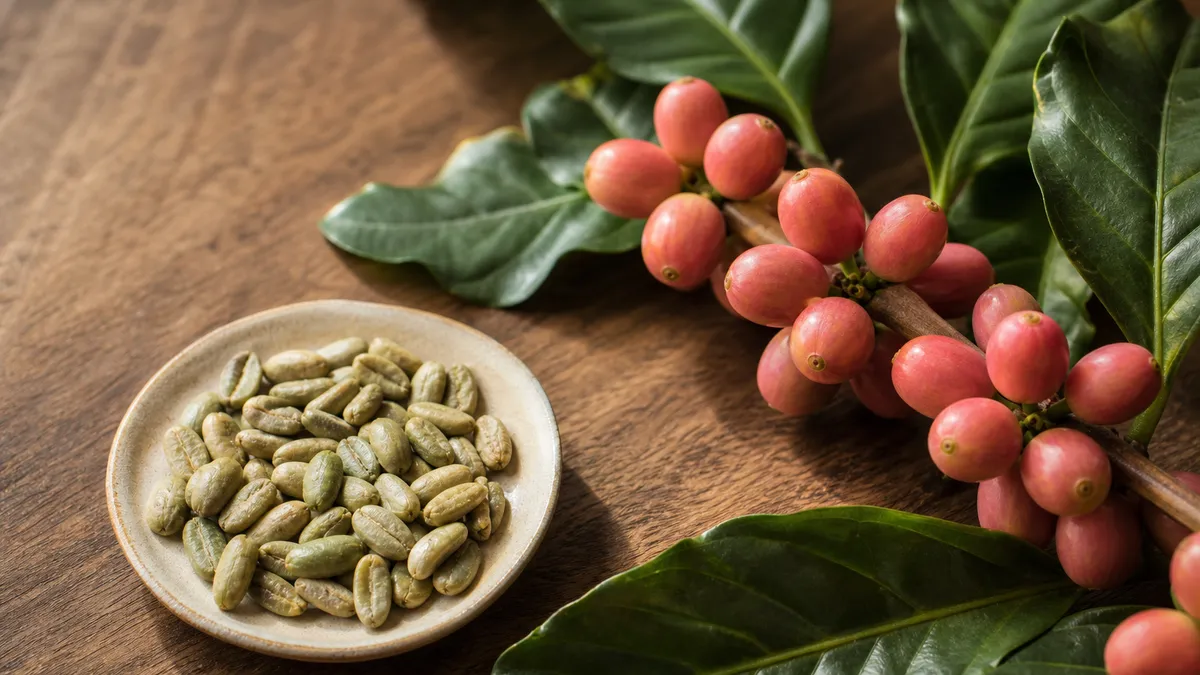
Pink Bourbon is associated particularly with Colombia’s Huila department. Its pink to salmon-coloured ripe fruit explains the first part of the name; the second has encouraged a persistent explanation that it arose from Red Bourbon crossed with Yellow Bourbon.
What genetic testing actually found
Cafe Imports reports testing by DNA Analytica in 2017 and by Christophe Montagnon’s RD2 Vision in 2023. The sampled Pink Bourbon material pointed towards Ethiopian landrace genetics, not the traditional Bourbon lineage or the proposed Red Bourbon and Yellow Bourbon cross.
RD2 Vision’s Arabica Coffee Cultivars Wheel, version 1.1, places Pink Bourbon among landraces in the Core Ethiopia group. This is a genetic grouping, not a documented Ethiopian village of origin or a complete account of how the plants reached Colombia.
The distinction between testing and naming matters. Cafe Imports’ commercial testing found mixed returns involving Bourbon or Catimor material. Its method could not establish whether those represented mixed beans or ancestry within individual beans. The name does not guarantee genetic identity across every farm.
These are importer-reported commercial tests, not a comprehensive peer-reviewed survey of everything called Pink Bourbon.
How to read the name on a bag
Treat Pink Bourbon as a useful field and trading name, not a certificate of parentage. Ask a roaster whether the identification comes from the producer’s planting records or genetic testing, without assuming that an untested lot is misrepresented.
Cherry appearance is useful for recognising a plant in context, but should not replace identification records. The broader distinction between a local population and a precisely identified selection is explored in Ethiopian landrace coffees.
Sudan Rume: from South Sudan to breeding programmes
Sudan Rume is also commonly written Rume Sudan, the form used by World Coffee Research in its breeding pedigrees. Its recorded origin is the Rume area of the Boma Plateau in present-day South Sudan, near Ethiopia.
A peer-reviewed study by Krishnan and colleagues, published in 2021, discusses collection records linking this material to A. S. Thomas’s 1941 expedition. Seed moved into East African research collections, providing a route through which the material became available for breeding and later cultivation.
The historical name can therefore mislead geographically. A Sudan Rume grown in Colombia is Colombian-grown coffee with a recorded South Sudanese varietal origin, not coffee harvested in South Sudan.
Partial disease resistance, not immunity
Sudan Rume’s significance extends beyond distinctive flavour. Controlled inoculation research published by Omondi and colleagues in 2000 found partial resistance to coffee berry disease in the tested Rume Sudan material.
Coffee berry disease is caused by the fungus Colletotrichum kahawae. Partial resistance means the tested plants restricted disease to some extent under the experiment’s conditions; it does not mean that every plant carrying the name is immune, or that resistance applies to every coffee disease.
World Coffee Research identifies Rume Sudan as a source of coffee berry disease resistance in the ancestry of Ruiru 11. This is a specific breeding contribution, not a reason to describe Sudan Rume casually as “disease-proof”.
Its role in Ruiru 11 and Batian
World Coffee Research records Ruiru 11 as a complex composite variety whose male-parent ancestry includes Rume Sudan. Batian also contains Rume Sudan ancestry through the breeding material used in its development.
Neither is simply Sudan Rume crossed once with another named variety. Multiple parents and generations of selection are involved, so “contributed to the pedigree” is more accurate than an abbreviated two-parent formula.
For related breeding approaches, see Castillo, Catimor and Sarchimor. Keep the distinction clear: sharing an ancestor does not make two coffees the same variety.
Origin and growing facts: use real lots, not universal ranges
These are varieties, not growing regions. There is no single harvest calendar or altitude range that describes every farm cultivating either one.
The panel below uses documented examples. Historical harvest months remain useful evidence of those lots, but are not a forecast for a future purchase.
| Fact | Pink Bourbon | Sudan Rume |
|---|---|---|
| Recorded association or origin | Particularly associated with Huila, Colombia; RD2 Vision classifies it within Core Ethiopia | Recorded origin in the Boma Plateau, present-day South Sudan |
| Variety named in the examples | Pink Bourbon | Sudan Rume |
| Documented growing altitude | Aguazul producer-group lot: 1,600 to 1,800 metres; Las Flores example: 1,750 metres | Las Margaritas producer listing: 1,571 to 1,852 metres |
| Documented processing | Washed in both cited Colombian examples | Washed, hybrid washed and natural in the cited producer and importer records |
| Documented harvest months | Aguazul: October to December 2020; Las Flores factsheet: March to July, year unspecified | Las Margaritas washed lot: April to June 2018 |
| Illustrative cup descriptions | Apple, lime, grapefruit, brown sugar; other lots show soft florals and strawberry | Chamomile, cardamom, citrus and stone fruit; other lots show mint, ginger and berries |
The altitude figures describe particular farms or producer groups, not proven biological limits. Likewise, a processing method belongs to the lot: Sudan Rume is not inherently a natural coffee, and Pink Bourbon is not inherently washed.
What do Pink Bourbon and Sudan Rume taste like?
Pink Bourbon: brightness with sweetness
Royal Coffee’s assessment of its Aguazul Pink Bourbon describes green apple, lime and grapefruit alongside brown sugar and baking-spice sweetness. A separate SEY selection from William Ortiz carries the roaster’s descriptions of pink lemonade, strawberry preserve and soft florals.
Those examples suggest an appealing direction for readers who enjoy lively fruit rather than a predominantly roasty cup. They do not establish a compulsory Pink Bourbon flavour, and a floral cup is not evidence of ancestry.
When choosing, look for descriptions that explain the balance. “Grapefruit with brown sugar” tells you more about the likely drinking experience than “rare and exceptional”.
Sudan Rume: flowers, herbs and spice
Sudan Rume can offer a particularly distinctive combination of floral and herbal impressions. Royal Coffee’s washed Las Margaritas example describes chamomile, cardamom, soft citrus and stone fruit.
Café Granja La Esperanza’s hybrid-washed listing adds mint, ginger, peach and mandarin to its own sensory description. DRWakefield’s natural example includes spearmint, ginger, citrus, berries and floral notes.
These are producer and importer tasting observations, not results from a controlled comparison between varieties. Use them to select a promising lot, rather than expecting every Sudan Rume to taste of cardamom or mint.
Rarity: what should influence your choice?
Sudan Rume has a documented history of limited commercial cultivation. Pink Bourbon, meanwhile, appears in distinct producer selections and small lots, but “rare” alone does not tell you how much exists or how carefully a particular harvest was handled.
Avoid treating either name as an automatic quality grade. Before buying from a UK roaster, look for:
- A named producer or producer group, rather than only a country and variety.
- A clear process description, including any additional fermentation treatment.
- Harvest information, distinguished from the roasting date.
- Specific tasting notes, preferably with some explanation of sweetness, acidity and texture.
- An honest identification claim, without unsupported promises of genetic purity.
My preference for a first comparison would be clearly documented washed examples of both, if available. That is a tasting choice, not a claim that washed processing removes every other influence.
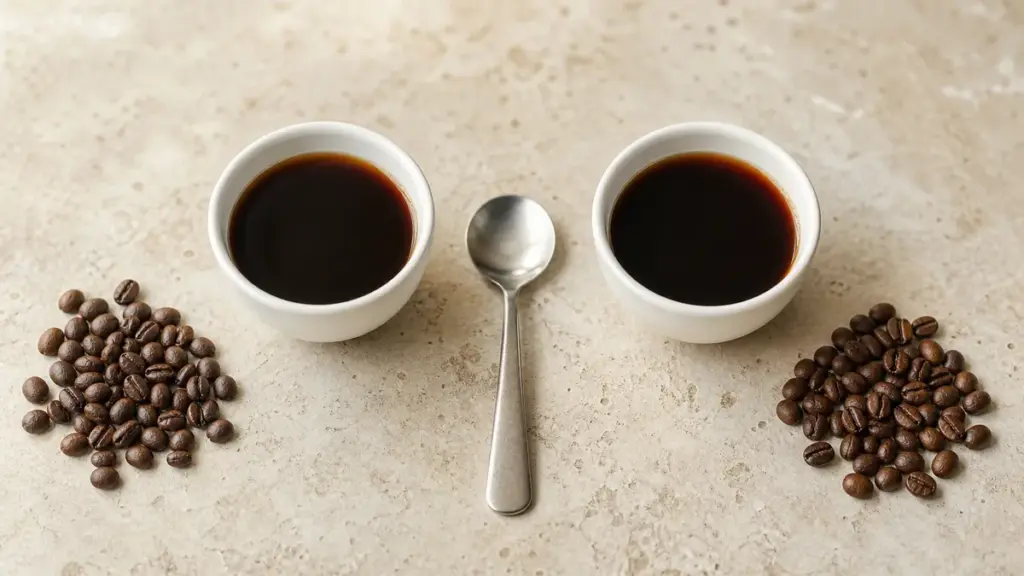
Compare them using the same familiar brewing method, water and serving temperature. Record what you actually perceive before rereading the tasting notes. Do not expect this exercise to isolate genetics: it compares two finished coffees, with their own growing, processing and roasting histories.
A deeper caution: Sudan Rume identity is not completely simple either
Pink Bourbon is not the only coffee here with identification questions. The 2021 South Sudan study found that historical research-collection material labelled Rume Sudan did not group neatly with the newly sampled wild South Sudanese populations.
One Rume Sudan accession retained a genetic marker associated with the South Sudan group. The researchers discussed cross-pollination or mislabelling as possible explanations for the collection material’s differences and called for further investigation.
That finding does not invalidate every commercial Sudan Rume label. It does rule out an overly tidy story in which every bag necessarily represents an unchanged wild population.
The practical lesson for Pink Bourbon and Sudan Rume is the same: appreciate the name, but follow the evidence back to the specific plants and lot whenever possible.
FAQ
Does Pink Bourbon make pink coffee?
No: “pink” refers to the ripe cherry’s appearance, not a promised colour in the brewed drink. Treat it as part of the plant’s familiar name rather than a beverage description. A roaster describing pink lemonade or pink grapefruit is also using a flavour comparison, not saying that those ingredients or colours must be present.
Can you identify either variety from bean shape?
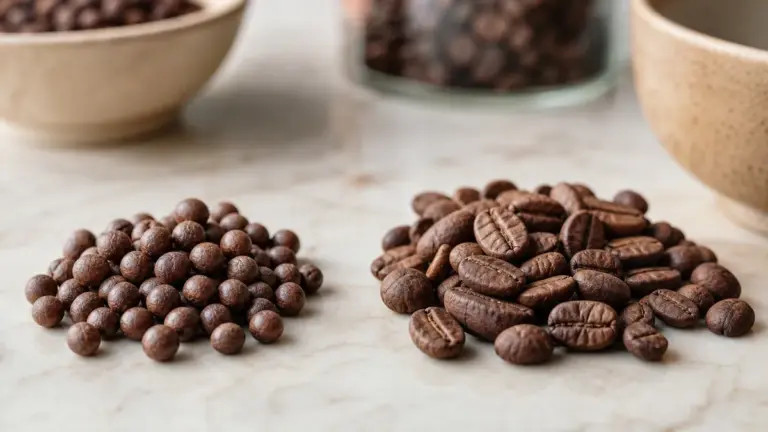
Not reliably from shape alone. Royal Coffee noted elongated seeds in its Pink Bourbon example and oblong seeds in its Sudan Rume example, so elongation is not a unique identifier between them. Physical appearance can support an assessment, but provenance records and suitable genetic testing provide different, more useful kinds of evidence.
Can I choose these coffees without liking strongly fermented flavours?
Yes: look for specific lots whose descriptions match your preferences rather than rejecting either variety. Documented washed examples exist for both, including the lots discussed here. Ask the roaster about the particular process and cup character; neither the variety name nor the word “washed” alone answers every question about fermentation.
Where to go next
Read Ethiopian Heirloom and Landrace Coffees for the terminology behind Pink Bourbon’s genetic classification, and Castillo, Catimor and Sarchimor for another route through breeding and disease resistance. Caturra, Catuai and Mundo Novo provides a useful comparison with more established cultivated family histories.
Sources
-
Cafe Imports, Pink…Bourbon?: Cryptozoology and Genetics in Specialty Coffee, 2023. Importer’s account of commissioned testing and its limitations.
https://www.cafeimports.com/north-america/blog/2023/09/26/pink-bourbon-cryptozoology-and-genetics-in-specialty-coffee/ -
RD2 Vision, The Arabica Coffee Cultivars Wheel, version 1.1, undated. Wheel inspected directly for genetic group placement.
https://rd2vision.com/the-arabica-coffee-cultivars-wheel/ -
Krishnan and colleagues, Validating South Sudan as a Center of Origin for Coffea arabica: Implications for Conservation and Coffee Crop Improvement, Frontiers in Sustainable Food Systems, 2021.
https://www.frontiersin.org/journals/sustainable-food-systems/articles/10.3389/fsufs.2021.761611/full -
Omondi and colleagues, Coffee Research Foundation and collaborators, Reaction of Some Coffea arabica Genotypes to Strains of Colletotrichum kahawae, the Cause of Coffee Berry Disease, Journal of Phytopathology, 148, 2000. Retrieved copy of the original research paper.
https://library.sweetmarias.com/wp-content/uploads/2020/08/Strains-of-Colletotrichum-kahawae-the-Cause-of-Coffee-Berry-Disease.pdf -
World Coffee Research, Arabica Varieties Catalogue: Ruiru 11 and Batian, live entries, undated.
https://varieties.worldcoffeeresearch.org/varieties/ruiru-11
https://varieties.worldcoffeeresearch.org/varieties/batian -
Genuine Origin, Colombia: Finca Las Flores Pink Bourbon, lot factsheet, undated.
https://www.genuineorigin.com/site/images/factsheets/factsheet-GEN21CLM04.pdf -
Royal Coffee, Colombia Huila Aguazul Pink Bourbon, lot report, 2020. Used for lot details and direct sensory observations, not its historical genetic interpretation.
https://cdn.royalcoffee.com/wp-content/uploads/2020/10/19090604/48492-CJ1405-Colombia-Huila-Aguazul-Pink-Bourbon-GrainPro.pdf -
Royal Coffee, CJ1241: Colombia Caicedonia Las Margaritas Sudan Rume Crown Jewel, 2018. Used for lot details, seed appearance and sensory observations, not its breeding summary.
https://cdn.royalcoffee.com/wp-content/uploads/2018/10/21123335/CJ1241-Colombia-Caicedonia-Las-Margaritas-Sudan-Rume-Crown-Jewel.pdf -
Café Granja La Esperanza, Sudan Rumé Hybrid Washed, producer listing, undated.
https://cafegranjalaesperanza.com/products/sudan-rume-hybrid-washed -
DRWakefield, Colombia CGLE Sudan Rume Natural, importer listing, undated.
https://drwakefield.com/coffees/cgle-sudan-rume-natural-ss/ -
SEY, William Ortiz: La Cabaña, Pink Bourbon, Colombia, 2026 listing, documenting an August 2025 harvest.
https://www.seycoffee.com/products/2026-william-ortiz-la-cabana-pink-bourbon-colombia
Research combined live retrieval of primary genetic and disease studies, specialist classification resources, and producer, importer and roaster lot records; sensory descriptions are attributed observations, not first-hand testing.
Last checked: November 2026