Indian coffee often combines a full body with gentle acidity, but its range extends from clean, aromatic washed arabicas to smooth robustas and the distinctive, earthy character of Monsooned Malabar. Shade-grown estates are central to its identity, while species, growing region and processing explain more about the cup than the country name alone.
In short
- Karnataka, Kerala and Tamil Nadu form India’s traditional coffee-growing heartland.
- Coffee commonly grows beneath a mixed shade canopy, alongside pepper, cardamom and fruit crops.
- Monsooned Malabar is processed with humid monsoon air after drying, not simply harvested during rainy weather.
- Plantation A means a grade of washed arabica; Arabica Cherry AB means a grade of naturally processed arabica.
- Kent, S.795, Selection 9 and Chandragiri are useful variety names to recognise, but they should not all be described as currently rust-resistant CCRI creations.
Indian coffee at a glance
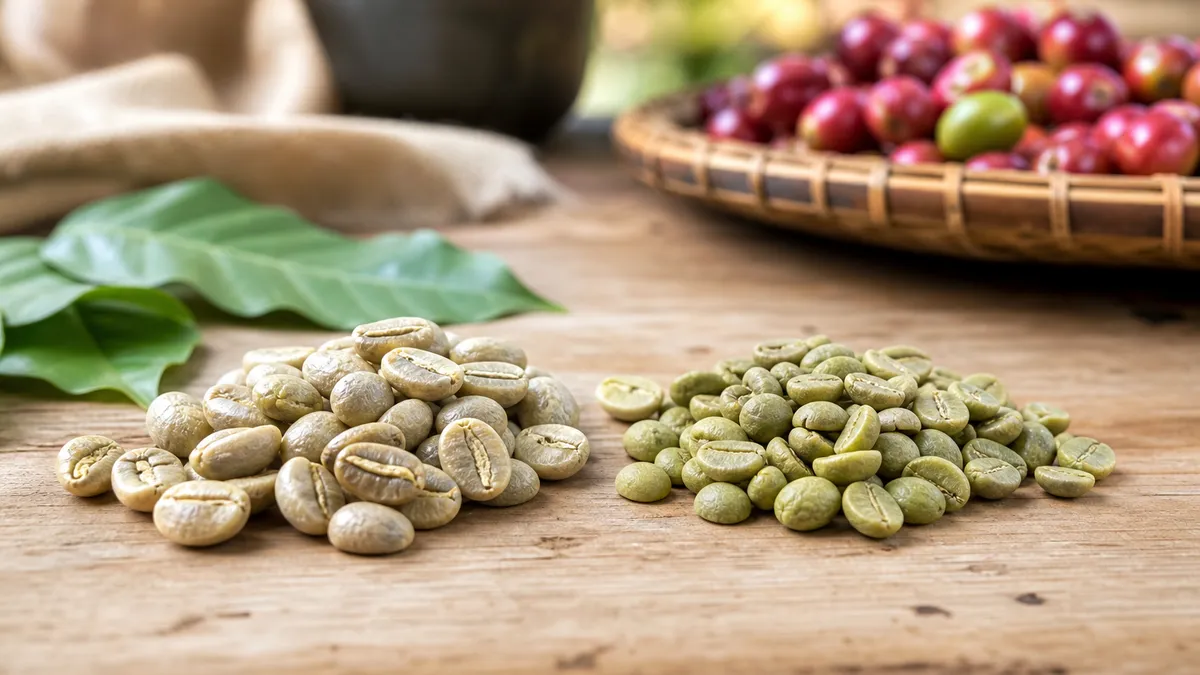
Arabica, Coffea arabica, and robusta, Coffea canephora, are different coffee species. India produces both, with arabica generally associated with cooler growing conditions and robusta with warmer, more humid sites.
The figures below are broad growing guidelines, not boundaries that every estate follows.
| Feature | Indian coffee |
|---|---|
| Growing altitude | General guidance: arabica at 1,000 to 1,500 metres; robusta at 500 to 1,000 metres above sea level. Individual regions extend beyond these bands. |
| Recognisable varieties | Arabica: Kent, S.795, Selection 9, Cauvery and Chandragiri. Robusta names include S.274 and CxR. |
| Main processing methods | Washed, natural and, for selected naturally processed beans, subsequent monsooning. |
| Typical harvest | Arabica: November to January. Robusta: December to February. Local conditions affect timing. |
| Cup profile | Washed arabicas can be balanced and aromatic; selected washed robustas are full-bodied and mellow; monsooned coffees have subdued acidity and a heavier, aged character. |
For the wider regional context, start with our guide to south asia. Within India, however, the most useful first question is often: which species and which process?
Where Indian coffee grows
Karnataka
Karnataka’s established coffee districts include Chikkamagaluru, also commonly written Chikmagalur, Kodagu or Coorg, and Hassan. Both arabica and robusta are important here.
Bababudangiris is particularly associated with arabica. An estate name, species and processing description are more informative buying details than “Karnataka coffee” on its own.
Kerala
Wayanad is strongly associated with robusta, while Travancore is another recognised coffee region. Kerala deserves attention from drinkers curious about robusta as an origin coffee rather than merely an unnamed blend component.
Tamil Nadu
Tamil Nadu’s coffee regions include the Nilgiris, Shevaroys, Pulneys and Anamalais. Arabica is prominent in several of these hill regions, although robusta also grows in the state.
India’s coffee geography extends beyond these southern areas into the Eastern Ghats and the North East. For neighbouring origins, see sri lanka and nepal, rather than assuming the same growing conditions apply across South Asia.
Shade-grown coffee among spices
Indian coffee commonly grows beneath a two-tier canopy: coffee bushes below, with different layers of shade trees above. Pepper, cardamom and fruit crops can share the plantation, making coffee part of a mixed farming system rather than an isolated crop.
Shade changes the growing environment. It moderates exposure to weather, while fallen leaves return organic material to the soil. Trees also provide habitat, although the ecological value of an individual plantation depends on its management and tree composition.
There is a useful distinction between describing this system and making a certification claim. “Shade-grown” alone does not establish that a coffee is organic, nor does it tell the buyer exactly how biodiversity is managed.
Likewise, pepper growing beside coffee is not evidence that pepper flavour has transferred into the beans. Treat “spice” on a tasting label as a sensory description, not an explanation based solely on neighbouring plants.
For buyers, a named estate with a clear account of its shade trees and farming practices offers more useful information than a broad environmental slogan.
Baba Budan and the seven seeds
Indian coffee’s best-known origin story concerns Baba Budan, a holy man said to have brought seven coffee seeds from Yemen and planted them in Karnataka’s hills.
It is a legend, not a securely documented shipment record. An Indian government account explicitly presents it as folklore, including the detail that he concealed the seeds beneath his clothing.
The story remains an important part of Indian coffee’s cultural identity. It should not, however, be used to assign a precise arrival date or prove the ancestry of every modern Indian variety. A memorable founding story and a documented breeding pedigree are different kinds of evidence.
What Monsooned Malabar actually means
Monsooned Malabar is a post-harvest preparation, not a coffee species or cultivar. Both arabica and robusta can undergo it, so check which one a bag contains.
The starting material is naturally processed coffee, meaning coffee dried in its fruit before the dried outer layers are removed. The resulting unroasted beans are then exposed to humid monsoon air in coastal curing warehouses.
How monsooning works
The Coffee Board and processor Aspinwall describe the essential sequence:
- Select suitable naturally processed beans. Monsooning begins with prepared green coffee, not freshly picked fruit.
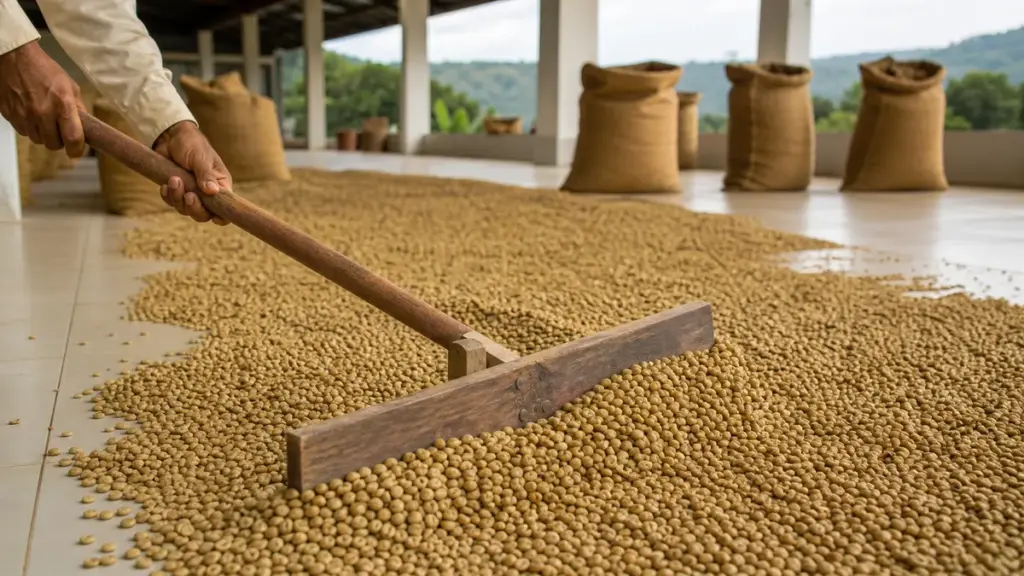
- Spread the beans in ventilated warehouses. Humid south-west monsoon air circulates around them.
- Rake and redistribute them. Repeated handling helps make exposure more even.
- Pack loosely and restack. Air can circulate around the sacks; monitoring and repacking help prevent mould.
- Finish and grade the coffee. The beans swell and become pale yellow or straw-coloured before final sorting and assessment.
The Coffee Board’s public specialty-coffee guidance gives June to September as the processing season and 12 to 16 weeks for completion. Aspinwall describes the same duration. An older Board manual gives 6 to 8 weeks, so this article follows the longer period in the Board’s public process description and the processor’s account, rather than treating duration as a fixed universal rule.
The crucial distinction is humid air under managed conditions, not beans deliberately left outside to be soaked by rain.
What changes in the cup?
Monsooning produces a distinctive aged character with reduced perceived acidity and a full, mellow body. Earthiness and a musty aromatic note can be part of the intended style, although those words should not excuse uncontrolled processing or mould.
The Coffee Board connects the style with changes that occurred during historic sea transport. Modern monsooning deliberately creates the desired character ashore.
Buying judgement: choose Monsooned Malabar if you want subdued brightness and substantial texture. Choose a washed Indian arabica first if you want to explore the origin without such a strong processing signature. Neither is a substitute for the other.
Arabica, robusta and the varieties behind them
Variety names describe planting material within a species or breeding programme. They are not interchangeable with processing names or export grades.
Kent
Kent, also written Kents, originated as an estate selection, not as a CCRI-bred cross. It became important for its early rust resistance and its role in later breeding.
World Coffee Research states that this resistance subsequently broke down. Calling Kent simply “rust-resistant” without that qualification gives an outdated impression.
S.795
S.795, listed by World Coffee Research as Selection 3, was developed by the Central Coffee Research Institute from S.288 and Kent. S.288 contributed ancestry from Coffea liberica.
It became widely cultivated in India. The Coffee Board describes relative rust tolerance, but that should not be read as permanent immunity. Its breeding history also shows why an arabica cultivar can contain ancestry introduced from another coffee species.
Selection 9
Selection 9 derives from Ethiopian arabica Tafarikela and the Timor Hybrid. The Coffee Board highlights its cup quality.
It is not safe to turn that pedigree into a blanket claim of current rust resistance. A published first-hand account of a visit to CCRI describes Selection 9 as susceptible to rust. That account is not a controlled resistance trial, but it reinforces the need to separate breeding ancestry from present field performance.
Chandragiri
CCRI released Chandragiri in 2007. It is a semi-dwarf arabica associated with a high proportion of large beans, and the Coffee Board reports good leaf-rust tolerance.
The practical lesson is not to memorise a list of “disease-proof” varieties. Ask what is planted, how it performs locally and what the harvested lot tastes like.
Reading Indian grades and cup descriptions
Indian trade terminology combines species, processing and physical preparation. These labels are useful, but they are not universal flavour scores.
| Label | What it tells you | What it does not establish |
|---|---|---|
| Plantation A | A grade of washed arabica | An estate name or guaranteed cup score |
| Arabica Cherry AB | A grade of unwashed, naturally processed arabica | That every coffee labelled “Cherry” is arabica |
| Robusta Kaapi Royale | A premium preparation of washed robusta with bold, carefully sorted beans | An arabica variety or roast level |
The full wording matters because Robusta Cherry AB also exists. “Cherry AB” without the species leaves out an essential part of the description.
Robusta Kaapi Royale is particularly worth understanding. The Coffee Board describes a full-bodied, soft, clean cup, challenging the assumption that all robusta must taste coarse.
Indian arabica is equally poorly served by a single national flavour stereotype. In a published blind assessment of coffees from the 2009 to 2010 harvest, Kenneth Davids found balanced sweetness and smooth texture in S.795 samples, while some Selection 9 coffees showed floral and fruit character. Those are documented examples, not promises for a present-day bag.
For a useful introduction, compare a named washed arabica, a clearly identified washed robusta and Monsooned Malabar. Ask the roaster for the estate or region, species, process and current tasting description. That comparison reveals more about Indian coffee than expecting every lot to taste earthy, spicy or low in acidity.
FAQ
Where is coffee grown in India?
Karnataka, Kerala and Tamil Nadu form the traditional heartland, with districts such as Chikkamagaluru, Kodagu (Coorg), Hassan, Wayanad and the Nilgiris. Coffee also grows in the Eastern Ghats and the North East.
What is Monsooned Malabar?
A post harvest preparation, not a variety. Naturally processed green beans are exposed to humid south west monsoon air in ventilated coastal warehouses, typically from June to September over 12 to 16 weeks. The result has subdued acidity and a full, mellow body. Both arabica and robusta can be monsooned.
What does Plantation A mean on Indian coffee?
Plantation A is a grade of washed arabica, and Arabica Cherry AB is a grade of naturally processed arabica. These grades describe species, processing and preparation, not a guaranteed cup score.
Did Baba Budan bring coffee to India?
The story says the holy man brought seven coffee seeds from Yemen and planted them in Karnataka’s hills. An Indian government account presents it as folklore, so it should not be used to date coffee’s arrival.
When is Indian coffee harvested?
Arabica is generally harvested from November to January and robusta from December to February, with local conditions affecting the timing.
Where to go next
Read South Asia to place Indian coffee within the wider region and choose your next origin to explore. Continue with Sri Lanka and Nepal for neighbouring coffee stories without treating them as extensions of India’s.
Sources
-
Coffee Board of India, Coffee Regions: India, undated. Regional names, varieties, growing conditions and specialty-coffee descriptions.
https://coffeeboard.gov.in/coffee-regions-india.html -
Coffee Board of India, Indian Coffee, undated. Traditional growing areas, species and harvest months.
https://coffeeboard.gov.in/IndexContent.html -
Tamil Nadu Agricultural University, Horticulture: Plantation Crops: Coffee, undated. Species, varieties and broad altitude guidance.
https://agritech.tnau.ac.in/horticulture/horti_plantation%20crops_coffee.html -
Coffee Board of India, India Coffee E-Magazine, volume 1, issue 1, October to December 2025. Regional context, mixed shade and intercropping.
https://coffeeboard.gov.in/Publications/OctDec2025/India_Coffee_E-Magazine%28Oct-Dec2025%29.pdf -
Press Information Bureau, Chandragiri: Moon Mountain of Brown Gold, 2013. Baba Budan folklore and Chandragiri’s release and characteristics.
https://www.pib.gov.in/newsite/erelcontent.aspx?relid=92354 -
World Coffee Research, Arabica Coffee Varieties: KP423, current online catalogue, undated. Kent’s selection history and loss of rust resistance.
https://varieties.worldcoffeeresearch.org/varieties/kp423 -
World Coffee Research, Arabica Coffee Varieties: S795, current online catalogue, undated. S.795’s pedigree, breeder and alternative designation.
https://varieties.worldcoffeeresearch.org/varieties/s795 -
Coffee Board of India, Research, undated. Chandragiri’s release and reported rust tolerance.
https://coffeeboard.gov.in/research.aspx -
Coffee Board of India, Specialty Coffees, undated. Monsooning method, season and duration.
https://coffeeboard.gov.in/Specialitycoffee.aspx -
Aspinwall Coffee, Monsooned Malabar Coffee, undated. Processor’s account of monsooning and its sensory results.
https://aspinwallcoffee.com/monsooned-malabar-coffee/ -
Coffee Board of India, Manual: Part IV, Marketing Department, undated. Older monsooning procedure and alternative duration.
https://coffeeboard.gov.in/CoffeeBoard/marketing-dept.pdf -
Coffee Board of India, Exporter: Major Types and Grades of Coffee, undated. Plantation, Cherry and Parchment terminology.
https://coffeeboard.gov.in/Exporter.aspx -
Coffee Board of India, Database on Indian Coffee Exporters, 2023. Robusta Kaapi Royale preparation and cup description.
https://coffeeboard.gov.in/Indian%20Coffee/Indian%20Coffee%20Exporters.pdf -
Kenneth Davids and Coffee Board of India, Best Indian Coffees from Flavour of India: The Fine Cup Award, assessment dated 2010. Blind sensory assessment of the 2009 to 2010 harvest.
https://coffeeboard.gov.in/Indian%20Coffee/fine%20cup%20award-Kenneth%20Davids.pdf -
Counter Culture Coffee, Katie Carguilo, India’s Arabica Coffee Varieties, undated, reporting a March 2024 visit. First-hand account of CCRI’s varieties and Selection 9’s rust susceptibility.
https://counterculturecoffee.com/blogs/counter-culture-coffee/india-s-arabica-coffee-varieties
This article was researched using retrieved Coffee Board publications, university guidance, World Coffee Research records, a processor’s technical description and clearly attributed sensory and field accounts; no first-hand testing was undertaken.
Last checked: November 2026