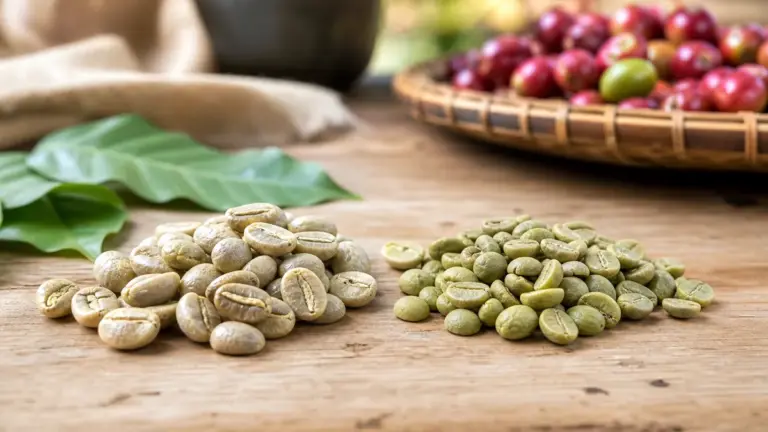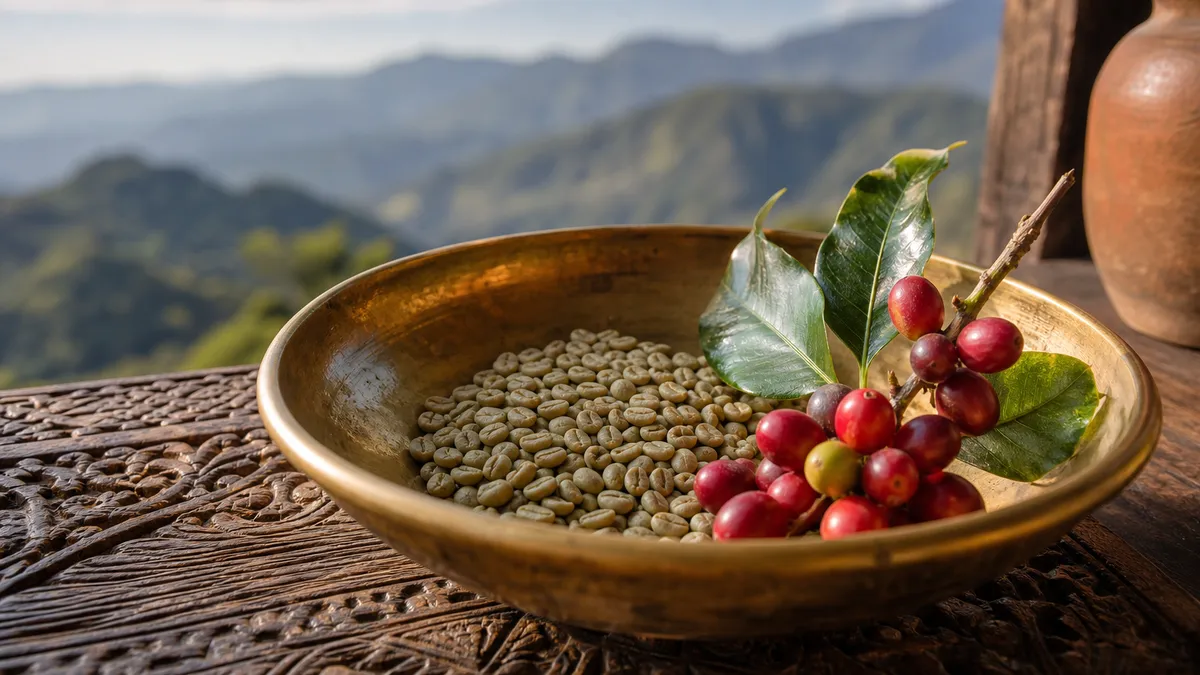
Coffee from Sri Lanka and Nepal can offer delicate floral aromas, citrus brightness and sweeter nut or cocoa notes, but neither country has a single dependable flavour profile. Sri Lanka is rebuilding an industry devastated by nineteenth-century coffee leaf rust, while Nepal is a small Himalayan foothill origin whose individual farms and processing methods deserve more attention than the mountain imagery on the bag.
In short
- Sri Lanka grows both arabica and robusta. Check the species rather than assuming every Ceylon coffee is arabica.
- Nepal’s national export strategy describes predominantly smallholder arabica production at 800 to 1,600 metres above sea level.
- Washed, natural and honey-processed coffees are available from these origins, so compare the processing method as well as the country.
- Ceylon’s rust disaster unfolded over years, not in a single failed harvest.
- Both origins have UK suppliers. A named producer, processing method and roast date are more useful buying clues than rarity alone.
Sri Lanka and Nepal coffee at a glance
This panel separates national agricultural guidance from examples of individual coffees. The altitude figures are not quality grades, and the tasting descriptions are reported characteristics rather than promises about every bag.
| Origin fact | Sri Lanka | Nepal |
|---|---|---|
| Growing altitude | Official guidance recommends arabica above 800 metres and robusta at lower elevations. MDF documents sample coffees from 1,250 to 2,000 metres, not a complete national range. | The national export strategy describes a main growing band of 800 to 1,600 metres. |
| Species and varieties | Arabica and robusta. Officially listed arabicas include Catimor, Lakparakum, Lak Saviru and Lak Komali. | Arabica. The export strategy lists Bourbon, Typica and Yellow Caturra among established varieties. |
| Processing | Washed and natural processing are documented; MDF also records honey-processed lots. | Washed processing is described in the export strategy. Producers also offer natural and honey processing. |
| Harvest months | A commercial regional guide gives November to February for Walapane. Treat this as indicative local information, not a verified national calendar. | November to March in the Nepal Horticulture Society account; the export strategy gives the narrower January to March window. |
| Reported cup characteristics | Individual documented lots include dates, fermented fruit, green apple and pomelo. UK offerings also include citrus-led and nutty profiles. | Individual offerings include jasmine, vanilla and cocoa; a Nepali producer describes washed coffees with citrus, caramel, floral and nut notes. |
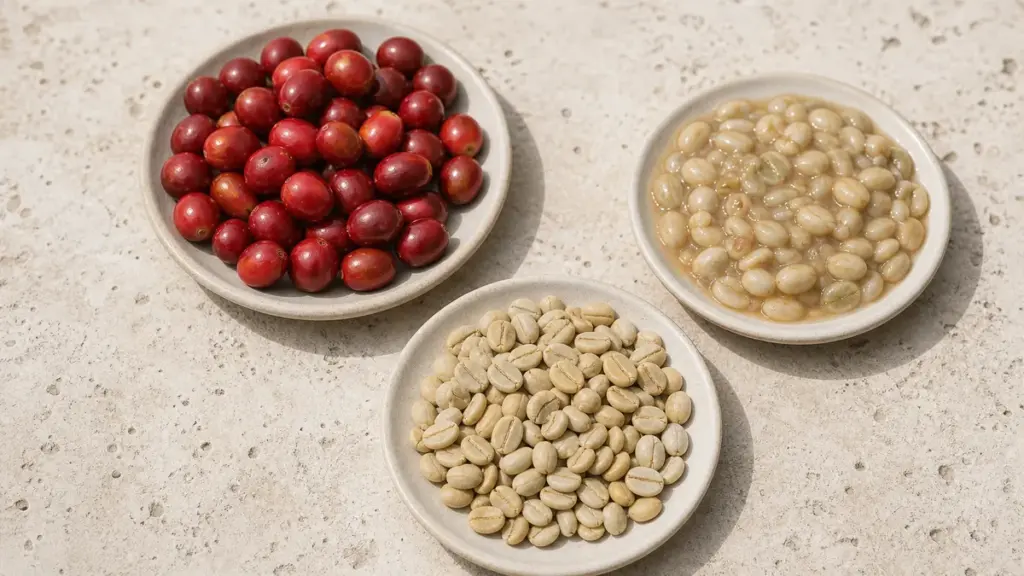
“Washed” means the fruit is removed before the coffee is dried, usually with fermentation and washing to remove the sticky layer around the seeds. Natural processing dries the whole cherry; honey processing removes the skin but leaves some of that sticky fruit layer during drying.
For the wider regional context, start with South Asian coffee. These origins should not simply be treated as smaller versions of Indian coffee.
Ceylon’s coffee industry and the leaf rust collapse
Before Ceylon became closely associated with tea, it was a major coffee-growing island. Its nineteenth-century plantation industry expanded across the hill country, but that concentration of coffee became vulnerable to a devastating leaf disease.
The central historical date is 1869. In a contemporary account published in Nature in 1879, botanist D. Morris reported that the disease had first been observed in May 1869 at Madulsima. He wrote that by 1873 all, or nearly all, of the island’s estates were affected.
Modern accounts sometimes mention earlier reports of symptoms. It is therefore more precise to identify 1869 as the year of the recognised epidemic and formal description of the fungus, rather than claim that nobody had previously seen diseased leaves.
What rust actually did
Coffee leaf rust is caused by the fungus Hemileia vastatrix. Infection can cause extensive leaf loss, followed by reduced yields and, in severe cases, dying branches.
The distinction matters: rust did not simply spoil a shipment of beans. It damaged the productive trees themselves, undermining successive crops and the plantation system built around them.
Tea progressively replaced coffee across much of the former coffee-growing area. Coffee cultivation continued, but on a much smaller scale. Calling Sri Lanka a “lost coffee island” captures the disappearance of its former international prominence, not the literal disappearance of every coffee tree.
A short timeline helps keep the sequence clear:
- 1869: the recognised Ceylon epidemic and description of Hemileia vastatrix.
- 1873: almost all estates affected, according to Morris’s contemporary account.
- 1970s: renewed government-supported coffee development, documented by MDF.
- 1980s and 1990s: further arabica introductions and planting initiatives.
Sri Lanka’s revival is about processing as well as planting
Sri Lanka’s recovery has involved government agricultural support, smallholders, processors and plantation businesses. MDF’s value-chain research describes successive planting initiatives and the development of locally named arabica selections.
The growing geography remains important. The Department of Export Agriculture identifies Nuwara Eliya, Kandy, Matale and Badulla among arabica-growing areas, while robusta is associated with lower elevations.
However, planting suitable trees is only part of the work. MDF’s research identified weaknesses in harvesting, separation of coffees and drying. Its subsequent programmes have supported better cherry purchasing and processing arrangements.
For the buyer, this makes traceability particularly useful. A clearly identified arabica lot, selectively harvested and carefully processed, tells you more than the word “Ceylon” alone. Ask whether a coffee comes from a particular estate, a group of smallholders or a broader collection area.
The revival should also leave room for different styles. MDF’s published cupping examples include honey, natural and washed coffees. There is no need to assume that one processing method is the only authentic expression of the island.
Nepal: coffee from the Himalayan foothills
Nepal’s coffee story is newer as a commercial export story, but it is not brand new. The Nepal Horticulture Society traces its introduction to 1938, when Hira Giri brought seeds from Burma, now Myanmar, and planted them in Gulmi.
For decades, coffee remained largely a curiosity crop before commercial development gathered momentum. The national export strategy describes production mainly by small farmers in the mid-hills, with Bourbon, Typica and Yellow Caturra among the varieties grown.
These are cultivated foothills, not coffee gardens beside permanent snow. Mountain branding can obscure that practical distinction. One UK-listed Nepal coffee, sold under the Mount Everest Estate name, is described by its supplier as coming from Nuwakot at 900 metres.
Why “high altitude” needs context
Altitude is useful information, but not a universal quality score. World Coffee Research explains that a variety’s suitable altitude depends partly on latitude: coffee farther from the equator can find suitable conditions at lower elevations than coffee nearer it.
That makes direct comparisons between Nepal and tropical origins misleading when they rely only on metres above sea level. Ask about the actual farm, variety and processing rather than choosing whichever bag carries the largest altitude figure.
Nepal also has processing diversity. MountBrew, a producer and roaster working with Nepali farms, reports natural, honey and fully washed coffees. Its existence is a useful corrective to the idea that all Nepali coffee follows one standard recipe.
What do the coffees taste like?
The most useful answer is look for a lot-specific description, then treat it as a tasting guide rather than a guarantee.
For Sri Lanka, MDF’s published examples show considerable variation. A natural coffee from Bandarawela was described with green apple and pomelo notes, while Kothmale examples included dates and fermented fruit. Those are sample results, not permanent regional signatures.
UK supplier Badda Bean provides another practical comparison. Its Sri Lankan offerings distinguish a citrus-led coffee from a wet-processed coffee described with biscuit and almond notes. These are the supplier’s descriptions, not results of independent testing for this article.
For Nepal, Sea Island Coffee describes its washed Caturra offering with jasmine, vanilla and cocoa, alongside mild acidity and an almost tea-like character. MountBrew describes washed coffees using citrus, caramel, floral and nut notes, while also producing other processing styles.
“Tea-like” usually helps communicate a delicate impression; it does not mean the coffee contains tea. Likewise, jasmine or cocoa tasting notes describe perceived aromas and flavours, not added ingredients.
My buying preference would be to start with a clearly documented washed lot from either country. The reason is comparison, not superiority: it gives you a defined processing style to return to before exploring naturals or honey lots.
Finding and choosing Sri Lankan and Nepali coffee in the UK
Both origins have identifiable UK supply routes. Badda Bean describes importing Sri Lankan green coffee for roasting in the UK, while Sea Island Coffee lists a Nepali washed coffee dispatched from its UK roastery.
These examples establish availability, not a recommendation based on comparative testing. Check the current product details and dispatch arrangements before ordering.
Use this checklist:
- Confirm where it was grown. “Sri Lankan brand” or “Nepali coffee company” is not, by itself, a farm origin.
- Ask for the species and variety. This is particularly useful for Sri Lanka, where both arabica and robusta are commercially grown.
- Identify the processing method. Washed, honey and natural coffees are different buying propositions.
- Look for a producer or collection area. A cooperative or smallholder group can be meaningful traceability; a single estate is not the only valid model.
- Separate harvest information from roasting information. Ask when the cherries were picked and when the coffee was roasted.
- Buy for the described cup. Choose floral delicacy, citrus brightness or nutty sweetness because you want that style, not simply because the origin is uncommon.
For Sri Lanka and Nepal coffee, the strongest buying story is the one that connects the country name to a particular, explainable lot.
FAQ
Is Ceylon coffee a separate variety?
No, Ceylon coffee is an origin description associated with Sri Lanka, not a botanical variety. The country commercially grows both arabica and robusta, with different varieties or selections within those species. A useful product description should therefore go beyond “Ceylon” and identify the coffee’s species, growing area and processing method.
Is every Nepali coffee organic?
Do not assume organic certification from the country name alone. Nepal’s export strategy discusses organic production practices, but a broad description of farming does not establish the certification status of every retail lot. If certification matters to you, ask the seller for the certification applying to that specific product.
Does Nepal’s altitude protect its coffee from leaf rust?
No, altitude is not a guarantee of immunity. World Coffee Research describes Caturra, a variety found in Nepali offerings, as highly susceptible to coffee leaf rust. It also warns that disease resistance can change as pathogens evolve. Variety, local conditions and crop management matter alongside elevation.
Where to go next
Read South Asia to place Sri Lanka and Nepal within the wider regional coffee picture. Continue with India for the neighbouring origin’s distinct growing traditions, processing styles and buying considerations.
Sources
-
D. Morris, Nature, “Coffee-Leaf Disease of Ceylon and Southern India”, 1879. Contemporary account of the epidemic and its spread.
https://www.nature.com/articles/020557a0 -
Hawai‘i Department of Agriculture and University of Hawai‘i Cooperative Extension, “Coffee Leaf Rust”, New Pest Advisory 20-03, revised January 2021. Disease mechanism and historical context.
https://dab.hawaii.gov/pi/files/2021/01/NPA-20-03-Coffee-leaf-rust1-21.pdf -
Market Development Facility, “Arabica Coffee Value Chain Analysis”, October 2020. Sri Lankan revival, varieties, harvesting and processing.
https://marketdevelopmentfacility.org/wp-content/uploads/MDF-Sri-Lanka-Coffee-Report.pdf -
Sri Lanka Department of Export Agriculture, “Coffee”, undated. Official crop guidance, growing areas, species and varieties.
https://deasrilanka.com/crop/coffee/ -
Market Development Facility, “A Guide to the Specialty Coffee Industry: Sri Lanka’s Coffee Renaissance”, 2023. Processing examples and cupping-note annex.
https://marketdevelopmentfacility.org/wp-content/uploads/2023/05/A-Guide-to-Sri-Lankan-Coffee-Industry.pdf -
Government of Nepal and International Trade Centre, “Nepal National Sector Export Strategy: Coffee 2017 to 2021”, 2017. Growing altitude, varieties, smallholder production and processing.
https://tepc.gov.np/tepc_pub/NepalNationalExportStrategyCoffee.pdf -
Nepal Horticulture Society, Ram Bahadur KC, Bhola Kumar Shrestha and Sanjay Dhimal, “Coffee as a Niche Crop for Mid-Hills of Nepal”, in Six Decades of Horticulture Development in Nepal, 2016. Introduction history and harvest season.
https://www.horticulturenepal.org/uploads/main_attachment/1630665868_Horticultural%20In%20last%20six%20decades-192-215.pdf -
World Coffee Research, “Caturra”, online Varieties Catalog, undated. Latitude-sensitive altitude guidance and rust susceptibility.
https://varieties.worldcoffeeresearch.org/varieties/caturra -
Lakpura, “Walapane Coffee”, undated. Commercial regional account, used only for explicitly qualified local harvest information.
https://www.lakpura.com/pages/walapane-coffee -
MountBrew Coffee Nepal, “Roasting”, undated. Producer-reported processing methods and sensory descriptions.
https://mountbrewcoffee.com/roasting/ -
Sea Island Coffee, “Nepal, Mount Everest Coffee Beans”, undated. Supplier-reported lot details, tasting notes and UK dispatch.
https://seaislandcoffee.com/products/nepal -
Badda Bean Coffee Co., “Our Coffee”, undated. Supplier-reported Sri Lankan coffee descriptions and UK roasting arrangements.
https://www.baddabeancoffee.co.uk/our-coffee/
Research combined contemporary historical evidence, official agricultural guidance, sector studies and clearly attributed producer or supplier descriptions; no first-hand tasting or testing was undertaken.
Last checked: November 2026