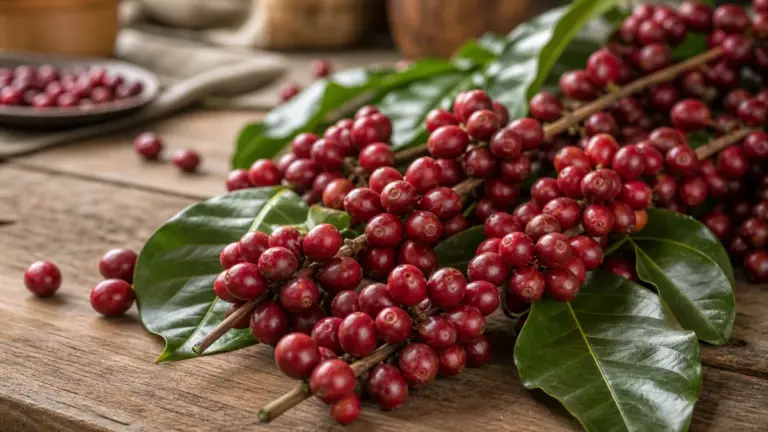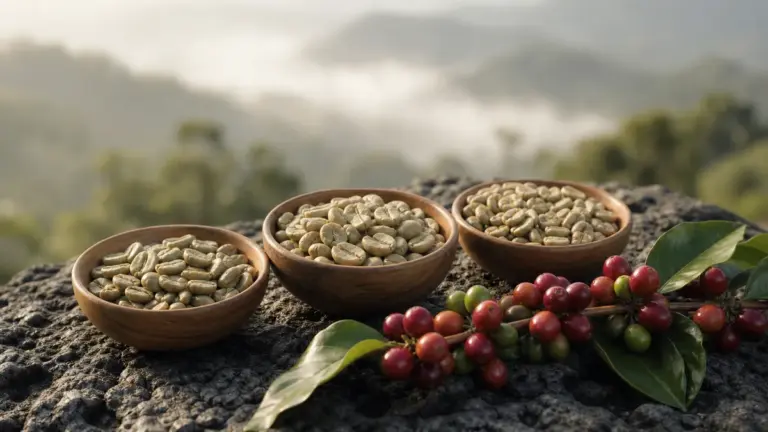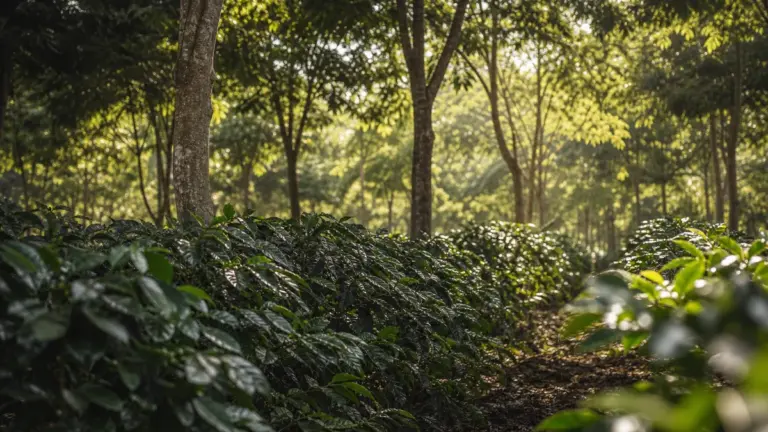
Honduran coffee often combines chocolate sweetness with citrus or fruit notes, while selected lots can be distinctly floral and peach-like. Honduras is Central America’s largest coffee producer, but its national output spans everyday commercial arabica and carefully separated speciality coffees, so the farm, variety and processing method tell you more than the country name alone.
In short
- Most farms occupy mountainous terrain, broadly 900 to 1,800 metres above sea level, rather than one uniform growing environment.
- The six recognised coffee regions are Copán, Opalaca, Montecillos, Comayagua, Agalta and El Paraíso.
- Washed processing is the main approach, but Honduran producers also make honey and natural coffees.
- Parainema is an important Honduran-developed arabica variety, not a region or processing method.
- When choosing beans, prioritise a named producer or producer group, clear processing information and tasting notes that match your preferences.
What does Honduran coffee taste like?
Chocolate, sweetness and citrus are useful starting points, not a complete national flavour description. Research using Honduran coffee samples has also identified fruity, honey-like, peach and floral characteristics, illustrating why two bags from Honduras can taste noticeably different.
For a first purchase, our suggestion is a washed coffee whose roaster describes chocolate sweetness and balanced citrus. This gives you a straightforward starting point before exploring more distinctive varieties or processing styles.
In tasting language, acidity means the bright, refreshing impression associated with fruit, rather than simply an unpleasant sour taste. Read a description such as “citrus acidity” alongside the stated sweetness and texture: the combination matters more than the presence of a single flavour word.
Honduras belongs within the wider mountain-growing traditions of Central American coffee, but treating the region as one flavour category misses much of its interest. Country guides are most useful for narrowing your search; the individual coffee should make the final case.
Honduras coffee fact panel
| Feature | Practical reference |
|---|---|
| Species | Arabica, Coffea arabica, is the basis of the country’s established coffee production. |
| Growing altitude | Most farms are broadly between 900 and 1,800 metres above sea level, according to the International Labour Organization’s sector mapping. This is a typical range, not a national minimum and maximum. |
| Main varieties | Lempira, Parainema, IHCAFE 90, Caturra, Pacas, Bourbon and Typica; Catuaí is also grown. |
| Main processing | Washed; honey and natural methods also appear among traceable speciality lots. |
| Harvest months | Broadly October to March, with variation between locations and seasons. Some picking continues beyond this general window. |
| Typical cup profile | Chocolate and sweetness, often with citrus; selected coffees show floral, honey-like, peach or other fruit characteristics. |
The altitude range comes from the ILO; varieties from IHCAFE and USDA; processing from producer-country information and competition records; harvest timing from FEWS NET and USDA; and flavour characteristics from published Honduran sensory research. Full references appear below.
How Honduras became a major producer
Honduras’s prominence is the result of sustained expansion and organised support, rather than a sudden discovery of suitable mountains. World Coffee Research describes its rise over roughly two decades to become Central America’s dominant coffee exporter, alongside a shift from a predominantly commercial-grade reputation towards a wider range of qualities.
That expansion has included increased planted area, improved varieties and the replacement of ageing or diseased trees. World Coffee Research identifies IHCAFE, the Honduran Coffee Institute, as central to support for inputs and renovation, including an organised renewal programme following the 2012 coffee leaf rust epidemic.
Growth is not uninterrupted. Weather, disease, labour availability and the productive cycle of coffee trees all affect individual harvests. USDA’s April 2026 assessment attributed its forecast recovery partly to better nutrition, pruning, additional productive area and the maturation of newer plantings.
Production and exports also need separating. Production measures the coffee grown; exports measure shipments leaving the country, which need not occur in the same reporting period. Avoid comparing a production total from one source with an export total from another as though they describe the same thing.
The main Honduran coffee regions
IHCAFE recognises six coffee regions. They are a useful geographical framework, but retail labels may instead name a department, municipality, mountain or farm.
Copán and Opalaca
Copán sits in western Honduras. Use the regional name as a starting point, then look for the municipality and producer to establish a more precise origin.
Opalaca belongs to the western mountain-growing areas. Published Honduran research associates Opalaca and Montecillos with higher-altitude production within its sample, but that does not make every Opalaca coffee equivalent in flavour or quality.
Montecillos and Comayagua
Montecillos is another important mountain-growing region. Its name is useful when exploring higher-grown Honduran coffees, provided the seller also identifies the actual lot and its growing conditions.
Comayagua is a separate recognised coffee region. Because Comayagua is also an administrative department name, ask what a listing means when it gives only that word: a regional description and a precise farm location are not interchangeable.
Agalta and El Paraíso
Agalta covers an eastern part of the country’s coffee-growing geography. It broadens the Honduran picture beyond the western areas that often attract speciality attention.
El Paraíso is another recognised eastern coffee region. It also appears in competition records, including washed Parainema lots, showing why buyers should not restrict their search to a single celebrated area.
Santa Bárbara is a further name worth recognising on bags. It is not an additional member of IHCAFE’s six-region list, but it appears prominently as an origin in Cup of Excellence results.
For neighbouring origins, use the separate guides to Guatemala’s coffee and Nicaragua’s coffee, rather than assuming that nearby farms across national borders produce interchangeable cups.
Varieties: traditional arabicas and Honduran selections
Honduran growers cultivate both established arabica varieties and varieties selected for productive performance and disease management. IHCAFE lists Lempira, Parainema, IHCAFE 90, Caturra, Pacas, Villa Sarchi, Bourbon and Typica among those grown in the country.
The distinction matters because a variety is a type of coffee plant, not a flavour guarantee. Its performance depends on its growing environment and the care given to the crop and harvested fruit.
Parainema is particularly useful to understand. IHCAFE developed it through selection from T5296 and released it in 2004. World Coffee Research places it in the Sarchimor group and describes resistance to coffee leaf rust and some nematodes, microscopic animals that can damage roots.
Disease resistance is not permanent immunity. World Coffee Research explicitly warns that Lempira and IHCAFE 90 have been confirmed susceptible to coffee leaf rust in Honduras. Older descriptions that simply call these varieties “rust-resistant” therefore need qualification.
Nor should breeding for resilience be treated as proof of an uninteresting cup. In the 2026 Honduras Cup of Excellence results, the washed Parainema lot Don Miguel received 89.04 points. That demonstrates the potential of that particular lot, not the likely score of every Parainema harvest.
Processing and the importance of drying
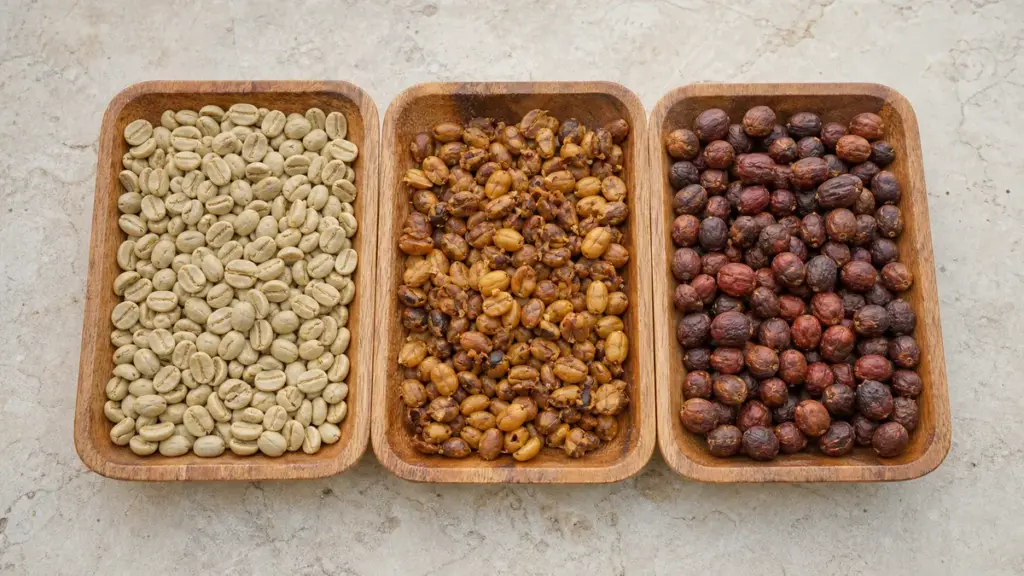
Washed coffee is the main Honduran processing tradition. The fruit’s skin and pulp are removed, followed by removal of the sticky mucilage surrounding the seed, before the coffee is dried in its parchment layer.
Other methods offer different ways of handling the fruit:
- Honey processing: the coffee is pulped, then dried with some or all of its mucilage retained.
- Natural processing: the coffee dries inside the whole cherry.
These terms describe processing, not an automatic quality ranking. Honduran competition records include washed, honey and natural coffees, so none should be dismissed merely because another method is more familiar.
The practical challenge is preserving quality throughout drying and storage. Honduras’s rainy conditions can make drying difficult, and research on its coffee sector has described deterioration associated with inadequately dried parchment moving through transport and trade.
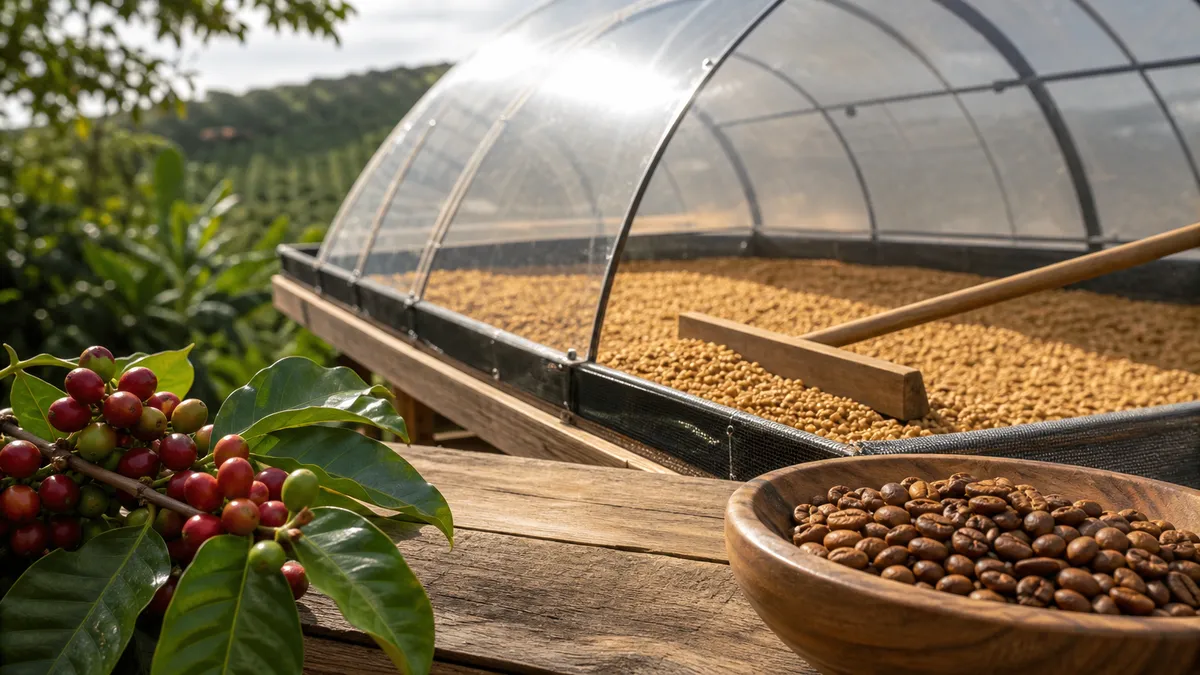
IHCAFE lists solar-dryer support among its producer programmes. The useful question for a buyer is not simply whether coffee was “sun-dried”, but whether the producer could manage drying consistently and protect the lot afterwards.
Readers interested in another country’s approach to processing can continue with Costa Rican coffee, without assuming that a shared process name means identical farm practice.
Quality improvements: what has actually changed?
Honduras’s stronger speciality reputation rests on several developments working together: agronomic support, plant renewal, quality assessment, producer training and the identification of individual coffees rather than an undifferentiated national supply.
IHCAFE’s infrastructure includes research and training centres, a quality laboratory and training for coffee tasters. These provide routes for assessing coffee and improving production, although their existence does not mean every farm has the same access or outcomes.
Competition results provide another form of evidence. They show that particular producers can deliver distinctive, highly assessed lots across different varieties and processing methods. They do not establish an average quality level for the entire country.
Challenges remain. The ILO’s sector mapping describes small-producer constraints involving technical capacity, space and resources, including dependence on intermediaries for later processing. The accurate picture is therefore improvement with uneven access, not a completed national transformation.
Does higher altitude mean better coffee?
Altitude is useful information, but it should not become a buying shortcut. A published observational analysis of Honduran samples found associations between altitude and sensory characteristics, including more citrus, floral and fruity fragrances in its higher-altitude category.
That is an association, not a controlled demonstration that elevation alone caused those flavours. Variety, rainfall, location and processing also varied.
Our buying advice is to use altitude as supporting context. A named, well-described lot with flavours you enjoy is a stronger proposition than an anonymous coffee promoted solely through a high elevation.
Choosing Honduran coffee in the UK
Start with the drink you want, then inspect the coffee’s details. Our suggested checklist is:
- Identify the producer. Prefer a named farm, producer group or clearly described cooperative lot.
- Check the process. “Honduras” alone does not tell you whether the coffee is washed, honey or natural.
- Read the flavour description. Choose chocolate-led notes for one direction, or floral and fruit-led notes for another.
- Ask about the harvest. Do not confuse harvest timing with the date the beans were roasted.
- Treat awards precisely. Check whether recognition belongs to the actual lot, a previous harvest or another coffee from the same producer.
For an instructive comparison, choose two Honduran coffees with similar roasting intentions but different varieties or processes. Keep your preparation consistent and note which differences you actually enjoy.
The best reason to explore Honduras is its breadth. Let the national origin introduce the coffee, then let the producer’s work and the individual lot tell the rest of the story.
FAQ
Is Honduran coffee always washed?
No, although washed processing is the main tradition. Honduran producers also make honey and natural coffees, both represented in Cup of Excellence records. Check the individual bag rather than inferring the method from the country. A process name describes how the harvested fruit was handled, not whether you will necessarily prefer the resulting drink.
Is Honduran coffee suitable for someone who dislikes fruity coffee?
It can be, but choose by the individual description rather than nationality. Our suggestion is to ask a roaster for a chocolate-led Honduran coffee without prominent floral or fruit notes. Honduras also produces distinctly citrus-led and fruity lots, so buying any bag carrying the country name would be an unreliable way to avoid those characteristics.
Does a competition-winning farm guarantee a winning coffee?
No, recognition applies to the assessed lot and harvest, not automatically to every coffee bearing the farm’s name. Competition records distinguish coffees by producer, variety, process and result. Those details make an award useful evidence, but they should support your choice rather than replace information about the particular beans being offered.
Where to go next
Read Central America for the regional framework, then Guatemala to explore a neighbouring origin through its own growing areas. Costa Rica provides another route into processing choices, while Panama is the next read for a contrasting national origin.
Sources
- S1. Starbucks Coffee Academy: Honduras, undated country reference sheet, hosted by Arizona State University. Used for producer status, regional geography, primary processing and drying challenges.
- S2. International Labour Organization: Mapping the coffee value chain in Honduras, 2024. Used for typical farm altitude, small-producer structure and processing constraints.
https://www.ilo.org/sites/default/files/2024-07/Honduras_Coffee_Value_Chain_Mapping.pdf - S3. IHCAFE: Regiones cafetaleras and Preguntas Frecuentes, undated live pages. Used for regional framework, varieties, technical support and solar-dryer programmes.
https://ihcafe.hn/regiones-cafetaleras/
https://ihcafe.hn/preguntas-frecuentes/ - S4. World Coffee Research: Honduras, undated live country profile. Used for production-sector development and renovation.
https://worldcoffeeresearch.org/countries/honduras - S5. USDA Foreign Agricultural Service: Coffee Annual: Honduras, report HO2026-0002, 29 April 2026. Used for production drivers, varieties, institutional infrastructure and seasonal context.
https://apps.fas.usda.gov/newgainapi/api/Report/DownloadReportByFileName?fileName=Coffee+Annual_Tegucigalpa_Honduras_HO2026-0002.pdf - S6. FEWS NET: Seasonal food production and rural employment contribute to improved food security, December 2025 update. Used for the broad harvest window.
https://fews.net/latin-america-and-caribbean/honduras/key-message-update/december-2025 - S7. Peligros-Espada, Sevilla-Palma and Uña-Juarez: Importance of Crop Altitude Range for Coffee Production: Findings from Honduras, Journal of Agricultural Science and Technology B, volume 8, 2018. Observational sensory analysis used for cup characteristics, altitude associations and historical drying problems.
https://pdfs.semanticscholar.org/32e9/5e447cde2bae3c6e42bdb417a37565e3c60f.pdf - S8. World Coffee Research: Arabica Varieties Catalog, live entries for Parainema, Lempira and IHCAFE 90, undated. Used for breeding history and disease-response qualifications.
https://varieties.worldcoffeeresearch.org/varieties/parainema
https://varieties.worldcoffeeresearch.org/varieties/lempira
https://varieties.worldcoffeeresearch.org/varieties/ihcafe-90 - S9. TechnoServe: Wet Mill Processing Guide, available in its March 2022 publication directory. Used for processing definitions and parchment terminology, not for Honduran prevalence.
https://www.technoserve.org/wp-content/uploads/2022/03/TechnoServe-Wet-Mill-Processing-Guide.pdf - S10. Alliance for Coffee Excellence: Honduras 2025 and Honduras 2026, competition results. Used for documented processes, origins and the individual Parainema result.
https://allianceforcoffeeexcellence.org/honduras-2025/
https://allianceforcoffeeexcellence.org/honduras-2026/
Research combined Honduran institutional information, authoritative sector reports, variety records, published sensory research and competition results; the buying suggestions are editorial guidance, not first-hand testing.
Last checked: November 2026