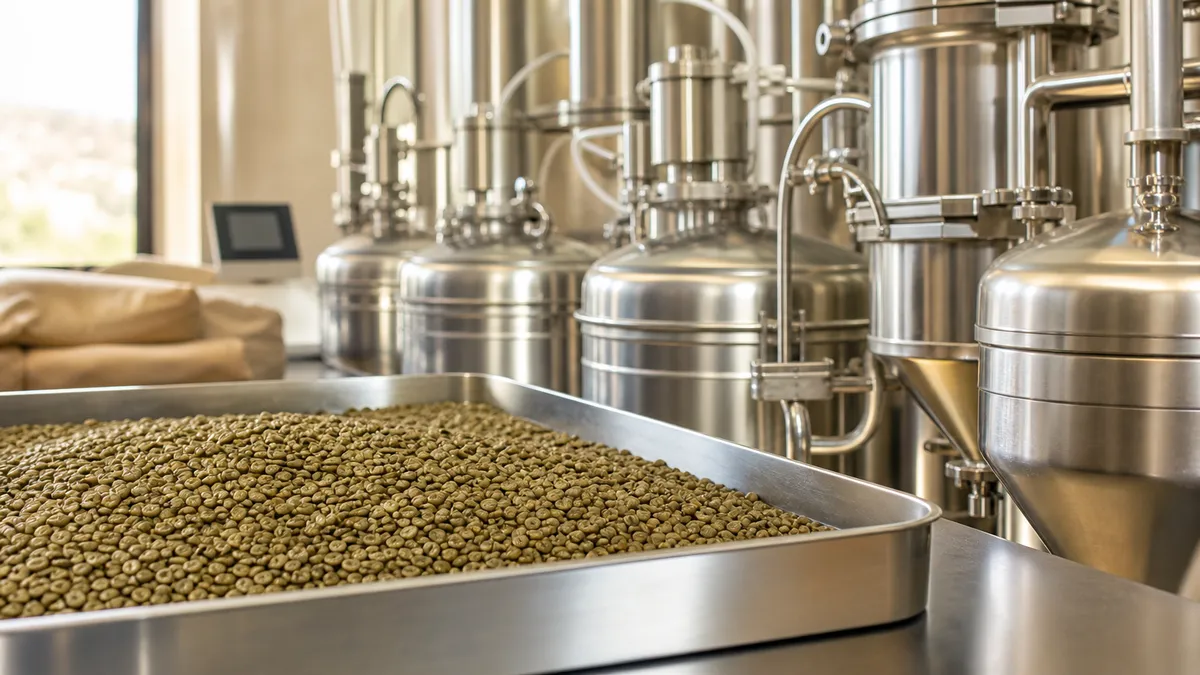
Swiss Water and Mountain Water Process remove caffeine from unroasted coffee using water containing dissolved coffee compounds, followed by carbon filtration. Swiss Water operates in Delta, British Columbia, Canada, while Mountain Water is carried out by Descamex in Córdoba, Veracruz, Mexico. Both are water-based alternatives to methods using added organic decaffeination solvents, but their names do not guarantee identical flavour or caffeine levels.
In short
- Green Coffee Extract, or GCE, contains dissolved compounds from unroasted coffee, with caffeine removed before it circulates around another batch.
- The caffeine concentration difference drives caffeine out of the beans. Diffusion, rather than osmosis, is the precise term for this movement.
- Carbon filtration removes caffeine from the circulating extract so that extraction can continue.
- Swiss Water’s former Burnaby location is outdated information. Production was consolidated in Delta in 2023.
- “Chemical-free” is marketing shorthand, not literal chemistry. Neither process name automatically makes the finished coffee organic or completely caffeine-free.
What the two process names mean
Swiss Water and Mountain Water are distinct commercial decaffeination processes, not interchangeable names for any coffee treated with water. Both work on green coffee, meaning the unroasted seed, before the coffee reaches the roaster.
Swiss Water is operated by Swiss Water Decaffeinated Coffee Inc. Its production facility is in Delta, British Columbia. Older descriptions often name Burnaby, but the company completed its consolidation of production in Delta during the third quarter of 2023.
Mountain Water is Descamex’s water-based process in Córdoba, in the Mexican state of Veracruz. Descamex also offers a separate methylene chloride process, so the company’s name alone does not identify which method a particular coffee underwent.
Neither processing location should be mistaken for the coffee’s growing origin. A bag should distinguish where its beans were grown from where they were decaffeinated.
For the wider subject, start with the caffeine and decaf guide. The important distinction here is how these two water-based systems separate caffeine from the other substances in coffee.
How Green Coffee Extract protects coffee compounds
Plain water is not selective enough to remove caffeine alone. When green coffee is soaked, caffeine and other water-soluble compounds enter the water.
The solution is to prepare water that already contains dissolved green-coffee compounds, then remove its caffeine. Swiss Water calls this Green Coffee Extract, usually shortened to GCE. Descamex describes a water-based solution saturated with soluble solids obtained from coffee beans.
“Saturated” in these process descriptions means that the liquid is already loaded with non-caffeine coffee solubles. It should not be read as proof that every individual compound is at its exact chemical solubility limit.
When prepared beans meet this extract, the surrounding liquid contains very little caffeine but substantial amounts of other coffee compounds. That creates a strong outward concentration difference for caffeine while reducing the tendency for other soluble substances to leave the beans.
An analogy is washing something in a liquid that already contains much of what you want to keep. It is not a perfect molecular lock, but it makes the extraction more selective than soaking coffee in fresh water alone.
Diffusion, not caffeine “osmosis”
Caffeine moves from the higher-concentration environment inside the hydrated beans towards the lower-concentration extract. This is diffusion.
Some trade explanations call this osmosis. Strictly, osmosis describes solvent movement, such as water moving across a selectively permeable membrane. Because the movement being explained here is caffeine leaving the beans, diffusion is the clearer term.
The aim is selective caffeine removal with limited disturbance to the remaining coffee chemistry. “Only caffeine moves” is a simplified process explanation, not evidence that every other constituent remains completely unchanged.
What the carbon filters do
The extract would become progressively richer in caffeine if it simply circulated around the beans. Removing caffeine from that liquid maintains the concentration difference that allows more caffeine to leave the coffee.
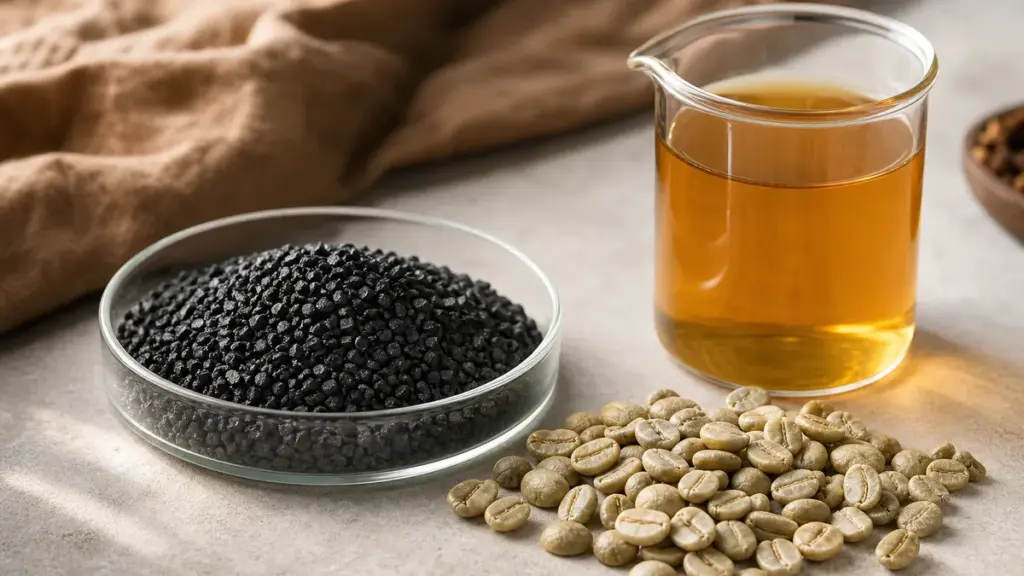
Swiss Water uses specially formulated activated carbon, a porous material that captures caffeine by adsorption. Adsorption means molecules attach to a surface, including surfaces inside the carbon’s pores. It is different from absorption into the bulk of a material.
The beans themselves do not pass through the carbon filter. The circulating liquid does.
Swiss Water describes regenerating and reusing its carbon. For Mountain Water, importer Belco’s first-hand account of a Descamex visit describes a carbon-cellulose filter collecting caffeine from the extract. These descriptions support the shared carbon-filtration principle, but not an assumption that the companies use identical filter materials, equipment or operating settings.
Carbon is therefore a working part of the separation system, not an ingredient added to the finished drink.
Swiss Water and Mountain Water Process compared
The useful comparison is process identity, documented mechanics and the information available about the finished coffee. These are more dependable criteria than a general promise of “purity”.
| Criterion | Swiss Water | Mountain Water |
|---|---|---|
| Operator and location | Swiss Water Decaffeinated Coffee Inc., Delta, British Columbia, Canada | Descamex, Córdoba, Veracruz, Mexico |
| Extraction liquid | Green Coffee Extract with caffeine removed | Water-based solution containing soluble green-coffee solids |
| Preparation and finishing | Cleaning, hydration and controlled drying | Analysis, steaming, controlled extraction, triple drying and polishing |
| Extract filtration | Proprietary activated-carbon system | Carbon-cellulose filtration described in Belco’s plant-visit account |
| Organic position | Operator reports organic certification for its process and plant | Operator reports organic certification for its water process |
Process descriptions and operator statements checked in November 2026. Certification claims do not mean that every coffee processed is sold as certified organic.
The process in five steps
This is a simplified shared sequence, not an operating specification for either factory:
- Prepare the green coffee. Hydration or steam treatment prepares the beans for extraction.
- Introduce the coffee-rich liquid. The beans contact an extract containing non-caffeine soluble coffee compounds.
- Allow caffeine to diffuse out. Controlled processing conditions support caffeine transfer into the surrounding liquid.
- Filter the extract. Carbon filtration removes caffeine, allowing the liquid to continue extracting it.
- Dry the beans. The decaffeinated green coffee is prepared for onward roasting.
The similarities explain why the methods are often discussed together. Their proprietary controls explain why they should not be described as one process under two labels. Our decaffeination methods overview places them alongside the other main approaches.
Are they really chemical-free?
Neither process is literally chemical-free. Water is a chemical substance, caffeine is a chemical compound, and coffee contains many more.
The scientifically useful description is water-based decaffeination without added organic decaffeination solvents, such as methylene chloride or ethyl acetate. Water itself acts as a solvent because substances dissolve in it. Calling a water-based method simply “solvent-free” therefore needs the same qualification.
This distinction describes the processing approach. It does not, by itself, establish that one finished coffee is healthier, tastier or environmentally preferable to another.
Likewise, organic-compatible processing is not the same as an organic finished product. Both operators report organic certification for their water processes, but buyers seeking organic coffee should check the certification attached to the actual product. A processing method does not turn conventionally grown beans into organic beans.
For a comparison with different extraction systems, see carbon dioxide and sugarcane decaf. “Water-based” is useful information, but it is not a complete quality assessment.
How much caffeine remains?
Decaffeinated does not necessarily mean completely caffeine-free. The process name alone is not a measurement of caffeine in your mug.
Swiss Water markets its coffee as 99.9% caffeine-free. Its annual information form published in March 2026 describes processing until no more than 0.1% caffeine remains in the beans. Those are manufacturer statements, not a universal independent certification shared by both methods.
Descamex’s public wording is less consistent. Its Spanish homepage states extraction exceeding 97%, while its English homepage states exceeding 98%. Neither statement should automatically be rewritten as “99.9% of the original caffeine removed”.
There is also a basic measurement distinction:
- Percentage removed compares caffeine before and after processing.
- Residual caffeine percentage describes how much caffeine remains relative to the coffee’s mass.
- Milligrams per serving describes caffeine in a particular prepared drink.
These are not interchangeable. A percentage describing beans cannot establish a serving’s caffeine content without further information about the coffee and preparation.
For procurement, ask for a residual-caffeine specification or laboratory result, including its units and whether it refers to green beans, roasted coffee or a prepared drink. The wider explanation belongs in decaf fundamentals.
What difference do the processes make to flavour?
Both systems aim to retain the starting coffee’s character while removing caffeine. That aim is credible as a process objective, but “preserves flavour” should not be interpreted as “makes no chemical or sensory change”.
Green coffee contains compounds that contribute to flavour development during roasting. Protecting those compounds matters, even though the green extract itself is not a finished coffee drink.
Research presented by the ZHAW Coffee Excellence Center at World of Coffee in June 2025 examined three paired coffees before and after Swiss Water decaffeination. Its stated scope included green-bean composition, roasting, espresso extraction and the final coffee. This was a paired-sample research project, not a published head-to-head ranking of Swiss Water against Mountain Water.
Consequently, it cannot justify declaring one of these two processes universally better tasting. Nor should operator descriptions of flavour retention be treated as independent comparative tasting results.
For choosing coffee, use the method as one selection criterion, then judge the particular product. Ask about growing origin, roast style, intended brewing method and tasting notes. There is no reason to expect every coffee sharing a decaffeination process to taste alike.
A practical comparison is to taste candidates without seeing their process names. Keep preparation consistent, then record sweetness, acidity, bitterness, body and aftertaste. Choose the coffee whose cup you prefer rather than assigning a flavour score to the processing label.
For an office, request samples of the actual products under consideration. Swiss Water and Mountain Water Process explain an important part of how those coffees were made, but the finished drink remains the decision that matters.
FAQ
Can I decaffeinate coffee this way at home?
No, soaking coffee at home does not reproduce either commercial process. Their selectivity depends on prepared coffee extract, controlled extraction and a filtration loop that continually removes caffeine from the liquid. A domestic soak provides no dependable measure of caffeine removal and should not be treated as a way to make verified decaf.
Is water-process decaf the same as washed coffee?
No, these labels describe different processing stages. In this article, water-process decaffeination means removing caffeine from green coffee before roasting. A washed coffee is not automatically decaffeinated. When buying, look for an explicit decaf description and the named decaffeination method rather than assuming that any reference to water means caffeine has been removed.
Can a supplier tell me how much caffeine is in each drink?
A supplier may have a tested serving figure, but a bean specification alone cannot establish it. Ask whether the result applies to the actual coffee, dose, drink size and brewing method you intend to use. If the supplier only provides a process percentage, do not present that as a measured milligram figure per drink.
Where to go next
Read Decaffeinated Coffee Explained for the wider meaning of decaf, then How Coffee Is Decaffeinated to compare the main extraction systems. CO2 and Sugarcane Decaf explains two alternatives, while Half-Caf and Low-Caffeine Varieties covers other approaches to reducing caffeine.
Sources
-
Swiss Water Decaffeinated Coffee Inc., The Swiss Water Process, undated, retrieved November 2026.
https://www.swisswater.com/pages/coffee-decaffeination-process -
Swiss Water Decaffeinated Coffee Inc., 2025 Annual Information Form, published 12 March 2026, especially “The Swiss Water Process”.
https://investor.swisswater.com/wp-content/uploads/2026/03/SWP-Q4-2025-AIF-FINAL-for-SEDAR-March-12-2026-1.pdf -
Swiss Water Decaffeinated Coffee Inc., Swiss Water Reports 2023 Year End and Strong Fourth Quarter Results, 13 March 2024.
https://investor.swisswater.com/swiss-water-reports-2023-year-end-and-strong-fourth-quarter-results/ -
Swiss Water Decaffeinated Coffee Inc., Q2 2025 Investor Presentation, 2025, process diagram.
https://investor.swisswater.com/wp-content/uploads/2025/08/SWP_Q225-Presentation-V2-min.pdf -
Descamex, MountainWater Process, undated, retrieved November 2026.
https://en.descamex.com.mx/mountainwaterprocess -
Descamex, Spanish and English homepages, undated, retrieved November 2026.
https://www.descamex.com.mx/
https://www.descamex.com.mx/home -
Belco, Water-based decaffeination, as exemplified by Descamex, Mexico, 12 December 2023. First-hand plant-visit account incorporating explanations from Descamex.
https://www.belco.fr/en/blog/cafe/decafeination-descamex -
IUPAC, Compendium of Chemical Terminology, fifth edition, online version 5.0.0, 2025, entries “Adsorption” and “Solution”.
https://goldbook.iupac.org/terms/view/A00155
https://goldbook.iupac.org/terms/view/S05746 -
Journal of General Physiology, Rockefeller University Press, The physical basis of osmosis, 2023.
https://rupress.org/jgp/article/155/10/e202313332/276211/The-physical-basis-of-osmosisThe-physical-basis-of -
World of Coffee / Specialty Coffee Association, Impact of decaffeination on coffee quality: a chemistry perspective, lecture abstract for Sebastian Opitz, ZHAW, 26 June 2025.
https://europe.worldofcoffee.org/site-calendar/impact-of-decaffeination-on-coffee-quality-a-chemistry-perspective
This article was researched using operator documentation, a first-hand processing-plant account, chemistry references and a research conference abstract; commercial claims are identified as such, and no first-hand testing is claimed.
Last checked: November 2026