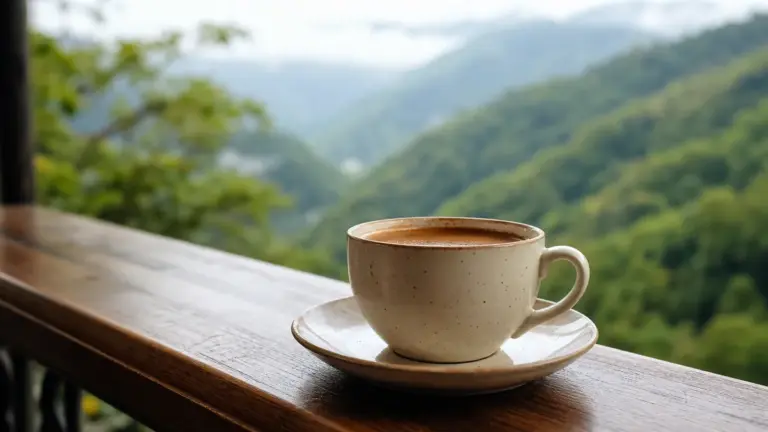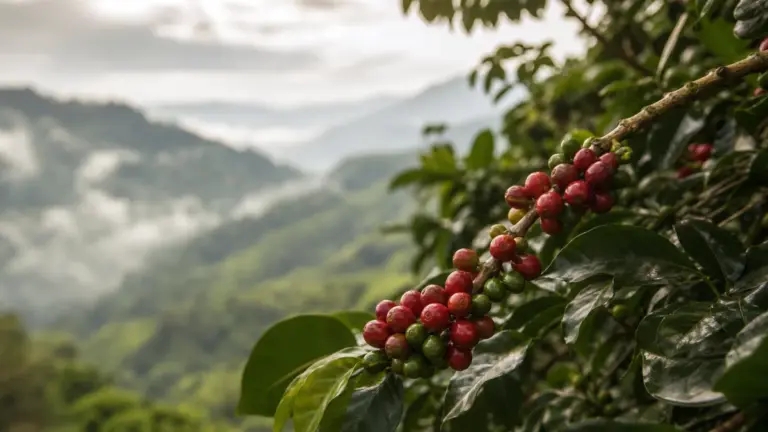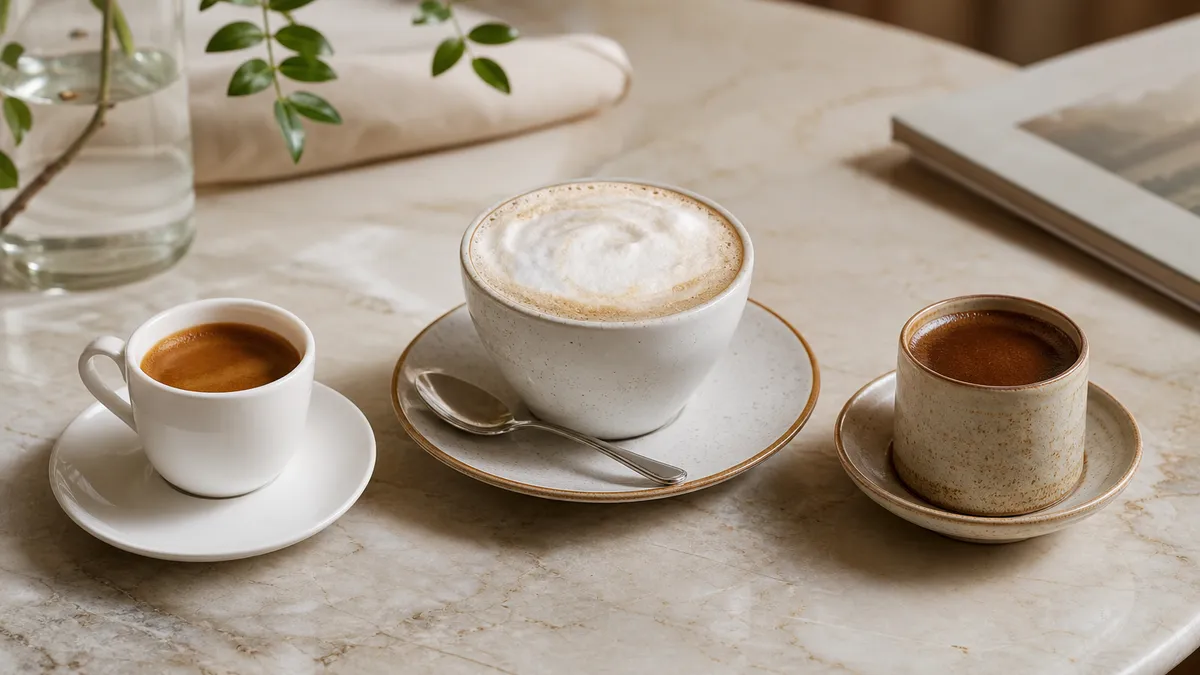
Coffee travel in Italy, Vienna and Istanbul offers three different ways to experience a city: espresso at an Italian bar, an unhurried table in a Viennese coffee house, and Turkish coffee served with time for conversation. Choose places for their brewing traditions and social character, not just their famous names. Two historic landmarks need particular care when planning: Rome’s Antico Caffè Greco cannot be recommended as open, while Vienna’s Café Central remains advertised as closed for renovation.
In short
- In Italy, un caffè normally means an espresso; choose between a counter stop and a seated visit.
- In Vienna, start with a Melange, coffee with warm milk and milk foam, and leave room in your schedule to linger.
- In Istanbul, specify your Turkish coffee’s sweetness when ordering, because sugar is normally added during preparation.
- Distinguish a historic coffee house from a roaster’s shop or confectioner: they offer different experiences.
- Venue status was checked in November 2026. Confirm opening arrangements again before making a special journey.
What makes these coffee traditions different?
The most useful comparison is not which destination has the “best coffee”, but what you want to do while drinking it. An Italian espresso bar puts the preparation and brief encounter at the centre; Vienna gives the table, room and newspaper a larger role; Turkish coffee makes preparation and hospitality part of the occasion.
These are starting points, not rules for every establishment. Italy also has grand seated cafés, and Istanbul’s neighbourhood coffee houses are not interchangeable with its visitor-facing confectioners. Use the wider coffee and travel guide to place these experiences within a trip rather than turn every day into a café checklist.
| Experience | First order to consider | What to pay attention to | Best suited to |
|---|---|---|---|
| Italian espresso bar | Un caffè | Counter service, preparation and the short social exchange | Travellers who enjoy everyday routines |
| Viennese coffee house | Melange | Table service, the room, newspapers and an unhurried stay | Readers, observers and architecture enthusiasts |
| Istanbul Turkish coffee stop | Türk kahvesi, with sweetness specified | The pot, foam, small cup and conversation | Travellers interested in hospitality and brewing traditions |
My recommendation is to pair one famous venue with one ordinary neighbourhood stop. The landmark supplies historical context; the second visit helps prevent a grand interior from becoming your entire picture of local coffee culture.
Italy: espresso bars and grand cafés
Ordering without overthinking it
In Italy, a bar commonly serves coffee as part of everyday life. Ask for un caffè, per favore for an espresso. For coffee with a little milk, ask for a caffè macchiato; latte alone means milk, rather than the coffee drink familiar from British menus.
Cappuccino belongs chiefly to the breakfast tradition. Treat that as cultural context rather than a test you must pass: choose the drink you want, and ask politely about anything unfamiliar.
At a busy counter, keep the exchange straightforward. Ask whether to order there or go to the cashier first, rather than assuming every bar follows the same sequence. If you want a table, make that clear before ordering.
The counter and the salon deserve different visits. At the counter, notice the movement between grinder, machine and cup. Seated, give yourself permission to look at the room rather than immediately planning the next stop.
Where the historic venues fit
Caffè Florian in Venice dates from 1720 and is a seated historic café in Piazza San Marco, not a substitute for observing an ordinary espresso bar. Its official contact page publishes current opening arrangements and says individual reservations are not accepted.
Gran Caffè Gambrinus in Naples, whose history begins in 1860, offers another grand-café setting. Its official site presents it as a literary salon and art-filled meeting place. Choose it for the combination of coffee and room, without assuming historical importance guarantees your favourite espresso.
Sant’Eustachio Il Caffè in Rome, founded in 1938, is a useful contrast. Its original premises in Piazza Sant’Eustachio remain listed with opening hours on the operator’s website. Make it the shorter, coffee-focused stop in your plan.
Antico Caffè Greco in Rome, founded in 1760, needs a warning rather than an itinerary slot. ANSA reported its closure in October 2025, and subsequent reporting continued to describe it as closed. A confirmed reopening was not established during this check, so do not travel there expecting coffee service.
Italy is a country, rather than a single coffee city. Choose Venice, Rome or Naples according to the rest of your journey, instead of treating these venues as a compact walking route.
Vienna: give the coffee house time
What to order and how to settle in
A Melange is a sensible first order: coffee with warm milk and a milk-foam topping. Vienna’s tourist board describes a version using slightly diluted espresso or mocha. Read the house description rather than expecting an exact copy of a British cappuccino.
For a different texture, an Einspänner is black coffee served in a glass with whipped cream. Here, the contrast between coffee and cream is part of the drink’s identity.
The classic coffee house is as much a place to spend time as a place to obtain caffeine. Marble-topped tables, bentwood chairs and newspapers help explain its character. Follow the venue’s seating arrangements, order from the table where appropriate, and avoid treating an occupied room as a photographic set.
Bring something to read if that appeals, but do not confuse an unhurried tradition with permission to ignore staff or other guests. Ask before moving furniture, taking close photographs or occupying a larger table alone.
Historic houses to consider
Café Landtmann, opened in 1873, is the grand Ringstrasse choice. Its operator publishes current opening hours and contact details.
Café Sperl, established in 1880, offers marble tables, bentwood chairs, newspapers and billiard tables. Its website also identifies a practical seasonal exception: it closes on Sundays in July and August.
Café Hawelka, opened in 1939, represents a more intimate literary-coffee-house tradition. Its official history describes its development as a meeting place for writers and artists, while the operator publishes current café hours.
Café Central, established in 1876, should not currently be presented as an open historic-venue recommendation. Its operator says it closed on 16 March 2026 for renovation. The German-language notice gives winter 2026 as the intended reopening period, while the English page still says autumn 2026. Neither establishes that the historic rooms have reopened.
The operator directs visitors to DECENTRAL at Freyung during the works. That is an alternative operated by the same business, not a visit to Café Central’s historic interior.
Istanbul: Turkish coffee, conversation and the roaster’s shop
Understand the cup before ordering
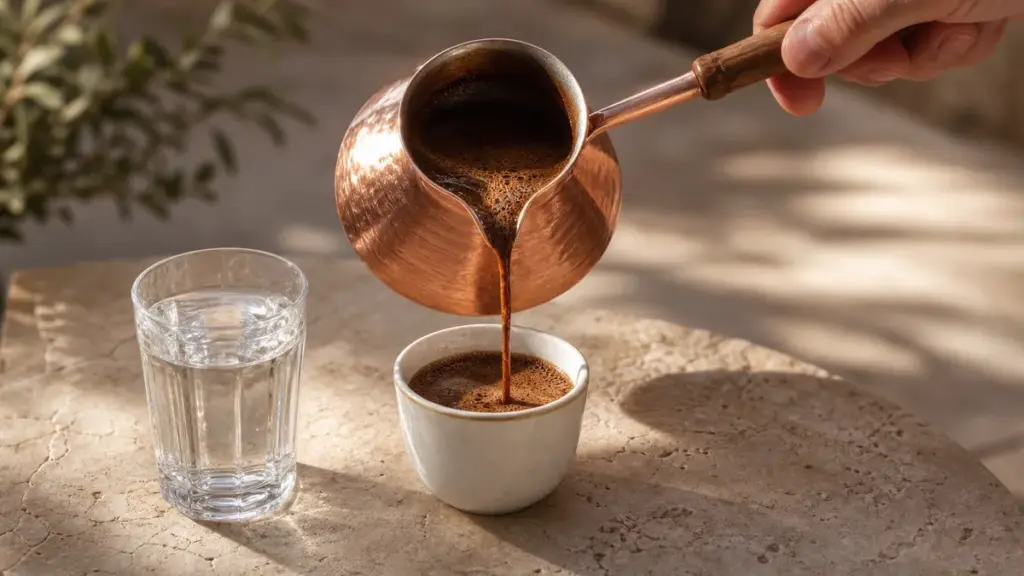
Turkish coffee uses beans ground to a fine powder and brewed with water in a small pot called a cezve. It is served without filtering away the grounds. Let the sediment settle, sip gently and leave the thick deposit at the bottom.
Specify sweetness before preparation:
- Sade: no sugar.
- Az şekerli: a little sugar.
- Orta şekerli: medium sweetness.
- Çok şekerli: very sweet.
Exact sweetness depends on the establishment, so describe your preference if necessary. Do not assume sugar will arrive separately for stirring into the finished cup.
Water commonly accompanies Turkish coffee, sometimes with Turkish delight. GoTürkiye describes drinking the water first to prepare the palate. More broadly, accept the pace of the occasion: this is a drink to sit with, not something that needs finishing in one swallow.
Three stops with different purposes
Mandabatmaz in Beyoğlu is the coffee-focused choice. Its operator traces the business to 1967 and continues to list its premises in Olivia Geçidi off İstiklal Caddesi. The small setting makes a useful contrast with the grand European salons elsewhere in this guide.
Kurukahveci Mehmet Efendi in Eminönü belongs in the itinerary as a roasting and retail stop. The company traces its prepared-coffee business to 1871 and lists its Tahmis Sokağı premises. Do not mistake a famous coffee merchant for a seated historic coffee house.
Hafız Mustafa, founded in 1864, is principally a confectionery business. Its current branch directory includes Sirkeci and Eminönü-Bahçekapı. Choose it for the confectionery setting, and check the selected branch’s menu rather than assuming every branch offers the same coffee experience.
For a neighbourhood coffee house, look for somewhere whose atmosphere you genuinely want to join. Ask before photographing people or a game in progress. A quiet, respectful visit tells you more than collecting pictures of strangers.
Historic venues: dates and present-day checks
This short chronology separates foundation history from present-day operation. “Listed as operating” means the operator publishes visitor information or current branch details, not that an in-person inspection was undertaken.
| Date | Venue | Place | Status checked in November 2026 |
|---|---|---|---|
| 1720 | Caffè Florian | Venice | Listed as operating |
| 1760 | Antico Caffè Greco | Rome | Closure reported; reopening not verified |
| 1860 | Gran Caffè Gambrinus | Naples | Active official visitor website |
| 1864 | Hafız Mustafa | Istanbul | Current branches listed; confectioner |
| 1871 | Kurukahveci Mehmet Efendi | Istanbul | Eminönü premises listed; roaster and retailer |
| 1873 | Café Landtmann | Vienna | Current opening hours published |
| 1876 | Café Central | Vienna | Renovation closure still advertised |
| 1880 | Café Sperl | Vienna | Current opening hours published |
| 1938 | Sant’Eustachio Il Caffè | Rome | Current opening hours published |
| 1939 | Café Hawelka | Vienna | Current café hours published |
| 1967 | Mandabatmaz | Istanbul | Café premises listed by operator |
Look beyond the famous interiors
The deeper distinction is between heritage as a social practice and heritage as a building or business name.
Viennese coffee house culture entered Austria’s national inventory of intangible cultural heritage in 2011. Turkish coffee culture and tradition entered UNESCO’s international Representative List in 2013. These are different forms of recognition. Neither is an award certifying the coffee quality of every individual establishment.
That distinction changes how to travel. In Vienna, notice how the room supports reading, conversation and staying. In Istanbul, notice preparation, serving and hospitality. In Italy, compare a brief counter exchange with a seated historic-café visit.
Keep your observations specific: Was the service hurried or measured? Did you prefer the coffee black, with milk or with cream? Did the setting encourage conversation? Those notes are more useful than deciding that an entire country drinks coffee one way.
For other styles of trip, use coffee destinations rather than stretching this historic-city guide into an origin-tour itinerary.
A practical checklist before you go
- Select one main venue and one alternative. Do not make a closure capable of derailing the whole day.
- Recheck the operator’s own information. Confirm the exact branch, opening day, renovation notices and reservation policy.
- Ask about access directly. Describe your needs, including entrance steps, seating and toilets, rather than relying on photographs.
- Keep the coffee stop within a workable sightseeing day. Choose the surrounding neighbourhood first, then the café.
- Check current travel advice. UK travellers should read FCDO advice for Italy, Austria and Türkiye, including entry requirements and disruption notices.
This guide is about coffee culture, not an assurance that travel conditions remain unchanged. In November 2026, FCDO advice for Türkiye specifically warns about regional tensions and possible transport disruption. Recheck before departure and keep arrangements flexible.
FAQ
Do I need to speak Italian, German or Turkish?
No, but learning the drink name and a polite greeting makes ordering easier. Start with un caffè in Italy, Melange in Vienna, and your preferred sweetness for Turkish coffee in Istanbul. If pronunciation becomes a barrier, point to the menu and describe what you want rather than repeating an unfamiliar term more loudly.
Can I plan these visits without a guided tour?
Yes. The named operators publish contact or visitor information, so you can arrange independent visits around your own interests. A guide may add historical interpretation, but check which premises the itinerary actually enters. A walk past a closed landmark is not the same experience as sitting inside an operating historic café.
Should a famous old café take priority over a modern roaster?
Only if history and setting are your priorities. For this guide, the historic venues are chosen to explain different coffee traditions, not ranked through comparative tasting. If your main interest is contemporary roasting or particular flavour profiles, combine a historic visit with a separately researched modern coffee stop.
Where to go next
Use Coffee and Travel to organise a coffee-led journey, and Coffee Destinations to compare other places worth exploring. Coffee Travel in Ethiopia, Colombia and Costa Rica shifts the focus towards producing countries, while Coffee Travel in the UK offers a closer-to-home continuation of coffee travel in Italy, Vienna and Istanbul.
Sources
Dates marked “undated” mean the retrieved page did not state a publication year.
-
Eataly, “A Guide to Italian Coffee Culture”, undated.
https://www.eataly.com/us_en/magazine/culture-and-tradition/italian-coffee-culture. -
Caffè Florian, official homepage and “Contatti”, undated.
https://caffeflorian.com/en/
https://caffeflorian.com/contatti/. -
Gran Caffè Gambrinus, “The historical local” and official homepage, undated.
https://grancaffegambrinus.com/en/il-salotto/
https://grancaffegambrinus.com/en/. -
Sant’Eustachio Il Caffè, “Our History” and official homepage with opening hours, undated.
https://caffesanteustachio.com/legend/?lang=en
https://caffesanteustachio.com/. -
ANSA, “Caffè Greco sealed, historic Rome café closes”, 10 October 2025, reproduced by AMAN; Falstaff, “Zukunft des Caffè Greco offen: Roms ältestes Café vor dem Wandel”, 11 June 2026.
https://www.aman-alliance.org/Home/ContentDetail/95799
https://www.falstaff.com/at/news/zukunft-des-caffe-greco-offen-roms-aeltestes-cafe-vor-dem-wandel/amp. -
Vienna Tourist Board, “10 Fascinating Facts About Viennese Coffee Houses”, undated.
https://www.wien.info/en/dine-drink/coffeehouses/wiener-kaffeehaus-fun-facts-433242. -
Austrian Commission for UNESCO, “Viennese coffee house culture”, inventory inscription 2011.
https://www.unesco.at/en/culture/intangible-cultural-heritage/inventory/element/article/viennese-coffee-house-culture. -
Café Landtmann, “Über Uns” and “Contact & Directions”, undated.
https://www.landtmann.at/ueber-uns/
https://www.landtmann.at/en/contact-directions/. -
Café Sperl, official English homepage and “History”, undated.
https://www.cafesperl.at/en
https://www.cafesperl.at/en/history. -
Café Hawelka, “Geschichte” and operator page carrying café opening hours, undated.
https://hawelka.at/home/geschichte/
https://hawelka.at/en/produkt/viennese-melange/. -
Café Central, German and English visitor notices, 2026.
https://cafecentral.wien/
https://cafecentral.wien/en/home/. -
UNESCO, “Turkish coffee culture and tradition”, Representative List inscription 2013.
https://ich.unesco.org/en/RL/-00645. -
Türkiye Ministry of Culture and Tourism, “Turkish Coffee”, undated; GoTürkiye, “Turkish Coffee in Istanbul Guide”, undated.
https://www.ktb.gov.tr/EN-98850/turkish-coffee.html
https://goturkiye.com/istanbul/turkish-coffee. -
Mandabatmaz, “Hakkımızda” and “İletişim”, undated.
https://www.mandabatmaz.com.tr/hakkimizda
https://www.mandabatmaz.com.tr/iletisim. -
Kurukahveci Mehmet Efendi, “Mehmet Efendi” and “Merkez (Eminönü)”, undated.
https://www.mehmetefendi.com/eng/about-us/history/mehmet-efendi
https://www.mehmetefendi.com/iletisim/merkez-eminonu. -
Hafız Mustafa, “Our History” and “Branches”, undated.
https://www.hm1864.ae/our-history/
https://www.hafizmustafa.com/en/hm1864-subeler. -
Foreign, Commonwealth & Development Office, travel advice for Italy, Austria and Turkey, current pages retrieved November 2026.
https://www.gov.uk/foreign-travel-advice/italy
https://www.gov.uk/foreign-travel-advice/austria
https://www.gov.uk/foreign-travel-advice/turkey.
Research combined official venue histories and visitor notices, tourism-board guidance, heritage inventories and authoritative closure reporting; no first-hand venue testing is claimed.
Last checked: November 2026