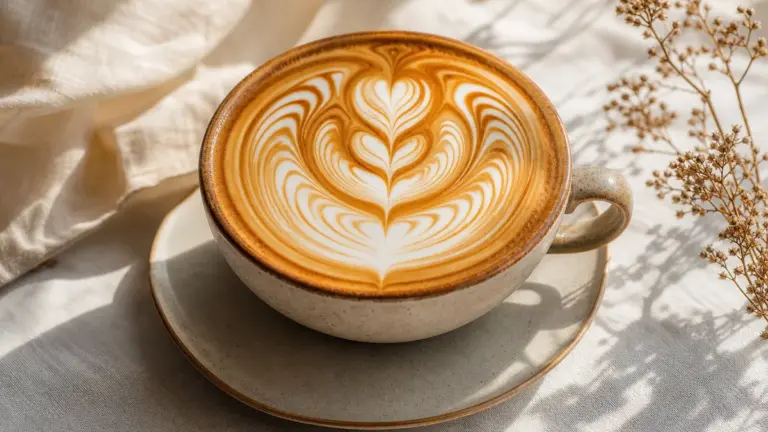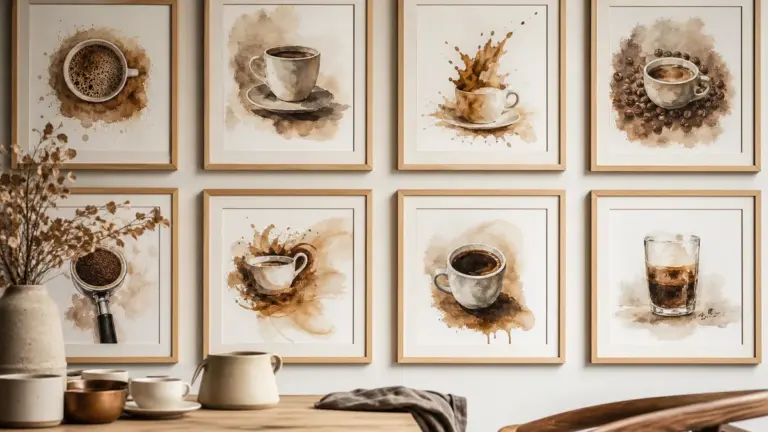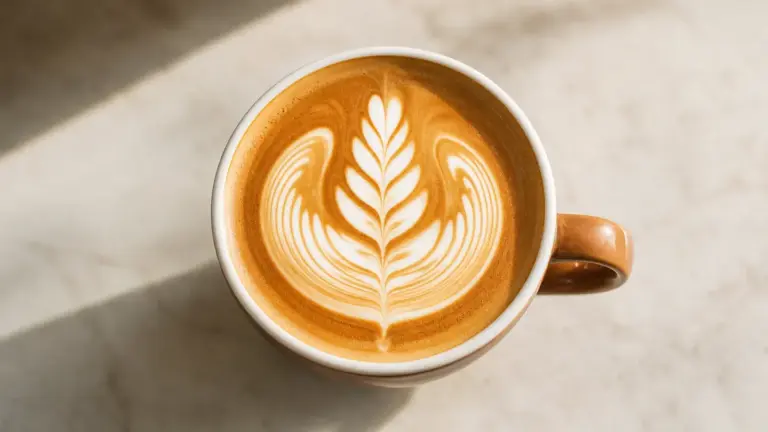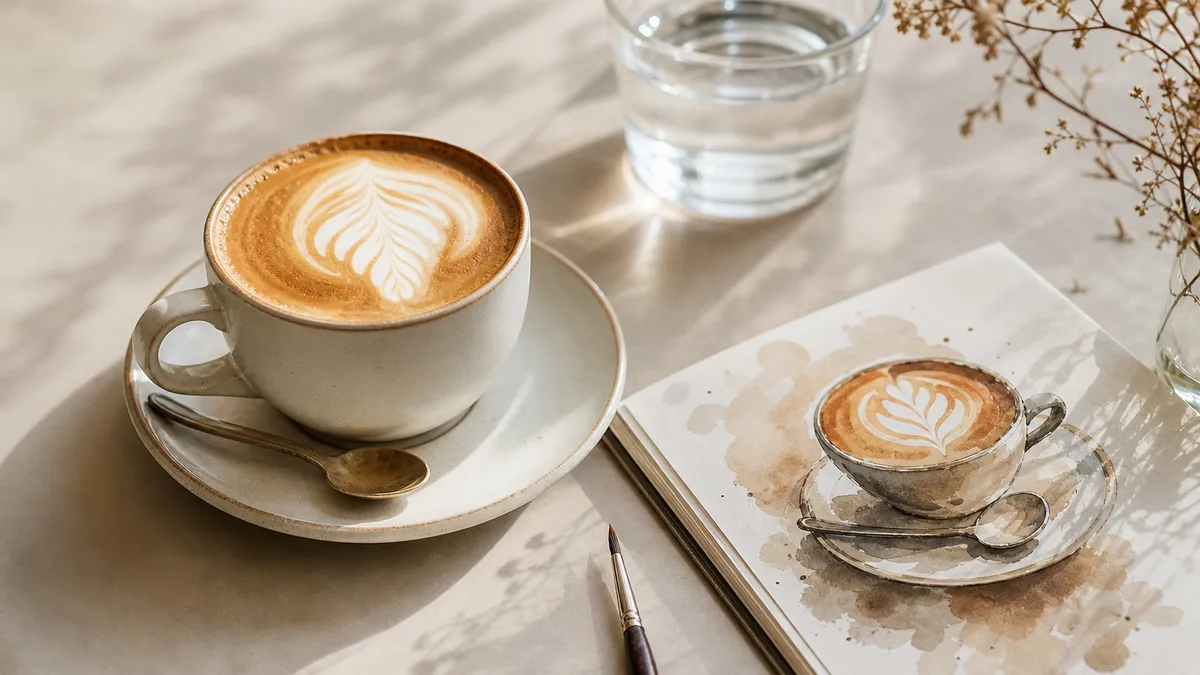
Coffee can be an art form in two distinct ways: as a drink shaped into a deliberate visual composition, and as a material used to make pictures. Modern latte art grew through Italian espresso-bar practice and Seattle’s experiments with milk texture, while coffee painting takes the same familiar brown liquid onto paper and canvas.
In short
- Free-pour latte art creates the design through the movement of poured milk; etching draws into or adds detail to the surface.
- Latte art has several pioneers, not one securely documented inventor.
- David Schomer’s published account records hearts at Espresso Vivace by 1989 and his development of a rosetta technique by the winter of 1992.
- Coffee painting uses dilution, staining and layers to create different tones.
- A photograph can preserve a beautiful pour, but it cannot establish how the drink tastes.
What makes coffee an art form?
A useful distinction is between making something skilfully and using that skill expressively. Preparing a consistent cappuccino is a craft. Choosing its shapes, contrast and composition gives that craft a visual language.
In this article, “art” means intentional expression through a material, rather than a claim that every decorated drink belongs in a gallery. A small heart can be an expression of hospitality; a complicated design can be an exercise in precision. Neither needs to imitate a conventional painting to be worth looking at.
Coffee also occupies two very different artistic roles. In latte art, the drink is the finished work, and drinking it changes or destroys the picture. In coffee painting, coffee becomes the colouring material rather than the thing being served.
That difference matters when judging the result. A drink should still be enjoyable to drink; a painting can be considered for its image, surface and meaning without that practical obligation. Our coffee art and latte art guide maps the wider subject.
How latte art developed: Italy and Seattle
The history is better understood as an exchange of techniques than a race to identify one inventor. Published first-person accounts show practitioners learning from other baristas, adapting existing patterns and sharing their methods.
The Italian espresso-bar tradition
Italian barista and trainer Luigi Lupi credits Piero Merlo of Bar Bauli in Verona with teaching him his first cappuccino decorations. In a 2013 interview, he described making figures through the movement of the milk jug, not simply adding decoration afterwards.
Lupi also recalled exchanging instructional videos with Seattle’s David Schomer around 2000. His account places Italian practitioners within the development and teaching of the technique, rather than treating Italy merely as a source of espresso equipment.
That recollection does not establish who poured the first recognisable design. It does, however, make a single-inventor story difficult to defend.
Seattle’s contribution: texture, repeatability and teaching
Espresso Vivace’s own history records that David Schomer and Geneva Sullivan founded the business in 1988. Schomer’s contemporary writing then provides unusually specific evidence of how its latte art developed.
| Date | Documented milestone |
|---|---|
| 1986 | Schomer credited Jack Kelly of Uptown Espresso with perfecting milk texturing in Seattle. |
| 1988 | Schomer and Geneva Sullivan founded Espresso Vivace. |
| 1989 | Schomer reported that his heart pattern had been perfected by the autumn. |
| 1992 | He reported perfecting his rosetta technique by winter, after seeing a photograph from Caffè Mateki in Italy. |
| 1994 | His December article, Latte Art 101, explained the patterns and their background. |
| 1995 | His author biography records the creation of the Caffe Latte Art instructional video. |
The distinction is between developing a personal technique and inventing the underlying pattern. Schomer explicitly acknowledged Italian examples and other baristas’ contributions.
Taken together, these accounts suggest why latte art spread: attractive results became repeatable, explainable and teachable. Its history belongs to both the Italian bar tradition and the people who documented and circulated techniques beyond it.
Free pour versus etching
Free pouring and etching both make images on coffee, but they work differently. The clearest way to distinguish them is to watch when and how the design appears.
| Feature | Free pour | Etching |
|---|---|---|
| Main action | Moving and controlling the milk stream | Drawing through or detailing the surface |
| Main tool | Milk jug | A fine drawing tool |
| Design develops | During pouring | Through surface manipulation |
| Best viewed as | Controlled movement of flowing materials | Drawing on a changing surface |
Free pour: making the image through movement
Free pouring depends on microfoam, milk containing very fine bubbles that remains smooth and pourable. It is not a separate, stiff mound of froth placed on top of the drink.
The barista changes the relationship between milk and coffee during the pour. An initially higher, thin stream helps milk enter beneath the surface; bringing the spout close allows pale foam to spread visibly across it. Jug movement then turns that spreading material into a deliberate shape.
This is why the finished image records a sequence of gestures. Its lines are not independent pencil strokes: each movement affects liquid already in the cup. The artistic challenge includes anticipating what the next movement will do.
For the preparation behind that behaviour, read steaming milk and making microfoam.
Etching: drawing into the surface
Etching manipulates the surface with a fine tool, allowing details to be drawn or existing shapes to be developed. It offers a different kind of control from pouring, rather than being an inferior version of it.
The distinction is formal as well as descriptive. The 2026 World Latte Art Championship rules prohibit etching in free-pour drinks but permit it in designer-pattern lattes.
When comparing two pictures, therefore, ask how they were made before deciding which demonstrates greater pouring skill. A finely drawn detail and a cleanly poured shape may be impressive for different reasons. Our guide to pouring latte art covers the practical technique.
Coffee painting: when the drink becomes the medium
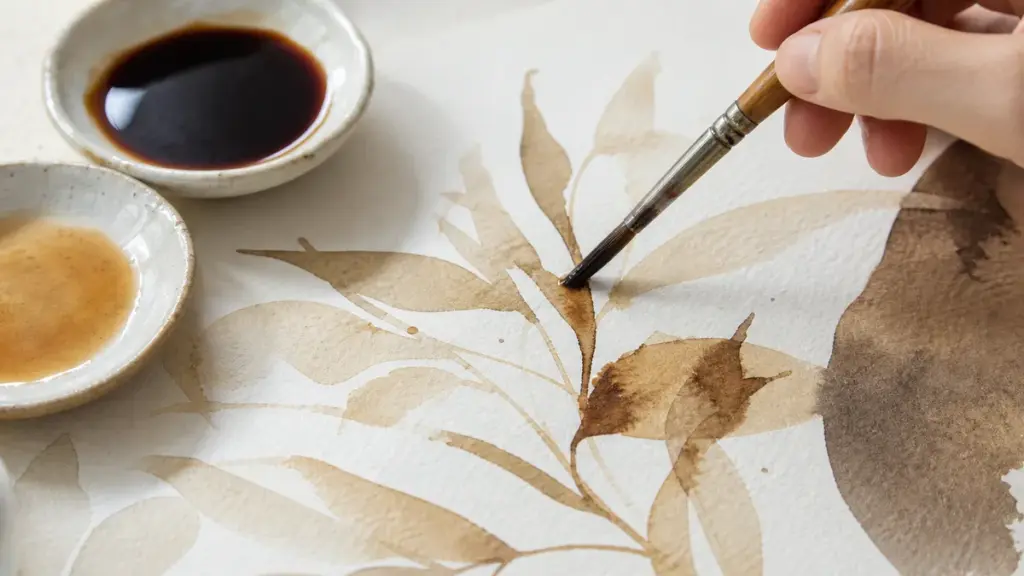
Coffee painting takes coffee out of the cup and uses its colour on a support such as paper or canvas. The subject need not be coffee: a portrait painted with coffee is coffee art even if no cup appears in it.
Dilution creates lighter washes, while repeated layers can build darker areas. The Fort Collins Museum of Discovery’s teaching activity demonstrates these effects and distinguishes the smoother results of instant coffee from the loose texture produced when grounds are included.
The artistic interest lies partly in working within a restricted palette. Without a full range of colours, the maker must decide how much the picture can communicate through light, darkness, edges and empty space. A pale wash and a dense brown mark need to do different jobs.
Documented examples beyond the cup
The US Department of State’s Art in Embassies programme lists Andrew Sauer works made with coffee on paper and canvas. Its artist profile describes Andy and Angel Sauer making paintings entirely with coffee, without additives.
These records are useful because they establish actual materials and artworks. They provide firmer evidence than a general claim that coffee painting is an ancient tradition with a known starting point.
Coffee can also carry meaning beyond its colour. David Kordansky Gallery describes Chase Hall using brewed coffee to make pigments that stain cotton supports, connecting his material choices with histories of oppression and trade.
Hall’s example shows why “coffee art” need not mean a decorative novelty. The material can be part of what the artwork is saying. Understanding the choice of coffee may matter as much as recognising the image.
How social media changed the audience
Social media did not create latte art: Schomer’s published photographs and instructions predate it. What image-sharing adds is a way for a temporary work to be encountered after the drink itself has disappeared.
A useful interpretation is that photography gives latte art a second life. The original belongs to the person holding the cup; its image can become a reference for someone who never sees the pour or tastes the coffee.
That creates an important difference between viewing and learning. A finished photograph shows the destination. An unbroken recording of the pour also lets a learner inspect the route: where the jug moved, when the stream changed and how the design developed.
Academic work has examined the relationship between photogenic drinks and online attention. Emily Truman’s 2022 chapter on the “unicorn latte” explores mobile photography, food marketing and changing expectations around appearance and taste. Its published abstract supports a cultural interpretation, not a numerical claim about how much social media increased latte-art participation.
The sensible lesson is to enjoy the picture without asking it to prove too much. It cannot tell you the drink’s temperature, flavour or texture. Nor does an intricate design make a simpler, well-prepared coffee less worthwhile.
Looking more closely: technique, composition and intention
You do not need to count leaves or identify every pattern to appreciate coffee art. Instead, separate what the maker intended from how successfully the material was controlled.
For latte art, the World Latte Art Championship’s visual criteria provide a useful starting point: surface quality, contrast, placement, balance and successful execution. Those are useful things to notice, not instructions to turn every coffee break into a judging session.
Try this short viewing sequence:
- Identify the method. Was the image poured, etched or developed through a combination of actions?
- Look at the surface. Notice whether it appears smooth and glossy, rather than judging only the outline.
- Follow the edges. Decide whether transitions look deliberate or whether shapes have blurred unintentionally.
- Consider the whole cup. Look at the relationship between the design, its surrounding space and the vessel.
- Ask what the work is for. Is it an inviting drink, a technical demonstration, a playful image or an artwork using coffee to express an idea?
For a coffee painting, the last question may be the most revealing. Coffee might be chosen for its brown tones, its staining behaviour or its associations. Ask what would be lost if the maker had used ordinary paint instead.
My view is that coffee as an art form is most convincing when the material and the intention belong together. Complexity alone is not the deciding factor: a restrained picture can make a clearer statement than a crowded one.
FAQ
Does an attractive latte prove that the coffee is good?
No, an attractive pattern does not establish the flavour of the drink. It can demonstrate control of visual presentation, but a photograph cannot tell you whether you will enjoy the coffee. Treat the design as one part of the experience, alongside aroma, taste, texture and how the drink is served.
Can you paint with instant coffee?
Yes, instant coffee can be used for painting. The Fort Collins Museum of Discovery includes it in its coffee-painting activity and describes smoother results than those made with grounds. Begin by testing dilution and layering on spare paper, letting each layer dry so that you can see how the tone changes.
Is etching considered cheating?
No, etching is a legitimate technique, but it is not free pouring. The relevant question is which method the maker claims to be using. The 2026 World Latte Art Championship separates them explicitly: etching is prohibited in free-pour drinks and allowed in designer-pattern lattes, subject to that category’s rules.
Where to go next
Start with Coffee Art and Latte Art for the wider subject, then read How to Steam Milk and Make Microfoam to understand the material behind a controlled pour. How to Pour Latte Art is the next practical read when you want to move from appreciating coffee as an art form to making your own.
Sources
-
David Schomer, Espresso Vivace, Latte Art 101, CoffeeTalk, December 1994, p. 13. The original page scan was inspected; the publication details are taken from the scan rather than the archive index.
https://www.espressovivace.com/archives/9412ct.jpg -
Espresso Vivace, Our Story, undated. Used for the partnership’s founders and founding year.
https://espressovivace.com/contact/our-story/ -
Comunicaffè, L’intervista con Luigi Lupi, 13 February 2013. First-person account of learning cappuccino decoration and exchanging instructional videos.
https://www.comunicaffe.it/antonio-lupi/ -
David Schomer, Daily Coffee News, A Call to Action on Espresso Grinders, 30 August 2019, with the currently displayed author biography. Used specifically for the biography’s dating of the Caffe Latte Art video to 1995.
https://dailycoffeenews.com/2019/08/30/a-call-to-action-on-espresso-grinders-by-david-schomer/ -
World Coffee Championships, Specialty Coffee Association, 2026 World Latte Art Championship Rules and Regulations, 2026 edition, especially sections 2.5 and 14.1.
https://wcc.coffee/s/2026-World-Latte-Art-Championship-Rules-and-Regulations.pdf -
Oldenburger Professional, Barista Milk, undated, especially “Step by Step: Latte Art”. Used for the practical explanation of milk flow, not branded performance claims.
https://www.oldenburger-professional.com/media/5b/14/4a/1752144388/OLB_BaristaMilk-Folder_A4_RZ_Preview.pdf -
US Department of State, Art in Embassies, Andrew Sauer, undated. Artist statement and records of coffee works on paper and canvas.
https://art.state.gov/personnel/andrew_sauer/ -
David Kordansky Gallery, Chase Hall, undated, current artist profile. Used for the artist’s coffee-based materials and the gallery’s interpretation of their meaning.
https://www.davidkordanskygallery.com/artist/chase-hall -
Fort Collins Museum of Discovery, Daily Discovery: Coffee Painting, 7 August 2020. Used for dilution, layering and the comparison between instant coffee and grounds.
https://fcmod.org/blog/2020/08/07/daily-discovery-coffee-painting/ -
Emily Truman, University of Illinois Press, Picturing Digital Tastes: #unicornlatte, Social Photography, and Instagram Food Marketing, in Food Instagram: Identity, Influence, and Negotiation, 2022. The publicly available chapter abstract was consulted, not the full chapter.
https://doi.org/10.5622/illinois/9780252044465.003.0008
This article was researched through an original magazine scan, first-person historical accounts, official competition rules, documented artist materials and educational resources; interpretation is distinguished from documented history.
Last checked: November 2026