Yes, coffee and cheese can work together, particularly when neither overwhelms the other. For a straightforward first pairing, try a medium-roasted black coffee with a small piece of Comté or mature Cheddar, then explore milder, tangier or more pungent cheeses.
In short
- Start with one coffee and three contrasting cheeses rather than a crowded cheeseboard.
- Use roast level as a starting point, but choose by the coffee’s actual flavour and intensity.
- Taste the coffee and cheese separately before trying a bite followed by a sip.
- Nordic kaffeost can mean cheese placed directly in hot coffee, not merely served alongside it.
- Treat the combinations below as tasting suggestions, not scientifically established matches.
Why coffee and cheese can work
The appeal is not that every cheese has a perfect coffee partner. It is that the combination offers several things to explore: contrasting textures, different basic tastes and flavours that may seem more noticeable together.
Think about what you want from the pairing. You might look for a familiar connection, such as nutty-tasting cheese alongside coffee that reminds you of toasted nuts. Alternatively, try a contrast: a mild, milky cheese against a distinctly roasty drink. These are useful culinary approaches, not guarantees.
Salt, bitterness and perceived sweetness
There is a scientific basis for investigating salt and bitterness together. Controlled human taste experiments have shown that sodium salts can suppress certain bitter tastes, making sweetness relatively more apparent in mixtures.
That does not establish that salty cheese will reliably sweeten coffee. The experiments used controlled solutions rather than a cheeseboard, and the result depends on the substances involved. For this pairing, the sensible application is a question: does the coffee seem less bitter after a bite of cheese?
Avoid the stronger claim that cheese “neutralises” coffee’s acidity. A change in how something tastes is not evidence that its acids have been chemically neutralised.
Texture matters as much as matching flavours
Pay attention to the transition between chewing and sipping. Does the coffee provide a pleasant contrast to the cheese, or does the combination leave an unwelcome drying, greasy or lingering sensation?
There is no need to find an elaborate flavour description. “The coffee tastes clearer afterwards” or “the cheese makes everything seem bitter” is useful information. The broader coffee and food pairings guide explains how to apply this approach beyond cheese.
Coffee and cheese pairings by style and roast
For this guide, the selection criteria are flavour intensity, acidity, bitterness, texture and the finish, meaning what remains after swallowing. The following combinations are editorial starting points for an informal tasting, not results from comparative testing.
Choose the description that resembles your actual coffee. A bag’s roast label alone cannot tell you whether the finished drink will taste fruity, smoky, thin or concentrated.
| Cheese style | Coffee to try first | What to look for | If the match disappoints |
|---|---|---|---|
| Mild fresh cheese, such as ricotta or plain cream cheese | Light to medium roast, brewed as filter coffee | Whether the cheese leaves the coffee’s delicate flavours distinguishable | Try a smaller bite or a gentler coffee |
| Fresh goats’ cheese without a mould rind | Light to medium roast with a fruity character | Whether the combined tang feels lively rather than sharply sour | Compare with a less acidic-tasting coffee |
| Comté, Gruyère or mature Cheddar | Medium roast with nutty or cocoa-like notes | A connection between the flavours without either disappearing | Reduce the cheese portion before strengthening the coffee |
| Brie or Camembert | Medium roast, initially without milk | Whether you enjoy the coffee with both the centre and rind | Taste the centre separately to identify what clashes |
| Blue cheese, such as Stilton | Medium to dark roast with a substantial flavour | Whether both remain enjoyable through the finish | Use a much smaller piece of cheese |
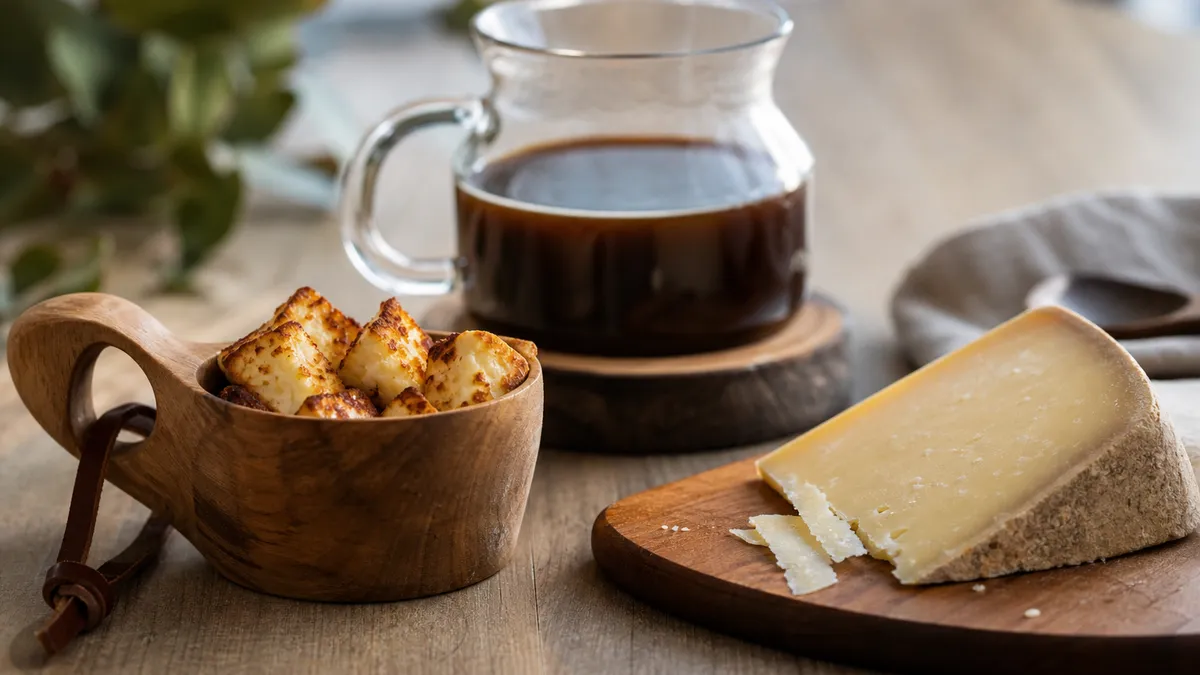
| Baked leipäjuusto | Medium-roasted black coffee | The contrast between mild cheese and coffee, alongside or in the cup | Try it alongside first, then submerged |
If you want just one starting point, my recommendation is the Comté or Cheddar row. It offers a straightforward comparison without requiring you to begin with cheese in the cup.
Do not interpret “strong cheese” as an instruction to use the darkest possible roast. In a controlled coffee sensory study, the darker roast produced higher bitter, burnt, smoky and cocoa intensities, while the lighter roast was more sour, citrusy and fruity. More roast character is another variable, not an automatic improvement.
For the fuller relationship between flavour, roast and growing region, see pairing by roast and origin.
How to run a useful tasting
Keep the first session small enough that you can remember the differences. The quantities below are a suggested home tasting setup, not an SCA assessment protocol or a prescribed serving size.
A simple tasting method
You will need one coffee, three cheeses, plain drinking water, small cups, a clean knife and a plate. Start with black coffee so that milk and sugar are not additional variables.
- Choose contrasting cheeses. Try one mild cheese, one firm cheese and one more assertive option. Set aside about 10 g of each per person, divided into small bites.
- Brew a familiar coffee. Use your normal, repeatable method rather than learning a new one during the tasting. If you need a starting dose, 15 g of coffee to 240 g of water is a coffee-to-water ratio of 1:16 by weight.
- Establish the coffee’s baseline. Let it cool until comfortable to sip. Note whether it seems bitter, sour, sweet, drying or full-bodied before adding food.
- Taste the mildest cheese alone. Notice its saltiness, tang, texture and lingering flavour. There is no requirement to eat the rind.
- Take another small bite, then a sip. Ask what changed in the coffee and whether you prefer the combination to either item alone.
- Rinse with water and repeat. Move towards the more assertive cheeses. Keep the bite and sip sizes reasonably similar.
- Revisit the favourite. Try it again as the coffee cools, then reverse the order by sipping before taking a bite.
For notes, use three simple verdicts: better together, enjoyable separately, or not for me. Add one reason rather than a score that suggests more precision than the exercise provides.
Leave chutney, strongly flavoured crackers and fruit preserves out of the first round. They introduce extra ingredients, making it harder to identify which part of the combination you like. Add them afterwards if you want to build a snack around the winning pair.
If sweet accompaniments are the main attraction, coffee and chocolate pairings is a more useful next experiment than adding several sweet elements to this one.
Nordic kaffeost: cheese directly in the coffee
In northern Nordic food traditions, coffee and cheese can share the same cup. Swedish kaffeost means coffee cheese; kahvijuusto is also recorded among Finnish names for leipäjuusto.
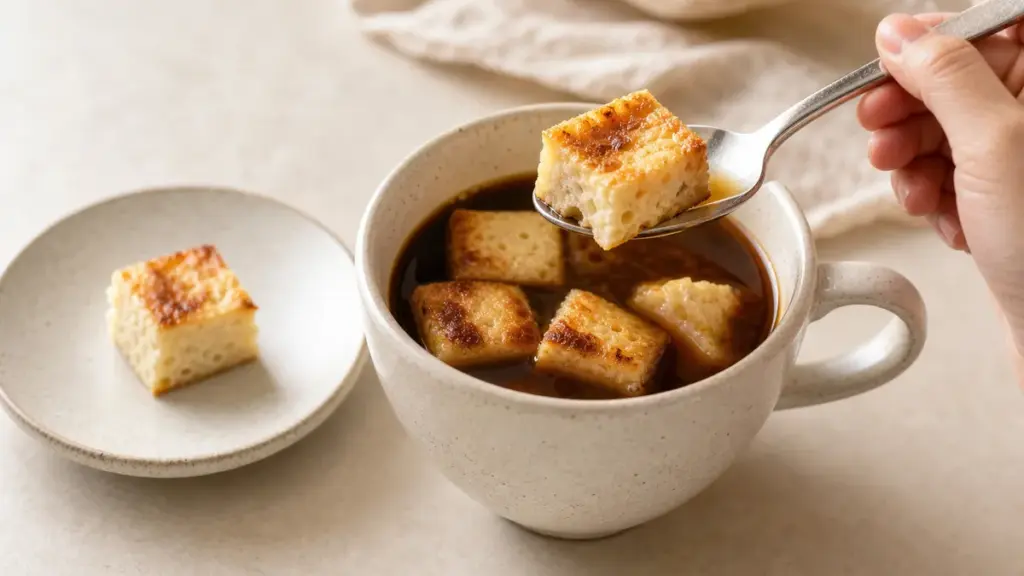
Finnish leipäjuusto, often called bread cheese or squeaky cheese, is a mild cheese typically made from cow’s milk and baked to produce a spotted surface. Visit Finland describes dipping it in hot black coffee as a traditional Sámi way of eating it.
The related Swedish tradition is more varied than “baked reindeer cheese in filter coffee” suggests. The producer specification hosted by Sweden’s food authority describes cow’s, goat’s or reindeer milk, with baked, smoked and untreated forms. It particularly associates kaffeost with boiled coffee rather than filter coffee.
The common point is the cheese itself going into the drink: small pieces soften and take on coffee flavour. Reindeer milk belongs to the tradition, but it is not a requirement.
A practical way to try it
For a home introduction, use ready-made baked leipäjuusto and freshly brewed black filter coffee. This is a convenient adaptation, not a claim that filter brewing is the only traditional preparation.
Cut a little cheese into bite-sized cubes and put them in a heatproof cup. Pour the hot coffee directly over them, allow the drink to become comfortable to sip, then lift out a piece with a spoon. Compare its texture and flavour with an unsoaked piece.
You are looking for warmed, coffee-flavoured cheese, not a smooth melted-cheese drink. A wooden cup is optional; ordinary heatproof crockery lets you explore the same basic combination.
Do not assume any cheese dropped into coffee will reproduce this experience. Begin with the intended cheese rather than using the experiment to dispose of an assortment of leftovers.
Looking beyond the roast label
For a more revealing second tasting, keep the cheese fixed and change the coffee. This separates “I dislike coffee with cheese” from “I dislike this particular combination”.
Distinguish brew strength, the concentration of dissolved coffee in the drink, from extraction, how much material the water removes from the grounds. Controlled drip-coffee research found that strength and extraction affected attributes including bitterness, sourness, sweetness, thickness and flavour persistence.
That matters because a pairing can disappoint for different reasons. If the cheese seems to erase the coffee, first try a smaller bite. If the coffee is unpleasant on its own, improve the brew before judging the cheese.
Change only one thing at a time. Compare two coffees with the same cheese, or two cheeses with the same coffee, rather than changing the roast, brewing method, milk and accompaniments together. At home or at an office coffee break, the most useful result is a pairing you can repeat.
Serving and food safety
Keep cheese refrigerated according to its label, observe use-by dates and bring out only what you intend to serve. Food Standards Agency guidance recommends a fridge temperature between 0 and 5 degrees Celsius.
Pouring hot coffee over cheese is not a validated cooking or pasteurisation step. During pregnancy, NHS guidance says mould-ripened soft cheeses and soft blue cheeses should be thoroughly cooked until steaming hot; pasteurisation alone does not make those categories suitable to eat uncooked. The NHS also advises no more than 200 mg of caffeine daily from all sources during pregnancy. Ask a midwife or GP if you need advice for your circumstances.
FAQ
Can I use decaffeinated coffee?
Yes, you can use decaffeinated coffee for this tasting. Choose one you already enjoy and follow the same comparison method, judging its flavour rather than treating decaffeination as a pairing category. You do not need a caffeinated version alongside it unless comparing those two particular coffees is something you want to explore.
Should I add milk or sugar?
You can, but try the coffee black first if your aim is to understand the cheese pairing. Afterwards, prepare it as you normally drink it and repeat your favourite combination. This keeps the first comparison simple without suggesting that black coffee is inherently the correct way to enjoy cheese.
What if I cannot find leipäjuusto?
You can still explore coffee and cheese by serving them alongside each other. Use one of the suggested cheese styles rather than describing a substitute as authentic kaffeost. For the in-cup experiment, ask a specialist retailer for baked Finnish bread cheese or a cheese specifically intended for serving in coffee.
Where to go next
Read Coffee and Food Pairings for the wider tasting framework, then Pairing by Roast and Origin to choose your next coffee comparison. Coffee and Chocolate Pairings explores a sweet alternative, while coffee and pastries helps you plan a more familiar accompaniment after experimenting with coffee and cheese.
Sources
-
Monell Chemical Senses Center, Breslin and Beauchamp, Salt enhances flavour by suppressing bitterness, Nature, 1997. Controlled human taste-mixture research, not a coffee-and-cheese trial.
https://pubmed.ncbi.nlm.nih.gov/9177340/ -
University of California, Davis, Liang and colleagues, Sensory analysis of the flavor profile of full immersion hot, room temperature, and cold brewed coffee over time, Scientific Reports, 2024.
https://doi.org/10.1038/s41598-024-69867-6 -
University of California, Davis, Frost, Ristenpart and Guinard, Effects of brew strength, brew yield, and roast on the sensory quality of drip brewed coffee, Journal of Food Science, 2020.
https://pubmed.ncbi.nlm.nih.gov/32652586/ -
Visit Finland, What to eat in Finland: guide to iconic Finnish foods, undated, retrieved November 2026.
https://www.visitfinland.com/en/articles/finlands-traditional-and-iconic-foods/ -
Sveriges Gårdsmejerister, hosted by Livsmedelsverket, Ansökan om skyddad ursprungsbeteckning: Kaffeost, revised 11 October 2024. Producer specification used for ingredients, preparation and regional variation.
https://www.livsmedelsverket.se/globalassets/foretag-regler-kontroll/livsmedelsinformation-markning-halsopastaenden/skyddade-beteckningar/ansokan-om-skyddad-ursprungsbeteckning-kaffeost_reviderad-24-10-11.pdf -
Anu Hopia, Molekyyligastronomia, Viulujuusto, 10 November 2025. Used for Finnish cheese terminology.
https://molekyyligastronomia.fi/viulujuusto/ -
Food Standards Agency, How to chill, freeze and defrost food safely, 2017, current retrieved guidance.
https://www.gov.uk/government/publications/how-to-chill-freeze-and-defrost-food-safely/how-to-chill-freeze-and-defrost-food-safely -
NHS, Foods to avoid in pregnancy, reviewed 15 June 2026.
https://www.nhs.uk/pregnancy/keeping-well/foods-to-avoid/
Research combined retrieved sensory studies, Nordic food and producer accounts, and official food-safety guidance; suggested pairings and tasting quantities are editorial proposals, not first-hand test results.
Last checked: November 2026