Coffee and food pairings work best when you choose a shared flavour to complement, or a difference in taste or texture to contrast, then check that neither overwhelms the other. Treat these as starting principles rather than fixed rules: controlled sensory research shows that food can change how coffee tastes, but the effect depends on the particular coffee and food.
In short
- Start with a coffee you enjoy on its own, then try one food at a time.
- For a complementary pairing, look for a shared impression, such as cocoa, toasted nuts or fruit.
- For contrast, try a brighter coffee alongside something rich, then judge whether the combination feels balanced.
- Compare acidity, sweetness, body and flavour intensity separately rather than relying on the roast label.
- Taste coffee, food, then coffee again. Keep the combinations you actually prefer, not those a chart says you should.
The two principles of coffee and food pairings
Complement: find a shared flavour
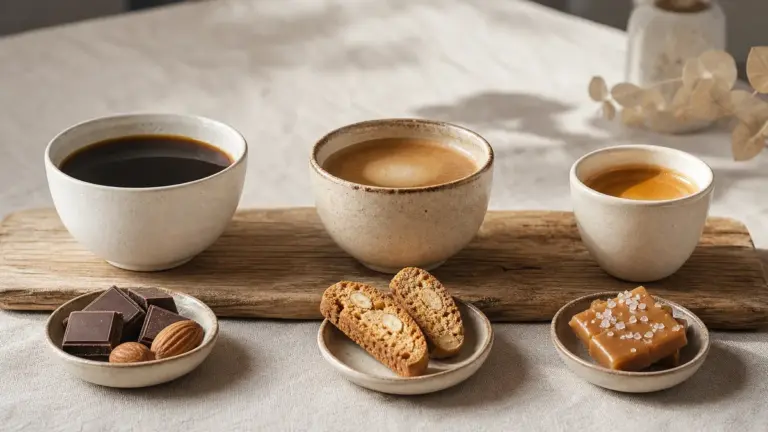
A complementary pairing follows a recognisable connection. As an experiment, try a coffee that reminds you of toasted hazelnuts alongside a plain nut biscuit, or one with a cocoa impression alongside chocolate.
Coffee genuinely has a broad sensory vocabulary. The World Coffee Research Sensory Lexicon includes fruit, nut, cocoa and sweet aromatic attributes, as well as mouthfeel characteristics. These are descriptions of sensory impressions, not a shopping list of ingredients added to the beans.
Choose one connection to investigate rather than trying to match every tasting note. Ask: does the food make that shared flavour easier to notice, or does it cover it completely?
For a first attempt, choose a relatively simple food. Compare plain shortbread before shortbread with chocolate, caramel and ginger. That is a useful experimental choice because it gives you fewer competing features to explain.
Contrast: look for an enjoyable difference
A contrasting pairing puts different qualities together. Try a bright, light-feeling coffee with buttery pastry, or a roasty coffee with a creamy, mildly sweet dessert.
Here, “balance” is a judgement about the experience, not a claim that one ingredient chemically cancels another. When tasting, ask whether the next sip feels welcome and refreshing, or unexpectedly sharp and disjointed.
Complement and contrast can coexist. With an almond pastry, you might look for a toasted-nut connection while also testing whether the coffee provides a pleasing change from the rich filling.
The wider coffee and food pairings hub provides routes into particular foods. This guide supplies the method for evaluating them.
Read the cup before choosing the food
Before pairing anything, describe the coffee in ordinary language. “Bright, light and citrus-like” is more useful for this exercise than “excellent”.
Acidity: brightness and sourness
For practical tasting, use acidity to describe the coffee’s bright, tangy or sour impression. Record both its intensity and whether you enjoy it, rather than assuming that more acidity means better coffee. Coffee research assesses sourness separately from attributes such as citrus flavour and sweetness.
Try a modestly acidic food before an intensely tart one. If the combination becomes uncomfortably sharp, set it aside and compare something gentler. There is no need to force a citrus pairing simply because the coffee bag mentions orange.
Body: the feel of the drink
Body is the tactile impression of the coffee, including how thin, thick or oily it feels. World Coffee Research distinguishes thickness, an oily mouth-coating sensation, and mouth drying as separate attributes.
Use that distinction when choosing food. Test whether a lighter-feeling coffee provides a pleasant contrast to creaminess, or whether you prefer a fuller-feeling drink alongside substantial food. Neither approach is automatically correct.
Do not confuse body with bitterness. Record “thick” and “bitter” separately so you can identify what you actually want to change.
Sweetness: judge the combination, not just the food
For pairing, distinguish a coffee’s perceived sweetness from the literal sweetness of the food. A coffee described as caramel-like should still be tasted before you decide how it behaves beside a sugary dessert.
Do not assume that sweeter food will make coffee taste sweeter. A controlled coffee-pairing study found that prior exposure to basic tastes changed subsequent coffee perception, with effects that differed between samples and sensory attributes.
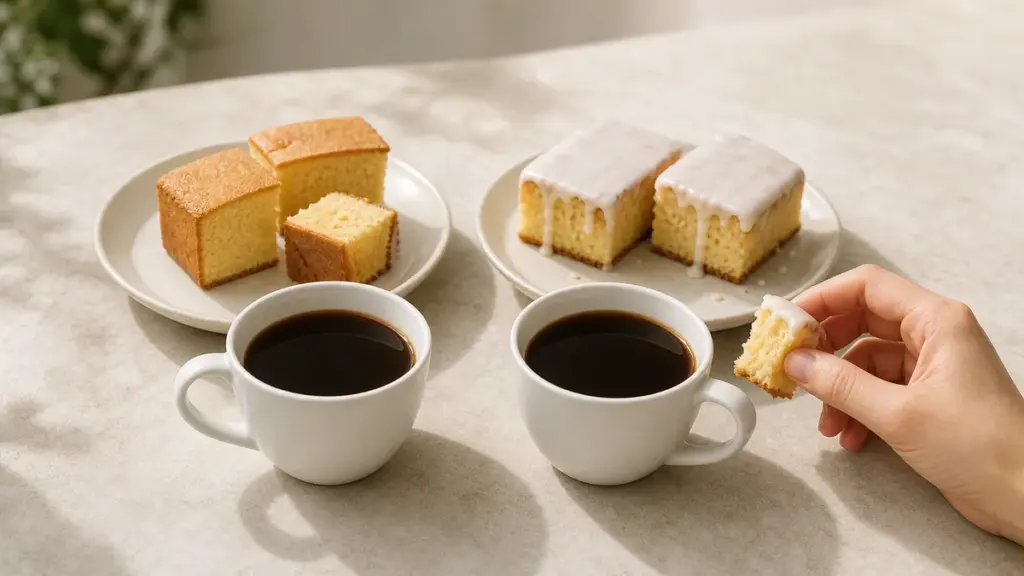
Try a less sweet version of the food if the coffee becomes unpleasant after a bite. For example, compare an uniced cake with its heavily iced equivalent rather than immediately replacing the beans.
Intensity: give both partners room
As an editorial starting rule, match broadly similar flavour intensities before attempting dramatic contrasts. Try restrained foods with delicate coffees, and more assertive foods with coffees that remain recognisable beside them.
Then challenge that rule. If you enjoy a delicate coffee as a quiet interval between bites of rich food, that is a successful pairing for you. The purpose is enjoyment, not equal volume at every moment.
How roast and origin should guide your choice
Use roast as a clue, not a complete flavour description. Experiments reported by the Specialty Coffee Association found that darker roasting increased perceived bitter and roasted attributes while reducing perceived acidity and fruitiness. Body did not increase continuously as roasting became darker.
For an initial comparison, try:
- A lighter roast with a simple fruit-based food.
- A medium roast with plain biscuits or a gently toasted food.
- A darker roast with a creamy accompaniment, while checking that bitterness remains enjoyable.
These are suggested experiments, not verified matches for every roast.
Use origin to organise questions rather than dictate a menu. Ask what the particular bag tastes like, how it was processed and how it was roasted. Avoid choosing food solely because a country name appears on the label.
A useful test is to hide the packaging during your first tasting. Write down what you notice, then compare that with the roaster’s description. Build the pairing around the brewed cup rather than trying to reproduce somebody else’s notes.
Food pairings to try first
The following are editorial tasting suggestions, not combinations established as universally preferable. Choose by the coffee’s actual flavour and texture, then use the final column to decide whether to keep the match.
| Coffee impression | Food to try | Pairing approach | What to check |
|---|---|---|---|
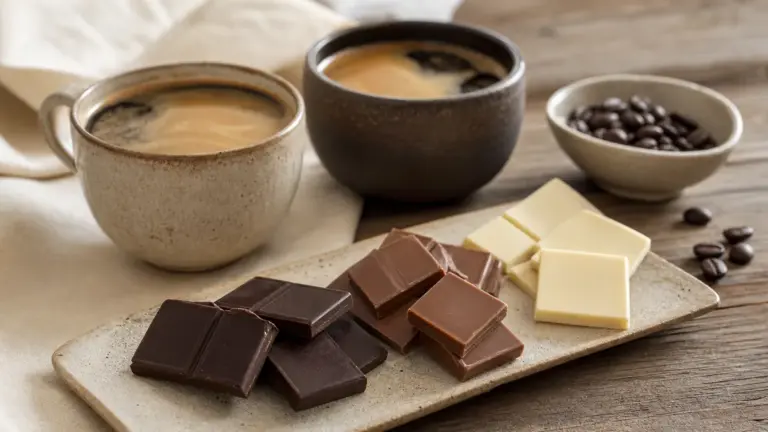
| Cocoa-like, gently roasty | A small piece of chocolate | Complement | Is cocoa clearer, or is the finish too bitter? |
| Toasted-nut, rounded | Plain almond biscuit | Complement | Can you still recognise the coffee? |
| Bright, light-feeling | Plain croissant | Contrast | Does the next sip feel refreshing or sharp? |
| Fruity, gently tangy | Ripe pear or a few berries | Complement | Does fruit character remain enjoyable? |
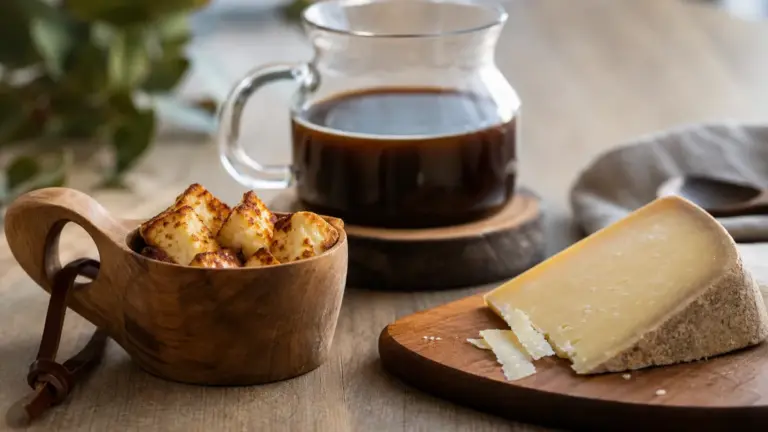
| Roasty, substantial | Mild cheese on a plain cracker | Contrast | Does the savoury finish work for you? |
| Delicate, floral | Plain sponge cake | Restrained accompaniment | Are the floral impressions still noticeable? |
Keep the chocolate example simple at first. The dedicated chocolate pairing guide takes that category further without turning this article into a chocolate-by-chocolate directory.
Likewise, begin pastry comparisons with an unfilled example before testing icing, jam or custard. Follow coffee with pastries when you want to concentrate on that family of foods.
For savoury experiments, start with a small portion of something familiar. Try plain toast, a mild cheese or a lightly seasoned cracker before assembling a whole meal around the coffee.
A repeatable tasting method
You do not need professional cupping equipment. The sequence below adapts the coffee, food, coffee approach used in published pairing research, with water between comparisons. The portion sizes and order suggested here are practical choices, not a formal sensory standard.
- Choose a manageable comparison. Start with one coffee and two foods. Keep portions small enough to repeat the tasting.
- Prepare the coffee consistently. Use your usual successful recipe and record the dose, water quantity and method. Avoid changing the brewing recipe between foods.
- Taste the coffee alone. Note acidity, sweetness, body, bitterness and one recognisable flavour. Use simple descriptions.
- Taste the food alone. Identify its strongest feature, such as sweetness, tanginess, saltiness, creaminess or toasted flavour.
- Take another sip of coffee. Notice what changed. Is the coffee more enjoyable, less enjoyable or simply different?
- Rinse with plain water. Pause, then repeat with the other food. Later, reverse the order.
- Write a decision. Record “keep”, “adjust” or “not for me”, with a short reason.
Try “coffee became sharp after the icing” rather than “bad match”. That observation suggests a useful next comparison: less icing, a different cake, or another coffee.
If hosting, ask guests about allergies before choosing foods, check ingredient labels and prevent allergen cross-contact through clean equipment and separate handling. Food Standards Scotland advises checking guests’ requirements, cleaning surfaces and utensils thoroughly, and keeping allergens separate.
When a pairing disappoints
Use this table as a set of hypotheses to test, not a diagnosis. Change one thing at a time.
| Symptom | Possible explanation | Next comparison |
|---|---|---|
| Coffee seems unpleasantly sharp after food | That food changes the coffee’s perceived balance | Try a less sweet or less tart accompaniment |
| Coffee seems absent | The food dominates the experience | Try a plainer food or a more assertive coffee |
| The finish feels excessively bitter | The combination emphasises qualities you dislike | Compare a less bitter food or a less roasty coffee |
| Every food seems disappointing | The coffee itself may not suit you | Taste it alone before adjusting the pairing |
| Results differ on repeating | Preparation, order or serving conditions changed | Repeat with the same recipe and reverse the order |
Check brewing before rejecting the food. Controlled drip-coffee research found that brew strength and extraction affected sensory character. Strength means the concentration of dissolved coffee in the drink; extraction means the proportion removed from the grounds. They are related but not interchangeable.
Avoid changing several brewing variables while comparing foods. Otherwise, you are evaluating both a new drink and a new pairing, which makes your notes harder to interpret.
What the science can and cannot tell you
The strongest directly relevant evidence here is a controlled sensory and consumer study published in 2022. It compared four coffees alone and after sweet or savoury foods, alongside experiments using basic-taste solutions. Food changed perception and liking, but the results were sample-specific.
Within that study, chocolate-like, nutty and sweet coffee profiles were generally more suitable for the tested food pairings than fruity, floral and berry profiles. That finding does not establish that fruity coffee should be served without food: it describes the samples and conditions examined, not every possible breakfast or dessert.
The practical inference is modest: shared flavours and contrasting textures are useful ways to choose candidates, but tasting must decide the result. Separate “I can describe the change” from “I prefer the change”.
That distinction makes coffee and food pairings more useful. Keep a short record of combinations you would happily serve again, including those that work against your initial expectations.
FAQ
Do I need to drink the coffee black?
No, use the drink you actually enjoy. If you normally add milk or sugar, keep those additions consistent throughout the comparison. Treat black coffee and your usual finished drink as separate experiments, rather than finding a match with one and assuming it will suit the other.
Should I dip the food into the coffee?
Not for the first comparison. Taste separately so you can identify what changes after the food, then try dipping if that is how you prefer to eat it. The suggested sequence follows the separate coffee, food, coffee approach used in the cited pairing research.
Can two people reasonably disagree about the same pairing?
Yes, record individual preferences rather than requiring a group verdict. Ask each person what changed and whether they liked it. The published consumer study found sample-specific drivers of liking, so its findings support a cautious approach to universal pairing rules rather than a single compulsory menu.
Where to go next
Visit Coffee and Food Pairings to choose your next food category. Read Coffee and Chocolate Pairings for a focused chocolate comparison, or Coffee and Pastries to explore breakfast and bakery accompaniments.
Sources
-
University of Copenhagen, Rune and colleagues. Pairing coffee with basic tastes and real foods changes perceived sensory characteristics and consumer liking. International Journal of Gastronomy and Food Science, 2022.
https://researchprofiles.ku.dk/en/publications/pairing-coffee-with-basic-tastes-and-real-foods-changes-perceived/ -
World Coffee Research. Sensory Lexicon, version 2.0, 2017.
https://worldcoffeeresearch.org/download/bf904452-fc8c-488f-b591-c0b20d9bcab2 -
Specialty Coffee Association. Modulating Perception, 25 Magazine, issue 5, publication year not stated on the retrieved page. Researcher account of roasting experiments.
https://sca.coffee/sca-news/25-magazine/issue-5/modulating-perception-25-magazine-issue-5-dxzar -
University of California, Davis, Frost, Ristenpart and Guinard. Effects of brew strength, brew yield, and roast on the sensory quality of drip brewed coffee. Journal of Food Science, 2020. Retrieved through PubMed.
https://pubmed.ncbi.nlm.nih.gov/32652586/ -
Food Standards Scotland. Cooking for people with allergies, undated live guidance, checked November 2026.
https://www.foodstandards.gov.scot/consumer-advice/food-safety/food-allergies/cooking-for-people-with-allergies
This guide was researched using published sensory experiments, the World Coffee Research lexicon, an SCA researcher account and official food-allergy guidance; the suggested food combinations are editorial tasting exercises, not first-hand test results.
Last checked: November 2026