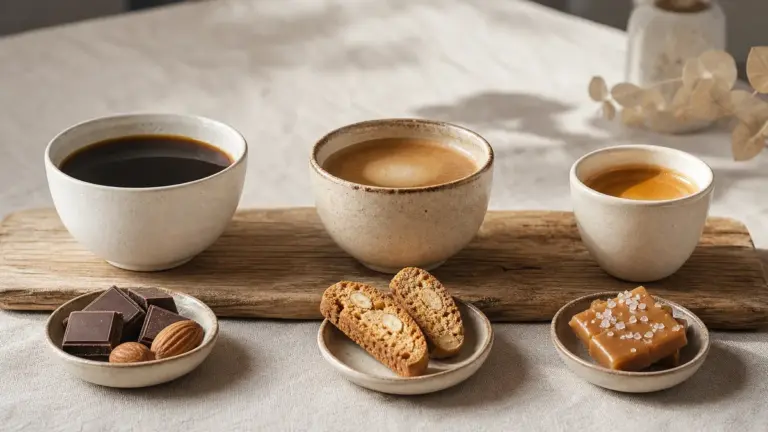
Croissants, almond biscotti, fruit pastries and British bakes all make good coffee companions: start by matching the intensity of the drink to the richness of the bake. For an easy introduction to coffee and pastries, try a plain croissant with cappuccino, almond biscotti with black coffee, or shortbread with a gentle filter brew.
In short
- Choose by the pastry’s dominant flavour, including its filling or topping, rather than its name alone.
- Use shared notes, such as almond, cocoa or fruit, as a starting point, not a guarantee.
- Compare espresso and milk drinks with the same pastry before changing beans.
- Dunk biscotti briefly, then check the texture before dipping again.
- Treat the combinations below as tasting suggestions, not scientifically established matches.
How to Choose Coffee and Pastries
A useful pairing gives both the coffee and the pastry room to be noticed. You might want buttery pastry to remain the main attraction, or prefer a coffee whose fruit notes become more interesting alongside jam.
The recommendations here are editorial starting points based on flavour, texture and relative intensity. Coffee sensory research helps describe what is in the cup, but it does not establish a universally correct pastry partner.
For the wider subject, the coffee and food pairings hub brings the related guides together.
Look for a shared flavour
Coffee can have recognisable almond, cocoa, fruit and spice attributes. These belong to the vocabulary used in the World Coffee Research sensory lexicon, rather than simply being imaginative descriptions.
Use that vocabulary practically. Try almond biscotti with a coffee you describe as nutty, a raisin pastry with one showing dried-fruit notes, or an apple turnover with a cup that reminds you of apple or caramel. The question is whether you enjoy the combination, not whether the tasting notes match perfectly.
For ordinary unflavoured coffee, an almond descriptor does not mean almonds have been added. Actual ingredients and allergen information are a separate matter.
Decide between similarity and contrast
Similarity is a straightforward place to begin: toasted pastry beside a gently roasty coffee, for example. Contrast means deliberately putting different sensations together, such as a bright black coffee beside a rich, buttery bake.
Here, acidity means the sour or bright taste sensation discussed in coffee tasting, not a health judgement. You may enjoy that brightness beside butter, but describing it as “cutting through fat” is a tasting metaphor, not a claim that coffee removes fat from the mouth.
Match intensity before chasing detail
Start by asking whether either partner disappears. If a delicate pastry becomes merely something crunchy beside a forceful espresso, try a less assertive drink. If you notice only icing and filling, taste the coffee separately again before deciding what to change.
Keep the pastry fixed while comparing drinks. This makes it easier to identify your preference than changing the bake, beans and brewing method together.
Coffee and Croissants
A plain croissant is an excellent starting point because there is no jam, chocolate or almond filling competing for attention. Croissant dough is laminated, meaning butter and dough are arranged in layers through rolling and folding, producing its characteristic flaky structure.
My preferred first comparison is a plain croissant with espresso, followed on another occasion by the same style of croissant with cappuccino. Neither is the correct answer: they offer different balances between pastry, coffee and milk.
Plain croissants with espresso drinks
Espresso suits readers who want a distinct contrast between a bite of pastry and a small sip of coffee. Look for a cup you already enjoy on its own. A pastry should not have to rescue an unpleasant drink.
Cappuccino is my recommendation for a gentler starting point. Try it without adding sugar initially, so you can judge the combination as served. Take a bite, finish chewing, then sip rather than trying to taste everything at once.
Flat white is another useful option if you prefer it to cappuccino. Do not rely on the drink name alone when comparing: ask how the café prepares it, then judge the actual cup beside your croissant.
Americano is worth trying if you want black coffee to sip throughout the pastry rather than a short espresso. Choose it because you enjoy the drink, not because black coffee is somehow a more serious pairing.
Filled croissants and pain au chocolat
With filled pastries, let the filling guide your first choice:
- Almond croissant: try a coffee with almond, cocoa or caramel-like notes.
- Pain au chocolat: start with a cup you find rounded and chocolatey.
- Jam-filled croissant: try a fruit-led coffee, then compare it with a milk drink.
- Heavily iced pastry: assess the icing with the coffee, not just an uncoated corner.
These are suggestions rather than rules about origins or roast levels. A bag’s country name alone cannot tell you whether you will enjoy it with an almond filling.
For chocolate-heavy pastries, coffee and chocolate pairings covers that relationship in more detail.
Biscotti with Coffee
The long, crisp biscuits commonly sold as biscotti are made by baking dough, slicing it and baking the slices again. That second bake creates the dry, firm texture that makes dunking useful.
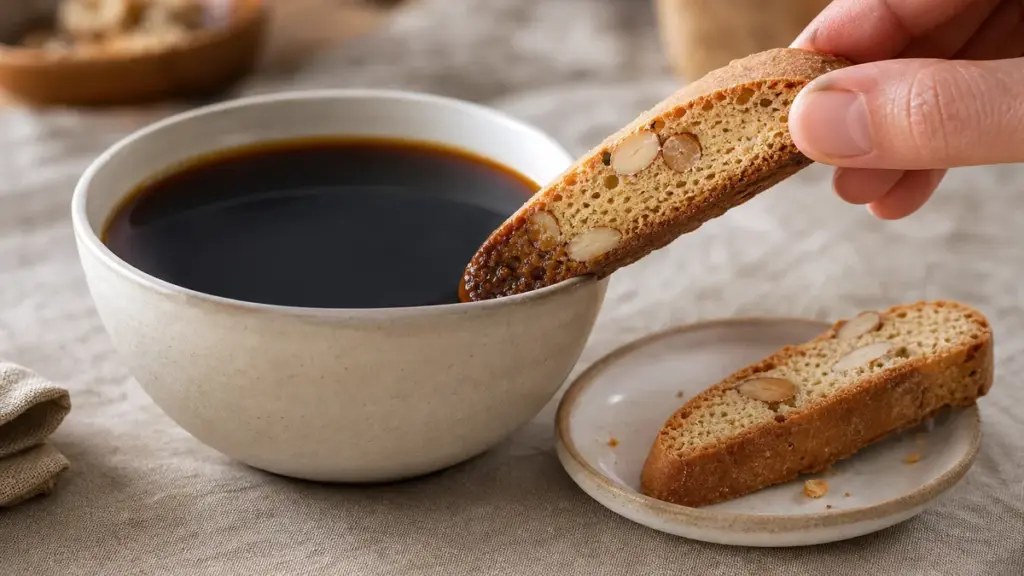
Almond biscotti are my first suggestion for black coffee. Try a bite without dipping, then compare it with a dipped piece: you are choosing a texture as well as a flavour combination.
What the dunking tradition actually involves
Tuscan cantucci have a documented traditional association with Vin Santo, a sweet wine, including dipping the biscuits into it. It would therefore be misleading to present coffee dunking as the sole or defining Tuscan tradition.
Coffee is nevertheless a perfectly reasonable drink to use at home. You do not need to reproduce a particular custom to enjoy the biscuit.
How to dunk biscotti
- Pour a drink you already enjoy and leave enough space to dip without overflowing.
- Hold the biscuit securely and dip only the end you intend to eat.
- Lift it out promptly and check whether it has softened enough.
- Dip again briefly if necessary.
- Keep a saucer underneath while moving it towards your mouth.
There is no useful universal dunking time. Judge the actual biscuit rather than treating a particular number of seconds as a rule.
For chocolate-coated biscotti, include the coating in your tasting bite. For almond or aniseed versions, decide whether you want the coffee to echo that flavour or remain a quieter background.
British Bakes to Serve with Coffee
There is no need to restrict the plate to continental pastries. For choosing an accompaniment, shortbread, scones and buns belong in the same practical conversation, even though they are not all pastries.
The table uses three criteria: the bake’s dominant flavour, the proposed drink’s character and the kind of pairing the reader wants. Every match is an editorial suggestion, not a tested ranking.
| Bake | Coffee to try | Pairing approach | Who it suits |
|---|---|---|---|
| Plain shortbread | Gentle black filter coffee | Keep the accompaniment simple | Readers who want to notice the coffee |
| Scone with jam and cream | Rounded filter coffee or cappuccino | Compare black coffee with milk coffee | Readers happy to experiment with toppings |
| Eccles cake | Coffee with dried-fruit or cocoa notes | Look for flavour similarities | Readers who enjoy fruit-led bakes |
| Bakewell tart | Nutty coffee or a milk drink | Follow the almond and jam filling | Readers who prefer a softer starting point |
| Cinnamon bun | Cappuccino or rounded black coffee | Make the spice the main reference | Readers who enjoy aromatic bakes |
| Apple turnover | Fruit-led filter coffee | Explore fruit alongside fruit | Readers who enjoy bright coffee |
With a scone, taste the assembled mouthful. A bare piece of scone is not the same pairing exercise as one carrying jam and cream.
For Bakewell tart or a cinnamon bun, include enough filling or topping to represent the bake fairly. Otherwise, you may choose a drink for the plain edge and discover that you dislike it with the rest.
For a savoury alternative such as a cheese scone, coffee and cheese is the more useful next read.
A Simple Pairing Tasting at Home or Work
You do not need a formal tasting flight. Choose one bake and compare a black coffee with a milk drink, or compare two coffees prepared in the same way.
Use this short method:
- Taste the coffee alone. Write down a few plain impressions, such as bright, bitter, nutty or drying.
- Taste the bake alone. Identify what you notice most, including filling and topping.
- Take another bite, then sip. Ask whether you still enjoy both.
- Repeat in the opposite order. Sip first, then take a bite.
- Change one thing. Try another drink, a different topping or a smaller amount of filling.
The aim is a repeatable preference, not the most elaborate description. “I prefer this croissant with cappuccino” is a useful result.
For a shared table, retain packaging or ingredient details so people can check what they are eating. Keep fresh-cream bakes refrigerated until needed, follow their storage instructions and use clean serving utensils. The Food Standards Agency’s community-event guidance, applicable to England, Wales and Northern Ireland, specifically advises chilled storage for fresh-cream cakes and desserts.
Going Deeper: Strength, Extraction and Sensory Balance
When a pairing disappoints, separate the coffee’s flavour from the way it has been brewed. Strength describes the concentration of dissolved coffee in the drink; extraction yield describes the proportion of the dry coffee dissolved during brewing. They are related, but they are not interchangeable.
Peer-reviewed work on drip coffee combines controlled sensory measurements with consumer preference testing. It shows that sensory responses and preferences are more complicated than a single “ideal” brewing box suggests, including different groups of consumers with different preferences.
That matters here because “make the coffee stronger” is not a complete pairing solution. First identify the problem: do you want more coffee presence, less bitterness, a different aroma or simply a drink you prefer?
Likewise, sweetness in coffee descriptions needs care. A caramel-like or vanilla-like aroma can contribute to a sweet flavour impression without the drink tasting like coffee with sugar added. Do not assume that a “sweet” tasting note guarantees a match with a very sugary pastry.
The practical response is modest experimentation. Keep your normal satisfactory brewing method, compare the accompaniments, and avoid changing extraction merely because a pairing chart says you should. For the bean-selection questions behind those comparisons, see pairing by roast and origin.
FAQ
Does decaf work with pastries?
Yes, use the same tasting approach with decaf. Choose a cup you enjoy, identify the bake’s dominant flavour, then compare them together. The recommendations here depend on your experience of flavour and texture, not on choosing a caffeinated drink. There is no need to select a different pastry simply because you prefer decaf.
Should I add sugar before trying the pairing?
Try the combination without additional sugar first, then add it if you prefer. This gives you a clear starting point without prescribing how you should drink coffee. If sugar is part of your usual preparation, keep the amount consistent while comparing pastries so that you are not changing several things at once.
Can I use a plant-based drink instead of dairy milk?
Yes, judge the combination using the plant-based drink you actually intend to serve. Taste the prepared coffee on its own before adding the pastry to the comparison. For guests, keep the drink’s packaging and the bake’s ingredient information available rather than assuming that a particular substitution meets everyone’s dietary needs.
Where to go next
Read Coffee and Food Pairings: The Complete Guide for the broader approach, then Pairing by Roast and Origin to refine your coffee choice. For more focused accompaniments to coffee and pastries, Coffee and Chocolate Pairings helps with chocolate fillings, while Coffee and Cheese offers a savoury direction.
Sources
-
World Coffee Research, Sensory Lexicon, version 2.0, 2017. Used for recognised coffee flavour and texture vocabulary.
https://worldcoffeeresearch.org/resources/sensory-lexicon -
Guinard and colleagues, Journal of Food Science, A new Coffee Brewing Control Chart relating sensory properties and consumer liking to brew strength, extraction yield, and brew ratio, 2023. Used for brewing terminology, sensory variation, preference differences and the distinction between sweet taste and sweet flavour impressions.
https://ift.onlinelibrary.wiley.com/doi/10.1111/1750-3841.16531 -
Specialty Coffee Association, Manipulating and Measuring a Key Attribute in Drip Brew Coffee, 25, issue 15, publication year not displayed on the retrieved page. Used for the sensory meaning of acidity and brewing-related variation in sourness.
https://sca.coffee/sca-news/25/issue-15/manipulating-and-measuring-a-key-attribute-in-drip-brew-coffee-zwlhz -
King Arthur Baking, Laminated dough, 2014. Used for croissant lamination and layered pastry structure.
https://www.kingarthurbaking.com/blog/2014/07/29/flaky-buttery-fabulous -
King Arthur Baking, Biscotti, the most unassuming holiday cookies, may also be the best, 2021. Used for the two-stage baking method and firm texture of biscotti.
https://www.kingarthurbaking.com/blog/2021/12/14/best-biscotti-tips -
Regione Toscana, Cantuccini Toscani / Cantucci Toscani IGP, undated product record. Used for the traditional association with Vin Santo and dipping.
https://prodtrad.regione.toscana.it/LIB_DOPIGP/Prodotto.php?ID=48&LANG=ita&RIC=1 -
Food Standards Agency, Providing food at community and charity events, updated 4 September 2026. Guidance applies to England, Wales and Northern Ireland. Used for ingredient information, chilled storage and clean serving utensils.
https://www.gov.uk/government/publications/providing-food-at-community-and-charity-events/providing-food-at-community-and-charity-events
Research combined live checks of sensory research, baking guidance, a regional food record and official food-safety advice; individual pairing recommendations are labelled editorial suggestions, not reported testing.
Last checked: November 2026