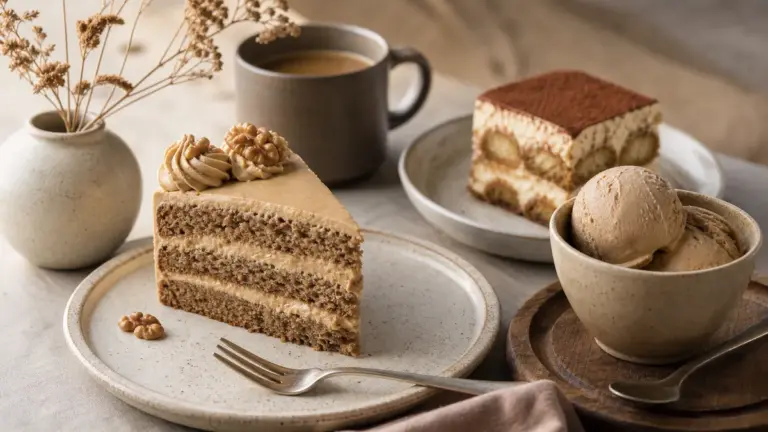
Coffee cake has two common meanings: in Britain, it normally means a coffee-flavoured cake, often with walnuts and coffee buttercream; in America, it usually means a cake to eat alongside coffee, often topped with cinnamon streusel and containing no coffee. Below are recipes for both: a simple crumble-topped cake and a British coffee and walnut sandwich cake.
In short
- Choose streusel coffee cake for a single-layer bake without icing.
- Choose coffee and walnut cake for coffee flavour in both the sponge and buttercream.
- Use a 23 cm square tin for the streusel cake, or two 20 cm sandwich tins for the walnut cake.
- Dissolve instant coffee before adding it, and let the solution cool before mixing it into buttercream.
- The streusel recipe has no caffeine-containing ingredients; the walnut recipe provides an estimated 25 to 45 mg caffeine per slice, depending on the instant coffee used.
Which coffee cake should you make?
The American-style cake is the simpler choice when you want something to slice straight from the tin. Streusel is a crumbly topping made from ingredients such as flour, sugar and butter, often with cinnamon. Here it provides a crisp contrast to a soft sour cream cake.
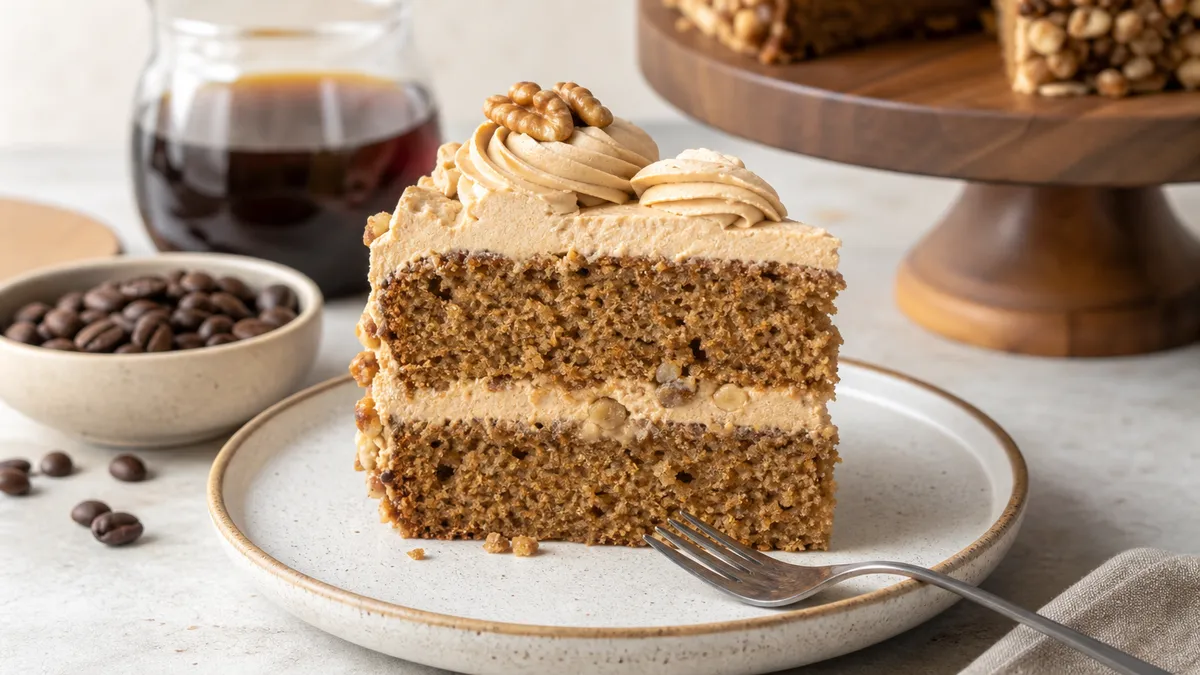
British coffee and walnut cake takes a little more assembly. Two coffee-flavoured sponges sandwich a layer of buttercream, with more icing and walnuts on top. Choose it when you want the coffee to be an ingredient rather than just the accompanying drink.
These recipes are adaptations of published baking recipes, with weighed coffee doses and metric instructions. The streusel version combines King Arthur Baking’s sour cream cake base with its simpler buckle-style crumble topping; the walnut version follows the classic proportions published by Great British Chefs, with adjusted coffee flavouring.
For other ways to use coffee in sweet dishes, browse our coffee desserts collection. If you want a layered dessert rather than a baked sponge, see tiramisu.
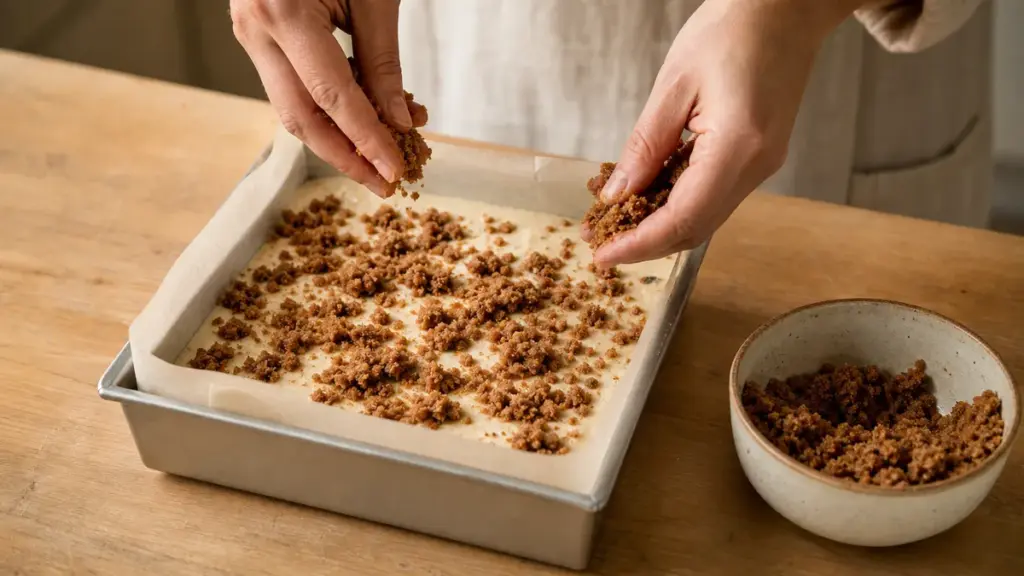
Streusel Coffee Cake
This version contains no coffee. Its character comes from the contrast between a tender sour cream cake and a buttery cinnamon topping.
Recipe card
Serves: 9
Preparation: approximately 20 minutes
Baking: 30 to 40 minutes
Total: approximately 1 hour 20 minutes to 1 hour 30 minutes, including partial cooling
Oven: 180°C conventional or 160°C fan
Equipment: 23 cm square metal cake tin, baking parchment, scales, mixing bowls, electric hand mixer, spatula, skewer and cooling rack
Approximate caffeine: 0 mg from the listed ingredients. Any accompanying coffee adds caffeine separately; pregnancy limits and individual sensitivity still apply to the drink.
Ingredients
For the cake
- 113 g unsalted butter, softened, plus a little for the tin
- 198 g granulated sugar
- 100 g beaten egg, weighed without shell
- 240 g plain flour
- 4 g baking powder
- 1.5 g bicarbonate of soda
- 3 g fine table salt
- 227 g sour cream, brought towards room temperature
For the streusel
- 57 g plain flour
- 67 g granulated sugar
- 3 g ground cinnamon
- 57 g unsalted butter, cool and cut into small pieces
For the small quantities of raising agents, use scales capable of measuring fractions of a gram. The baking powder is approximately one level measuring teaspoon; the bicarbonate is approximately a quarter teaspoon.
Method
- Prepare the tin. Heat the oven to the temperature above. Grease the tin and line it with parchment, leaving enough overhang to help lift out the cooled cake.
- Make the streusel. Mix its flour, sugar and cinnamon. Work in the cool butter with your fingertips until you have uneven crumbs, including some small clusters. Set aside.
- Cream the butter and sugar. Beat the softened butter and granulated sugar until paler and fluffy, scraping the bowl so no dense butter remains underneath.
- Add the egg gradually. Beat in small additions rather than pouring it all in at once.
- Finish the batter. Separately mix the flour, baking powder, bicarbonate and salt. Fold these into the butter mixture in additions, alternating with the sour cream. Scrape the bottom of the bowl and stop once everything is evenly combined.
- Top and bake. Spread the batter in the tin and scatter over the streusel without pressing it into a solid layer. Bake for 30 to 40 minutes, checking from 30 minutes.
- Check the centre. A skewer should come out without wet batter, although a few moist crumbs are fine. Cool on a rack before lifting out and cutting into nine pieces.
The batter is deliberately fairly thick: spread it with a spatula rather than adding water to make it pour. A coffee cake needs enough structure to carry its topping.
Coffee and Walnut Cake
This is the British version: coffee in the sponge, coffee in the buttercream, and chopped walnuts for texture. The measured instant coffee is dissolved in a small amount of water, keeping the added liquid controlled.
Recipe card
Serves: 12
Preparation and assembly: approximately 35 minutes
Baking: 20 to 25 minutes
Total: allow approximately 2 hours, including complete cooling
Oven: 180°C conventional or 160°C fan
Equipment: two 20 cm sandwich tins, parchment, scales, two small heatproof bowls, mixing bowl, electric hand mixer, spatula, skewer, cooling rack and palette knife
Approximate caffeine: 25 to 45 mg per slice when cut into 12 equal portions, using the manufacturer-based calculation explained below. This is an ingredient estimate, not a laboratory measurement. Count it towards caffeine intake during pregnancy and adjust for personal sensitivity.
Ingredients
For the sponge
- 225 g unsalted butter, softened, plus a little for the tins
- 225 g caster sugar
- 4 large eggs, beaten
- 225 g self-raising flour
- 75 g walnuts, chopped
- 6 g instant coffee granules
- 15 ml hot water
For the buttercream and decoration
- 175 g unsalted butter, softened
- 300 g icing sugar, sifted
- 6 g instant coffee granules
- 15 ml hot water
- 12 walnut halves
Use ordinary soluble instant coffee, not ground coffee or a sweetened coffee sachet.
Method
- Prepare. Heat the oven and grease and line both tins. Dissolve each 6 g portion of instant coffee in its own 15 ml portion of hot water. Leave both to cool, keeping the sponge and icing portions separate.
- Cream. Beat the sponge butter and caster sugar until pale and fluffy. Scrape the sides and base of the bowl.
- Add the eggs. Beat them in gradually. If the mixture starts looking curdled, add a little of the measured flour before continuing.
- Fold. Fold in the remaining flour, then the cooled sponge coffee and chopped walnuts, until evenly distributed.
- Bake. Divide between the tins and level gently. Bake for 20 to 25 minutes, until the centres spring back lightly and a skewer comes out without wet batter.
- Cool completely. Let the cakes settle briefly in their tins, then turn onto a rack and remove the parchment.
- Make the buttercream. Beat its butter until smooth, then gradually beat in the icing sugar. Add the cooled icing coffee in small additions, beating until evenly coloured.
- Assemble. Spread half the buttercream over one cold sponge. Add the second sponge, cover its top with the remaining icing and arrange the walnut halves around it.
Keep the sides uniced if you want straightforward assembly and a clear view of the two layers.
Tips for Better Coffee Cake
Give butter and eggs the right start
For creaming, butter should yield when pressed but should not look greasy or melted. Beating it with sugar incorporates air; starting with very cold butter makes that process harder.
Bring refrigerated eggs and sour cream towards room temperature before mixing. Adding cold ingredients to creamed butter can make the mixture separate, so add the egg gradually and scrape the bowl regularly.
Mix thoroughly, then stop
Once flour enters a creamed cake batter, fold until no dry pockets remain rather than continuing to beat vigorously. Under-mixing is not a virtue either: flour trapped at the bottom of the bowl can leave uneven patches.
For the walnut cake, chop the nuts into small pieces rather than grinding them into meal. The recipe is intended to contain distinct walnut pieces.
Keep coffee strength separate from liquid volume
In the walnut recipe, the coffee dose and water quantity are specified separately. For a repeatable result, weigh the granules instead of estimating spoonfuls.
Do not replace the concentrated solution with a mugful of brewed coffee. That changes the cake’s liquid balance, not just its flavour. Likewise, let the icing coffee cool before adding it to softened butter.
| Symptom | Likely cause | Fix |
|---|---|---|
| Butter and sugar remain lumpy | Butter is too cold | Allow it to soften before continuing |
| Batter looks curdled after egg additions | Cold egg or additions made too quickly | Add egg gradually; use a little of the recipe’s flour if needed |
| Dry, close-textured cake | Excess flour or excessive baking | Weigh flour and check from the earliest stated time |
| Buttercream slides off | Sponge is still warm | Cool both layers completely |
| Dense or uneven patches | Ingredients remain unmixed around the bowl | Scrape the base and sides during mixing |
Caffeine, Allergens and Storage
How the caffeine estimate works
NESCAFÉ UK states that its Original and Gold instant coffees contain 50 to 90 mg caffeine per 2 g serving. That is a manufacturer’s range for those products, not a universal value for all instant coffee.
For the walnut recipe, the calculation is:
- Total instant coffee: 12 g.
- Manufacturer-based caffeine range: 25 to 45 mg per gram.
- Estimated total: 300 to 540 mg.
- Divided into 12 equal slices: approximately 25 to 45 mg per slice.
This calculation assumes all the ingredient caffeine remains and is distributed evenly. It makes no deduction for baking and should not be treated as a measured result.
The NHS advises no more than 200 mg caffeine daily from all sources during pregnancy. Individual sensitivity varies; ask a midwife, GP or pharmacist if you need personal advice.
Handle and store safely
Do not taste raw cake batter: uncooked flour can carry food-poisoning bacteria. Wash hands, utensils and work surfaces after handling it.
Both cakes contain wheat, egg and milk; the British cake also contains walnuts. Keep the ingredient list available when sharing cake at work, and check packaged ingredients for additional allergen warnings.
Cool cake before sealing it in a clean container. Keep the streusel cake airtight in a cool, dry place, or freeze portions for longer storage. For the finished walnut cake, a covered container in the fridge is a cautious storage choice, particularly in a warm kitchen.
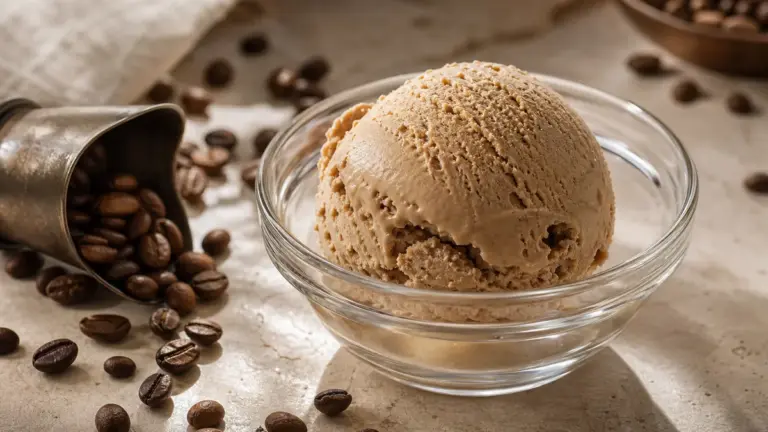
If you change the filling to fresh cream, keep the cake refrigerated. For a different chilled accompaniment, follow the separate coffee ice cream recipe rather than improvising a filling.
FAQ
Can I use yoghurt instead of sour cream?
Yes, plain yoghurt is an alternative in the streusel cake. King Arthur Baking’s source recipe allows yoghurt in place of sour cream and advises against a non-fat version. Use the same 227 g quantity here, choose an unsweetened product and keep the remaining ingredients unchanged rather than adjusting several parts of the recipe at once.
Do I need a stand mixer?
No, an electric hand mixer is sufficient for both recipes. Use it for creaming butter and sugar and for beating the buttercream, then use a spatula for folding and scraping. The British source recipe itself uses a hand-held whisk, so a stand mixer is not a requirement for this style of cake.
Can I bake the walnut cake in one deep tin?
Do not assume that the same baking time will work in one deep tin. These instructions are for two shallow 20 cm layers, and changing the depth changes how the centre bakes. For the most predictable result, use the specified tins or choose a separately developed deep-cake recipe rather than simply combining the batter.
Where to go next
Coffee Desserts: The Complete Guide is the next read for choosing between baked, chilled and frozen desserts. Tiramisu takes coffee into a layered dessert, while Coffee Ice Cream offers a cold alternative to serve after a meal or alongside coffee cake.
Sources
- King Arthur Baking, “Sour Cream Coffee Cake”, updated 2026. Cake-base quantities, mixing sequence, baking checks and yoghurt substitution.
https://www.kingarthurbaking.com/recipes/sour-cream-coffee-cake-recipe - King Arthur Baking, Kye Ameden, “Blueberry Buckle Coffee Cake”, 2019. American coffee-cake meaning and the basis of the separate streusel topping.
https://www.kingarthurbaking.com/blog/2019/08/14/blueberry-buckle-coffee-cake - Great British Chefs, Karen Burns-Booth, “Coffee and walnut cake”, undated webpage. British cake proportions, sandwich tins and baking method; coffee quantities and decoration adapted here.
https://www.greatbritishchefs.com/recipes/coffee-walnut-cake-recipe - King Arthur Baking, “Cake & Cupcakes”, undated guide. Mixing, ingredient temperature, bowl scraping and effects of changing cake tins.
https://www.kingarthurbaking.com/learn/guides/cake - King Arthur Baking, “Creaming butter and sugar: How to get it right”, 2015. Butter consistency and creaming technique.
https://www.kingarthurbaking.com/blog/2015/04/27/creaming-butter-and-sugar - King Arthur Baking, “Ingredient Weight Chart”, undated reference. Egg weight and conversions for raising agents and salt.
https://www.kingarthurbaking.com/learn/ingredient-weight-chart - NESCAFÉ UK & Ireland, “General FAQs”, undated manufacturer information. Published caffeine range for Original and Gold instant coffee.
https://www.nescafe.com/gb/faqs - NHS, “Foods to avoid in pregnancy”, current webpage checked 2026. Pregnancy caffeine guidance.
https://www.nhs.uk/pregnancy/keeping-well/foods-to-avoid/ - Food Standards Agency, “Handling flour and flour products safely”, 2024. Raw flour and batter precautions.
https://www.gov.uk/government/publications/handling-flour-and-flour-products-safely/handling-flour-and-flour-products-safely - Food Standards Agency, “Providing food at community and charity events”, updated 2026. Cake storage, fresh-cream fillings and sharing ingredient information.
https://www.gov.uk/government/publications/providing-food-at-community-and-charity-events/providing-food-at-community-and-charity-events
Researched from published recipe developers, baking guidance, manufacturer caffeine information and official food-safety advice; the adaptations have not been independently kitchen-tested.
Last checked: November 2026