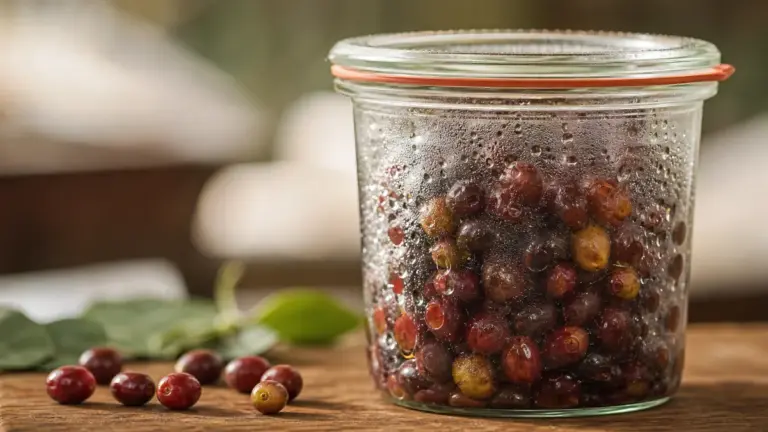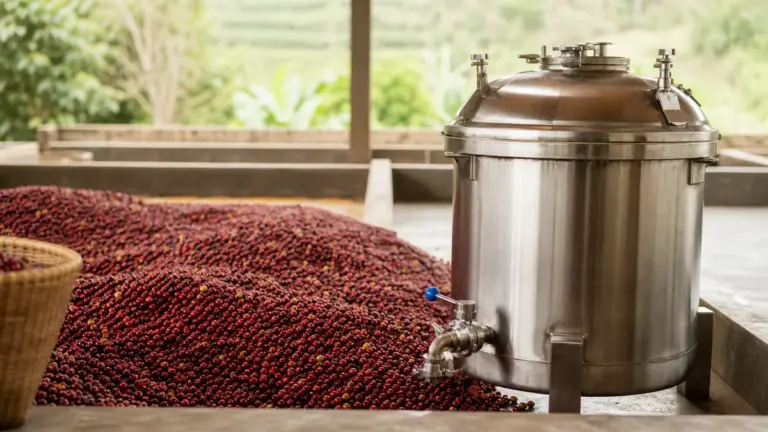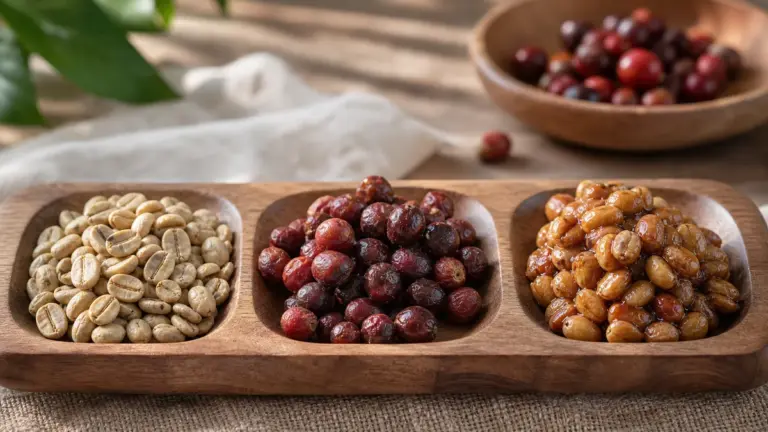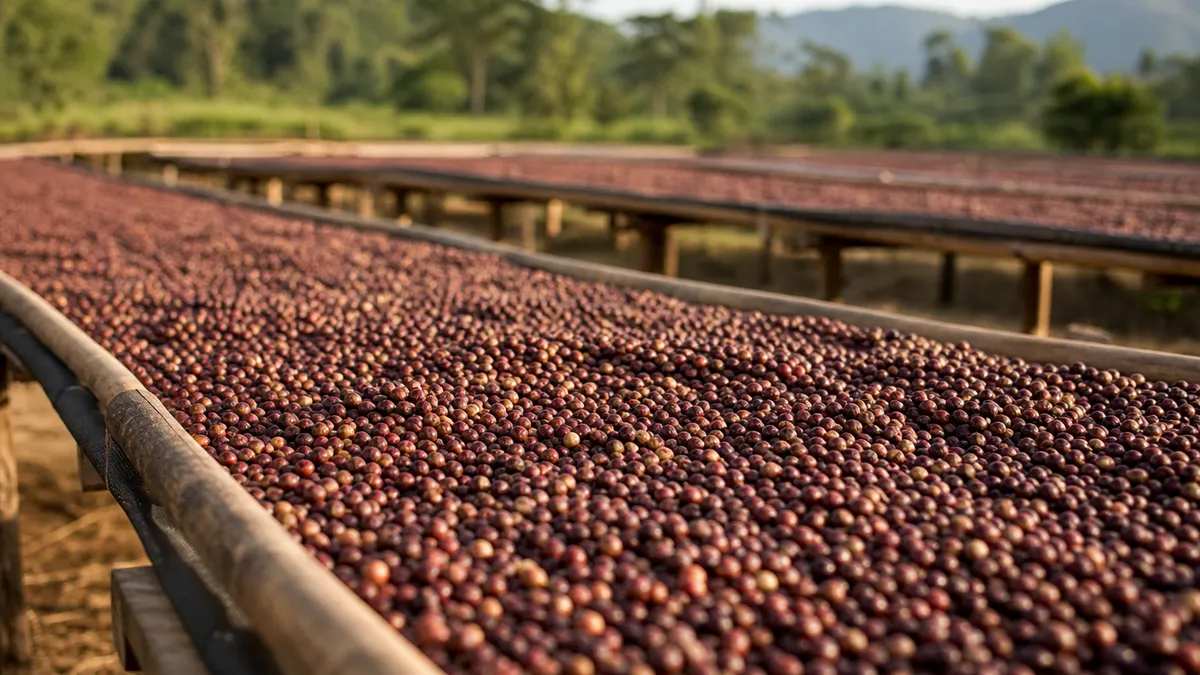
The natural process, also called dry processing, means drying coffee beans inside the whole coffee cherry before removing the dried fruit. Cherries are spread on patios or raised beds and turned during drying, which commonly takes two to six weeks, depending on conditions. The resulting coffee often has pronounced fruit flavours and a full body, although the process alone does not guarantee either quality or a particular taste.
In short
- Whole fruit stays on: the skin and flesh remain around the seeds during drying, unlike processes that remove them first.
- Raised beds and patios are both valid: airflow, cleanliness, weather protection and management matter more than the equipment name alone.
- Turning is essential: it helps coffee dry evenly and reduces conditions favourable to mould and unwanted fermentation.
- Time is not the finishing test: producers need moisture measurements, not simply a set number of sunny days.
- Brazil, Ethiopia and Yemen are established natural-processing origins: look for the process of the individual lot rather than assuming everything from a country is natural.
What is the natural coffee process?
A coffee bean is the seed inside a fruit known as a coffee cherry. Natural processing keeps that fruit intact while it dries; hulling, the mechanical removal of the dried outer layers, comes afterwards. The defining feature is therefore what surrounds the seed during drying, not whether the coffee touches water at any point.
Producers may clean and sort cherries using water before spreading them out. That does not turn the coffee into a washed coffee: the skin and flesh still remain during drying. In the washed process, those fleshy layers are removed before the main drying stage.
Natural processing also differs from the honey process, where the skin is removed but some sticky mucilage, the sugary coating around the parchment-covered seed, remains. For the wider framework, start with coffee processing methods.
From ripe cherry to green coffee
The basic sequence is straightforward, but each stage needs attention:
- Harvest and sort. Remove unsuitable fruit and foreign material, including leaves and twigs.
- Begin drying promptly. Spread the cherries rather than leaving fresh fruit waiting in sacks or unmanaged heaps.
- Manage the drying layer. Turn the cherries, maintain airflow and protect them against rewetting.
- Check the endpoint. Measure representative samples rather than judging the whole lot by its appearance.
- Hull and grade. Remove the dry fruit coverings, then clean and sort the unroasted green beans.
This is a production method, not simply fruit left outdoors until it looks dry. Good naturals depend on deliberate control throughout the drying period.
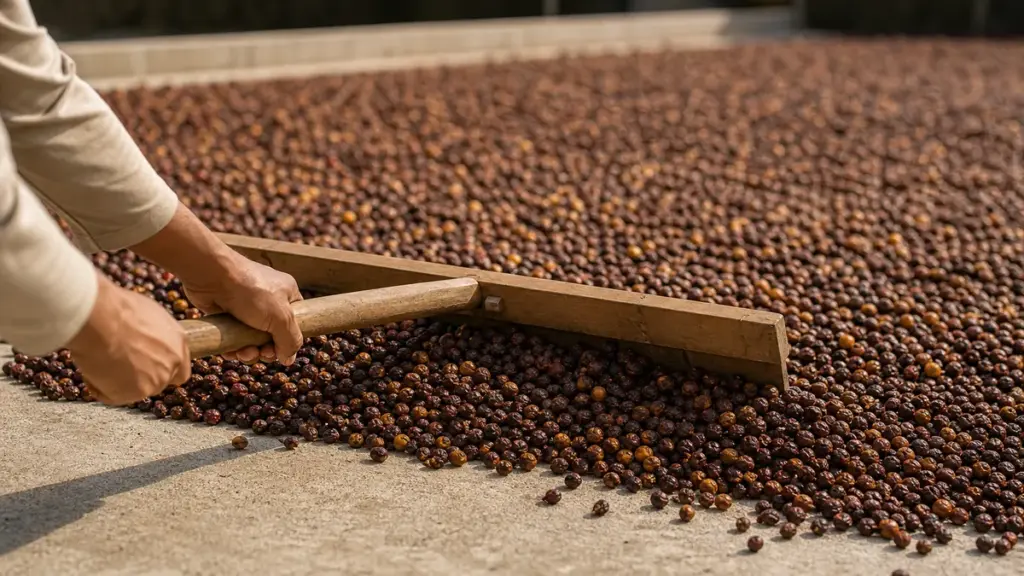
Sundried Natural
A sundried natural is whole-cherry coffee dried using solar heat and circulating air. On a patio, cherries lie on a prepared surface, commonly concrete or brick, and workers move them with rakes or by hand. Turning exposes different surfaces and helps prevent persistently damp pockets.
The patio must be clean and suitable for the local climate. Bare earth introduces contamination concerns, while an impermeable surface can retain moisture beneath the coffee if poorly managed. Rain protection is not enough on its own: producers must also manage ventilation and spread the coffee back out when conditions permit.
Patio drying is not automatically inferior to raised-bed drying. FAO guidance reports that differences between drying surfaces can be small and inconsistent, while weather and the way equipment is used have substantial effects. A well-managed patio should not be dismissed merely because another coffee’s description mentions raised beds.
Some producers combine sun drying with mechanical drying. Research on Brazilian natural coffee has examined precisely this combination, including controlled resting periods between drying stages. The important distinction remains that the coffee is processed as whole fruit; “natural” need not mean exclusively sun-dried from start to finish.
Raised Bed Natural
Raised-bed naturals follow the same whole-cherry process, but the drying surface is elevated and permeable, usually mesh or matting supported by a frame. These structures are often called African beds. Their practical advantage is that air can circulate beneath the coffee as well as above it.
Elevation also keeps the drying fruit away from direct soil contact. However, a raised bed still needs appropriate loading, regular turning and protection from rain. Putting cherries on mesh does not remove the risks associated with wet weather or neglected fruit.
The useful comparison is operational rather than a ranking of prestige:
| Criterion | Patio natural | Raised-bed natural |
|---|---|---|
| Supporting surface | Prepared solid surface | Elevated, permeable surface |
| Air beneath the cherries | Restricted by the solid surface | Can circulate through the bed |
| Daily handling | Raking or manual turning | Manual turning and sorting |
| Shared priorities | Cleanliness, even drying, weather protection | Cleanliness, even drying, weather protection |
Both systems require active management; neither provides a quality guarantee by itself.
Turning and drying time
Two to six weeks is a useful broad description, not a production recipe. Kenya’s Agriculture and Food Authority gives this range for naturals, with the duration depending on country and climate. The International Trade Centre gives the same broad interval.
Sunshine, humidity, air movement, layer thickness and rainfall all affect progress. Consequently, a drying duration printed on a coffee bag tells only part of the story: it does not establish whether the coffee dried evenly or reached an appropriate final condition.
How often are cherries turned?
There is no single schedule suitable for every drying site. FAO’s mould-prevention guidance suggests turning four times daily where possible, while Codex calls for constant turning during daytime. These are general management recommendations, not interchangeable specifications for every climate and lot.
The shared principle is to avoid leaving a damp, static layer. Producers need to adapt their routine to weather and drying behaviour rather than treating a turning count as proof that the work is complete.
When is drying finished?
The endpoint should be measured. FAO’s Lao coffee manual describes natural processing to approximately 12% bean moisture, while Codex requires coffee intended for transport to be uniformly dried below 12.5% moisture. These figures concern moisture content, not the percentage of the cherry that has disappeared.
Representative sampling matters because one reading cannot establish uniformity across an entire lot. Codex recommends sampling different points and using instrumental measurements as drying approaches completion. The practical question is not “Has it had enough days?” but “Is it sufficiently and evenly dry?”
Fermentation, flavour and the risks of getting it wrong
Dry processing does not mean fermentation is absent. Microorganisms remain active while sufficient moisture is available in the fruit. A peer-reviewed processing experiment by De Bruyn and colleagues found different microbial communities and chemical profiles under wet and dry processing, including abundant acetic acid bacteria and yeasts in the dry treatments.
That study provides direct experimental evidence that processing conditions affect coffee chemistry. It does not establish a universal formula linking a particular microorganism, drying duration or chemical measurement to a named flavour in every finished cup. Its findings came from a specific case study, not every natural-producing region.
What does natural coffee taste like?
Naturals are commonly associated with fruity flavours, pronounced perceived sweetness and a heavier body. Body means the drink’s sense of weight or thickness in the mouth. These are useful expectations when choosing coffee, but not promises attached to every bag labelled natural.
It also helps to separate fruit character from fermentation defects. World Coffee Research’s sensory lexicon distinguishes fruit attributes from fermented, acetic, musty and mouldy characteristics. “Fruity” should not become an all-purpose defence for an unpleasantly tainted cup.
Over-fermentation and mould are different problems
Uncontrolled fermentation can damage flavour; mould growth is a separate spoilage concern. Delayed processing, badly managed drying and rewetting can compromise the coffee before it reaches the roaster. Later processing cannot reliably restore quality already lost through poor handling.
Certain moulds can also produce ochratoxin A, a food-safety contaminant addressed by Codex’s coffee code of practice. This is why drying control, sorting and dry storage are more than cosmetic quality measures. It is not a reason to assume that natural coffee as a category is unsafe.
Regions known for naturals
Brazil, Ethiopia and Yemen are established examples of countries where natural processing is prevalent. The International Coffee Organization associates the method particularly with locations where water is scarce, while the International Trade Centre highlights low humidity and low rainfall as favourable conditions.
Naturals are not confined to those countries, nor are they exclusive to arabica. FAO describes dry processing across several producing origins and its extensive use for robusta. Country, species and processing method are separate pieces of information, so check each rather than allowing one to stand in for the others.
For UK readers choosing a bag, my recommendation is to favour a clear description over elaborate terminology. Use this checklist:
- Is the coffee identified as whole-cherry natural, rather than pulped natural?
- Does the description distinguish patio drying, raised-bed drying or a combined system?
- Are the tasting notes appealing to you, rather than merely impressive-sounding?
- Is there useful information about the producer and handling, beyond a long drying duration?
These are reading and buying criteria, not a certification scheme. The best use of “natural process” is as a clue to how the coffee was made, followed by a judgement of the particular coffee rather than the label alone.
FAQ
Can a natural coffee be washed before drying?
Yes, cherries can be cleaned or separated by flotation before natural drying. What defines the process is that the whole fruit remains around the seed during the main drying stage. A preliminary encounter with water does not make it a washed-process coffee, where skin and pulp are removed before drying.
Does natural processing mean no water is used?
No, the name does not guarantee zero water use. Producers may use water for sorting or cleaning, even though the central process dries intact cherries rather than washing away their fruit layers. For the same reason, “natural” alone is not enough information to support a precise water-use or wider environmental claim.
Is pulped natural the same as natural?
No, pulped natural coffee has its outer skin removed before drying, whereas a whole-cherry natural retains it. The similar wording can be confusing, but the difference is fundamental to the processing sequence. Read the fuller description rather than treating every name containing “natural” as an identical method.
Where to go next
Read Coffee Processing: The Complete Guide for the full sequence from harvested cherry to green bean, then Washed Process to compare drying with the flesh removed. Honey Process explains retained mucilage, while Semi-Washed Process helps untangle another easily confused processing label.
Sources
-
International Trade Centre, The Coffee Guide, fourth edition, 2021. Processing overview and broad natural-drying duration.
https://www.intracen.org/media/5718 -
FAO and WHO, Codex Alimentarius, Code of Practice for the Prevention and Reduction of Ochratoxin A Contamination in Coffee, CXC 69-2009, adopted 2009. Drying, sampling, moisture and contamination controls.
https://www.fao.org/fao-who-codexalimentarius/sh-proxy/zh/?lnk=1&url=https%253A%252F%252Fworkspace.fao.org%252Fsites%252Fcodex%252FStandards%252FCXC%2B69-2009%252FCXC_069e.pdf -
FAO, Guidelines for the Prevention of Mould Formation in Coffee, 2006. Climate, drying surfaces, turning and equipment-management evidence.
https://www.fao.org/fileadmin/user_upload/agns/pdf/coffee/guidelines_final_en.pdf -
FAO, Arabica Coffee Manual for Lao-PDR, 2005, Chapter 6, “Harvesting and processing”. Process definitions, moisture endpoint and quality losses.
https://www.fao.org/4/ae939e/ae939e08.htm -
FAO, Introduction, sections 1.7 to 1.9, undated web chapter. Whole-cherry processing, flotation, patios, raised tables and hulling.
https://www.fao.org/4/x6939e/x6939e01.htm -
International Trade Centre, The Coffee Exporter’s Guide, third edition, 2011. Harvest handling, drying hygiene, raised tables and weather protection.
https://digitallibrary.un.org/record/721086/files/Coffee-guide-2012.pdf -
Agriculture and Food Authority, Kenya, Coffee Year Book 2023/24, processing section. Natural-processing duration, turning and sensory tendencies.
https://www.afa.go.ke/download/5226/ -
International Coffee Organization, Coffee Development Report 2022-23: Beyond Coffee, Towards a Circular Coffee Economy, section B.2.4. Processing, established origins and water-scarce settings.
https://ico.org/documents/cy2024-25/coffee-development-report-2022-23.pdf -
De Bruyn and colleagues, Applied and Environmental Microbiology, Exploring the Impacts of Postharvest Processing on the Microbiota and Metabolite Profiles during Green Coffee Bean Production, 2017, volume 83, issue 1, e02398-16.
https://pmc.ncbi.nlm.nih.gov/articles/PMC5165123/ -
Isquierdo and colleagues, Ciência e Agrotecnologia, Quality of Natural Coffee Subjected to Different Rest Periods during the Drying Process, 2012, volume 36, issue 4.
https://www.scielo.br/j/cagro/a/rCJyTYJSrwvkPhkKWhjHbsG/?lang=en -
World Coffee Research, Sensory Lexicon, version 2.0, October 2017. Sensory vocabulary and distinctions between fruit, fermented and mould-related attributes.
https://worldcoffeeresearch.org/resources/sensory-lexicon
This article was researched using retrieved production manuals, international technical guidance, a national coffee authority publication and peer-reviewed processing experiments, with general guidance distinguished from individual experimental findings.
Last checked: November 2026