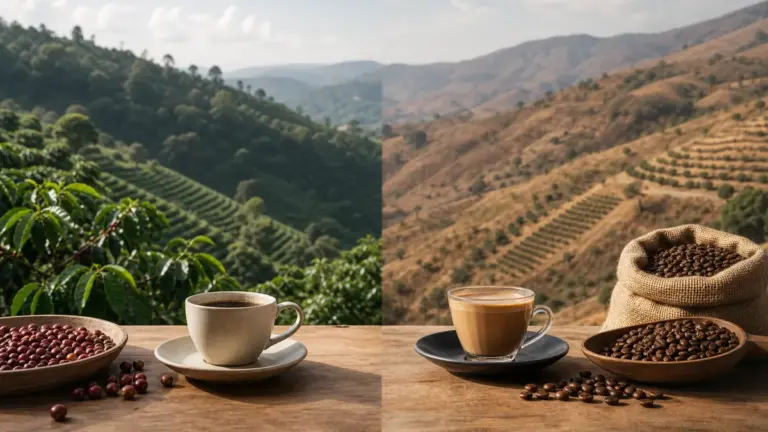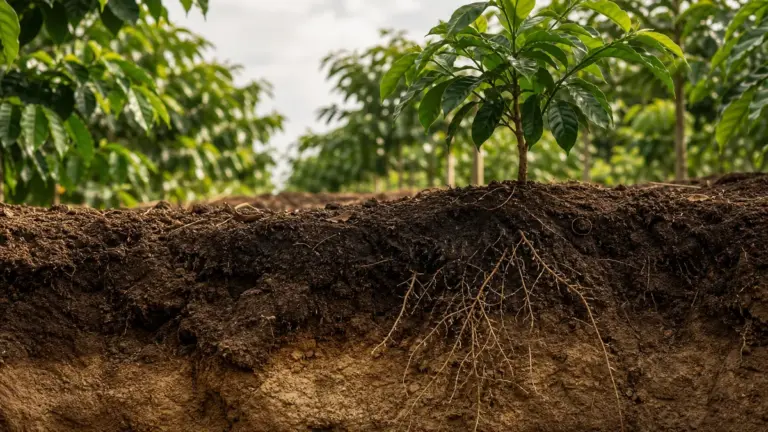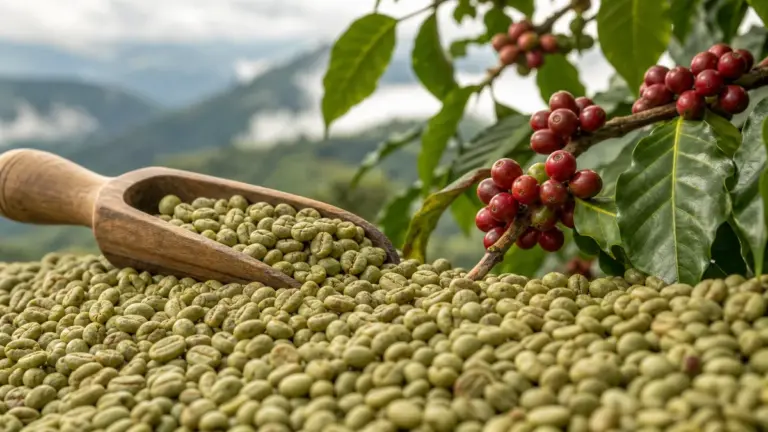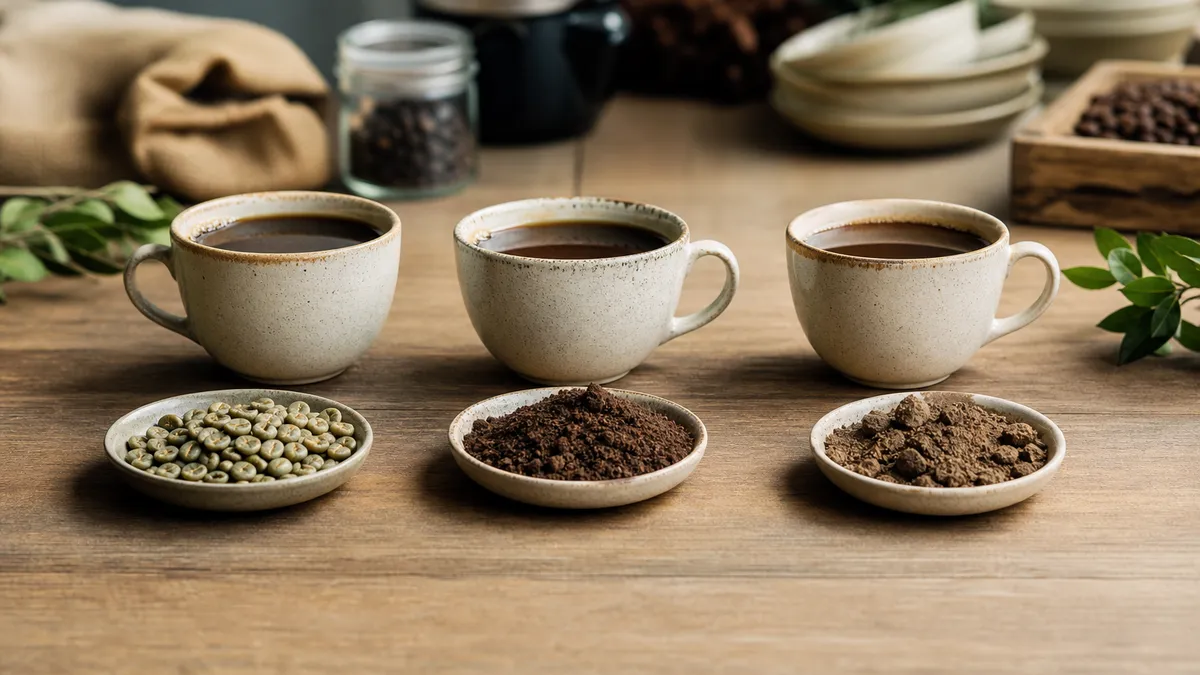
Coffee terroir affects flavour profiles by changing how the plant develops its seeds, influencing the acidity, aromas and texture that emerge after processing, roasting and brewing. Cooler growing conditions and higher altitude can favour distinctive, lively cups, but no elevation, soil type or rainfall pattern guarantees a particular flavour.
In short
- Treat altitude as a clue to growing conditions, not a flavour guarantee.
- Separate acidity, aroma and body when comparing coffees: they need not change together.
- Soil nutrients can affect bean chemistry, but they do not provide a simple mineral-to-flavour recipe.
- Match variety, processing and roast as closely as possible before attributing differences to terroir.
- A side-by-side tasting reveals differences between coffees, not proof of what caused them.
How growing conditions reach the cup
Terroir means the influence of a growing place and its conditions. Here, the useful question is not simply where coffee grew, but how that environment affected the developing bean. For the wider definition, start with terroir explained.
Research has connected growing conditions with changes in green coffee chemistry and, in some studies, with the sensory character of the brewed drink. These are related findings, but they are not interchangeable: a chemical difference does not automatically produce a noticeable flavour difference.
Think of growing conditions as shaping the raw material rather than writing a finished tasting note. Processing changes that material after harvest, while roast and extraction influence what reaches your cup. This is why comparing two bags from different countries, with different varieties and processing methods, cannot isolate terroir.
The coffee terroir hub provides the broader reading path. This article concentrates on recognising possible differences without giving them more certainty than the evidence allows.
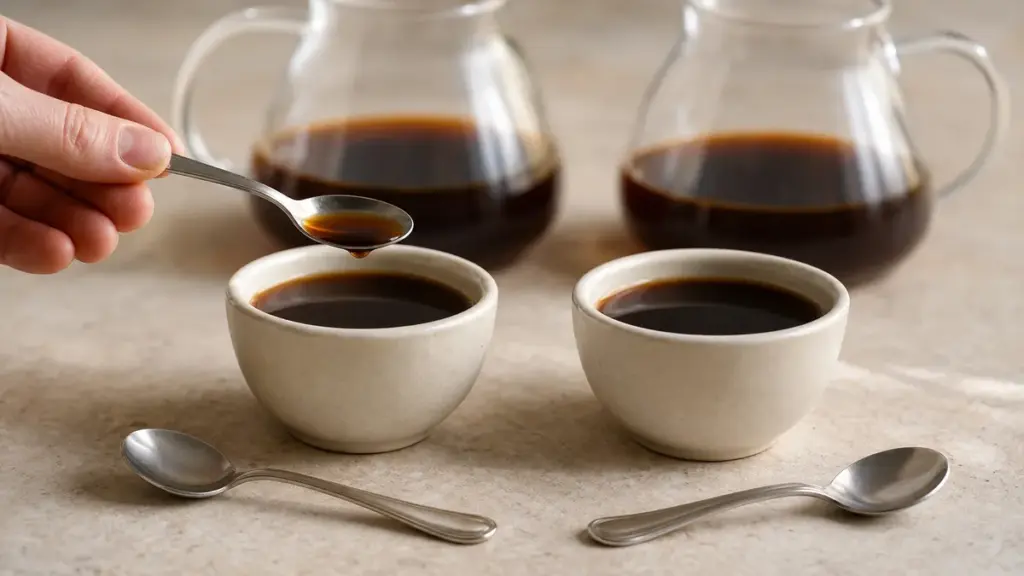
Recognising terroir’s impact on flavour profiles
Begin with separate observations rather than a verdict such as “more complex”. The World Coffee Research Sensory Lexicon distinguishes taste, aroma and mouthfeel attributes, providing a useful model even when you are not conducting a professional assessment.
| Attribute | What to record | What it cannot establish alone |
|---|---|---|
| Acidity | How pronounced the sour taste is, and whether it feels balanced | Growing altitude or the concentration of a particular acid |
| Aroma | Floral, fruity, nutty or other recognisable aromatic impressions | A unique geographical origin |
| Body | Relative fullness and thickness in the mouth | Soil fertility or growing temperature |
| Sweetness | The strength of the sweet impression | How much sugar the green bean contained |
| Finish | Which sensations remain after swallowing | Whether the difference arose before or after harvest |
These are observation prompts, not diagnostic tests. “More citrus-like, less thick and with a longer floral finish” is a more useful comparison than “this tastes mountainous”.
Keep description separate from preference, too. You might prefer a rounder, quieter coffee while still finding a brighter sample more distinctive. Neither preference establishes which growing environment was better.
Altitude and acidity: a useful clue, not a rule
Higher-grown coffee can show more pronounced acidity, but elevation does not act independently of the rest of the growing environment.
A field study by Avelino and colleagues in Costa Rica found a positive relationship between altitude and taster preference within the areas studied. Slope exposure also mattered: east-facing sites produced coffees with higher acidity scores than other exposures. That makes altitude a useful starting clue, not a complete explanation.
The same study offers a warning against simple flavour charts. Coffees from Orosi showed floral character, while those from Santa María de Dota showed chocolate character that became more marked at higher elevation. Higher did not simply mean “more floral”.
When tasting comparable coffees, ask whether acidity changes in intensity and whether the aromatic character changes alongside it. Do not assume that the brightest cup must come from the highest plot. See altitude and temperature for the growing conditions behind that relationship.
Temperature and maturation: why development matters
Temperature during seed development can affect the composition of the bean. Joët and colleagues found relationships between growing temperature and particular chlorogenic acid and fatty acid profiles. Chlorogenic acids are a group of naturally occurring plant compounds, not another name for the sourness you taste.
There is also experimental evidence connecting slower maturation with cup quality. In a Costa Rican trial, Vaast and colleagues manipulated shade and fruit load. Shade delayed cherry flesh ripening and improved beverage quality under the conditions tested.
That supports a role for the pace of development, but not the slogan “slower always means sweeter”. The trial’s sun-grown beans actually contained more sucrose, yet produced greater bitterness and astringency, the drying sensation in the mouth.
Nor does every chemical component follow temperature in the same way. Joët’s study did not find a climatic influence on total soluble sugar content. A careful explanation therefore concerns changes in development and composition, not a universal accumulation of “more flavour”.
Soil nutrients: influence without a flavour code
Soil-related nutrition can change bean chemistry and beverage quality. In an experiment by Clemente and colleagues, the balance of nitrogen and potassium, and the potassium dose, affected chemical measurements and cup quality.
This is evidence that nutrition matters. It is not evidence that potassium tastes of caramel, or that one soil description predicts a floral cup. The experimental result concerns a plant’s response to nutrient supply, not the direct transfer of a soil’s taste into coffee.
For the drinker, the sensible question is whether a soil claim comes with actual tasting and growing information. “Volcanic soil” alone tells you much less about the cup than a comparison that also identifies variety, processing and roast.
Avoid treating an earthy note as proof that you are tasting the farm’s earth. The nutrient experiment does not establish that interpretation. Read soil composition for the underlying agronomy rather than trying to diagnose soil from a sip.
Rainfall: why less water does not automatically mean more flavour
Rainfall matters through the water available to the plant, but an annual rainfall total is not itself a tasting note. A useful comparison needs to consider the growing season and the coffee variety, rather than sorting origins into “wet” and “dry” flavour categories.
Pappo and colleagues tested reduced precipitation using rainout shelters in a field experiment with arabica cultivars. The treatment produced a moderate overall decline in sensory quality. Acidity scores moved down across the cultivars, although the authors reported substantial uncertainty.
This challenges the appealing claim that water stress necessarily concentrates desirable flavour. In this experiment, reduced water availability did not provide that simple benefit.
It also illustrates why harvest yield and cup character should be assessed separately. The study found increased yield alongside reduced sensory quality. More production did not mean a more highly rated drink, and a grower’s response cannot be inferred from cup quality alone.
Variety and processing change the expression of place
A variety is a genetically distinguishable type within a coffee species. It is not merely another name for the location where the coffee grew.
World Coffee Research describes Panamanian Geisha as having delicate floral, jasmine and peach-like aromas, with high cup quality associated with good management at high altitude. That is a variety-and-environment relationship, not evidence that altitude creates jasmine in every coffee.
Processing also modifies the material being compared. Joët’s research found that the effect of wet processing on sorbitol, a sugar alcohol, depended on glucose present in the fresh seed. Growing conditions and processing were interacting, rather than making neatly separate contributions.
Body deserves particular caution. Tarzia and colleagues compared processing treatments and found differences in beverage composition without differences in measured viscosity or surface tension. Chemistry had changed, but those physical measurements had not.
The practical lesson is to match variety and processing where possible. If both differ, describe the result as a comparison between finished coffees, not a test of growing place.
A practical comparison you can make at home
This is a learning exercise, not a controlled terroir experiment. Ask a roaster for coffees with the same named variety, similar processing, comparable roast development and traceable growing information. If the match is incomplete, record the differences rather than ignoring them.
- Choose the comparison question. For example: does the higher-grown lot have more pronounced acidity? Avoid asking which coffee has “more terroir”.
- Keep preparation consistent. Use the same brewer, water, grinder setting and measured recipe. Record coffee and water in grams, water temperature in degrees Celsius and brewing time.
- Taste without the origin information visible. Write your observations before reading the supplied tasting notes.
- Compare like with like. Taste the coffees at similar drinking temperatures and record acidity, aroma and body separately.
- Repeat before explaining. Look for a difference you can recognise again, then consider possible causes and remaining confounding factors.
Consistency matters because brewing itself changes sensory character. Frost and colleagues experimentally varied roast, brew strength and extraction, finding changes in attributes including sourness, sweetness, citrus flavour and thickness.
Use restrained conclusions: “This lot repeatedly tasted brighter under the same preparation” is defensible. “The altitude caused its brightness” requires evidence that the tasting cannot provide.
Evidence and myths: how confidently can you interpret a cup?
Different research designs answer different questions. A field comparison can identify relationships between location and flavour, but several conditions may change together. An experiment that manipulates shade or rainfall gives stronger evidence about that treatment, while remaining specific to its tested setting.
Keep these common shortcuts in check:
- “Higher always tastes better.” Elevation is easy to compare on a bag, but the Costa Rican field study also found effects associated with slope exposure.
- “Slower maturation means more sugar and therefore more sweetness.” The shade experiment showed that sucrose concentration and desirable sensory outcomes did not follow that simple sequence.
- “Drought concentrates quality.” The rainfall experiment instead found a decline in sensory quality under reduced precipitation.
- “A chemical difference proves a sensory difference.” The processing study found changed composition without changed measured viscosity or surface tension.
These findings are not necessarily contradictions. They measure different treatments, compounds and outcomes. The most useful approach is to recognise repeatable cup differences first, then use growing information to form a cautious explanation.
FAQ
Can I identify a coffee’s altitude by tasting it?
No, acidity or aroma alone cannot establish growing altitude. Field research shows that sensory attributes can vary with slope exposure as well as elevation, while brewing experiments demonstrate additional changes after roasting. Taste can help you compare samples, but traceable producer information is needed to establish where they grew.
Does a fruit tasting note mean the coffee contains added fruit?
Not by itself: a fruit descriptor can describe an aromatic resemblance. World Coffee Research identifies peach-like aromas in Panamanian Geisha, for example. A tasting note is not an ingredient declaration, so ask the roaster for processing information if you need to establish whether anything was added.
Does body mean the same thing as strength?
No, body describes mouthfeel, while brew strength concerns the concentration of dissolved coffee material. They can be related, but they are not interchangeable. Brewing research found that thickness changed with experimental brewing conditions, which is another reason not to attribute a fuller cup directly to its growing environment.
Where to go next
Read Coffee Terroir Explained for the wider definition, then Altitude and Temperature for the growing conditions behind possible acidity differences. Soil Composition examines the root environment, while Coffee Terroir brings the subject together so you can explore its impact on flavour profiles without relying on origin stereotypes.
Sources
-
World Coffee Research, Sensory Lexicon, version 2.0, 2017. Descriptive vocabulary for taste, aroma and mouthfeel.
URL: https://worldcoffeeresearch.org/resources/sensory-lexicon. -
CIRAD, ICAFE and IICA-PROMECAFE, Avelino and colleagues, Effects of slope exposure, altitude and yield on coffee quality in two altitude terroirs of Costa Rica, Orosi and Santa María de Dota, 2005, Journal of the Science of Food and Agriculture. Field evidence on elevation, exposure and cup character.
URL: https://scijournals.onlinelibrary.wiley.com/doi/abs/10.1002/jsfa.2188. -
CATIE and CIRAD, Vaast and colleagues, Fruit thinning and shade improve bean characteristics and beverage quality of coffee (Coffea arabica L.) under optimal conditions, 2006, Journal of the Science of Food and Agriculture. Experimental evidence on maturation and quality.
URL: https://scijournals.onlinelibrary.wiley.com/doi/abs/10.1002/jsfa.2338. -
IRD and collaborating researchers, Joët and colleagues, Influence of environmental factors, wet processing and their interactions on the biochemical composition of green Arabica coffee beans, 2010, Food Chemistry. Primary study abstract in the institutional repository.
URL: https://www.documentation.ird.fr/hor/PAR00004292. -
Universidade Federal de Viçosa, Clemente and colleagues, Effects of nitrogen and potassium on the chemical composition of coffee beans and on beverage quality, 2015, Acta Scientiarum. Agronomy. Nutrient-treatment experiment.
URL: https://periodicos.uem.br/ojs/index.php/ActaSciAgron/article/view/19063. -
University of Florida and collaborating researchers, Pappo and colleagues, Effects of reduced rainfall on coffee quality and volatile composition, 2024, Journal of the Science of Food and Agriculture, published online in 2023. Rainfall-manipulation experiment.
URL: https://scijournals.onlinelibrary.wiley.com/doi/10.1002/jsfa.12949. -
World Coffee Research, Arabica Coffee Varieties: Geisha (Panama), undated catalogue entry, accessed November 2026. Variety-specific quality and aroma information.
URL: https://varieties.worldcoffeeresearch.org/varieties/geisha-panama. -
Universidade Federal do Paraná and Instituto Agronômico do Paraná, Tarzia and colleagues, Influence of the postharvest processing method on polysaccharides and coffee beverages, 2010, International Journal of Food Science and Technology. Processing, composition and physical measurements.
URL: https://academic.oup.com/ijfst/article/45/10/2167/7865267. -
University of California, Davis, Frost, Ristenpart and Guinard, Effects of brew strength, brew yield, and roast on the sensory quality of drip brewed coffee, 2020, Journal of Food Science. Controlled brewing and sensory experiment.
URL: https://ift.onlinelibrary.wiley.com/doi/10.1111/1750-3841.15326.
Researched using retrieved primary research abstracts, publisher records and World Coffee Research resources; the suggested tasting exercise is editorial guidance, not a validated method for isolating terroir.
Last checked: November 2026