Coffee harvesting means collecting the fruit of the coffee tree, known as cherries, either by selecting ripe cherries individually, stripping fruit from branches or using machinery. The aim is to deliver suitable, consistently ripe fruit to processing before its condition deteriorates, using a method that fits the farm, terrain and available workforce.
In short
- Selective picking leaves unripe cherries on the tree for later visits; hand harvesting does not always mean selective picking.
- Ripeness depends on the variety: some coffee cherries mature yellow rather than red.
- Strip picking and mechanical harvesting need careful timing and separation of unsuitable fruit.
- Harvest seasons vary between countries and within them, so a national calendar is only a guide.
- Picking, transport and processing must work together. A carefully harvested crop can still lose quality through poor handling.
What is actually harvested?
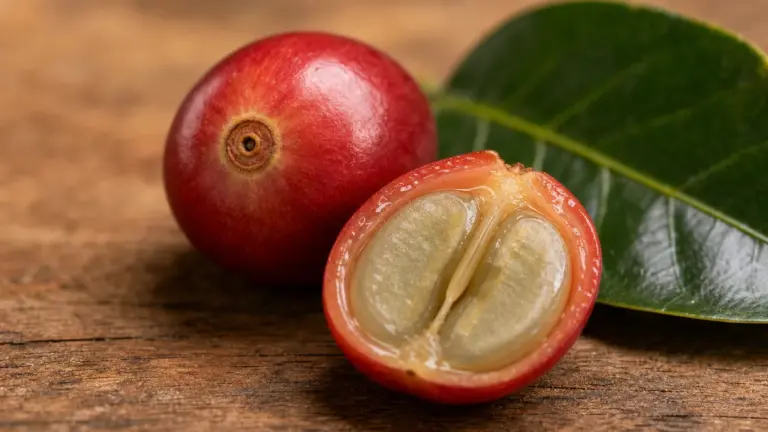
Harvesters collect coffee cherries, not the dry brown beans that go into a grinder. The beans are seeds inside the fruit, surrounded by protective layers that processing and milling subsequently remove.
That distinction explains why harvesting matters so much. Workers are handling a perishable agricultural crop, not a finished, shelf-stable ingredient. For a closer look at the fruit’s layers, read coffee cherry anatomy.
Harvesting is also only one part of the journey. It determines which fruit enters processing and in what condition, but it does not replace the work of sorting, drying or evaluating the finished green coffee.
Ripeness: knowing when to pick
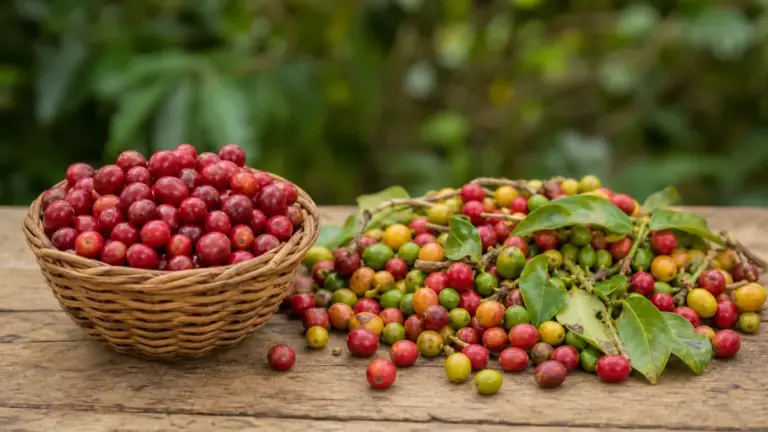
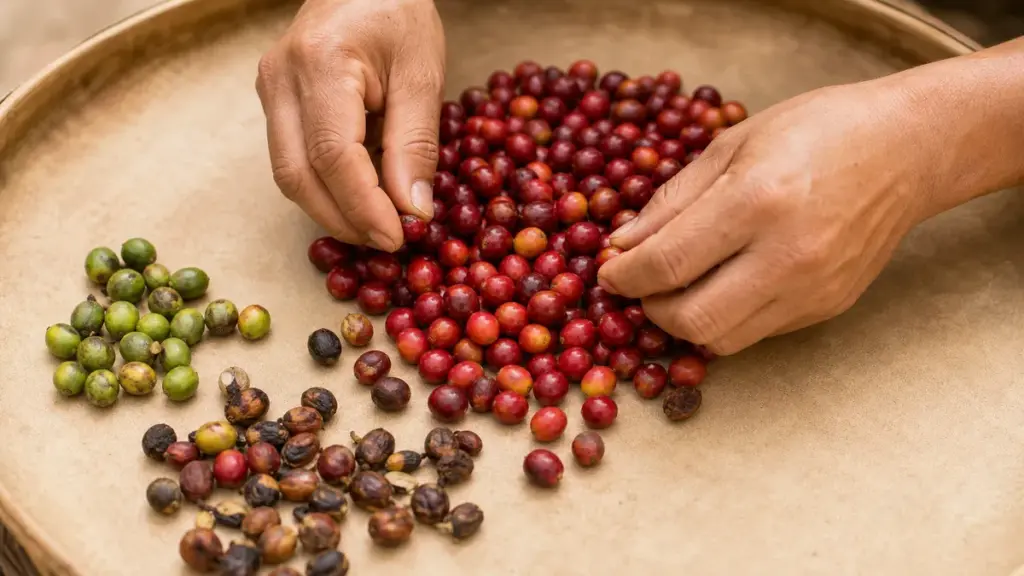
The central task is recognising the correct maturity for the variety and intended process. On a red-fruited coffee tree, a branch can carry green, partly coloured and fully red cherries together. Selective picking separates those stages at the tree rather than leaving the whole task to the processing station.
Red is not a universal instruction. World Coffee Research identifies both yellow-fruited and red-fruited types of Catuaí, for example. A yellow cherry might therefore be ripe fruit or an intermediate stage, depending on the plant.
Why the crop does not ripen together
Flowering does not necessarily happen in a single event. Where flowering occurs at different times, cherries reach maturity at different times too, making repeated picking necessary.
Climate and altitude also influence the harvest calendar. ICAFE, Costa Rica’s coffee institute, describes early, middle and late-maturing regions, with temperature, rainfall and elevation helping explain their different schedules.
The practical rule is to assess the fruit in the field rather than work solely from a date. A calendar helps organise workers and equipment; it cannot confirm that a particular branch is ready.
The three main coffee harvesting methods
The most useful comparison is not simply hands versus machines. It is how selectively the fruit is removed, how mixed the harvested material becomes and what happens to it afterwards.
| Method | How it works | Where it fits | Main limitation |
|---|---|---|---|
| Selective hand picking | Workers remove ripe cherries individually and return for later fruit | Crops with uneven ripening where careful selection is practical | Requires repeated visits and substantial labour |
| Hand strip picking | Workers remove the fruit from a branch together | Branches or blocks with sufficiently concentrated maturity | Collects a mixture if ripening is uneven |
| Mechanical harvesting | Machinery detaches cherries through vibration | Plantations accessible to suitable equipment | Performance depends on terrain, crop condition and machine settings |
Selective picking
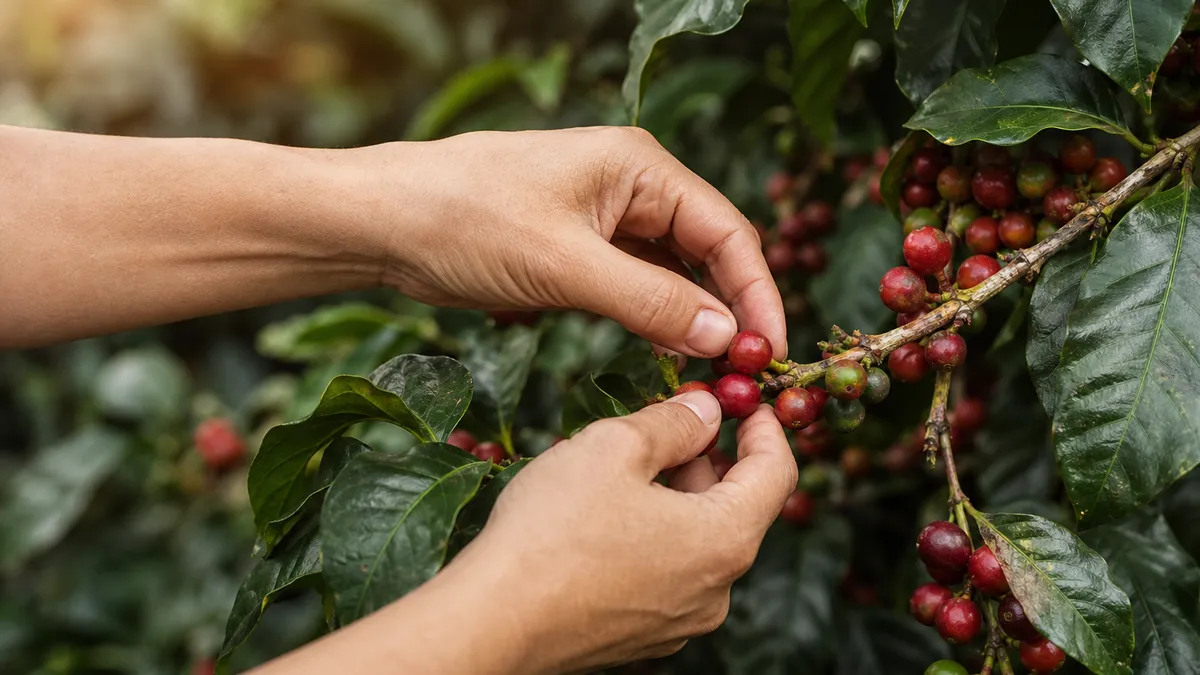
Selective picking means choosing individual ripe cherries while leaving less mature fruit attached. It is particularly useful when a branch holds several stages of ripeness.
The advantage is control at the point of collection. Instead of harvesting everything and separating it later, workers exclude much of the unsuitable fruit before it enters the basket.
The limitation is the work involved. Picking teams must revisit trees as the remaining cherries mature, and careful selection requires clear instructions about acceptable fruit. The label “hand-picked” alone does not establish that this happened, because stripping can also be done by hand.
Strip picking
Strip picking removes fruit together rather than selecting each cherry. It may involve a whole crop in one operation, or successive visits to branches bearing predominantly ripe fruit.
Timing is therefore crucial. If maturity is concentrated, stripping can collect a more uniform crop; if many cherries remain green while others are already overripe, the harvested mixture needs greater separation.
It is misleading to treat stripping as proof of poor coffee. The relevant questions are how ripe the crop was, what unsuitable material was removed and how the selected fruit was processed.
Mechanical harvesting
Mechanical harvesters use vibrating components to detach fruit. Their operation involves choices about settings and movement through the crop, rather than simply switching a machine on.
Research has examined selective mechanical harvesting as well as complete removal. A field experiment published in Precision Agriculture compared a two-pass selective approach with a single total harvest, using settings adapted to areas with different maturity and productivity.
Terrain remains a constraint, but “machines only work on flat land” is too absolute. Brazilian research has tested equipment adapted for slopes, while showing that slope affects operational performance. Suitability must be assessed for the particular machine and plantation, not inferred from a general description.
Harvest seasons: why there is no single coffee calendar
Coffee harvesting follows local crop development, so seasons differ by region. Even within one country, an early-maturing district may be finishing while a later one is still preparing.
Costa Rica illustrates the spread. ICAFE’s regional guidance gives an estimated July start for Turrialba, compared with November for Tarrazú. These are planning windows, not promises for every farm or season.
Colombia demonstrates another pattern. The Federación Nacional de Cafeteros describes central-region harvest peaks between April and June and between September and December. The larger harvest is called the main crop; the smaller is the mitaca or traviesa. Which period supplies the main crop varies by location.
For a UK buyer, the useful question is therefore “When was this lot harvested?” rather than “When does this country harvest?” Ask for the producing region and harvest period together. Avoid treating a broad national calendar as evidence about an individual coffee.
Labour and wages: the people behind the harvest
Selective picking is labour-intensive because workers repeatedly search for suitable cherries rather than collect every fruit they encounter. In Kenya, FAO describes harvesting that draws on both family members and hired labour.
Payment arrangements matter too. Piece-rate pay means earnings depend on the amount collected, commonly measured by weight or volume. Verité’s research in the Latin American coffee sector identifies risks including inaccurate measurement, excessive hours, underpayment and child labour.
Those findings are evidence of risks, not proof that every piece-rate arrangement is abusive. Verité also reports workers who preferred piece rates, while recommending safeguards such as minimum-wage protection, understandable employment terms and transparent records.
There is a quality connection: rewarding quantity without supporting careful selection can encourage indiscriminate collection. Buyers should ask how workers are paid and protected, not assume that a harvesting description answers those questions.
Conditions also extend beyond wages. An ILO study in Honduras identified concerns involving temporary workers’ accommodation and social protection. These findings are specific to its study context, but show why responsible sourcing requires more than a photograph of cherries being picked.
From the branch to the processing station
A good harvest needs an organised handover. FAO’s account of Kenyan production describes prompt transport to processing facilities, while Codex guidance recommends processing cherries as soon as possible.
Use this checklist to understand the sequence:
- Define acceptable fruit. Establish the correct ripe appearance for the variety and explain it to the picking team.
- Plan the passes. Revisit selectively harvested trees as remaining fruit matures.
- Keep collection clean. Where fruit is detached onto sheets, prevent it becoming mixed with old fallen cherries.
- Separate unsuitable material. Remove immature, overripe, diseased or otherwise unacceptable fruit before the main lot proceeds.
- Arrange prompt transport. Coordinate collection with the receiving station rather than leaving harvested fruit waiting unnecessarily.
- Match harvesting to processing capacity. Do not collect more fruit than the available processing and drying arrangements can handle properly.
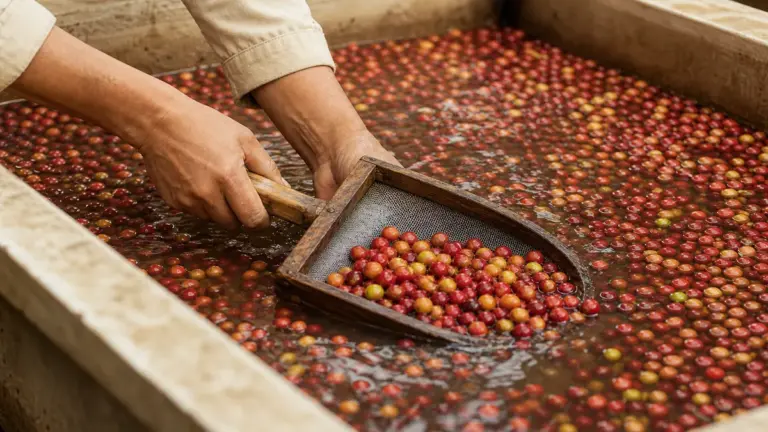
At the station, cherries may undergo visual sorting and water separation. These are additional controls, not reasons to ignore harvest quality.
The next route depends on the process. Natural coffee dries inside the whole cherry; washed coffee has the skin and pulp removed before further treatment and drying. See picking and processing for the fuller explanation of that handover.
How harvesting affects coffee quality
Harvesting changes the raw material available to the processor. Its effects are easiest to understand through three connected factors: maturity, uniformity and condition.
Maturity affects flavour potential
FAO’s Arabica coffee manual for Lao PDR associates harvesting green cherries with green or grassy flavours. It also identifies overripe fruit and prolonged holding before pulping as potential sources of unwanted fermented flavours.
These are risks, not a diagnosis that can be made from tasting alone. A grassy or fermented note does not establish exactly what happened during harvesting.
Uniformity helps processing
A more consistent batch is easier to handle consistently. FAO notes that processing ripe cherries together allows better adjustment of pulping equipment and reduces potential bean damage.
This explains why selection still matters even when a station has sorting machinery. Sorting removes unsuitable material; it does not make immature fruit mature.
Handling preserves the selection
Fruit quality can deteriorate after collection. Old fallen cherries, dirty drying surfaces and poor processing hygiene are among the problems identified in FAO guidance.
The best assessment therefore follows the chain: what was picked, how it was separated, how quickly it moved and how processing was managed. That is a more useful way to judge coffee harvesting than treating either human hands or machinery as a guarantee.
FAQ
Are coffee beans picked straight from the tree?
No, harvesters collect the cherries that contain the coffee seeds. The surrounding fruit tissues are removed during processing and milling, with the sequence depending on the method used. What reaches a roaster is green coffee, not an intact cherry, and roasting happens after those earlier stages.
Can coffee cherries dry on the tree before harvesting?
Yes, deliberate drying on the plant is an option in suitable dry harvesting conditions. Codex recognises this approach, but it should not be confused with leaving fruit unmanaged in humid conditions. The acceptability of tree-dried fruit depends on the production system and its controls, not simply its dark appearance.
Does selective picking guarantee fair treatment of workers?
No, selective picking describes fruit selection, not employment conditions. It does not establish whether workers receive lawful wages, accurate payment records or adequate protection. Ask about those arrangements separately. Verité’s research shows why a quality-focused sourcing description should not be treated as a substitute for labour due diligence.
Where to go next
Read Coffee Cherry Anatomy to understand what harvesters collect and which layers protect the seeds. Continue with Picking and Processing to follow the harvested fruit into its next stage, or use Coffee Harvesting to explore the wider harvesting topic.
Sources
-
CIRAD, “Coffee: Plant and uses”, undated web resource, retrieved November 2026. Background on mixed maturity, selective picking and stripping.
https://www.cirad.fr/en/our-activities-our-impact/tropical-value-chains/coffee/plant-and-uses -
World Coffee Research, Arabica Varieties Catalog: Catuaí, undated current entry, retrieved November 2026. Red-fruited and yellow-fruited types.
https://varieties.worldcoffeeresearch.org/varieties/catuai -
Federación Nacional de Cafeteros de Colombia, Cartilla Cafetera 19: Recolección de café, undated retrieved edition. Harvest distribution, flowering and picking guidance.
-
ICAFE, “Preguntas frecuentes: Recolección”, guidance referring to the 2020/2021 campaign, retrieved November 2026. Regional harvest windows and maturity differences, used as illustrative guidance rather than a current-season forecast.
https://www.icafe.cr/icafe/preguntas-frecuentes/ -
Kazama and colleagues, “Methodology for selective coffee harvesting in management zones of yield and maturation”, Precision Agriculture, volume 22, 2021, published online 2020. Field experiment comparing selective and total mechanical harvesting.
https://link.springer.com/article/10.1007/s11119-020-09751-1 -
Santinato and colleagues, “Mechanical harvesting of coffee in high slope”, Revista Caatinga, volume 29, 2016. Field study of slope-adapted harvesting equipment.
https://www.scielo.br/j/rcaat/a/X89DGy7F49sWYjFpZ6tyDbf/ -
Verité, Piece Rate Pay and Production Quotas in the Latin American Coffee Sector: The Impacts on Wages, Hours of Work, Women, and Children, October 2024. Labour research and recommended safeguards.
https://verite.org/wp-content/uploads/2024/11/white-paper-piece-rate-pay-coffee-sector.pdf -
International Labour Organization, Improving occupational safety and health in the global coffee value chain in Honduras: Drivers and constraints, 2020. Country-specific research on workers and working conditions.
https://vzf.ilo.org/wp-content/uploads/2021/04/Improving-occupational-safety-and-health-in-the-global-coffee-value-chain-in-Honduras-Drivers-and-constraints.pdf -
FAO, Arabica coffee manual for Lao PDR, Chapter 6: “Harvesting and processing”, 2005. Processing routes, pulping and potential quality problems.
https://www.fao.org/4/ae939e/ae939e08.htm -
FAO, “Annex 5: Coffee Post Harvest Handling and processing in Kenya”, undated retrieved annex. Family and hired harvesting labour, transport and processing.
https://www.fao.org/4/x6939e/x6939e11.htm -
Codex Alimentarius Commission, Code of Practice for the Prevention and Reduction of Ochratoxin A Contamination in Coffee, CXC 69-2009, adopted 2009, retrieved current text. Harvest systems and handling recommendations.
https://www.fao.org/fao-who-codexalimentarius/sh-proxy/en/?lnk=1&url=https%253A%252F%252Fworkspace.fao.org%252Fsites%252Fcodex%252FStandards%252FCXC%2B69-2009%252FCXC_069e.pdf
This guide was researched using agricultural research organisations, national coffee guidance, peer-reviewed field studies, labour research and FAO/Codex handling recommendations, without first-hand farm testing.
Last checked: November 2026