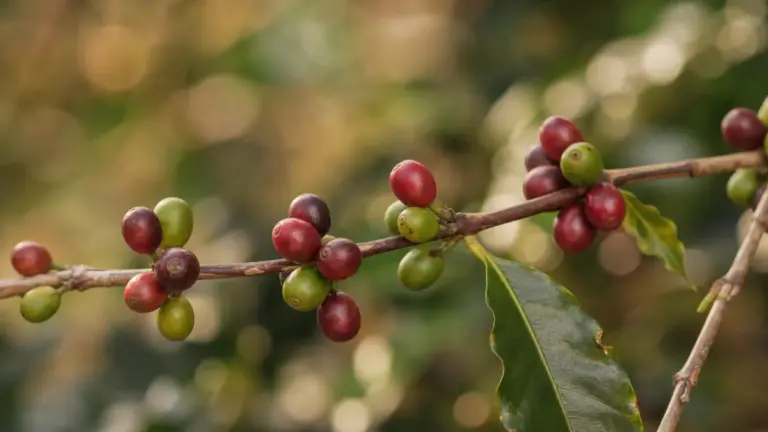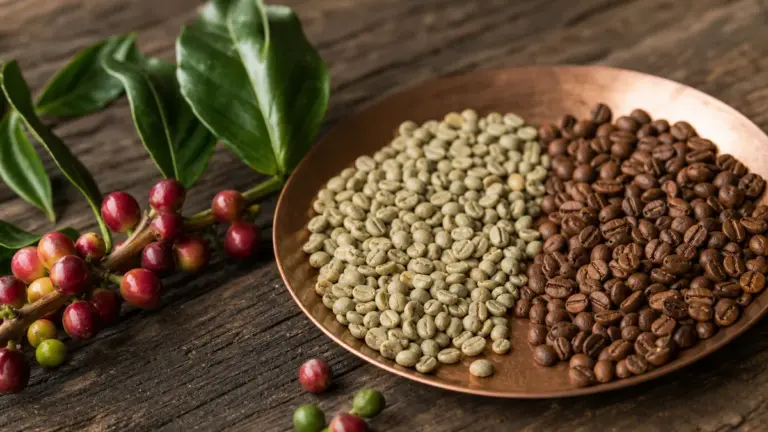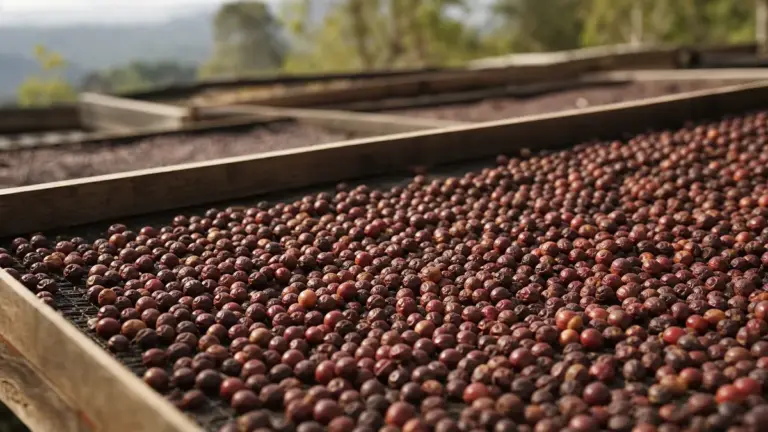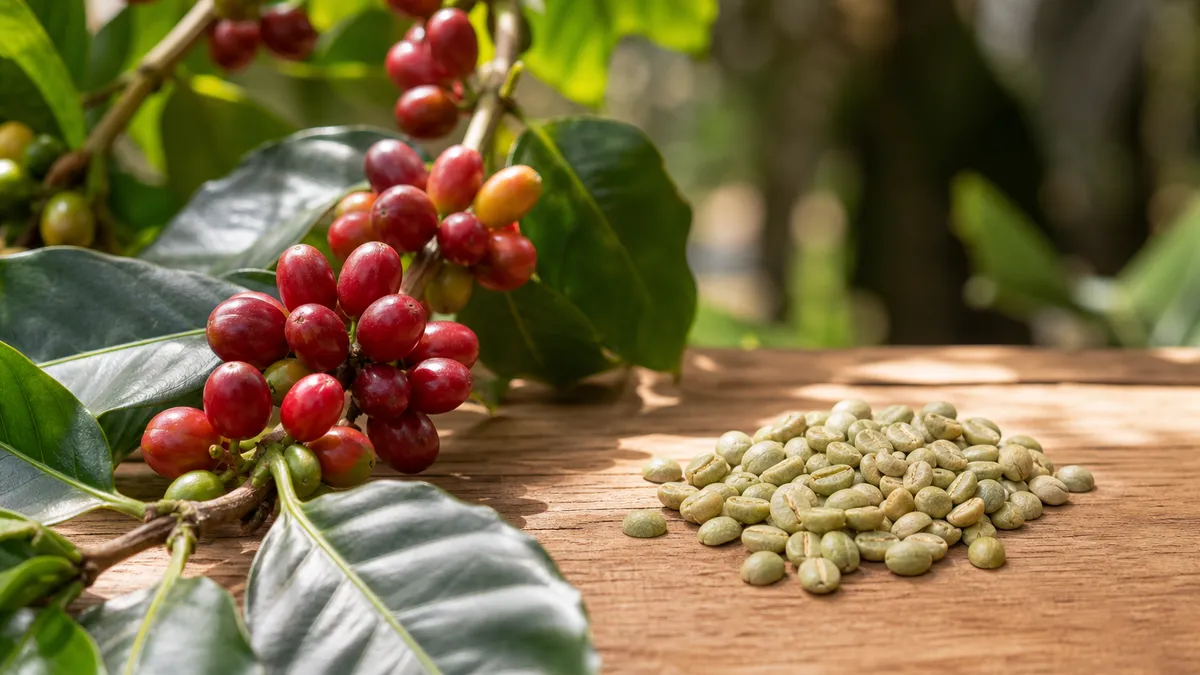
Angolan coffee is chiefly robusta, with chocolate, earthy and woody notes appearing in commercial descriptions, although the individual lot matters more than the national label. Once a major producer under Portuguese colonial rule, Angola is rebuilding its coffee sector after decades of conflict, while arabica remains a smaller part of the story.
In short
- Look for the species, producing area and processing method, not simply “Angolan coffee”.
- Amboim, Ambriz and Cazengo are established origin names, but should not automatically be read as genetically verified cultivars.
- Natural processing, in which the whole coffee cherry is dried before its outer layers are removed, is an established method.
- FAO’s historical calendar gives June to October for harvesting; ask suppliers for the actual lot’s harvest dates.
- Recovery projects now address planting material, farmer support, traceability and quality, rather than production volume alone.
What does Angolan coffee taste like?
The most useful starting point is a substantial robusta rather than an assumption of bright, fruit-led arabica. Portuguese roaster CafeLab describes its Amboim coffee as full-bodied, with chocolate and earthy notes and a woody aroma. Those are the seller’s descriptions of its product, not the results of independent testing for this article.
There is also a longer-standing reputation for a relatively balanced cup. A Common Fund for Commodities project appraisal published in 2006 described Angolan robusta as pleasant and comparatively neutral, and recorded its use in southern European blends with arabica. That historical assessment helps explain the origin’s reputation, but cannot establish how a current shipment tastes.
For a first purchase, ask what the roaster means by “strong”. Does it describe a weighty texture, a dark roast, pronounced bitterness or simply an assertive flavour? These are different things, and a country name does not answer the question.
Treat descriptions of Angolan arabica separately. Do not transfer the tasting notes of an Amboim robusta to an arabica grown on the Central Plateau. Look for a description attached to the actual coffee offered, ideally supported by a recent tasting.
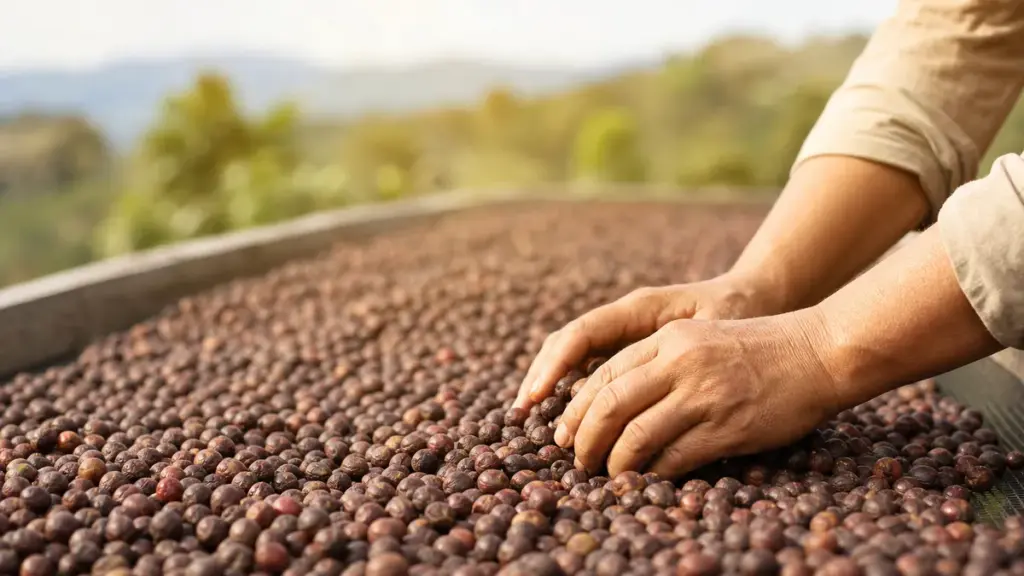
Angolan coffee fact panel
The figures below describe documented examples and historical reference material. They are not a complete national survey of every coffee-growing district.
| Feature | Documented picture | Scope and source |
|---|---|---|
| Altitude | CAFRICA lists Ambriz robusta at 600 to 700 metres, Amboim robusta at 800 to 1,700 metres and Andulo arabica at 2,000 metres | Exporter-published examples, not national limits |
| Main species and variety names | Mainly Coffea canephora, traded as robusta; smaller arabica production. Amboim, Ambriz and Cazengo appear as local names | European Commission/Agrinatura, 2020; botanical identity below species level needs qualification |
| Processing | Dry or natural processing is established; CAFRICA lists it for both robusta and arabica examples | FAO, 2000; current exporter information |
| Harvest months | June to October in FAO’s country profile | Historical national calendar, not a guarantee for every current lot |
| Typical cup profile | An Amboim robusta is described as full-bodied, earthy and chocolate-like, with woody aroma; an older sector appraisal describes a comparatively neutral, pleasant robusta cup | CafeLab product description; CFC appraisal, 2006 |
An altitude on a product sheet is useful only when it belongs to the coffee being sold. The broad spread in these examples is a reason to seek farm or collection-area details, not to give every Angolan coffee the same growing conditions.
For the wider regional context, start with southern African coffee, then return to the species and provenance of the individual lot.
Where robusta and arabica grow
Angola’s established coffee economy centres on robusta. The European Commission’s coffee value-chain analysis places much of that production in northern growing areas, while identifying arabica development at higher elevations on the Central Plateau.
A peer-reviewed agroclimatic study published in 2018 helps explain that division. It describes plateau and mountain conditions favourable to arabica, but also records robusta in Angolan tropical forest regions above 1,300 metres. Robusta therefore should not be reduced to “low-altitude coffee” in this origin.
Current commercial examples reinforce the distinction. CAFRICA lists robusta from Amboim in Cuanza Sul and arabica from Andulo in Bié. These listings establish that both species are being offered, but do not establish the national proportion of each.
What the local names actually tell you
Amboim, Ambriz and Cazengo can be confusing because different publications use different terminology. The 2020 value-chain analysis calls them local varieties, while the International Coffee Organization’s compilation of Angolan quality standards recognises these names as geographical origins.
This article therefore treats them as origin or commercial designations unless a supplier provides more precise botanical identification. “Robusta Amboim” is useful provenance information, but is not, by itself, proof of a single genetically uniform cultivar.
When a listing gives “robusta” under “variety”, read that as a species-level description. A named cultivar or documented planting selection would provide a different level of detail.
How Angola became a major producer, then declined
Angola’s coffee history is not simply a story of prosperous plantations followed by abandonment. Historian Jelmer Vos describes an industry in which African smallholders and estates coexisted, and in which memories of successful family farming sit alongside memories of colonial forced labour.
That context matters when describing the colonial production peak. Output was substantial, but production statistics alone say nothing about who controlled land, who performed the work or who benefited.
The ICO, Common Fund for Commodities and World Bank country profile records production peaking at 4 million bags in the 1972/73 crop year. It describes the pre-independence sector as primarily plantation-based and records annual production averaging below 100,000 bags during the 1990s.
Independence in 1975 was followed by civil war. The departure of Portuguese settlers and the destruction of economic and social infrastructure disrupted the sector. The European Commission’s later analysis also identifies the breakdown of market networks and support systems during the conflict.
A short timeline puts the change in perspective:
- 1972/73: the ICO/CFC/World Bank profile records the production peak.
- 1975: independence and the beginning of the civil-war period.
- 1990s: the same profile records annual production averaging below 100,000 bags.
- 2002: the conflict period ends, followed by gradual coffee-sector recovery.
The decline was therefore more than a reduction in planted area. Rebuilding required functioning routes from farms to processors and buyers, alongside practical agricultural support.
How the coffee sector is rebuilding
Recovery is best understood through specific projects and their reported work, rather than predictions that Angola will soon regain its former ranking.
An earlier ICO-supported project sought to rehabilitate neglected plantations as small family production units and help displaced farming families resettle. The ICO records that project as concluded in May 2013. It belongs to the history of reconstruction, not the list of programmes still operating.
More recent work has a broader supply-chain focus. AFD’s European Union-supported project runs from March 2023 to March 2028 and targets Kwanza Norte, Kwanza Sul and Uíge. Its objectives include producer support, stronger quality management, traceability and improved links between institutions and businesses.
AFD reports nursery establishment, seedling production and distribution, recruitment of agricultural advisers and refurbishment of an INCA warehouse at the Port of Luanda. These are the agency’s reported outputs, not an independent evaluation of their long-term effects.
Research is also part of the revival. In February 2026, CIRAD reported a mission with Angola’s National Coffee Institute, INCA, and agricultural business SIRIUS to characterise robusta diversity and develop production models.
That work is relevant to buyers because it addresses what distinguishes Angolan planting material, rather than treating all robusta as interchangeable. It is still research and development, however, not proof that every export lot has a distinctive or superior cup.
Processing and what buyers should ask
Natural processing has a long-established place in Angolan coffee. In this method, harvested cherries dry with the fruit surrounding the seeds, before hulling removes the dried outer material. FAO’s historical country profile identifies dry processing, and CAFRICA’s current listings include natural robusta and arabica.
The 2006 rehabilitation appraisal placed emphasis on harvesting mature fruit, prompt drying, separating unripe fruit and improving post-harvest handling. Its recommendations show why rebuilding a coffee sector involves more than planting trees.
For a purchase, turn that background into practical questions:
- What exactly is the coffee? Request the species, named growing area and producer or collecting organisation.
- When was it harvested? Ask for the harvest period of the offered lot, rather than relying on a national calendar.
- How was it processed? Seek an explanation beyond “traditional” or “premium”.
- Has this lot been tasted recently? Request current tasting notes and information about noticeable defects.
- Can the provenance be followed? Ask how the coffee moves from its producer or collection point to the exporter and roaster.
Use the answers to decide whether to try a sample. An interesting history is a reason to investigate a coffee, not a substitute for information about what is in the bag.
Availability for UK readers
There is an active export route: CAFRICA publishes Angolan coffee offerings and identifies several overseas markets. A Portuguese roaster also lists an Amboim robusta. Neither fact guarantees immediate UK availability or delivery.
The safest approach is to ask a UK roaster or green-coffee importer specifically about Angola, then request details of the actual lot. An origin information page is not evidence that its owner currently holds that origin in stock.
For an office, establish repeat availability before making the coffee a regular choice. Ask whether the supplier expects further deliveries of the same coffee and what would replace it if supply changes. For home use, a clearly identified small purchase is a sensible introduction.
Keep neighbouring origins distinct. Read Zambia’s origin guide and Zimbabwe’s origin guide as separate accounts, rather than using “southern African coffee” as a shared flavour description. With Angola, the useful buying question is not only where it comes from, but which coffee has reached you.
FAQ
Does coffee roasted in Portugal count as Angolan coffee?
Yes, if the beans were grown in Angola. Origin and roasting location describe different stages of the supply chain. A Portuguese brand name or roasting address does not establish where the coffee grew, so check the stated bean origin, species and any blend information before assuming the contents are entirely Angolan.
Is Angolan coffee automatically organic?
No, do not infer organic certification from the country name, traditional farming or a description of limited agricultural inputs. For a purchase requiring certified organic coffee, ask the supplier for the certification covering that product and supply chain. This article does not treat general environmental language on commercial websites as verification of certification.
Can I judge quality from the name Amboim alone?
No, Amboim is useful origin information, not a complete quality assessment. The name appears in geographical classifications and commercial offerings, but does not tell you the harvest date, processing care, storage history or current flavour. Ask for the offered lot’s details and, where possible, taste a sample before choosing it.
Where to go next
Read Southern Africa for the regional framework in which this Angola guide sits. Continue with Zambia and Zimbabwe to explore those origins separately and compare the information available about their coffees.
Sources
-
International Coffee Organization, Common Fund for Commodities and World Bank. Country Profile: Angola, February 2000.
-
Jelmer Vos, University of Glasgow. The coffee frontier in proto-colonial and colonial Angola, Commodity Frontiers, volume 2, 2021.
https://eprints.gla.ac.uk/245073/ -
European Commission and Agrinatura. Analysis of the coffee value chain in Angola, VCA4D brief number 27, July 2020.
https://www.eeas.europa.eu/sites/default/files/vca4d_27-_angola_coffee_eng_final.pdf -
FAO, Joackim Mutua. Post Harvest Handling and Processing of Coffee in African Countries, December 2000, Annex 4, “Africa Coffee Producing Countries Profiles”.
https://www.fao.org/4/x6939e/X6939e10.htm
Publication details: https://www.fao.org/4/x6939e/x6939e00.htm -
Ngolo and colleagues. Agroclimatic zoning for coffee crop in Angola, Pesquisa Agropecuária Tropical, volume 48, issue 1, 2018.
https://www.scielo.br/j/pat/a/hgxsyHSM4V9sVQfHJyQxCnF/ -
International Coffee Organization. National Quality Standards, document ICC 122-12, 23 August 2018, English edition, Angola section.
https://ico.org/documents/cy2017-18/icc-122-12e-national-quality-standards.pdf -
Common Fund for Commodities. Pilot Rehabilitation of Neglected Coffee Plantations into Small Family Production Units in Angola, CFC/ICO/15, Final Appraisal Report, 31 May 2006.
-
International Coffee Organization. Partnerships & Projects, undated live register, Angola rehabilitation entry.
https://ico.org/what-we-do/partnerships-and-projects-2/ -
Agence Française de Développement. Improving the performance and growth of the Angolan coffee value chain, undated project page, project period 2023 to 2028.
https://botswana.afd.fr/en/projects/improving-performance-and-growth-angolan-coffee-value-chain -
CIRAD. Etudier et valoriser la diversité génétique du café robusta angolais pour relancer la filière, 19 February 2026.
https://www.cirad.fr/en/worldwide/our-regional-offices/central-africa/actualites-afrique-centrale/cafe-robusta-angolais -
CAFRICA. Angolan Origin, undated commercial origin and product information, retrieved November 2026.
https://cafrica.africa.com/angolan-origin/ -
CafeLab. Angola Robusta, undated commercial product description, retrieved November 2026.
https://cafelab.pt/products/angola-amboim
This article was researched using institutional reports, peer-reviewed research and current commercial listings, with historical evidence distinguished from present-day supplier claims.
Last checked: November 2026