Madagascar coffee is chiefly robusta, with a full-bodied, low-acidity style that exporters describe in terms of cocoa, nuts and roasted grain. Its other distinction is botanical: Madagascar and neighbouring Indian Ocean islands support more than 60 endemic wild Coffea species, many naturally caffeine-free, but these are not the same plants as the robusta in an ordinary bag of Malagasy coffee.
In short
- Check the species: Malagasy robusta is Coffea canephora, not one of the island’s endemic wild coffees.
- Harvest varies by location: an exporter lists May to October for its robusta, broadly consistent with the older FAO country calendar.
- Species totals need dates: a 2021 botanical paper recorded 65 Coffea species in Madagascar after describing six new ones.
- Naturally caffeine-free does not mean all Malagasy coffee: that characteristic belongs to particular wild species, not the country’s commercial crop generally.
- Buy a documented lot: ask for the species, growing area, processing method, harvest and current availability rather than relying on the country name.
What does Madagascar coffee taste like?
For a first purchase, think substantial texture and a restrained acidic impression rather than assuming a bright, floral cup. Malagasy exporter EKL describes its robusta as cocoa-like, nutty and reminiscent of roasted grain, with pronounced body and low acidity. Those are supplier descriptions, not the results of independent tasting for this article.
Treat that profile as a starting point, not a national flavour guarantee. Ask the roaster what the particular batch tastes like and how it was assessed. “Madagascar” tells you where the coffee came from; it does not tell you whether the seller selected it for a chocolate-led espresso, a lighter black coffee or a blend.
The useful buying question is therefore not simply “Is Madagascar coffee good?” It is “What is this lot, and does its documented character match what I enjoy?” If you prefer a rounded, substantial drink, request a sample with that aim. If you want pronounced fruit and floral aromas, ask for specific tasting evidence rather than assuming an unusual origin will provide them.
For its regional context, start with southern African origins, then return to the species and lot details when choosing a bag.
Madagascar coffee fact panel
This panel separates documented commercial information from national generalisations. The exporter figures describe its supply, not the limits of every coffee-growing area.
| Feature | Documented picture | How to use it |
|---|---|---|
| Main commercial species | Robusta dominates; arabica is also produced. The FAO’s historical country profile records both. | Confirm whether the bag contains robusta, arabica or a blend. |
| Main varieties | The exporter identifies C. canephora but does not name a cultivar. | “Robusta” is a species-level trade description, not a precise cultivar identity. |
| Altitude | EKL lists 200 to 800 metres above sea level for its robusta. | Request the altitude of the actual lot. |
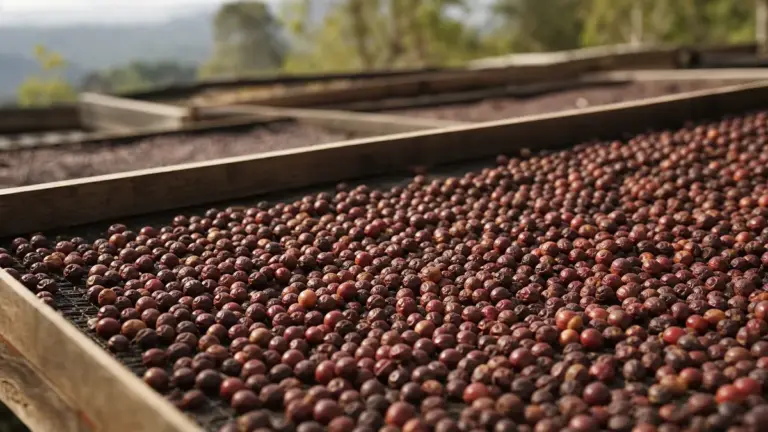
| Processing | The FAO records mainly dry processing; EKL offers natural or washed preparation. | Do not assume every Malagasy coffee uses the same method. |
| Harvest months | EKL lists May to October, depending on area; the older FAO calendar gives May/June to October. | Confirm the harvest year as well as the months. |
| Typical cup direction | Supplier-described cocoa, nuts, roasted grain, substantial body and low acidity. | Use a sample to assess the individual batch. |
Sources: FAO, Post Harvest Handling and Processing of Coffee in African Countries, Annex 4, December 2000; EKL Export, product information dated October 2025, checked November 2026.
Robusta production and the coffee you can buy
Robusta is central to Madagascar’s commercial coffee identity. The FAO’s country profile places production principally in the east and north-east, while current exporter information also identifies supply from northern and eastern regions. These sources support a robusta-led picture, but the older national profile should not be mistaken for a current production census.
A useful distinction runs through the whole subject: commercial species, named cultivars and endemic wild species are different categories. A robusta product description does not identify a particular cultivar. Equally, a scientific paper describing a newly recognised Malagasy Coffea species does not establish that it is being farmed, exported or sold as a drink.
For buyers, the best response is to request information at the right level. Ask first which species is present, then whether the producer or exporter can identify its planting material more precisely. Do not fill a missing cultivar field with a familiar name from another origin.
When comparing Madagascar with Zambia’s coffee, keep the comparison grounded in the lots available to you. Compare processing, traceability and the seller’s tasting evidence rather than treating either country as a single flavour.
Wild endemic coffee: Madagascar’s other coffee story
An endemic species occurs naturally within a particular geographical area and nowhere else. Madagascar is exceptionally significant for coffee diversity: Aaron Davis and Franck Rakotonasolo’s 2021 Kew Bulletin paper brought its documented total to 65 species. The six additions included Coffea callmanderi, C. darainensis and C. rupicola, all endemic to northern Madagascar.
The broader island group comfortably exceeds 60 endemic wild coffees. Older literature often places these plants in the group historically called Mascarocoffea. Despite the name, this discussion extends beyond the Mascarene islands to Madagascar and the Comoros. Coffea humblotiana, for example, is endemic to the Comoro archipelago, not Madagascar.
This geographical distinction matters. “Indian Ocean wild coffee” is not interchangeable with “Malagasy coffee”, and neither expression identifies a commercial robusta lot.
Species totals also need context. New descriptions and different taxonomic scopes change the numbers encountered in publications. This article uses the dated 2021 figure for Madagascar rather than presenting it as an unchanging total for November 2026. A larger regional total in another study may cover additional islands or include a broader set of taxa, meaning the biological units being counted.
The point is not to memorise a headline number. It is to recognise that Madagascar’s coffee heritage includes a large collection of distinct plants, not simply unusual versions of arabica and robusta.
Naturally caffeine-free species and what research shows
Many wild coffees from Madagascar and neighbouring islands contain no detectable caffeine or only very small amounts. However, “all Mascarocoffea are caffeine-free” is too sweeping: research has demonstrated variation between species and sampled populations.
Malagasy examples associated with traditional wild coffee use include Coffea homollei, C. kianjavatensis and C. lancifolia, documented by the Slow Food Foundation. That record concerns particular wild coffees and their use, not a certification that any product labelled “Madagascar” is caffeine-free.
The clearest mechanistic example comes from the neighbouring Comoros. In a 2021 genomic study, researchers investigated C. humblotiana and found that it lacked the caffeine synthase gene. This gene normally helps the plant perform the final chemical step from theobromine to caffeine. Its absence was identified as the likely explanation for the species’ naturally caffeine-free condition.
This was comparative genomic research, not a human trial and not proof that a new commercial drink was ready. It explains an important biological mechanism; it does not demonstrate that the trait can simply be transferred into a productive, good-tasting crop.
Keep three questions separate when reading such research:
- What did the researchers establish about the plant?
- What remains a proposed breeding or development opportunity?
- What, if anything, is actually available to drink?
A discovery can be valuable without answering all three.
Why conserving wild coffee matters
Forest loss threatens wild coffee by removing its habitat. Kew’s 2019 global assessment found that 60% of the 124 coffee species assessed were threatened with extinction. That is a dated global finding, not a current percentage specifically for Madagascar, but it demonstrates why protecting wild populations matters.
Conservation also happens outside natural populations. Madagascar’s agricultural research organisation, FOFIFA, documents a living wild-coffee collection at its Kianjavato research station. Such collections preserve research material, while protecting plants in their original habitats retains the wider ecological setting in which they occur.
Research is not confined to caffeine. A 2024 study examined the evolutionary relationships of three western Malagasy coffees in the Baracoffea group using chloroplast and nuclear DNA. These plants occur in dry deciduous forest and are associated with sandy soils, illustrating a different ecological setting from the humid forests commonly associated with coffee.
That work helps explain diversity and relationships. It should not be stretched into a claim that a particular species is already a proven replacement for a commercial crop. Genetic interest, agricultural performance and drink quality require different kinds of evidence.
Nor should “wild” automatically be treated as a desirable purchasing claim. Ask who manages harvesting, how the species was identified and what evidence supports any conservation benefit. Rarity alone is not a reason to buy.
Availability and buying in the UK
Commercial Malagasy robusta is offered through exporters, but an exporter’s offer does not establish ready-to-dispatch UK retail stock. Availability should be checked against a specific product and batch, not inferred from an origin guide or a general catalogue page.
During research, one UK-facing supplier’s Madagascar origin page displayed product cards identifying coffees from other countries. That page was therefore not accepted as evidence of stocked Malagasy beans. This is a useful warning for buyers: read the product’s own origin information before ordering.
Ask a prospective seller for:
- Species and composition: robusta, arabica, or a clearly described blend.
- Traceability: growing region, producer or producer group, and exporter.
- Harvest and processing: including whether the preparation applies to this batch.
- Condition and assessment: roast date for roasted coffee, plus a lot-specific tasting description.
- Availability: confirmation that the identified coffee is currently supplied to UK customers.
For an office, request a trial through the intended supplier before committing to regular supply. For a curious home drinker, a small, well-documented batch is a more useful introduction than an extravagant story with little traceability.
Use Zimbabwe’s origin guide for another regional comparison, but let the documented batch decide what you buy. Madagascar coffee is most rewarding to investigate when its commercial crop and its remarkable wild relatives are kept clearly distinct.
FAQ
Does “Madagascar vanilla coffee” mean the beans were grown in Madagascar?
No, that wording alone does not establish the origin of the coffee beans. Ask whether Madagascar describes the coffee, the vanilla ingredient or simply the product’s flavouring description. For an origin purchase, request an explicit statement identifying where the coffee itself was grown, separately from any added ingredients.
Can I buy the wild species described in scientific papers?
Do not assume publication means retail availability. The botanical and genomic papers cited here investigate species identity, diversity or biological mechanisms; they are not product catalogues. No verified UK retail listing for the particular wild research species discussed here was established during this research. Ask for species identification and a documented supply chain before considering such an offer.
What should a seller provide to support a caffeine-free claim?
Ask for evidence applying to the actual product, ideally an analytical result with its test method and reporting limit. A species’ reputation or a general article about Madagascar is not enough. Published research shows variation among wild coffees, so a botanical association should not substitute for product-specific evidence.
Where to go next
Read Southern Africa to place Madagascar within the wider regional guide. Continue with Zambia and Zimbabwe for separate country profiles and a useful basis for comparing the origin information supplied with your next coffee.
Sources
-
FAO, Joackim Mutua. Post Harvest Handling and Processing of Coffee in African Countries, December 2000, especially Annex 4, “Africa Coffee Producing Countries Profiles”. Historical production geography, species and processing context.
https://www.fao.org/4/x6939e/x6939e00.htm
https://www.fao.org/4/x6939e/X6939e10.htm -
EKL Export. Green Robusta coffee, 2025. Commercially claimed growing information, processing, harvest and sensory profile, not independent tasting evidence.
https://ekl-export.mg/en/produit/green-robusta-coffee/ -
Davis, A. P. and Rakotonasolo, F., Kew Bulletin. Six new species of coffee (Coffea) from northern Madagascar, 2021, volume 76. Taxonomy, endemic species and the dated species count.
https://link.springer.com/article/10.1007/s12225-021-09952-5 -
Raharimalala, N. et al., Scientific Reports. The absence of the caffeine synthase gene is involved in the naturally decaffeinated status of Coffea humblotiana, a wild species from Comoro archipelago, 2021, volume 11, article 8119. Retrieved through IRD’s document repository.
https://horizon.documentation.ird.fr/exl-doc/pleins_textes/2021-06/010081437.pdf -
Clifford, M. N. et al., Phytochemistry. Caffeine from green beans of Mascarocoffea, 1991. Historical terminology and evidence against assuming universal caffeine absence. Retrieved through IRD.
https://horizon.documentation.ird.fr/exl-doc/pleins_textes/pleins_textes_6/b_fdi_33-34/36388.pdf -
Slow Food Foundation for Biodiversity. Mascarocoffea Wild Coffee, undated. Documentation of Malagasy wild-coffee species and traditional use.
https://www.fondazioneslowfood.com/en/ark-of-taste-slow-food/mascarocoffea-wild-coffee/ -
Royal Botanic Gardens, Kew. Kew scientists reveal that 60% of wild coffee species are threatened with extinction, causing concern for the future of coffee production, 2019. Dated global conservation assessment.
https://www.kew.org/about-us/press-media/kew-scientists-reveal-that-60-of-wild-coffee -
FOFIFA. Diversité des Mascarocoffea, Caféiers sauvages endémiques de Madagascar et des Iles voisines, 2020, webpage displaying an update in 2026. Kianjavato living collection.
https://www.fofifa.mg/diversite-des-mascarocoffea-cafeiers-sauvages-endemiques-de-madagascar-et-des-iles-voisines/ -
Bezandry, R. et al., PLOS ONE. The evolutionary history of three Baracoffea species from western Madagascar revealed by chloroplast and nuclear genomes, 2024, volume 19, article e0296362. Retrieved through IRD.
https://horizon.documentation.ird.fr/exl-doc/pleins_textes/2024-03/010089523.pdf -
Green Coffee Collective. Madagascar, undated, checked November 2026. Used only to assess the displayed product information, not as evidence of Malagasy stock.
https://greencoffeecollective.com/pages/origin/madagascar
Research combined retrieved botanical and genomic papers, agricultural and conservation sources, and explicitly attributed supplier information; no first-hand coffee testing was undertaken.
Last checked: November 2026