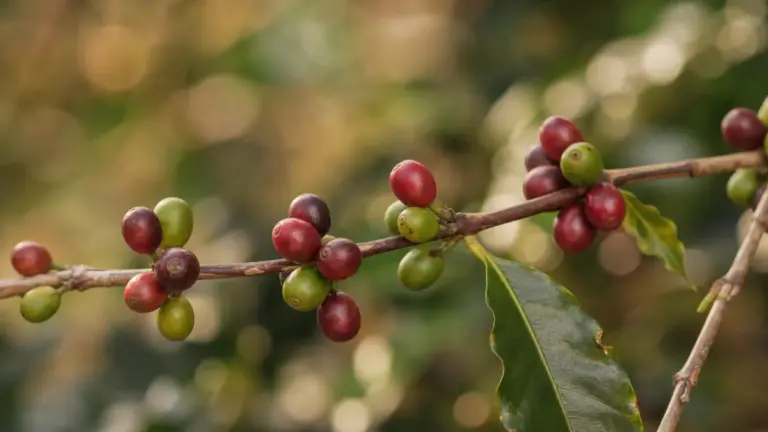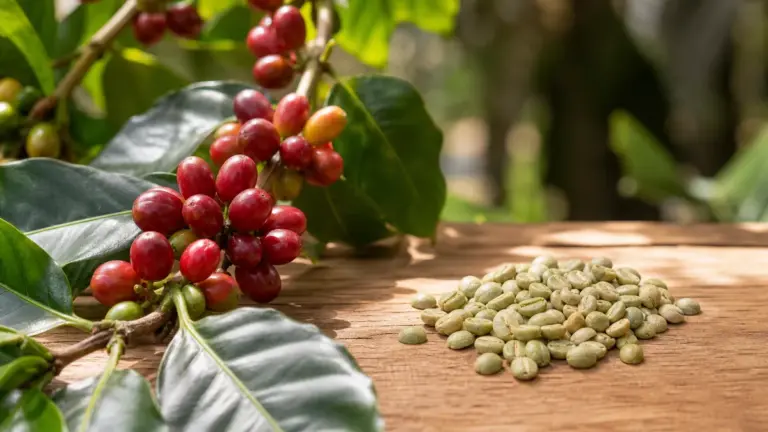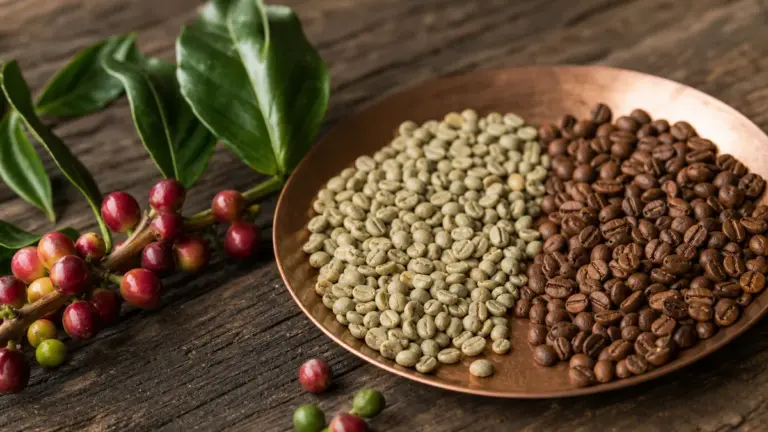
Zimbabwean coffee is chiefly washed arabica from the Eastern Highlands, known for balanced body and acidity, with some lots showing lively red-berry and currant flavours. Honde Valley and Chimanimani are important names in its recovery story, but choose by the producer, processing and tasting notes rather than assuming every Zimbabwean coffee tastes alike.
In short
- Growing area: focus on Manicaland’s Eastern Highlands, including Honde Valley, Chimanimani, Chipinge and Mutare.
- Varieties: SL28 and Catimor selections are documented, but there is no verified current national breakdown of plantings.
- Processing: washed coffee is the established reference style.
- Harvest: May to September is a useful general guide, not a fixed calendar for every farm.
- The comeback: rehabilitation, farmer training and renewed buying relationships are documented; a complete return to historic production is not established by the sources used here.
Zimbabwe coffee at a glance
The following panel describes the established origin profile. Its altitude range is a published regional guide, not a claim that every Zimbabwean coffee farm falls within those limits.
| Feature | Origin guide | Source basis |
|---|---|---|
| Species | Arabica, Coffea arabica | Zimbabwe government proposal published by the International Coffee Organization |
| Altitude | About 900 to 1,200 metres above sea level in the published Eastern Highlands overview | Producer Perceptions on Branding for Chipinge Coffee |
| Documented varieties | SL28 and Catimor 128; historic commercial plantings also included SL35, K6 and K7 | Ashanti partner-farm details and an Inter African Coffee Organisation appraisal |
| Main processing | Washed, also called wet processed | Zimbabwe government proposal and Chipinge producer presentation |
| Harvest months | Generally May to September; some harvesting can begin in March | Omwani sourcing guide, 2022 |
| Typical cup profile | Balanced acidity and body; selected coffees show red berries, currants, cranberry and bright fruitiness | Zimbabwe government proposal and TechnoServe’s origin account |
For orientation beyond the country, the southern African coffee guide puts Zimbabwe alongside neighbouring origins without treating them as one flavour category.
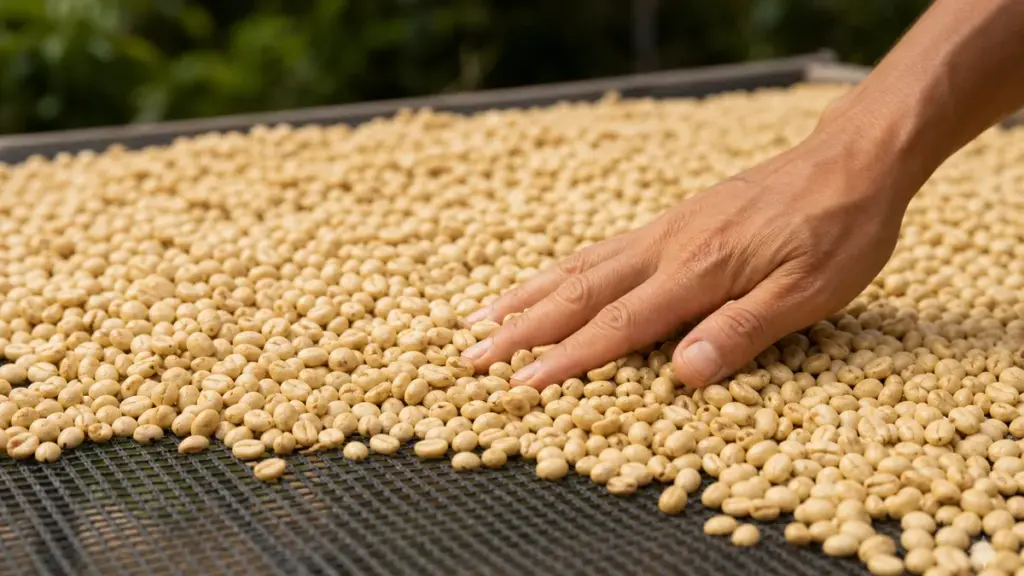
What does Zimbabwean coffee taste like?
Two descriptions help explain Zimbabwe’s appeal. The Zimbabwean government’s account published through the International Coffee Organization, or ICO, emphasises balanced acidity, body and consistent quality. TechnoServe’s description of coffees associated with its revival work is more fruit-led, naming red berries, currants and cranberries.
These are complementary descriptions, not competing definitions. One gives the broad commercial reputation; the other describes a more particular selection of coffees. Neither supports a promise that every bag will taste of cranberry.
For a first purchase, decide which description sounds more appealing. If you want a relatively rounded cup, ask the roaster for a Zimbabwean lot described as balanced and full rather than sharply fruity. If you enjoy a more vivid cup, look for explicit berry or currant notes and ask how pronounced the acidity is.
“Acidity” here describes the bright, mouth-watering impression in the drink, not simply unpleasant sourness. Treat tasting notes as comparisons to help you choose, rather than a checklist you must be able to detect. You can enjoy a coffee without finding every fruit named on its bag.
Most importantly, do not buy Zimbabwean coffee only because it is unusual. Ask what distinguishes that particular harvest and producer. A clear, modest description is more useful than a dramatic national reputation.
Where Zimbabwean coffee grows
Zimbabwe’s established coffee-growing belt lies in the Eastern Highlands of Manicaland, along the country’s eastern side. The names most relevant to buyers include Honde Valley, Chipinge, Chimanimani and Mutare, with Vumba also appearing in development documents.
These names are not all equivalent geographical units. Honde Valley is within Mutasa district, whereas Chimanimani and Chipinge are district names as well as names readers may encounter in coffee descriptions. A label saying “Eastern Highlands” therefore gives less precise provenance than one identifying a farm or farmer group.
Honde Valley
Honde Valley is particularly closely associated with the smallholder revival. TechnoServe has documented work there with Nespresso, including farmer training and improvements in agronomy, meaning the practical management of crops and soil.
Its farmer reporting also shows why coffee should not be pictured as an isolated plantation crop. In one documented household, banana leaves were used for mulch and compost, while food crops remained part of the farm’s daily work.
For a buyer, “Honde Valley” is a useful starting point, not the end of the traceability trail. Ask which growers supplied the coffee, how their harvest was processed and whether the seller can identify the crop year.
Chimanimani
Chimanimani belongs firmly in Zimbabwe’s coffee story, rather than being an alternative name for Honde Valley. A government proposal published by the ICO in 2013 identified ARDA Rusitu Estate in Chimanimani among its proposed nursery locations.
That matters because the recovery was not conceived solely as buying more coffee from existing trees. Planting material, replanting and practical support were also part of the proposed rebuilding work.
The evidence used here does not establish a dependable “Chimanimani flavour” distinct from a “Honde Valley flavour”. If a seller claims such a difference, ask for the producer details and tasting evidence behind it.
Chipinge, Mutare and Vumba
Chipinge has a longstanding place in commercial coffee production, while Mutare and Vumba also recur in accounts of the growing belt and its supporting infrastructure. Ashanti’s partner-farm description provides one concrete Eastern Highlands example: washed coffee grown at 1,200 metres, with SL28 and Catimor 128 named.
That is useful farm-level evidence, but it should not be stretched into a national recipe. One producer’s varieties, altitude or fermentation method cannot describe all Zimbabwean coffee.
From commercial expansion to steep decline
Zimbabwe’s coffee history predates the recent revival programmes. An Inter African Coffee Organisation appraisal traces planting in Chipinge to the 1890s, followed by commercial expansion in the 1950s.
A short timeline shows the scale of change:
- 1890s: the appraisal records early planting in Chipinge, initially for domestic consumption.
- 1950s: commercial cultivation expanded with growers arriving from Kenya and India.
- 1961: the Coffee Growers Association was formed and hulling and grading machinery was installed in Mutare.
- 1989/90: a later Zimbabwean government submission records peak national production of about 14,600 tonnes.
- 2010/11: the same submission records production of 206 tonnes.
- 2017: TechnoServe dates the beginning of its work with Nespresso to restore coffee-growing communities.
- 2018: Nespresso publicly announced a five-year training and technical-assistance plan for 400 smallholders.
The decline needs more explanation than a single political or weather event. TechnoServe identifies land reform, economic turmoil and natural disasters among the causes. The government’s 2013 submission also describes hyperinflation, neglected plantations, inadequate finance and gaps in technical training.
Together, these accounts describe damage to a whole production system. Trees were only one part of it: growers also needed skills, inputs, processing infrastructure and a workable route to buyers.
These are historical figures and explanations. They should not be presented as measurements of the sector in November 2026.
What Zimbabwe’s coffee revival actually involves
The best-supported account of the revival is practical rather than triumphal. TechnoServe describes training in coffee agronomy and processing, while Nespresso’s 2018 announcement set out a commitment to technical assistance and purchasing relationships.
The distinction between an announcement and an achieved result matters. A programme’s target number of growers is not automatically the number still producing coffee several years later. Nor does the appearance of a Zimbabwean coffee on an international market establish that national output has returned to its former level.
There is also an earlier institutional story. The government proposal circulated by the ICO in 2013 sought to support smallholders and newly resettled farmers through nurseries, replanting and capacity building. The later commercial partnership therefore belongs within a longer effort to rehabilitate the sector.
TechnoServe’s household reporting gives a more tangible view of the work: advice on mulching young trees, maintaining soil moisture and making compost. These are documented examples of training, not proof that every participating farm achieved the same outcome.
The fair conclusion is that Zimbabwe’s comeback is documented through renewed cultivation, support and market access. The sources retrieved for this article do not establish a complete national recovery. Programme accounts are valuable first-hand records, but they are not substitutes for a consistent national production series.
Varieties, altitude and processing
SL28 and Catimor selections
World Coffee Research lists Zimbabwe among the countries where SL28 is commonly found. It describes SL28 as drought tolerant, with strong cup-quality potential, but susceptible to major coffee diseases.
That combination helps explain why variety selection involves more than taste. A plant with attractive quality potential may still present substantial management challenges. World Coffee Research also stresses that a variety’s local performance can vary.
Catimor needs careful wording. It is a family of cultivars derived from crosses involving Caturra and Timor Hybrid, not one uniform variety. A label naming Catimor 128 is consequently more informative than one saying only “Catimor”.
Ashanti documents SL28 and Catimor 128 together on its partner farms. That confirms their presence, but not their national planting shares. There is insufficient evidence here to rank Zimbabwe’s varieties by current acreage.
Why altitude needs context
The published Eastern Highlands overview gives about 900 to 1,200 metres as its growing-area range. Do not interpret that as a quality ceiling, or compare it mechanically with an equatorial origin.
World Coffee Research adjusts its altitude guidance according to latitude because a suitable elevation depends partly on how far a farm lies from the equator. The useful buying question is therefore not simply “How high?”, but “Which farm, under what conditions, producing what cup?”
What washed processing means here
Washed processing is the established Zimbabwean reference. The Chipinge producer presentation describes harvesting, pulping, fermentation and drying: the fruit is removed before the coffee completes drying.
Ashanti supplies a specific example involving tank fermentation followed by sun drying. Its published fermentation time belongs to that producer’s process, not to Zimbabwe as a whole.
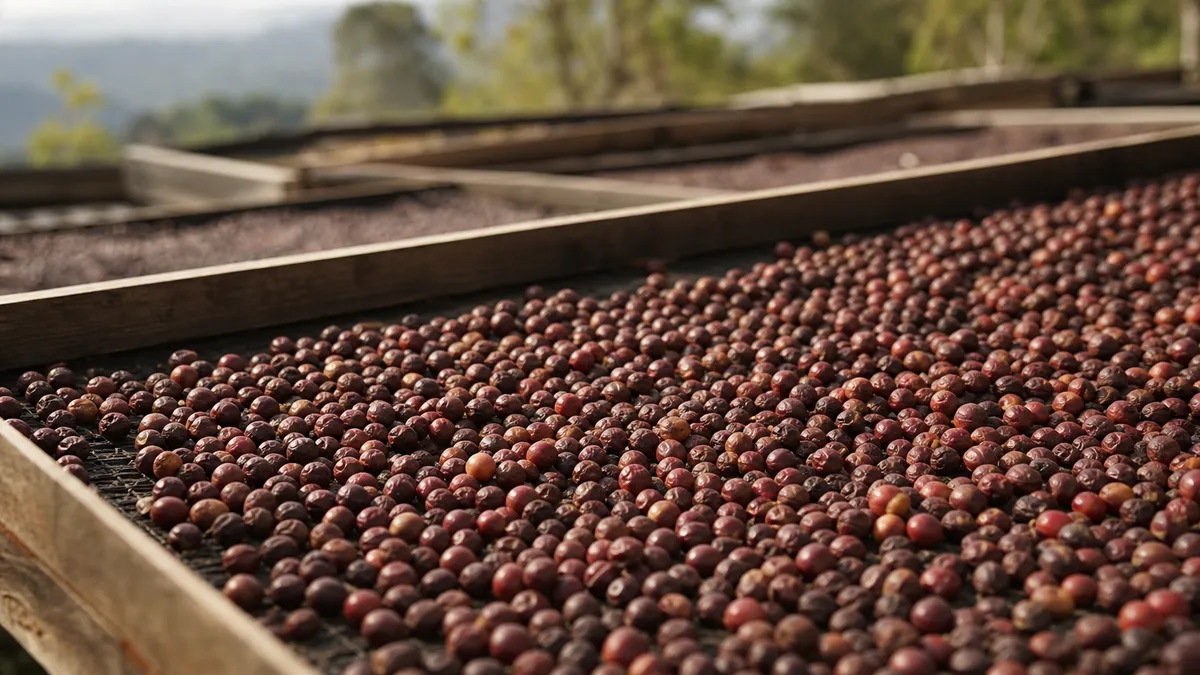
Do not assume that an image of intact cherries drying represents the processing of a washed lot. Ask the seller to identify the actual method rather than relying on generic origin photography.
How to choose Zimbabwean coffee in the UK
Use provenance and a clear flavour description as your starting criteria. Before ordering, look for:
- A named source: ideally a farm, estate, farmer group or identifiable collection.
- Harvest information: the crop year as well as the roasting date.
- Specific variety information: named selections where available, with uncertainty acknowledged.
- The actual processing method: not simply an attractive photograph.
- A description of the current lot: including how bright, rounded or fruit-led it tastes.
These are selection recommendations, not a guarantee of quality. If the seller cannot supply everything, ask what is known rather than assuming the missing details.
For a useful comparison, read about Zambian coffee, then explore the separate histories of Angolan coffee and Madagascar’s coffee. Keep those origins distinct: a regional comparison should sharpen your questions, not replace the details of the coffee in front of you.
FAQ
Is Zimbabwean coffee the same as Kenyan coffee?
No, Zimbabwean coffee is a separate origin, although SL28 is documented in both countries. A shared variety does not make two coffees interchangeable. World Coffee Research records SL28’s spread from Kenya to other producing countries, including Zimbabwe. Use that connection as useful background, then judge the named producer and the seller’s description of the actual lot.
Does buying Zimbabwean coffee support its recovery?
It can create demand for the producer supplying that coffee, but the national origin alone does not establish a particular benefit. Ask the seller who supplied the lot and what buying relationship exists. If a product refers to a named development programme, distinguish the programme’s stated aims from documented results and avoid assuming every Zimbabwean coffee participates.
Is Zimbabwean coffee always sold as capsules?
No, Zimbabwean coffee is not confined to capsules. Nespresso’s revival work is prominent, but Ashanti documents Zimbabwean coffee supplied through its own partner-farm and roasting operation. Product format and origin are separate matters. When choosing whole beans, ground coffee or capsules, ask for the same basic information about producer, harvest, processing and flavour.
Where to go next
Read Southern Africa for the regional framework, then Zambia for a neighbouring origin comparison. Angola and Madagascar provide separate country histories that help place Zimbabwe’s coffee revival in context without reducing the region to one story.
Sources
-
Government of Zimbabwe / International Coffee Organization. Promotion of coffee production in Zimbabwe through establishing nurseries, replanting and capacity building of farmers, PJ 65/13, 4 December 2013.
https://icocoffee.org/documents/cy2013-14/pj-65e-promotion-zimbabwe.pdf -
Inter African Coffee Organisation / Common Fund for Commodities, hosted by the ICO. Enhancing Competitiveness of African Coffee through a Value Chain Strengthening, appraisal report, CFC/ICO/43FT, undated retrieved copy.
-
International Trademark Association, host. Producer Perceptions on Branding for Chipinge Coffee, undated presentation. Used for its published growing-area and cultivation description, not as a current statistical series.
https://www.inta.org/wp-content/uploads/2020/08/Producer_Perceptions_on_Branding_for_Chipinge_Coffee.pdf -
World Coffee Research. Arabica Varieties Catalog: SL28, live catalogue, publication date not stated.
https://varieties.worldcoffeeresearch.org/varieties/sl28 -
World Coffee Research. Arabica Varieties Catalog: Caturra, live catalogue, publication date not stated.
https://varieties.worldcoffeeresearch.org/varieties/caturra -
TechnoServe. Coffee Consumer Spotlight: Zimbabwean Coffee, 20 September 2019.
https://www.technoserve.org/blog/coffee-consumer-spotlight-zimbabwean-coffee/ -
TechnoServe. Meet the Farmers Behind Your Coffee: Reviving Origins in Zimbabwe, 2 August 2021.
https://www.technoserve.org/blog/meet-coffee-farmers-reviving-origins-zimbabwe/ -
Nestlé / Nespresso. Nespresso revives Zimbabwe’s coffee production, 6 September 2018.
https://www.nestle.com/media/news/nespresso-revives-zimbabwe-coffee-production -
Ashanti Coffee Roasters. From Farm To Cup, undated producer-partner account.
https://ashanticoffee.com/pages/from-farm-to-cup -
Omwani. Zimbabwe Coffee Production & Sourcing Guide, 26 September 2022. Used for the general harvest calendar.
https://www.omwani.com/post/zimbabwe-coffee-production-sourcing-guide
This article was researched from retrieved institutional documents, variety references, programme accounts and producer or sourcing information; it does not report first-hand farm visits or tasting.
Last checked: November 2026