Coffee from El Salvador often combines chocolate and caramel sweetness with citrus acidity and a rounded texture. Bourbon and Pacas underpin its traditional character, while Pacamara, bred in El Salvador, offers a route into more floral, fruity and distinctive cups.
In short
- Start with a washed Bourbon or Pacas if you want to explore the origin’s classic chocolate-led character.
- Pacas is a naturally occurring compact mutation of Bourbon, not a separate coffee species.
- Pacamara was bred from Pacas and Maragogipe; its unusually large beans are a varietal characteristic, not a quality grade.
- Bourbon and Pacas historically dominated planting, but old percentages should not be presented as today’s national mix.
- The leaf rust epidemic of 2012 to 2013 reshaped production and accelerated interest in more resistant varieties.
El Salvador coffee at a glance
The altitude figures below are cultivation guidance for particular varieties, not the country’s absolute growing limits. Published mountain-range elevations can include summits, so they should not be mistaken for the elevation of a coffee farm.
| Feature | Origin fact panel |
|---|---|
| Indicative cultivation altitudes | The Instituto Salvadoreño del Café’s harvest manual gives 800 to 1,500 metres above sea level for Bourbon and Pacas, and 1,300 to 1,800 metres for Pacamara. |
| Main varieties | Historically Bourbon and Pacas, with Pacamara especially important to the country’s specialty identity. Rust-resistant varieties are increasingly planted. |
| Processing methods | Washed, honey and natural methods are documented in the national harvest and post-harvest manual. |
| Harvest months | October to March is the general picking season recorded by the International Coffee Organization’s country profile. Individual lots can differ. |
| Typical cup profile | Chocolate, caramel and citrus, with rounded or creamy texture; Pacamara can bring floral and tropical-fruit notes. These are tendencies, not guarantees. |
For the wider regional context, begin with Central American origins. Here, the most useful distinction is between the country’s established Bourbon and Pacas heritage and the individual lots now emerging from a changing varietal mix.
What does coffee from El Salvador taste like?
The familiar starting point is sweetness rather than extreme intensity: chocolate, caramel and a citrus lift. Pacas descriptions in the national manual also include almond and vanilla, while Pacamara can move towards flowers, peach and tropical fruit.
Treat those descriptions as a shortlist of possibilities. They are not ingredients, and a country name alone cannot tell you exactly what a particular bag will taste like.
My suggested first purchase is a washed Bourbon or Pacas with clearly stated tasting notes. It provides a useful reference before you explore a more fruit-forward Pacamara or compare processing methods.
For a meaningful comparison, ask a roaster for coffees with similar roast intentions. Otherwise, you may end up comparing the roaster’s choices as much as the origin or variety.
The growing regions
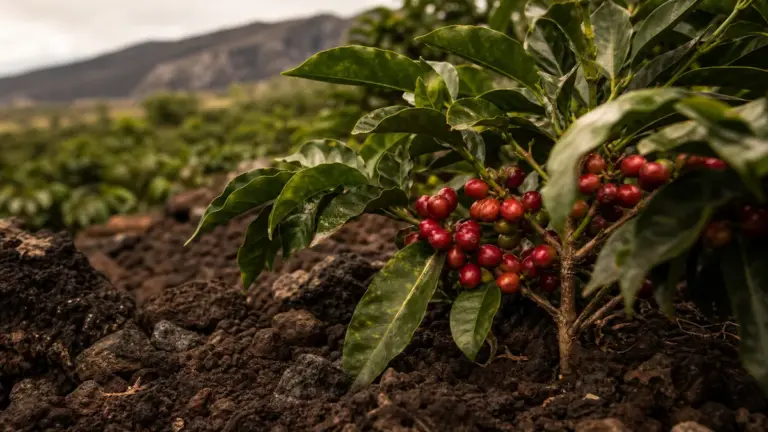
Café de El Salvador identifies six principal coffee regions. Their names describe growing areas associated with mountain ranges, rather than six fixed flavour categories.
Apaneca-Ilamatepec
This western region includes coffee-growing areas in Ahuachapán, Sonsonate and Santa Ana. Santa Ana is also central to the story of Pacas, which was discovered on a Pacas family farm there.
When a bag says only “Santa Ana”, ask for the farm and lot details as well. A department name is useful geographical information, but it is not a complete account of the coffee.
Alotepec-Metapán
This northern growing area includes parts of Chalatenango and Santa Ana. The national coffee directory lists Bourbon, Pacas and Pacamara among its varieties.
Look out for the difference between administrative and coffee-region names. “Chalatenango” and “Alotepec-Metapán” can describe different geographical levels of the same lot’s origin, rather than contradictory locations.
El Bálsamo-Quezaltepec
This region includes growing areas around La Libertad and San Salvador. The coffee institute’s geographical description also includes specified locations in Sonsonate.
It is another reason not to interpret department boundaries as neat boundaries between coffee regions. For buying purposes, a named producer and farm provide a more precise starting point.
Chichontepec, Tecapa-Chinameca and Cacahuatique
These complete the national six-region framework. All deserve attention beyond the more familiar western and northern names.
My buying advice is to avoid assigning each a compulsory tasting note. Use the region to locate the coffee, then use the variety, processing details and roaster’s description to decide whether that particular lot interests you.
Bourbon and Pacas: the foundations
Bourbon and Pacas are varieties of Coffea arabica, not different species. Their historical importance explains much of El Salvador’s reputation, but it also helps explain its vulnerability to disease.
World Coffee Research’s 2024 seed-sector report states that, before the rust crisis beginning in 2012, Bourbon occupied 68% of the country’s coffee area and Pacas 29%. Those are historical land-area estimates, not current production shares.
That distinction matters. A variety can occupy a substantial area without contributing the same proportion of a particular year’s harvest, and renovation changes the planted mix over time.
Bourbon
World Coffee Research describes Bourbon as a tall variety with relatively low production, susceptibility to major diseases and excellent cup-quality potential. Its name comes from Bourbon Island, now La Réunion, rather than from the American whiskey.
Bourbon was not created in El Salvador. Its importance here comes from cultivation and selection, not national ownership of the original variety.
For readers, the useful lesson is that “Bourbon” identifies plant material. It does not certify the care taken during harvesting, processing or roasting.
Pacas
Pacas is a natural Bourbon mutation discovered in 1949 on a farm owned by the Pacas family in Santa Ana. A mutation affecting plant stature makes it compact, allowing closer planting.
The Salvadoran coffee research institute began a programme of pedigree selection in 1960. This means selecting individual plants through successive generations, rather than simply multiplying every plant found in a field.
Pacas remains part of the country’s coffee identity, but compact growth does not mean disease resistance. World Coffee Research rates it as highly susceptible to coffee leaf rust.
Pacamara’s birthplace and significance
Pacamara was bred in El Salvador by the Salvadoran coffee research institute, ISIC, from Pacas and Maragogipe. It is a deliberately bred arabica cross, unlike the naturally occurring mutation that produced Pacas.
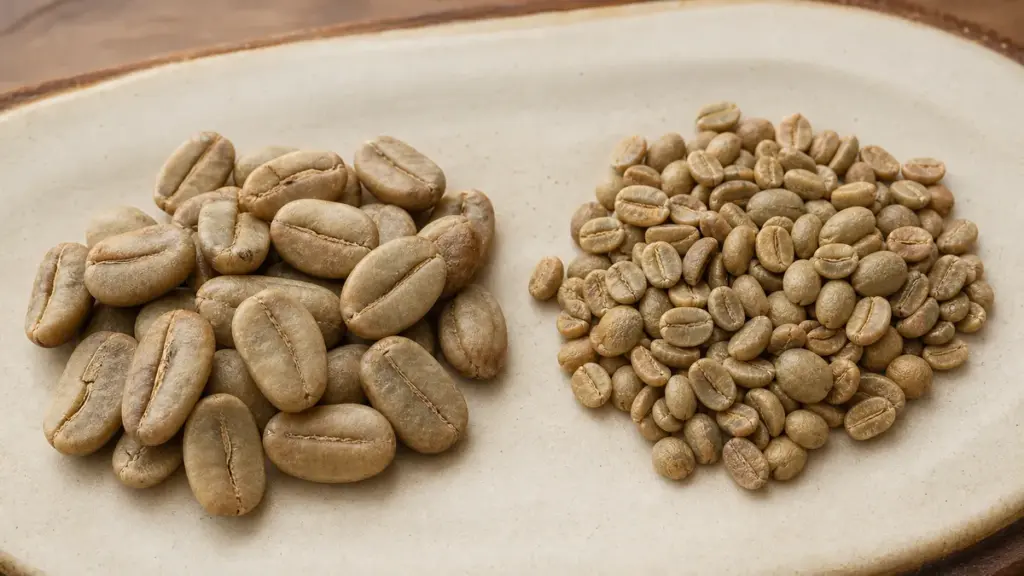
World Coffee Research classifies its beans as very large and recognises its potential for exceptional cup quality. It also records very high susceptibility to leaf rust.
There is a further qualification behind the name: Pacamara is not genetically uniform, and plants are not stable from one generation to the next. This is a breeding characteristic, not evidence that every Pacamara lot will taste inconsistent.
For the buyer, it reinforces a sensible rule: choose the actual lot, not just the celebrated variety. Large beans and an interesting pedigree are reasons for curiosity, not substitutes for a convincing cup.
If you want to continue exploring neighbouring origins, Nicaragua is a useful next stop. Keep country, variety and processing method separate in your notes rather than treating any one of them as the whole explanation.
Processing: what the label tells you
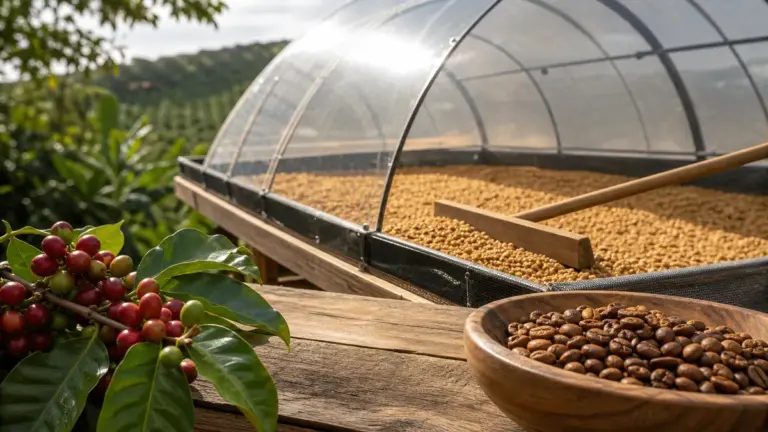
Processing describes how the harvested fruit is handled to produce dried coffee seeds. The national manual documents washed, honey and natural approaches.
- Washed: the skin and pulp are removed, the sticky mucilage surrounding the seeds is removed, and the coffee is dried.
- Honey: the fruit is pulped, but some or all of the mucilage remains during drying. The name does not mean honey has been added.
- Natural: the coffee dries inside the whole fruit before the dried outer layers are removed.
These are meaningful differences in handling, but not a ranking from ordinary to superior. TechnoServe’s processing guide also notes that terminology and the amount of mucilage retained can vary.
For a practical tasting exercise, ask for the same variety processed in different ways, ideally from the same producer. Treat the comparison as exploration, not a controlled experiment: unless the lots were deliberately matched, other differences remain.
A short coffee history
The International Coffee Organization’s country profile records early exports and government encouragement of coffee cultivation during the nineteenth century. Coffee subsequently became central to the country’s export economy.
A short timeline helps distinguish that wider history from the origins of individual varieties:
- 1855/56: the ICO profile records the first Salvadoran coffee export in this coffee year.
- 1860s and 1870s: coffee cultivation received strong government support.
- 1949: Pacas was discovered in Santa Ana.
- 1960: formal pedigree selection of Pacas began.
- 2012 to 2013: the regional leaf rust epidemic struck a sector heavily reliant on susceptible varieties.
This is not simply a story of old varieties surviving unchanged. The current industry combines that inheritance with renovation, new planting material and attention to distinctive specialty lots.
Leaf rust and the changing coffee crop
Coffee leaf rust is caused by the fungus Hemileia vastatrix. It attacks living leaves and can cause severe leaf loss, branch death and reduced harvests.
Avelino and colleagues’ peer-reviewed analysis of the regional crisis describes interacting agronomic, economic and weather-related factors. It does not support explaining the epidemic through one cause alone.
El Salvador’s reliance on susceptible Bourbon and Pacas was a substantial vulnerability. World Coffee Research reports a 58.5% production decline between the 2012/13 and 2013/14 coffee years.
Renovation is therefore about more than replacing missing trees with identical ones. World Coffee Research documents a transition towards more resistant material, while USDA’s 2025 country report describes continuing constraints involving plant nutrition, disease management, agricultural labour and support until replacement trees become productive.
For buyers, the implication is worth remembering: heritage varieties are not the only legitimate expression of Salvadoran coffee. My recommendation is to judge newer varieties by the quality and traceability of the lot, rather than rejecting them because they do not fit an older picture of the origin.
Choosing an El Salvador coffee in the UK
Use the country name as your starting point, then ask for:
- The producer and farm, rather than only a broad region.
- The variety or varietal mixture, including whether the identification is known.
- The processing method, with further explanation where the label is unusual.
- The harvest and roast information, kept distinct from each other.
- A description of the intended cup, and whether the roaster recommends it for your brewing method.
For a first exploration, I would choose a washed Bourbon or Pacas. For a second, I would seek a Pacamara with contrasting tasting notes, then compare what changes and what remains familiar.
The rewarding question is not “Does this taste exactly like El Salvador should?” It is “What does this particular El Salvador coffee show?”
FAQ
Is Bourbon coffee flavoured with whiskey?
No, Bourbon is the name of a coffee variety, not a whiskey flavouring. World Coffee Research traces its name to Bourbon Island, now La Réunion. A bag labelled Bourbon therefore identifies the coffee plant variety; any separate flavouring or barrel treatment would need its own description.
Does SHG mean a coffee is guaranteed to taste better?
No, SHG is an altitude classification, not a guarantee of superior flavour. The ICO’s Salvadoran country profile defines Strictly High Grown as coffee grown above 1,200 metres. Use it as background information alongside the producer, variety and process, rather than as a replacement for information about the actual lot.
Is Pacamara the same as Maragogipe?
No, Maragogipe is one of Pacamara’s parents, alongside Pacas. They are different varieties, even though both can have conspicuously large beans. Check the full variety name when buying, and do not assume that bean size alone identifies the variety or demonstrates its quality.
Where to go next
Read Central America to place El Salvador within the wider region, then Nicaragua to continue exploring neighbouring origins. Panama is the next useful country guide if you want to keep developing your origin comparisons without treating national reputations as fixed flavour rules.
Sources
-
Instituto Salvadoreño del Café, Ministerio de Agricultura y Ganadería and Italian Agency for Development Cooperation, Manual de cosecha y poscosecha del café, 2024, especially the variety descriptions and processing sections.
URL: -
World Coffee Research, Arabica Coffee Varieties: Bourbon, undated live catalogue, retrieved November 2026.
URL: https://varieties.worldcoffeeresearch.org/varieties/bourbon -
World Coffee Research, Arabica Coffee Varieties: Pacas, undated live catalogue, retrieved November 2026.
URL: https://varieties.worldcoffeeresearch.org/varieties/pacas -
World Coffee Research, Arabica Coffee Varieties: Pacamara, undated live catalogue, retrieved November 2026.
URL: https://varieties.worldcoffeeresearch.org/varieties/pacamara -
World Coffee Research, Quality Assurance in the Coffee Seed Sector: Technical Report on Seed Sources in El Salvador, Guatemala, Honduras, Nicaragua, and Peru, 2024, particularly page 11.
URL: https://worldcoffeeresearch.org/index.php/actions/wcr/downloads/download?assetUid=42f76c84-0ef7-415d-bbd2-0ff49d8536da -
International Coffee Organization and Consejo Salvadoreño del Café, Perfil de país cafetero: El Salvador, ICC 117-8, 16 September 2016. Used for historical information, the general harvest calendar and altitude classifications, not current production shares.
URL: https://icocoffee.org/documents/cy2015-16/icc-117-8c-profile-el-salvador.pdf -
Café de El Salvador, Regiones cafetaleras and national coffee directory, undated live pages, retrieved November 2026.
URLs: https://cafedeelsalvador.com/ and https://regiones.cafedeelsalvador.com/ -
Instituto Salvadoreño del Café, Denominaciones de origen, undated live page, retrieved November 2026. Used for geographical descriptions.
URL: https://isc.gob.sv/distintivo-de-calidad/denominacion-origen/ -
TechnoServe, Coffee Wet Mill Processing Guide, 2022 web edition, section “Common Coffee Processing Methods”.
URL: https://www.technoserve.org/wp-content/uploads/2022/03/TechnoServe-Wet-Mill-Processing-Guide.pdf -
Avelino, J. and colleagues, The coffee rust crises in Colombia and Central America (2008 to 2013): impacts, plausible causes and proposed solutions, Food Security, volume 7, 2015, pages 303 to 321.
URL: https://link.springer.com/article/10.1007/s12571-015-0446-9 -
USDA Foreign Agricultural Service, Coffee Annual: El Salvador, report ES2025-0003, 2025.
URL: https://apps.fas.usda.gov/newgainapi/api/Report/DownloadReportByFileName?fileName=Coffee+Annual_San+Salvador_El+Salvador_ES2025-0003.pdf
This article was researched from the national coffee institute’s material, World Coffee Research’s catalogue and technical reporting, the ICO country profile, agronomic research and published processing guidance; no first-hand tasting or farm visits are claimed.
Last checked: November 2026