Bourbon is a traditional variety of Coffea arabica and one of the founding lineages behind much of the arabica coffee grown worldwide. Named after Bourbon Island, now Réunion, it has considerable cup-quality potential and a family tree that includes compact descendants such as Caturra, Pacas and Villa Sarchi.
In short
- Red, yellow and orange describe the colour of the ripe coffee fruit, not the roasted beans.
- Bourbon reached Réunion from Yemen in the early eighteenth century, then spread more widely during the nineteenth century.
- The traditional plant is tall, with green growing tips, and is susceptible to major coffee diseases.
- Caturra, Pacas and Villa Sarchi are dwarf mutations of Bourbon. Tekisic is a selection within Bourbon.
- SL28 belongs to the Bourbon genetic group. SL34 belongs to the Typica group, while World Coffee Research currently classifies Mibirizi as Typica-related too.
What is Bourbon coffee?
Bourbon is a variety within arabica, not a separate coffee species, a growing region or a processing method. A variety is a recognisable type of plant within a species, with inherited characteristics that can affect its growth, fruit and agricultural performance.
There is also a distinction between Bourbon the variety and the Bourbon genetic group. The latter includes related varieties that are not identical to Bourbon itself. That distinction matters when reading family trees: genetic relatedness does not always establish a simple parent-to-child relationship.
For the wider framework, start with coffee varieties. Our guide to arabica coffee explains the species to which Bourbon belongs.
Bourbon and Typica are often called arabica’s two founding lineages. This is useful shorthand for their enormous influence on cultivated coffee, not a claim that all arabica diversity comes from these two named varieties. Ethiopia retains a much broader reservoir of arabica genetic diversity.
From Yemen to Réunion and beyond
Bourbon’s story begins before the island that supplied its name. Arabica originated in Ethiopia, and coffee taken to Yemen became the source of planting material that travelled along several routes.
World Coffee Research records French attempts to introduce coffee from Yemen to Bourbon Island in 1708, 1715 and 1718. Plants survived from the second and third introductions. The island population became associated with the Bourbon name.
The important distinction is between where the planting material came from and where the named variety became established. Bourbon is not a coffee species native to Réunion.
A short Bourbon timeline
- 1708, 1715 and 1718: recorded introductions from Yemen to Bourbon Island, with surviving plants from the latter two attempts.
- Mid-nineteenth century: Bourbon began spreading beyond the island.
- Around 1860: Bourbon reached Brazil, from which it spread into other parts of South and Central America.
- 1930: Yellow Bourbon was recorded at Pederneiras in São Paulo state, Brazil.
- 1977: Tekisic, a selected Bourbon population developed in El Salvador, was released.
French missionary networks helped distribute Réunion planting material in East Africa. However, coffee populations subsequently became mixed, selected and renamed. A coffee described as Bourbon-related in East Africa should not automatically be treated as genetically identical to the Bourbon variety cultivated in Latin America.
The neighbouring Typica lineage followed a different dispersal history. Keeping those routes separate makes the later family relationships much easier to understand.
Bourbon growing facts
Bourbon is grown across different countries and climates, so it has no single worldwide altitude range or harvest season. The panel below separates variety guidance from a documented farm example rather than presenting one origin’s conditions as universal.
| Attribute | Bourbon reference |
|---|---|
| Altitude guidance | WCR places Bourbon in its high-altitude category: above 1,600 m within 5° of the equator, above 1,300 m at latitudes of 5° to 15°, and above 1,000 m beyond 15°. These are suitability guidelines, not absolute limits. |
| Documented growing range | Royal Coffee lists a Bourbon lot from Finca El Destello, Antigua, Guatemala, at 1,650 to 1,850 m above sea level. |
| Main named forms | Red Bourbon and Yellow Bourbon; Orange Bourbon is also documented in research and competition records. These colour names do not establish identical ancestry across every planting. |
| Processing | Washed Bourbon and honey-processed Orange Bourbon appear in Cup of Excellence records. Processing is a separate description from variety. |
| Harvest months | December to April for the documented El Destello lot, not a worldwide Bourbon calendar. |
| Cup profile | WCR rates Bourbon’s high-altitude quality potential as very good. Producer descriptions include chocolate, lively acidity and a sweet, sometimes wine-like finish, but individual lots differ. |
The altitude guidance needs its latitude qualification. An elevation that provides suitable conditions farther from the equator is not necessarily equivalent to the same elevation near it.
Likewise, harvest months describe the place and crop, not an inherited timetable shared by every Bourbon tree worldwide. When buying in the UK, ask for the particular lot’s origin and harvest information rather than relying on a generic variety calendar.
Red, yellow and orange Bourbon
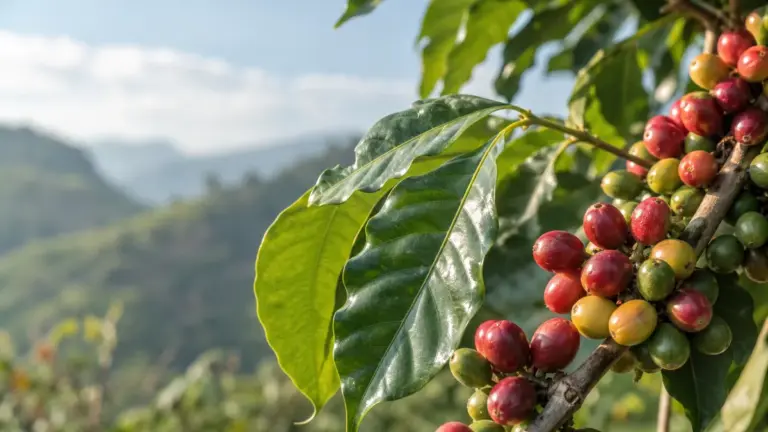
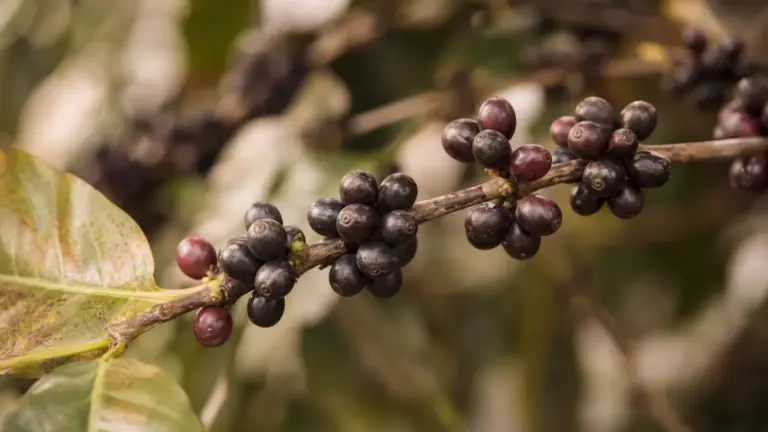
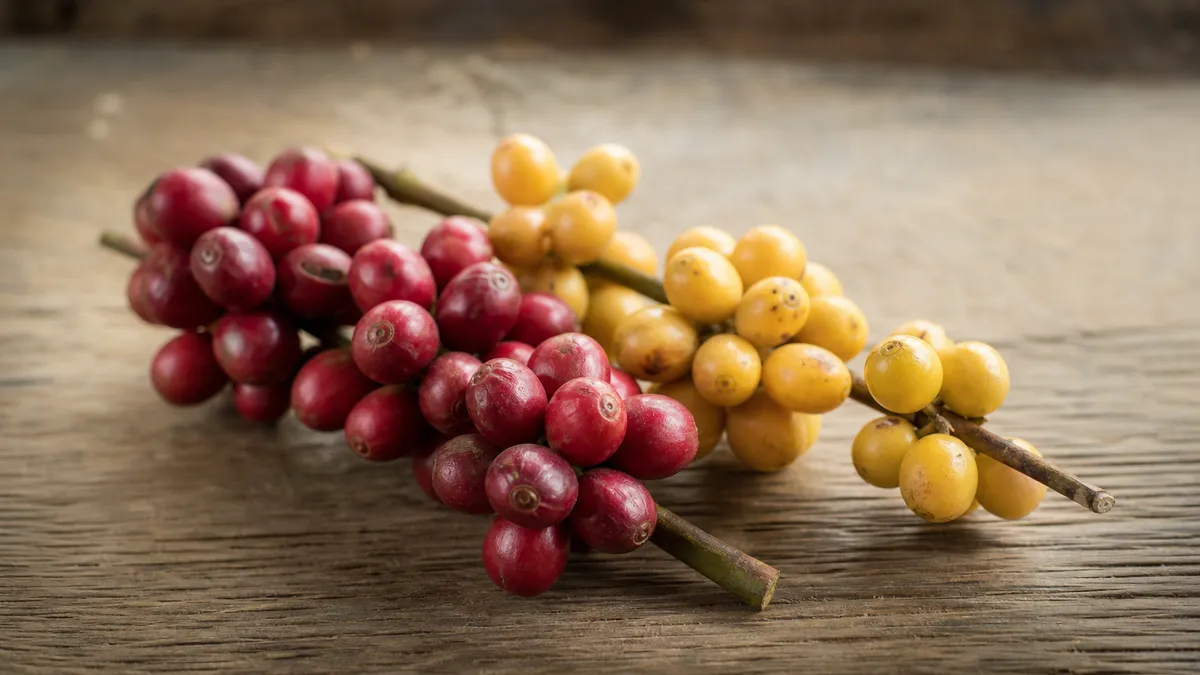
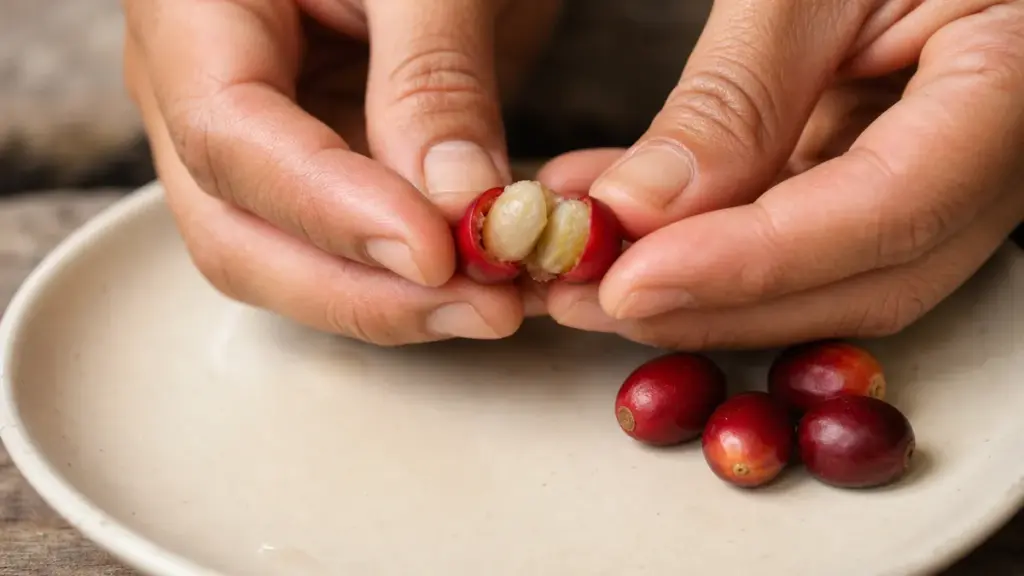
The colours refer to the skin of the ripe coffee cherry, the fruit containing the seeds that become coffee beans. They are useful descriptions, but they should not be treated as a flavour ranking or a complete genetic identity.
Red Bourbon
Red Bourbon is the familiar red-fruited form. Brazil’s Instituto Agronômico, usually abbreviated to IAC, maintains a named Red Bourbon cultivar alongside its Yellow Bourbon selections.
A red ripe cherry is not, by itself, proof that a plant is Bourbon. Colour is only one visible characteristic, and many coffee varieties share it.
Yellow Bourbon
Yellow Bourbon, or Bourbon Amarelo in Portuguese, ripens yellow. Its history is more complicated than the common explanation that every yellow Bourbon is simply a colour mutation of Red Bourbon.
IAC’s historical account records its discovery at Pederneiras in 1930 and identifies natural hybridisation between Red Bourbon and Amarelo de Botucatu as the likely origin. That wording matters: it is an account of probable ancestry, not a reason to assign the same pedigree to every yellow-fruited tree.
Orange Bourbon
Orange Bourbon is a documented name, not merely an imaginative tasting description. Cup of Excellence records include an Orange Bourbon lot from El Salvador, and a peer-reviewed study examined orange-fruited material identified as Bourbon alongside other fruit colours.
However, those records do not establish a single verified pedigree for everything sold under the name. The study compared fruit chemistry, not the ancestry of all commercial Orange Bourbon populations.
Nor does fruit colour alone justify claims that yellow Bourbon is always sweeter, or orange Bourbon always more complex. Comparing coffees from different farms, processes and roasts cannot isolate a colour effect.
The plant: quality potential with agricultural weaknesses
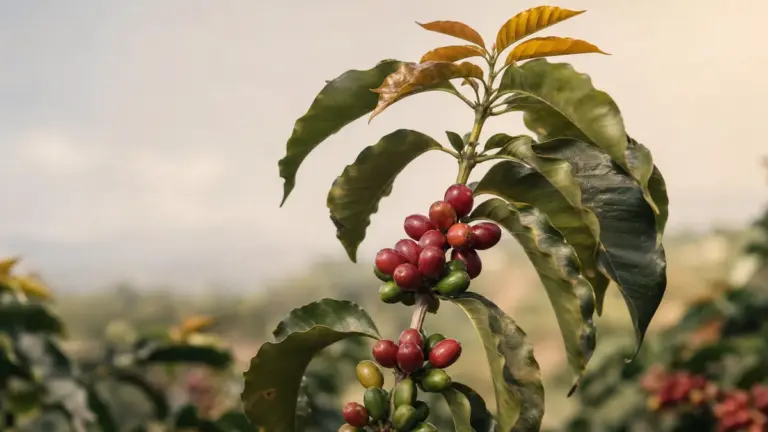
WCR describes traditional Bourbon as tall, with green leaf tips and average-sized beans. Its catalogue assigns medium yield potential and early fruit ripening relative to its reference varieties.
These are comparative descriptors, not promises about a particular farm. “Early ripening” means relatively early within the relevant local season, not that Bourbon is harvested in the same month everywhere.
The major weakness is disease susceptibility. WCR lists Bourbon as susceptible to coffee leaf rust, coffee berry disease and the nematodes covered by its catalogue. Nematodes are microscopic animals, some of which damage plant roots.
Its cup-quality reputation therefore comes with agricultural compromises. Excellent potential in a favourable site does not make it an easy or resilient choice everywhere.
This also explains why Bourbon’s descendants matter. Breeders and farmers have selected plants that retain useful characteristics while changing others, especially plant stature. A shorter plant can be easier to manage and can permit closer planting, although compactness should not be mistaken for disease resistance.
What does Bourbon taste like?
Bourbon has strong quality potential, but there is no single flavour that proves a coffee is Bourbon. Treat the variety name as useful background rather than a tasting guarantee.
Chocolate, sweetness, balanced structure and lively acidity are reasonable reference points in some producer descriptions. Café Eleta in Panama, for example, describes its Bourbon with chocolate and a sweet, wine-like finish. Those are descriptions of its coffee, not a universal sensory specification.
The distinction between potential and result is essential. WCR’s quality rating describes what the variety can achieve under suitable conditions. A bag of roasted coffee is the outcome of a particular crop and its handling.
For a practical comparison, ask a roaster for Bourbon and another variety from similar growing conditions, processed similarly and roasted to a comparable style. Taste them without knowing which is which, and record sweetness, acidity, texture and finish before reading the tasting notes. This is a more useful learning exercise than trying to memorise a supposed Bourbon flavour.
Bourbon’s descendants and related selections
A useful family tree distinguishes three things: a mutation, a selection and membership of a broader genetic group.
A mutation is an inherited genetic change. Selection means choosing plants with desirable characteristics and propagating their offspring. A genetic group describes relatedness, which need not reveal a direct parent.
| Variety | Best-supported relationship | Why the distinction matters |
|---|---|---|
| Caturra | Natural Bourbon mutation with a single-gene dwarfing trait | A direct example of Bourbon giving rise to a compact variety. |
| Pacas | Natural Bourbon mutation with a single-gene dwarfing trait | A separate compact descendant identified in El Salvador. |
| Villa Sarchi | Natural Bourbon mutation with a single-gene dwarfing trait | A compact descendant identified in Costa Rica. |
| Tekisic | Selection within Bourbon | Developed by repeated selection, rather than simply discovered as a dwarf mutant. |
| SL28 and Jackson 2/1257 | Bourbon-related genetic backgrounds | Related selections, not interchangeable names for Bourbon itself. |
Caturra, Pacas and Villa Sarchi illustrate how a relatively small inherited change can have substantial practical consequences. Their reduced stature permits closer planting than a traditional tall tree.
Tekisic illustrates a different route. Salvadoran researchers repeatedly selected desirable Bourbon plants, building a selected population over successive generations. It remains Bourbon-related without being the same kind of development as a dwarf mutation.
Why SL34 and Mibirizi need correcting
SL34 should not be listed as a Bourbon descendant. Its historical selection story involved a tree labelled “French Mission”, a name associated with Bourbon planting material. Genetic testing instead places SL34 in the Typica group. WCR explicitly notes that the original selection account may be incorrect.
SL28 is different: WCR places it in the Bourbon group and records its selection from Tanganyika Drought Resistant material. Sharing the “SL” prefix does not make SL28 and SL34 members of the same genetic group.
Mibirizi needs similar care. Although it is sometimes grouped with Bourbon-related East African coffees, WCR currently classifies it as Typica-related and describes its background as likely Typica-like. Its origin remains poorly documented, so it should not be presented as an established Bourbon descendant.
For Bourbon coffee, the useful buying question is therefore not simply “Which famous names appear in its family tree?” It is “What is known about this particular planting, and how confidently is its identity documented?”
FAQ
Do Yellow Bourbon beans stay yellow after roasting?
No, Yellow Bourbon refers to the ripe fruit’s skin, not the colour of the roasted coffee. The beans are seeds taken from inside that fruit. A yellow cherry therefore does not imply a yellow roasted bean, and photographs of roasted coffee cannot reliably establish whether the original fruit was red, yellow or orange.
Does a Bourbon label prove that every tree was genetically verified?
No, the name on a coffee listing is not itself evidence of genetic testing. Ask whether the identification comes from planting records, nursery information, field identification or laboratory analysis. These are different kinds of evidence. WCR’s distinction between named varieties and wider genetic groups is particularly useful when a seller uses “Bourbon” loosely.
How can I compare Red and Yellow Bourbon fairly?
Choose coffees matched as closely as possible for farm conditions, processing and roast, rather than comparing colour names alone. Ask the roaster what is genuinely comparable about the lots. A tasting can reveal which coffee you prefer, but without a controlled comparison it cannot establish that cherry colour caused the difference.
Where to go next
Read Coffee Varieties for the wider family framework, then Typica for the other major cultivated lineage. Arabica Coffee explains the species behind both, while Geisha provides a useful next study in why a variety’s name, history and genetic identity need careful separation.
Sources
-
World Coffee Research, Arabica Coffee Varieties: Bourbon; History of Arabica, live catalogue, undated, accessed November 2026.
Bourbon · History of Arabica -
World Coffee Research, Arabica Coffee Varieties, downloadable catalogue retrieved November 2026, altitude guidance and variety summaries.
Catalogue PDF -
World Coffee Research, Caturra; Pacas; Villa Sarchi; Tekisic, live catalogue entries, undated, accessed November 2026.
Caturra · Pacas · Villa Sarchi · Tekisic -
World Coffee Research, SL28; SL34; Jackson 2/1257; Mibirizi, live catalogue entries, undated, accessed November 2026.
SL28 · SL34 · Jackson 2/1257 · Mibirizi -
Instituto Agronômico, Alcides Carvalho, Histórico do desenvolvimento do cultivo do café no Brasil, Documentos IAC 34, 2007; and Programa Café, undated.
Historical account · Coffee programme -
Hu and colleagues, Comparative Metabolome Profiles and Antioxidant Potential of Four Coffea arabica L. Varieties Differing in Fruit Color, Diversity, volume 15, article 724, 2023.
Research paper -
Alliance for Coffee Excellence, El Salvador 2019, competition results, 2019.
Results and declared varieties -
Royal Coffee, Guatemala Antigua Finca El Destello Bourbon, undated lot record; Café Eleta, Nuestros Cafés, undated producer descriptions, both accessed November 2026.
El Destello lot record · Café Eleta descriptions
Research used WCR’s genetic and agronomic references, IAC’s historical records, a peer-reviewed fruit-chemistry study and attributed producer and competition records; no first-hand growing or tasting is claimed.
Last checked: November 2026