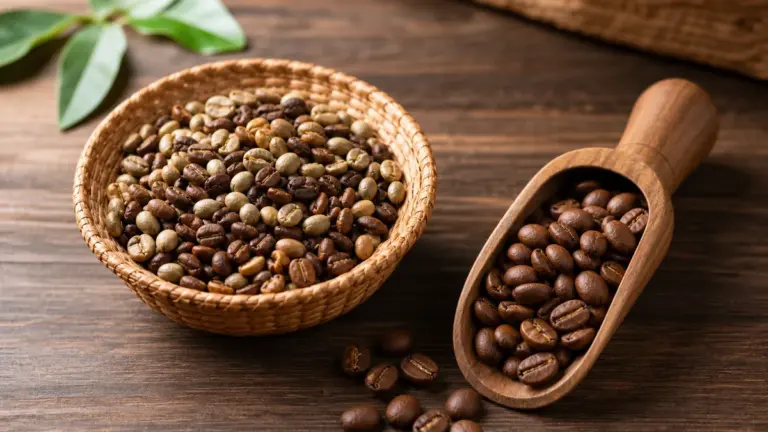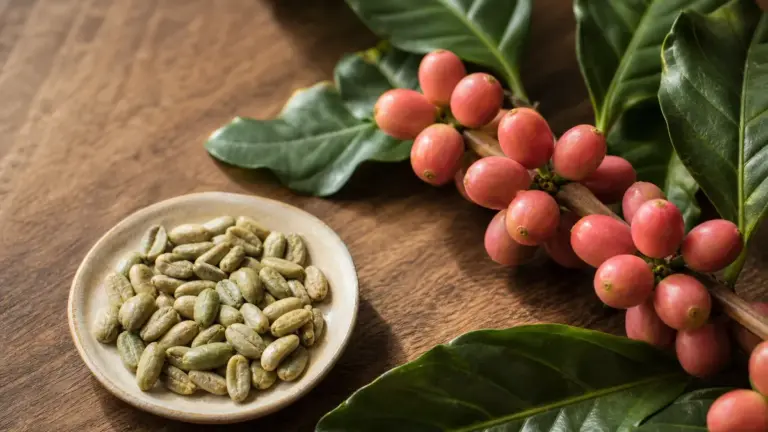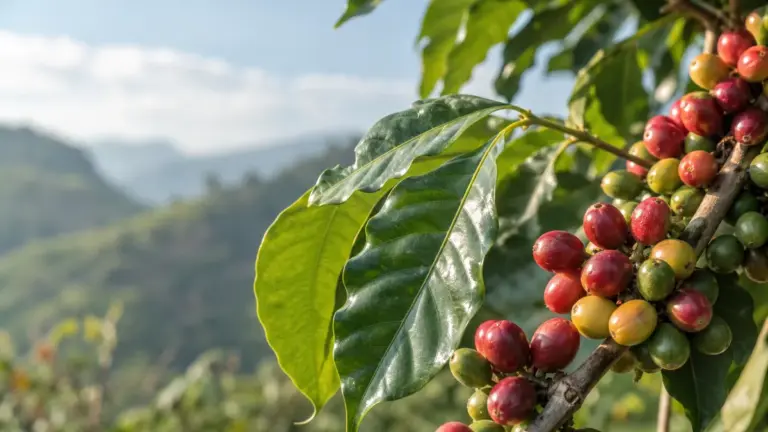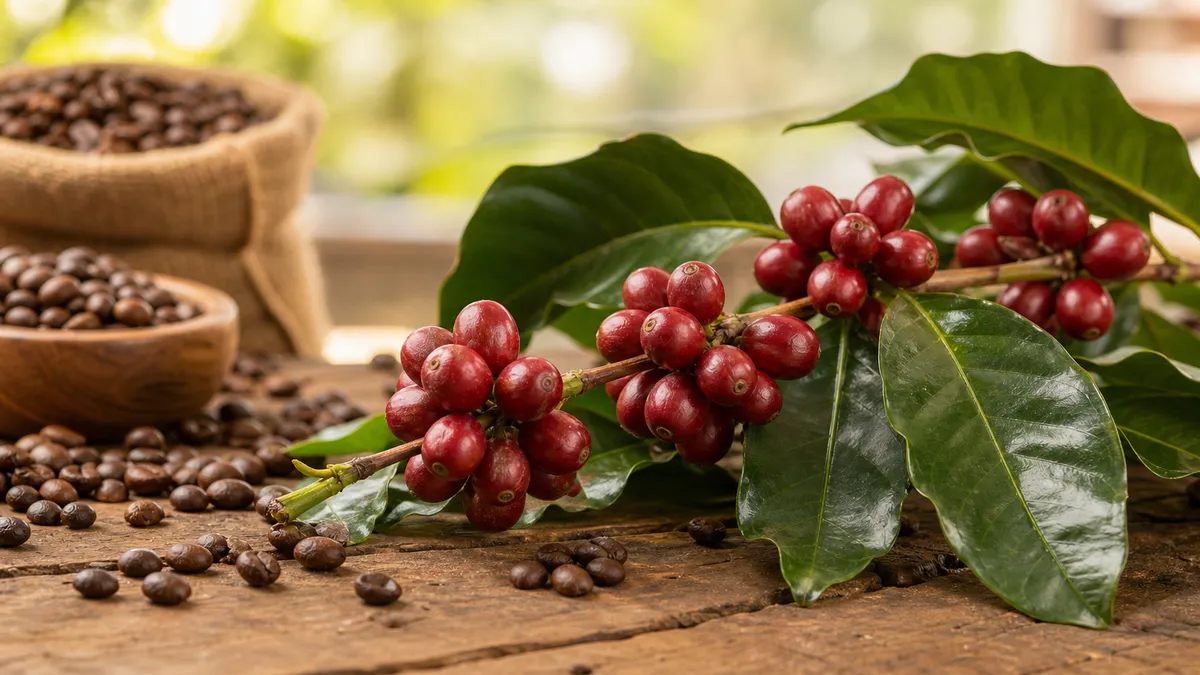
Arabica coffee is coffee made from the seeds of Coffea arabica, a species native to the forests of Ethiopia and South Sudan. It is prized for its aromatic range, from chocolate and nuts to citrus, berries and flowers, but the word “arabica” identifies the plant, not a guaranteed level of quality.
In short
- Arabica accounted for approximately 56.9% of world coffee production in the International Coffee Organization’s September 2026 estimate for 2025/26.
- Typica and Bourbon are varieties within arabica, not separate coffee species.
- Modern references describe genetic groups and cultivated varieties rather than dividing everyday arabica coffees into botanical subspecies.
- Altitude is useful context, not a quality score: temperature, variety, farming and processing also matter.
- Arabica’s limited genetic diversity makes disease resistance and adaptation to a changing climate especially important.
What is arabica coffee?
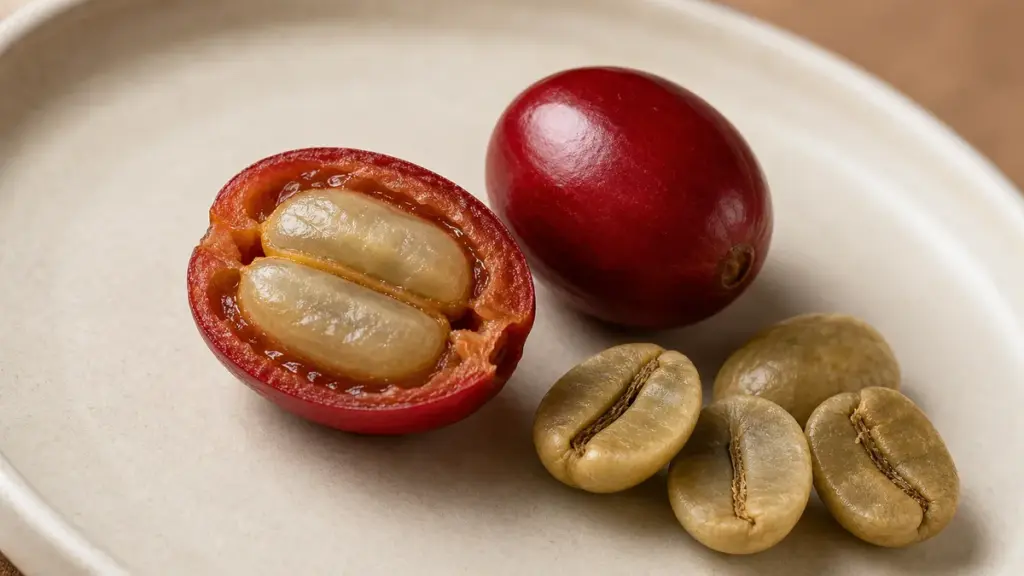
The “beans” are seeds inside the coffee plant’s fruit, commonly called cherries. After harvesting, producers remove the fruit and dry the seeds through different processing methods, before the green coffee is roasted.
Arabica is a species, not a country of origin, roast level or brewing method. Within it sit numerous cultivated varieties, with differences in plant size, productivity, disease resistance and potential cup quality. Our coffee varieties guide puts these names into their wider context.
A useful distinction is between identity and quality. An arabica coffee can be carefully produced and expressive, or poorly handled and disappointing. A label stating “100% arabica” tells you the declared species composition, but cannot describe how well the coffee was grown, processed, stored or roasted.
How much of the world’s coffee is arabica?
The International Coffee Organization’s September 2026 report estimated 104.4 million 60 kg bags of arabica out of 183.6 million bags of coffee overall for 2025/26. Dividing arabica production by total production gives approximately 56.9%.
“Roughly 55% to 60%” is therefore a reasonable shorthand for recent ICO figures, not a permanent biological or market rule. The share changes with harvests, weather and production of the other major commercial species, robusta. Brazil’s alternating heavier and lighter arabica crops can contribute to those movements, but do not explain every change.
Production estimates also differ between organisations and are revised. The percentage above belongs specifically to the named ICO report and season.
Where arabica originated
Arabica’s native home is African forest, particularly southern and south-western Ethiopia and neighbouring South Sudan. Its name should not be read as proof that the species originated on the Arabian Peninsula.
Yemen nevertheless holds a central place in its cultivation history. Coffee moved from Ethiopia to Yemen, where farmers cultivated and selected plants; descendants subsequently spread through trade and colonial planting networks.
That movement helps explain a striking imbalance: coffee grown around the world can have a relatively narrow ancestry, while Ethiopia retains much of the species’ genetic diversity. Yemen also contains diversity that was underrepresented in earlier studies.
For the drinker, origin and ancestry answer different questions. “Grown in Colombia” identifies where a crop was produced; “Bourbon” describes its variety. Neither replaces the other.
Arabica genetics in plain English
Arabica arose through natural hybridisation between ancestors of Coffea canephora, the species traded as robusta, and Coffea eugenioides. This happened long before modern coffee breeding.
It inherited chromosome sets from both parents. Arabica has 44 chromosomes, arranged in four sets, rather than the two sets found in its parental species. The technical term is allotetraploid: four chromosome sets originating from different species.
That does not mean a bag of arabica is a blend of arabica and robusta beans. An ancient hybridisation event produced a distinct species.
Later breeding introduces another layer. Some cultivated arabicas carry additional C. canephora ancestry introduced through more recent crosses, particularly descendants of the Timor Hybrid. These two histories, the formation of the species and subsequent breeding, should not be confused.
For the naming distinctions, see species, varieties and cultivars.
Arabica Subspecies
“Arabica subspecies” is a common search term, but it is not the most useful description of the coffees encountered on packets. World Coffee Research’s catalogue uses genetic descriptions such as Ethiopian landrace, Bourbon-Typica group, introgressed varieties and F1 hybrids.
A genetic group gathers plants with related ancestry. It is not necessarily a formally named botanical subspecies. Nor do all research papers draw group boundaries in exactly the same way.
Bourbon-Typica ancestry
The Bourbon and Typica lineages underpin much cultivated arabica outside its native range. They include named varieties and descendants produced through selection, mutation and crossing.
The names operate at different levels: Typica is a particular variety, while “Typica-related” describes a broader relationship. Read the individual Typica guide for its characteristics rather than treating every related coffee as identical.
Ethiopian landraces and Core Ethiopia groups
A landrace is a traditional, locally adapted cultivated population shaped over time by farming and its environment. “Ethiopian landrace” does not mean one uniform variety, and should not be used as a synonym for every wild Ethiopian coffee plant.
Genetic research can distinguish populations within this diversity. A 2022 study identified two “Core Ethiopia” clusters, alongside other clusters associated with the movement and domestication of arabica. These are research findings about ancestry, not a replacement set of botanical subspecies.
New-Yemen and Yemenia
Research published in 2021 identified a New-Yemen genetic cluster. The name Yemenia is also used in connection with this group.
The distinction matters: this is evidence of diversity within arabica, not the discovery of another coffee species. Later work examining Ethiopia and Yemen together identified additional structure, including Harrar and Ethiopian Legacy clusters.
The apparent difference between simplified catalogue categories and research clusters reflects different purposes, samples and analytical methods. This article follows World Coffee Research for practical variety descriptions and uses the research names when discussing population genetics.
Introgressed varieties and F1 hybrids
Introgression means bringing genetic material from another species into a breeding population through crossing. Catimor-related and Sarchimor-related arabicas commonly carry C. canephora ancestry through the Timor Hybrid, used by breeders for disease resistance.
An F1 hybrid is the first generation of a cross between selected parents. This describes a breeding generation, not a subspecies. The categories can overlap: an F1 hybrid can also be introgressed.
Bourbon remains a useful example of an established variety within this wider family. Our Bourbon guide covers its particular history and growing characteristics.
Growing conditions and the arabica fact panel
Arabica is associated with tropical highlands because elevation often provides cooler conditions. Kew gives an optimum mean temperature range of 18 to 23°C and describes its native habitat as humid mountain forest.
However, a habitat range is not a universal farming prescription. Latitude, exposure, shade, rainfall and variety change what is possible at a particular elevation. The Coffee Board of India, for example, gives its own regional growing guidance rather than one worldwide altitude rule.
Arabica fact panel
| Feature | Species-wide context or clearly bounded example |
|---|---|
| Native origin | Southern Ethiopia and South Sudan |
| Altitude | Kew describes a native-habitat range of 950 to 1,950 metres; the Coffee Board of India gives 1,000 to 1,500 metres in its general arabica cultivation guidance |
| Varieties and breeding groups | Examples include Typica, Bourbon and their descendants, Ethiopian landraces, introgressed varieties and F1 hybrids |
| Main processing approaches | Washed, natural and pulped natural or honey processing |
| Harvest months | No single global season. India’s arabica harvest is generally November to January; central Colombia commonly has a main harvest in October to December and a secondary harvest in April to June |
| Typical cup possibilities | Sweet-associated aromas, chocolate, nuts, fruit and flowers, with varying acidity, bitterness and body; not a guaranteed profile |
Washed processing removes the fruit and mucilage before the coffee finishes drying. Natural processing dries the cherries before the dried fruit is removed. Pulped natural and honey approaches remove the skin but retain some mucilage during drying.
These are processing choices, not arabica varieties.
Arabica Growing Regions
Arabica is cultivated across tropical parts of the Americas, Africa, Asia and the Pacific. Brazil is the largest arabica producer, while Colombia, Ethiopia and Honduras are other substantial origins.
The Americas
Brazil, Colombia and Peru are important South American sources. Further north, arabica is grown in Honduras, Guatemala, Mexico, Nicaragua and Costa Rica.
These countries should not be treated as single flavour categories. Even within one origin, the variety, growing environment and processing method provide additional information about a particular lot. Country names are a starting point for exploration, not a tasting verdict.
Africa and Yemen
Ethiopia combines commercial production with exceptional importance as a reservoir of arabica diversity. Kenya, Rwanda, Burundi and Tanzania also grow arabica.
Yemen belongs geographically to Asia, but its cultivation history is closely connected to Ethiopia. Its role in domestication and its surviving genetic diversity make it more than a historical stepping stone.
Asia and the Pacific
Arabica is also grown in India, Indonesia and Papua New Guinea. Some producing countries grow both arabica and robusta, so a national origin alone does not establish the species.
For UK readers comparing bags, look for the combination of species, origin, variety where known, processing method and the roaster’s flavour description. More useful detail is preferable to assuming that a familiar country name guarantees a particular result.
What does arabica coffee taste like?
Arabica’s appeal lies in its range rather than one signature flavour. Chocolate, nutty, fruity and floral attributes all appear in the World Coffee Research Sensory Lexicon, which was developed using arabica samples.
“Acidity” in tasting means the sour or bright component of flavour. “Body” describes aspects of mouthfeel, such as fullness or thickness. Neither word, by itself, tells you whether you will enjoy the coffee.
For a practical starting point, choose descriptions that match your preferences. Chocolate, caramel and nut notes suggest a different intended experience from jasmine, citrus and berry notes. Treat them as the roaster’s description of that coffee, not promises attached to the entire species.
A useful comparison is to taste contrasting arabicas without trying to rank their countries. Ask which seems more floral, fuller-bodied, brighter or more bitter. That turns a broad species label into something you can actually recognise in the cup.
Disease, climate and arabica’s future
Arabica’s narrow genetic base is a vulnerability. Many established varieties are susceptible to coffee leaf rust, a fungal disease that causes leaf loss and can severely reduce production.
Resistance breeding is therefore not a departure from quality coffee. It is part of keeping coffee viable for farmers. World Coffee Research describes Centroamericano, an introgressed F1 hybrid, as combining rust resistance with exceptional cup-quality potential under suitable management and growing conditions.
Climate adds another pressure. Heat and drought can affect plant growth and production, while changing rainfall complicates cultivation. Moving uphill is not a universal answer, and shade management must suit the site.
In a field study of smallholder arabica systems, moderate shade buffered the microclimate and reduced leaf ageing without reducing yields, while excessive shade could reduce productivity. That illustrates why adaptation needs local evidence rather than a blanket instruction.
Protecting genetic diversity and evaluating varieties across different environments are complementary tasks. Arabica coffee’s future depends not simply on preserving familiar names, but on maintaining the diversity from which useful, good-tasting and better-adapted plants can be selected.
FAQ
Does “100% arabica” mean specialty coffee?
No. It describes the declared species composition, not an assessment of quality. Arabica includes coffees with very different characteristics and standards of handling. Use the statement alongside origin, processing information and a useful flavour description, rather than treating it as an award or an assurance that the coffee will suit your taste.
Can arabica beans come from more than one country?
Yes. Arabica is grown in many countries, and a blend can combine arabicas from different origins while remaining entirely arabica. Species and geographical origin are separate pieces of information. If you want to understand a blend, look for its component origins and the roaster’s explanation of the intended flavour.
Are modern hybrid arabicas necessarily poorer tasting?
No. Hybrid ancestry alone does not determine cup quality. World Coffee Research identifies high cup-quality potential in some modern hybrids, including Centroamericano. A variety’s performance also depends on where and how it is grown. Judge the particular coffee and the evidence about that variety, rather than assuming that newer breeding means inferior flavour.
Where to go next
Continue with Coffee Varieties for the wider family, then Coffee Species, Varieties and Cultivars Explained to make sense of naming on packets. For the two foundational lineages discussed here, Typica and Bourbon explain how individual varieties fit within arabica coffee.
Sources
-
Royal Botanic Gardens, Kew, Arabica coffee: Coffea arabica, undated plant profile. Native range, habitat, altitude and temperature.
https://www.kew.org/plants/arabica-coffee -
International Coffee Organization, Coffee Market Report: September 2026, Table 3. Production estimates.
https://ico.org/documents/cy2025-26/cmr-0926-e.pdf -
US Department of Agriculture, Foreign Agricultural Service, Coffee: World Markets and Trade, July 2026. Producing countries, species breakdowns and Brazil’s arabica production cycle.
https://apps.fas.usda.gov/psdonline/circulars/coffee.pdf -
World Coffee Research, History of Arabica, undated online catalogue background. Origins, dissemination and cultivated ancestry.
https://varieties.worldcoffeeresearch.org/arabica-2/history-of-arabica -
World Coffee Research, Arabica Varieties, catalogue PDF, retrieved November 2026; publication year not stated in the retrieved edition. Practical genetic categories, landraces, introgression and rust.
https://cdn2.assets-servd.host/worldcoffee-research/production/pdf/catalogEnglish/Combined/arabica-1769602235.pdf?dm=1769602235 -
Salojärvi and colleagues, The genome and population genomics of allopolyploid Coffea arabica reveal the diversification history of modern coffee cultivars, Nature Genetics, volume 56, 2024. Species ancestry, chromosomes and genetic vulnerability.
https://www.nature.com/articles/s41588-024-01695-w.pdf -
Montagnon and colleagues, Unveiling a unique genetic diversity of cultivated Coffea arabica L. in its main domestication center: Yemen, Genetic Resources and Crop Evolution, 2021. New-Yemen cluster.
https://d-nb.info/1230750908/34 -
Montagnon and colleagues, Deciphering Early Movements and Domestication of Coffea arabica through a Comprehensive Genetic Diversity Study Covering Ethiopia and Yemen, Agronomy, 12, 3203, 2022. Core Ethiopia and domestication-associated clusters.
https://www.mdpi.com/2073-4395/12/12/3203/pdf?version=1671687439 -
Scientific Reports, Identifying the origin of Yemeni green coffee beans using near infrared spectroscopy: a promising tool for traceability and sustainability, 2024. Use of Yemenia alongside New-Yemen.
https://www.nature.com/articles/s41598-024-64074-9 -
Coffee Board of India, Coffee Regions in India and general industry information, undated. Regional cultivation guidance and arabica harvest timing.
https://coffeeboard.gov.in/coffee-regions-india.html
https://coffeeboard.gov.in/IndexContent.html -
Cenicafé, Cosecha del café, 2013. Geographical variation in Colombian harvest seasons.
https://biblioteca.cenicafe.org/handle/10778/4343 -
International Trade Centre, The Coffee Guide, fourth edition, 2021. Processing methods and coffee quality context.
https://www.intracen.org/media/5718 -
World Coffee Research, Sensory Lexicon, version 2.0, 2017. Flavour, aroma and mouthfeel terminology.
https://worldcoffeeresearch.org/download/bf904452-fc8c-488f-b591-c0b20d9bcab2 -
World Coffee Research, Centroamericano, undated online variety profile. Parentage, resistance and cup-quality potential.
https://varieties.worldcoffeeresearch.org/varieties/centroamericano -
World Coffee Research, Climate Change + Coffee, undated programme page. Adaptation and variety evaluation.
https://worldcoffeeresearch.org/programs/climate-mitigation -
Agriculture, Ecosystems & Environment, Disentangling effects of altitude and shade cover on coffee fruit dynamics and vegetative growth in smallholder coffee systems, volume 326, 2022. Field evidence on temperature, shade and productivity.
https://www.sciencedirect.com/science/article/abs/pii/S0167880921004904
This article was researched using botanical references, original genetic and field studies, official production statistics, national coffee guidance and World Coffee Research resources; the production percentage was calculated from the cited ICO totals.
Last checked: November 2026