Common coffee machine faults include scale-blocked water circuits, worn seals, pump problems, temperature-control faults, sticking brew units and jammed grinders. The same symptom can have several causes: a machine that produces no coffee may have a blocked filter or an air-filled water circuit rather than a failed pump.
In short
- Slow delivery does not prove pump failure: scale, fine grounds and blocked outlets can also restrict flow.
- A leaking portafilter may need cleaning or correct fitting, not necessarily a new gasket.
- A temperature warning can involve the sensor, its wiring, the heater or the control board.
- Remove and lubricate a brew unit only where the manufacturer provides instructions for doing so.
- Stop using a machine with electrical damage, overheating signs or an unexplained internal leak.
Understanding common coffee machine faults
A useful way to understand a fault is to separate the symptom you observe from the component responsible. “No water” describes an outcome; it does not identify the pump, valve, water supply or blockage that caused it.
Manufacturer troubleshooting tables illustrate this clearly. They list several possible explanations for slow coffee delivery, leaking and poor heating, with different remedies for each. This article explains those mechanisms rather than providing a universal repair sequence.
For checks organised around what your machine is doing, use coffee machine troubleshooting. The wider equipment care and repairs hub covers maintenance and repair decisions.
Start with the safety boundary
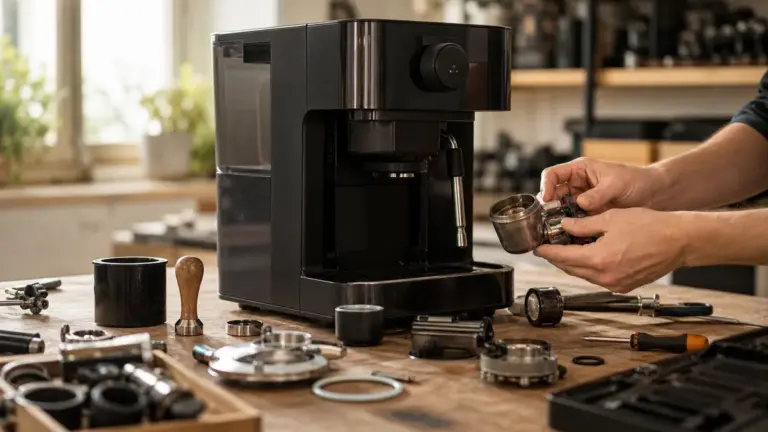
Switch off and unplug the machine before inspecting user-accessible parts, and allow hot components to cool. Follow its shutdown instructions before removing a brew unit, because some machines must first park the mechanism.
Do not remove outer panels, bypass safety switches or work on internal electrical connections. In Great Britain, HSE guidance says electrical repairs should be carried out by someone with the necessary skills, knowledge and experience. Unexpected steam, scorching, damaged cables or water escaping from inside the casing are reasons to stop using the machine and seek competent assistance.
Scale build-up: restricted water passages
Hard water contains dissolved minerals that can leave limescale deposits. Water hardness varies with the supply, so use your local water supplier’s published information or the test specified in your machine manual rather than assuming one hardness level applies throughout the UK.
Inside a coffee machine, mineral deposits can obstruct water outlets and valves. The result may be slower delivery, dripping or failure to dispense. Manufacturer service guidance also identifies scale on tanks, heaters and temperature probes as a possible contributor to abnormal heating behaviour.
Scale is therefore more than the white crust visible around a tank connection. Deposits in an inaccessible passage may affect operation even when the outside looks clean.
Prevention means matching the machine’s hardness setting, filter arrangement and descaling programme to its instructions. Do not repeatedly run stronger descaling mixtures to treat an undiagnosed fault. A completely blocked circuit or persistent heating problem needs assessment rather than increasingly aggressive cleaning.
Worn gaskets and seals: water takes the wrong route
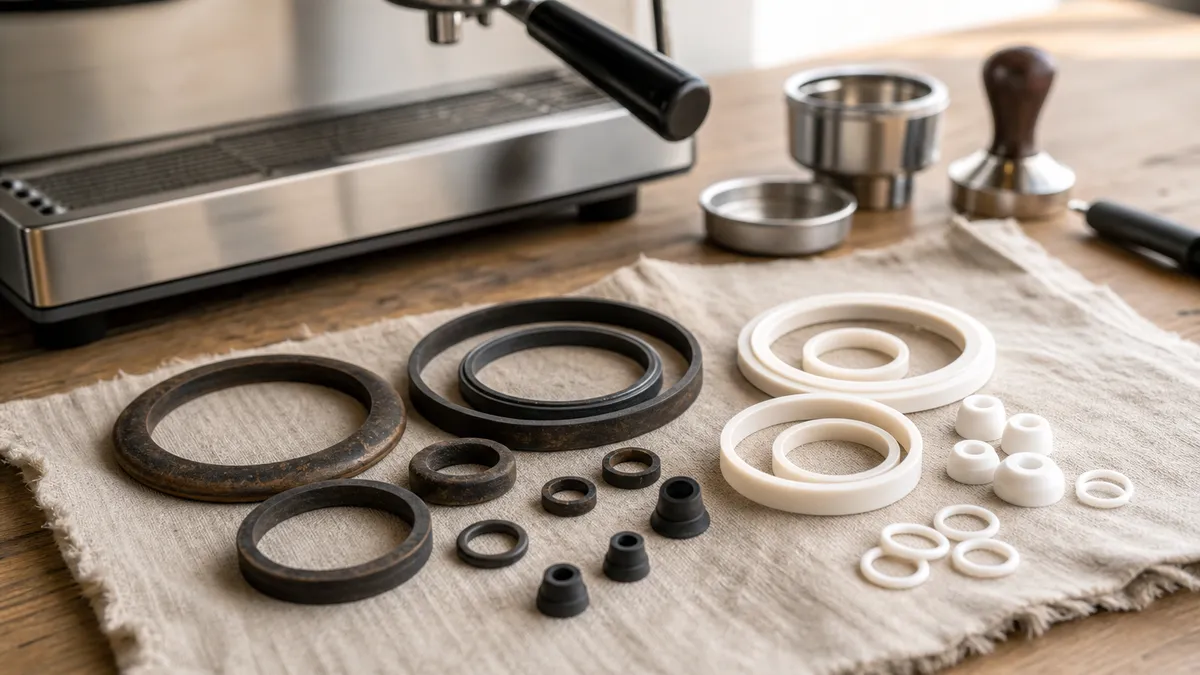
A gasket seals the joint between components. On a traditional espresso machine, the group gasket helps seal the portafilter, the removable handle holding the coffee basket, against the group head above it.
Rubber seals need enough resilience to maintain contact with adjoining surfaces. One failure mechanism is compression set, permanent flattening after compression. Heat and unsuitable operating conditions can contribute to seal deterioration, although appearance alone cannot establish the cause.
When a group seal no longer works properly, coffee may escape around the portafilter rim instead of through the spouts. De’Longhi identifies loss of gasket elasticity as one possible cause of this symptom.
However, grounds on the sealing surfaces, incorrect fitting and a blocked filter can produce similar leakage. Cleaning the accessible surfaces and checking correct assembly come before assuming the gasket has failed. Replacement must follow the model’s instructions: some manufacturers describe a user procedure, while others direct owners to a service centre.
Pump failure: distinguish the pump from its supply
The pump moves water through the machine. In a vibration pump, an electromagnetic coil drives an oscillating piston; valves direct the resulting movement into useful flow. Other pump designs work differently, so diagnosis must match the machine.
A pump-related problem can involve the pump itself, its electrical supply or protection against overheating. Sage, for example, identifies pump or grinder overheating as a possible reason for its safety thermal cut-out to stop operation.
But a pump cannot deliver normally if water does not reach it. An empty or incorrectly seated tank, or trapped air in the circuit, can interrupt delivery without a failed pump. Philips provides model-specific procedures for releasing trapped air, illustrating why priming instructions must come from the correct manual.
Sound alone is not a diagnosis. Normal vibration-pump operation can be audible, while an altered sound does not tell you which component needs replacement. After permitted tank and priming checks, persistent failure requires a technician to distinguish a supply restriction, blockage, control problem and pump defect.
Thermostat and sensor faults: losing control of heat
Temperature control relies on both measurement and switching. Depending on the design, a machine may use a thermostat or an electronic sensor linked to a control board; a separate protective device may interrupt operation if conditions become unsafe.
An electronic temperature sensor may be a thermistor, a component whose electrical resistance changes with temperature. The controller uses that signal to determine whether heating is needed.
If the sensor circuit becomes disconnected or short-circuited, the controller may receive an invalid reading. BUNN’s programming guidance identifies broken connections and shorted sensor wiring as causes of temperature-sensor warnings. A warning naming a sensor therefore does not automatically mean the sensor itself needs replacing.
Failure to heat can also involve the heating element, limit thermostat or control board. Conversely, excessive steaming can have more than one cause, including scale and temperature-control problems. These are service diagnoses, not reasons to bypass a protective cut-out.
A lukewarm drink is less conclusive. Cold cups, added milk and a low temperature setting can reduce serving temperature even when the heating system works.
Brew unit problems: movement, cleanliness and alignment
In a bean-to-cup machine, the brew unit, also called the infuser or brew group, contains the mechanism that handles the grounds during brewing. Problems can arise when it becomes dirty, needs specified lubrication or is not in the correct position.
Coffee residue around moving parts and inadequate lubrication can interfere with operation. Philips advises cleaning and lubricating the appropriate parts on its removable brew groups, but that is not permission to grease every machine mechanism.
Position matters too. A unit that has stopped away from its removal position may appear jammed. The correct response is the manufacturer’s reset or parking procedure, not pulling harder.
Some loose coffee beneath a brew unit can be normal, according to Philips. Treat a change in operation, repeated errors or increasing spillage as more useful information than an isolated dusting of grounds.
Only remove a unit described as user-removable. Use the specified lubricant on the specified locations, and never improvise a reset by defeating a door switch.
Grinder jams: blocked movement or blocked delivery
A grinder can stop delivering grounds because its chamber or outlet chute is blocked. Moisture in these areas is another cause identified in manufacturer troubleshooting guidance.
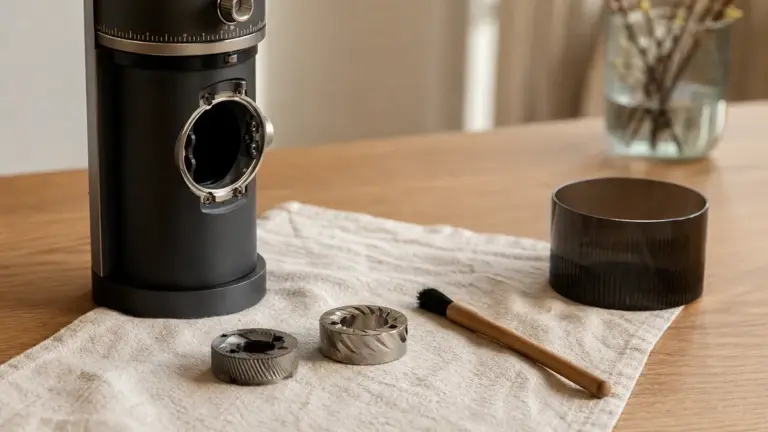
The distinction matters: beans failing to reach the burrs, the grinding surfaces, are not the same fault as ground coffee failing to leave them. A blocked chute may prevent delivery even though grinding has taken place.
Foreign material can also obstruct a grinder. JURA’s troubleshooting guidance associates an unusually loud grinder noise with foreign objects and directs the owner to customer support.
Stop the machine if a new harsh noise suggests an obstruction. Do not put fingers or tools into a powered grinder, repeatedly restart it against a suspected jam, or pour water into the grinding chamber. Use grinder cleaning guidance alongside the manufacturer’s instructions for the parts owners may safely access.
Symptom, possible cause and safe next action
This table is a guide to fault categories, not a confirmed diagnosis. Stop immediately where there is an electrical or scalding hazard.
| Symptom | Possible cause | Safe next action |
|---|---|---|
| Coffee only drips | Fine grounds, blocked filter or scale | Check permitted cleaning and grind adjustments in the manual |
| Coffee escapes around the portafilter | Dirty sealing surface, incorrect fitting or worn gasket | Cool, clean and refit; arrange replacement if required |
| No water is delivered | Tank problem, trapped air, blockage or pump-related fault | Check the tank and the model’s priming instructions |
| Persistent heating warning | Sensor circuit, heater or control fault | Record the message and contact service support |
| Brew unit will not come out | Mechanism not in its removal position | Follow the parking or reset procedure; do not force |
| Grinder makes a harsh new noise | Possible foreign object or obstruction | Stop grinding and seek model-specific support |
Preventing recurrence and helping the technician
Prevention works best when it addresses the mechanism rather than simply increasing cleaning frequency.
- Use the correct maintenance programme. Follow the machine’s cleaning, descaling and filter instructions, including its water-hardness setting.
- Keep accessible coffee passages clear. Clean removable components as directed, without transferring a procedure from another machine.
- Respect lubrication instructions. Where lubrication is required, use the approved product and application points.
- Report changes early. Record slower delivery, new leakage, unusual sounds and recurring warnings instead of repeatedly resetting the machine.
- Keep a maintenance record. Note completed cleaning, filter changes and servicing, especially where several colleagues share responsibility.
For a service request, provide the exact model, displayed message, when the fault occurs and what changed beforehand. “No coffee after a filter change” is more useful than “pump broken”.
Ask for a written diagnosis distinguishing the observed symptom from the confirmed failed part, plus an itemised written quotation before authorising work. Understanding common coffee machine faults helps you describe the problem accurately without guessing at a replacement component.
FAQ
Does water in the drip tray mean the machine is leaking?
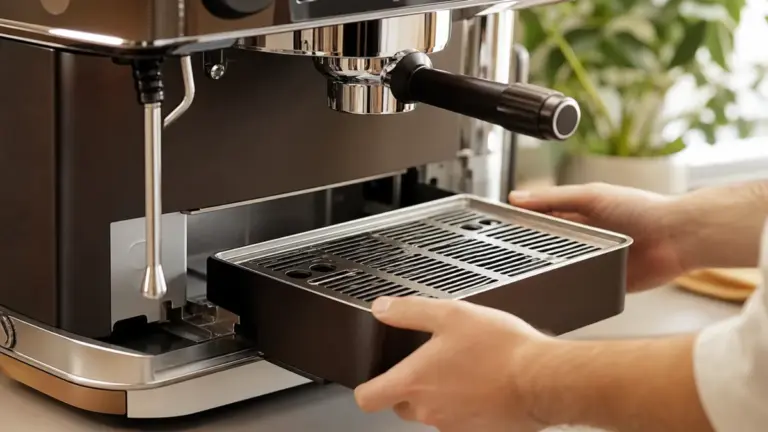
No, some machines deliberately discharge water into the drip tray during normal operation. Sage describes this as part of its automatic purge function. An overflowing or incorrectly positioned tray can then resemble a leak. Water appearing beneath the casing, or a marked change from normal behaviour, still needs investigation.
Can the same error code mean different things on different machines?
Yes, interpret an error code using the instructions for the exact model. Manufacturers use their own diagnostic systems, and a message may describe a detected condition rather than identify one failed component. Record the complete wording, not just the number, and avoid applying an online reset procedure intended for another machine.
Does an expired guarantee mean I have no rights over a faulty machine?
No, an expired guarantee does not automatically end statutory consumer rights. GOV.UK explains that rights concerning faulty goods can exist independently of a warranty or guarantee. Contact the seller with your purchase evidence and fault history before arranging invasive work. For a workplace purchase, check the supply contract rather than assuming consumer remedies apply.
Where to go next
Read Coffee Machine Troubleshooting for symptom-led checks, and Cleaning a Coffee Grinder for permitted cleaning rather than mechanical repair. Once the fault has been properly diagnosed, Repair or Replace? helps you consider the next decision.
Sources
Manufacturer manuals below are used as evidence of documented mechanisms and model-specific instructions, not as proof that every machine shares the same design.
-
HSE, Work using electrically powered equipment, undated live guidance.
https://www.hse.gov.uk/ELECTRICITY/electricequip.htm
Isolation before checks and referral of unsafe equipment for competent assessment. -
HSE, Introduction to electrical safety, undated live guidance.
https://www.hse.gov.uk/electricity/introduction.htm
Warning signs and competence requirements for electrical repairs. -
Thames Water, Hard water, undated live guidance.
https://www.thameswater.co.uk/help/water-and-waste-help/water-quality/hard-water
Mineral content, local geology and limescale. -
Sage, The Barista Express BES875/SES875: EN Quick Guide, UG1 C21, 2021.
https://assets.sageappliances.com/BES875/SES875_UK_UG1_C21_FA_LR.pdf
Restricted delivery, thermal protection, grinder blockages and normal purging. -
De’Longhi, Instructions for use, document EN-5713234581, undated.
https://dls.delonghigroup.com/files/docs/5/EN-5713234581.pdf
Leakage associated with gasket elasticity, dirt, fitting and blocked filters. -
Apple Rubber Products, Compression Set: Seal Design Guide, undated.
https://www.applerubber.com/seal-design-guide/troubleshooting-help/compression-set/
Seal flattening and contributing material and operating conditions. -
CEME, Fluid Control Components, electropump operating-principle section, undated catalogue.
https://files.cemegroup.com/uploads/Cat%20Ceme%20Ulka.pdf
Electromagnetic oscillating-piston pump operation. -
Philips, A warning light on my Philips espresso machine is not turning off, live support guidance, 2023.
https://acc.philips.co.uk/c-t/XC000017669/a-warning-light-on-my-philips-espresso-machine-is-not-turning-off
Trapped air, water delivery and model-specific recovery instructions. -
BUNN, ITB/ITCB/HV Service Manual, document 54299, 2017, manufacturer-authored copy hosted by ManualMachine.
https://manualmachine.com/bunn/itbitcbhv/27315904-service-manual/
Scale-related faults, heating components and temperature-probe testing principles. -
BUNN, ICB Twin SH, ICB SH, ICBA SH Programming Manual, 53669.0000A, April 2017, manufacturer-authored copy hosted by WebstaurantStore.
https://www.webstaurantstore.com/documents/pdf/bunn_icb_programming_guide.pdf
Temperature-sensor wiring faults and diagnostic messages. -
Philips, 3100 Series Super Automatic Espresso Machine User Manual, 4219.460.4098.1, 2017.
Brew-group positioning, lubrication and serving-temperature explanations.
-
Philips, There is coffee powder under the brew group of my Philips Espresso Machine, undated live support guidance.
https://www.usa.philips.com/c-f/XC000004108/there-is-coffee-powder-under-the-brew-group-of-my-philips-espresso-machine
Loose grounds, cleaning and specified lubrication points. -
JURA, C3 Instructions for Use, North American edition, undated.
https://us.jura.com/-/media/global/pdf/manuals-na/Home/C3/download_manual_c3_us.pdf
Grinder noise associated with foreign objects and referral to support. -
GOV.UK, Accepting returns and giving refunds: the law, undated live guidance.
https://www.gov.uk/accepting-returns-and-giving-refunds
Statutory consumer remedies and guarantees.
Research combined manufacturer operating and service documents with seal-engineering guidance, a UK water supplier’s information, HSE guidance and GOV.UK consumer guidance; no first-hand testing was undertaken.
Last checked: November 2026