To descale a coffee machine in UK hard water, use the descaler and programme specified in its manual, then complete every fresh-water rinse. Check your local water hardness and enter the correct machine setting: harder water generally means more frequent descaling, but there is no safe universal monthly schedule.
In short
- Find your supplier’s local hardness result, preferably in mg/L as calcium carbonate, rather than relying on a national map.
- Descaling removes mineral deposits. Coffee-oil cleaning, backflushing and milk-system cleaning are separate jobs.
- Measure the product precisely. A liquid dose, powder sachet and tablet dose are not interchangeable.
- Remove the tank filter if instructed, and let the complete descale-and-rinse programme finish.
- Choose a filter that explicitly reduces hardness or limescale. Improving chlorine taste alone does not establish scale protection.
Why hard water leaves scale inside a coffee machine
Hardness comes mainly from dissolved calcium and magnesium. Water picks these minerals up as it passes through rock and soil, so neighbouring supply areas can have different hardness.
When suitable hard water is heated, changes in the balance between dissolved carbon dioxide, bicarbonate and carbonate encourage calcium carbonate to form solid deposits. These deposits collect on heated surfaces and inside waterways. Scale can restrict flow and interfere with heating.
Descaling uses an acidic solution to dissolve those mineral deposits. It is not a substitute for removing coffee oils or milk residue: follow the separate routines in the coffee machine cleaning guide.
A white crust in the tank is a useful warning, but a clean-looking tank does not prove that the heated circuit is scale-free. Follow the machine’s maintenance instructions rather than waiting for visible deposits.
Find your local water hardness first
Use your drinking-water supplier’s website and enter your full postcode where a checker is available. Thames Water, for example, provides a postcode-based water-quality lookup. If the result does not include hardness, ask the supplier for the figure for your supply zone.
Look for total hardness expressed as mg/L CaCO₃, meaning milligrams per litre expressed as calcium carbonate. This is a reporting convention, not a measurement of loose chalk floating in the water. Do not confuse it with a result labelled simply “calcium”.
Local figures matter more than regional reputation. Scottish Water’s published 2024 annual averages, for example, list Acharacle at 9.53 mg/L as CaCO₃ and Ringford & Glengap at 57.96 mg/L. Those are historical supply-zone results, not current readings for every nearby address.
Match the units to your machine
Machine menus may use German degrees, written °dH, or a numbered hardness level. Supplier reports may also include Clark degrees, a traditional British hardness unit.
Approximately:
- 1 German degree equals 17.8 mg/L as CaCO₃.
- 1 Clark degree equals 14.3 mg/L as CaCO₃.
Use the manual’s conversion table or supplied test strip to select the machine level. A menu setting called “4” does not necessarily mean 4 °dH.
For water treated before entering the machine, follow the manufacturer’s instructions about testing and settings. Do not automatically enter the untreated postcode figure, or select “soft” merely because a cartridge is fitted.
Choose the right descaling product
Start with compatibility, not the ingredient name. The product must be suitable for your machine’s internal materials and permitted by its manufacturer.
Use the specified liquid, powder or tablets at the stated dilution. Manufacturers may require their own maintenance products, and instructions for one machine do not establish compatibility with another.
Cleaning tablets are not necessarily descaling tablets. JURA, for example, provides separate cleaning and descaling procedures, using different products and entry points. Putting a coffee-cleaning tablet into the water tank is not a substitute for descaling.
Avoid homemade vinegar or citric-acid recipes unless the machine manufacturer explicitly permits them. Sage’s published descaling support says not to use vinegar. A household kettle recipe is not evidence that the same mixture suits an espresso machine.
Read the safety label before opening the product. Avoid skin and eye contact, protect delicate worktops and keep the solution away from children. Never combine maintenance chemicals.
How to descale a coffee machine step by step
This method is a preparation and completion checklist, not a replacement for your model’s button sequence. If the manual assigns descaling to a technician, stop at that instruction.
Before you begin
Have the correct manual, compatible descaler, fresh drinking water and a collecting vessel of the specified capacity ready. At a shared office machine, take it out of use and tell colleagues that a chemical maintenance cycle is running.
Allow enough uninterrupted time. Published programmes differ: the JURA E6/E60/E600 manual gives approximately 40 minutes, while Sage’s Luxe Brewer manual gives approximately 30 minutes. These are manufacturer-stated times for those models, not promises for yours.
-
Make the machine ready.
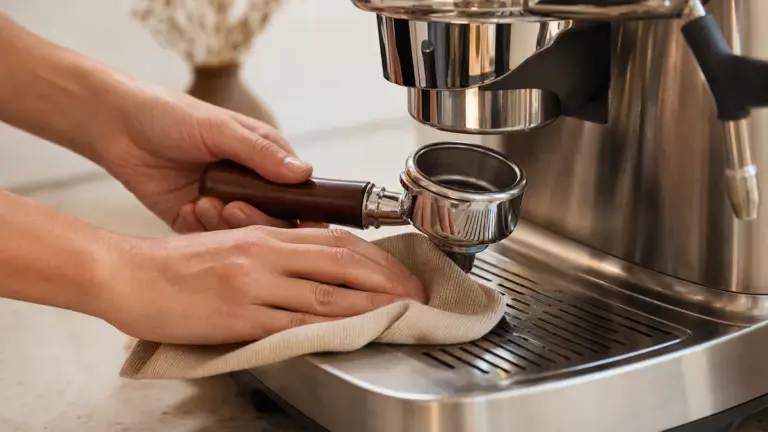
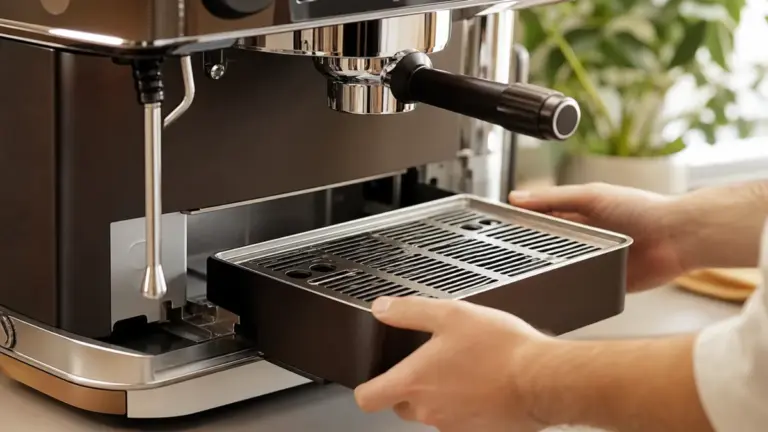
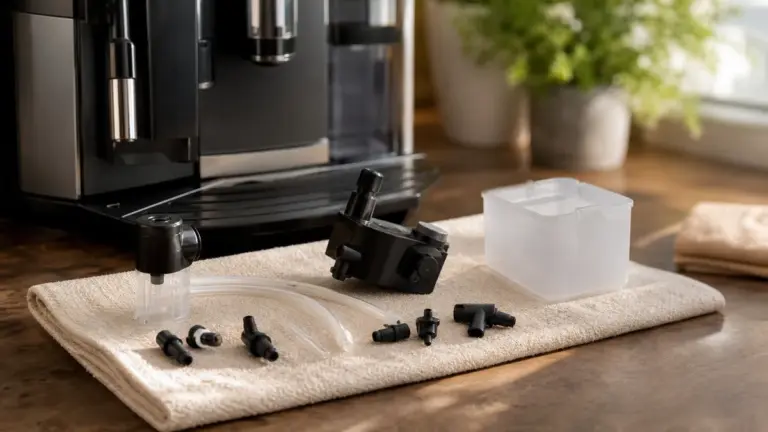
Follow its shutdown, cooling and preparation instructions. Remove used capsules, coffee grounds or accessories where directed, and empty the drip tray. Do not open the casing or disconnect internal hoses. -
Prepare the water tank.
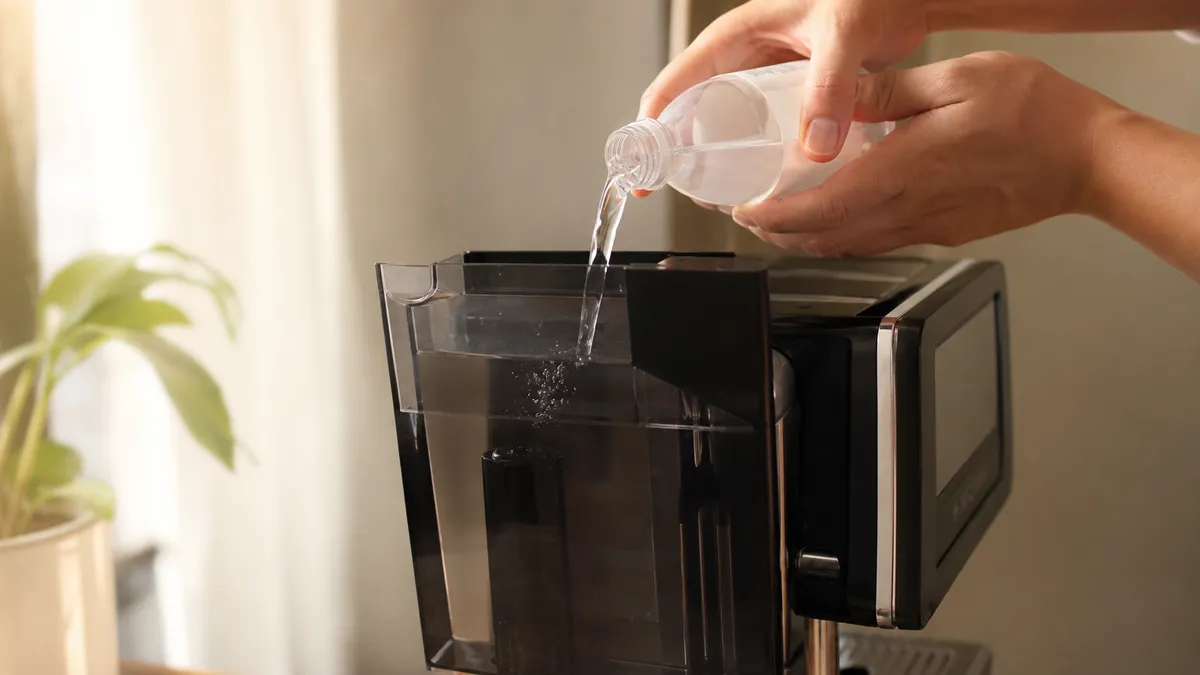
Empty it and remove the filter cartridge if the manual requires this. Keep the cartridge separate from the descaling solution. Check when it must be refitted: some programmes specify a particular rinse stage. -
Measure the exact dose and water volume.
Use grams for powder and millilitres for liquid and water. As a product-specific example, Urnex’s household Coffee and Espresso Machine Descaling Powder instructions specify 28 g in 1,000 ml of lukewarm water for drip brewers; espresso owners are directed to their machine instructions. By contrast, the De’Longhi Rivelia manual specifies 100 ml of its descaler plus 1,000 ml of drinking water. Neither is a universal recipe. -
Use the specified water temperature.
Follow “cold” or “lukewarm” exactly where stated. Do not substitute kettle water heated to 100 degrees Celsius to speed things up. If the instructions give no numerical mixing temperature, there is no reason to invent one. -
Position the collecting vessel and start the correct programme.
Put it beneath every outlet identified in the manual. Select descaling, not coffee-system cleaning, and follow the prompts. Descaling liquid leaving the outlets may be hot. -
Let the programme run through its pauses.
Automatic pumping and waiting periods are part of some programmes. Do not add an overnight soak, increase the concentration or interrupt the cycle because nothing appears to be happening. Keep the tank supplied as instructed and never deliberately run the pump dry. -
Complete every fresh-water rinse.
Empty and rinse the tank, refill to the requested level and empty the collecting vessel when prompted. Rinse requirements vary. Urnex’s cited drip-brewer powder procedure specifies three full fresh-water tanks after the solution; use your machine’s procedure where applicable. -
Finish and record the maintenance.
Refit or replace the filter at the instructed point and complete its activation or flushing procedure. Confirm that the maintenance programme has ended before making drinks. Record the date, product and any continuing symptoms.
Do not taste discharged solution to judge whether rinsing is complete. Use the prescribed rinse sequence and contact support if the machine cannot complete it.
How often should you descale in hard water?
Use the manufacturer’s hardness setting, reminder and maintenance schedule together. Hardness alone cannot produce a reliable interval: water throughput, heating conditions and treatment also affect scale formation.
The following categories are the Drinking Water Inspectorate’s published classification, not universal machine-menu settings.
| Supplier hardness, mg/L as CaCO₃ | DWI description | What to do |
|---|---|---|
| Up to 100 | Soft | Enter the correct setting; retain the prescribed maintenance routine |
| 100 to 150 | Slightly hard | Match the measured result to the manual’s hardness band |
| 150 to 200 | Moderately hard | Check that the reminder is configured correctly |
| 200 to 300 | Hard | Follow prompts promptly and review suitable scale-reducing filtration |
| More than 300 | Very hard | Confirm treatment and maintenance arrangements with the manufacturer or service provider |
Supplier category boundaries can differ, so use the numerical result wherever possible.
For a machine without a hardness-sensitive reminder, follow its published schedule and ask the manufacturer how to adapt it to your local water. Urnex’s household liquid-descaler guidance, for example, says every three months, or more often in hard water. That is product guidance, not a schedule for every machine.
In an office, nominate someone to check prompts and record maintenance. A calendar reminder should prompt a check, not override the machine’s instructions.
Filters that reduce scale, and their limits
Check what the cartridge actually does. Activated carbon is commonly used to improve taste by reducing chlorine, while ion-exchange media can reduce hardness. BRITA states that its relevant combined-media cartridges reduce carbonate hardness, but distinguishes its carbon-based MicroDisc product.
Look for an explicit limescale-reduction claim, the cartridge’s replacement instructions and compatibility with the coffee machine. Follow the stated replacement interval or capacity: a fitted cartridge is not evidence that it remains effective.
Machine-specific exceptions matter. JURA states that the E6 does not require machine descaling while its CLARIS Smart filter system is being used correctly, although the removable tank can still develop deposits. Other machines retain descaling requirements with a filter installed. Do not transfer one brand’s policy to another.
For wider maintenance planning, use the equipment care and repairs hub.
Why hardness is not the whole water specification
Total hardness measures calcium and magnesium; alkalinity describes the water’s ability to neutralise acid. Both affect scale behaviour, so two waters with similar hardness can behave differently when heated.
The SCAE Water Chart discusses these properties together, including corrosion risk. Its brewing-water guidance is not a universal safe-water specification for every boiler. Follow the machine manufacturer’s water requirements rather than trying to eliminate every mineral.
Common descaling mistakes
- Making the solution stronger because the water is very hard. Hardness should inform maintenance frequency and treatment, not an improvised chemical concentration.
- Leaving solution inside overnight. A tank-soaking instruction does not authorise soaking the machine’s internal circuit. Follow the specified contact time.
- Resetting the warning without completing the programme. An incomplete rinse or missed completion step can leave the warning active.
- Treating descaling as all-purpose cleaning. Coffee oils and milk deposits need their own procedures. See espresso machine backflushing and bean-to-cup milk-system cleaning.
Troubleshooting during and after descaling
These are possible causes, not diagnoses. Do not keep adding acid when a completed cycle has failed to restore operation.
| Symptom | Likely cause | Fix |
|---|---|---|
| No liquid emerges | Tank seating, priming problem or restricted water path | Check the manual’s tank and priming steps; contact support if unresolved |
| Programme will not advance | Missed prompt, insufficient water or incorrectly fitted component | Check the displayed instruction and required fill level |
| Descale warning remains | Incomplete cycle, rinse or completion step | Follow the model’s completion procedure before repeating treatment |
| Flow remains restricted afterwards | Scale not fully resolved or another fault | Stop repeated chemical treatment and seek manufacturer support |
Keep a maintenance record and proof of purchase if a fault develops. For UK consumer purchases, statutory rights are separate from a manufacturer’s guarantee; GOV.UK also explains that accidental damage or misuse is not automatically the seller’s responsibility. Workplace purchases made by a business should not be assumed to have the same consumer protections.
FAQ
Can I descale a machine that has never been maintained?
Check with the manufacturer first if maintenance is seriously overdue or flow is already restricted. A normal descaling programme is not a guaranteed remedy for an obstructed machine. Describe the symptoms and maintenance history to support, and do not compensate with stronger solution or an extended soak.
Can bottled water replace a scale-reducing filter?
Not automatically: bottled water is not necessarily soft. Its mineral composition must suit the machine’s published requirements, and “mineral water” is not a scale-protection specification. Ask the manufacturer what water characteristics it requires before changing supply, rather than assuming any bottled product removes the need for maintenance.
Does descaling affect my guarantee?
Incorrect descaling can affect cover for resulting damage under a manufacturer’s guarantee. De’Longhi’s Rivelia manual, for example, warns about unsuitable descaler and incorrect procedures. That is separate from statutory rights for a consumer purchase. Keep the instructions and maintenance record, and ask the seller to explain any rejected fault claim in writing.
Where to go next
Use Coffee Machine Cleaning Guide to build the cleaning routine that descaling does not replace, and Espresso Machine Backflushing for the separate brew-path procedure on compatible espresso machines. Cleaning Bean-to-Cup Milk Systems covers milk-circuit care, while Coffee Equipment Care and Repairs helps organise the wider maintenance plan around how you descale a coffee machine.
Sources
Manufacturer procedures below are published instructions, not results of independent machine testing.
-
Drinking Water Inspectorate, “Water Hardness / Hard Water”, undated current webpage. Hardness definitions, classification and local variation.
https://www.dwi.gov.uk/consumers/learn-more-about-your-water/water-hardness-hard-water/ -
Thames Water, “Check your water quality”, undated current webpage. Postcode-based local lookup.
https://www.thameswater.co.uk/help/water-and-waste-help/water-quality/check-your-water-quality -
Scottish Water, “Hardness calculations using the average results for 2024 for calcium and magnesium from regulatory supply zones”, 2024 data, published 2025.
https://www.scottishwater.co.uk/-/media/scottishwater/document-hub/key-publications/water-quality/130225waterhardnessdata24.pdf -
Speciality Coffee Association of Europe, “The SCAE Water Chart: Measure, Aim, Treat”, undated retrieved edition. Water chemistry, unit conversions, treatment and scale formation.
-
JURA, “E6/E60/E600 Instructions for Use”, retrieved V19 manual, E-Line 2019. Hardness setting, descaling, cleaning and filter instructions.
https://ch.jura.com/-/media/global/pdf/manuals-global/home/E-Line-2019/download_manual_v19_E6_E60_E600.pdf?la=en -
Sage, “The Luxe Brewer: Instruction Book”, document SDC415/465, A25 revision, 2025. Descaling preparation, duration and rinsing.
https://assets.sageappliances.com/BDC465/SDC415_465_EN_UG8_A25_LR.pdf -
Sage, “Unable to Descale Machine”, undated current support article. Safety, vinegar restriction, priming and incomplete-cycle troubleshooting.
https://www.sageappliances.com/en-gb/support/article/ka0QU000002WDH7YAO -
De’Longhi, “Rivelia: Instructions for Use”, document EN-57132C8735, undated retrieved edition, descaling section.
https://www.delonghi.com/medias/EN-57132C8735-compressed.pdf -
Urnex, “Coffee and Espresso Machine Descaling Powder”, undated current product instructions. Household powder dose and rinse sequence.
https://urnex.com/dezcal-descaling-powderh -
Urnex, “Coffee Maker Descaler with Natural Ingredients”, undated current product instructions. Maintenance-frequency guidance.
https://urnex.com/coffee-maker-descaler-natural -
BRITA, “FAQs about BRITA cartridges”, undated current manufacturer guidance. Claimed filtration functions and cartridge differences.
https://www.brita.co.uk/pages/faq-maxtra -
GOV.UK, “Accepting returns and giving refunds: the law”, undated current guidance. Consumer remedies, misuse and guarantees.
https://www.gov.uk/accepting-returns-and-giving-refunds
This article was researched using water-authority information, coffee-industry water chemistry guidance and manufacturers’ published maintenance instructions, with UK consumer guidance checked separately.
Last checked: November 2026